
Cash flow forecast versus profit forecast
12 November 2024

A cash flow forecast is a projection of receipts and payments; a profit forecast measures recognised income and expenses, including unpaid amounts.
Understanding the distinction between cash flow and profit forecasting is vital for managing corporate liquidity and fulfilling legal obligations in South Africa. A profit forecast estimates net earnings by matching revenue against incurred expenses under the accrual principle, providing a structural view of economic viability. Conversely, a cash flow forecast models the actual timing of liquid receipts and disbursements across operating, investing, and financing activities to ensure operational continuity.
While profit establishes long-term financial health, cash timing dictates whether an enterprise can satisfy its immediate operational and statutory obligations.
Accrual performance versus actual cash timing
Accrual performance and actual cash timing serve complementary functions in small and medium enterprise (SME) management. Accrual accounting measures economic activity when transactions occur, recognizing revenue when earned and expenses when incurred, regardless of when cash changes hands 1. This framework establishes the net financial performance of a business over a specified reporting period, capturing asset growth, trade receivables, and long-term liabilities 1 2.
In contrast, actual cash timing focuses exclusively on liquid cash movements. Under global accounting guidance, cash comprises cash on hand and demand deposits, while cash equivalents represent short-term, highly liquid investments readily convertible to known amounts of cash 3. A cash flow forecast projects the physical inflow and outflow of these funds across operating, investing, and financing categories 4.
Relying on a single model creates severe managerial risks. A business may present substantial accrual profits on its income statement while facing operational paralysis due to uncollected trade receivables. Conversely, an enterprise may hold abundant cash from customer deposits or loan disbursements while operating at a structural net loss. Sound financial management requires balancing accrual performance evaluation with rigorous cash timing projection.
Compare the criteria that matter: accrual performance
Evaluating accounting performance against liquid cash management requires comparing key criteria across corporate control, reporting, tax liabilities, and operational constraints.
Under South African company law, financial statements must satisfy prescribed reporting standards and present fairly the state of affairs and business of the company 5. The International Accounting Standards Board (IASB) Conceptual Framework establishes that general purpose financial reporting should supply useful information regarding financial position and performance to investors, lenders, and creditors 1 2. Accrual reporting fulfils this mandate by matching revenues with associated cost of sales and operating expenses 6.
— Practical point from this guide
Statutory tax obligations and cash flows operate on distinct timelines. Corporate income tax is calculated on taxable income, which is derived by applying statutory adjustments to accounting net profit 6 7 8 9. Small Business Corporations (SBCs) qualifying under section 12E of the Income Tax Act pay progressive normal tax rates (ranging from 0% on taxable income up to R95 750, up to 27% on amounts exceeding R550 000) 10 11 12, whereas standard companies pay a 27% flat tax rate for years of assessment ending on or after 1 April 2025 10.
Although tax liability accrues alongside profit, actual cash settlements are governed by provisional tax deadlines 13.
The decision comparison matrix below details how these criteria differ across accrual performance and cash timing models.
| Criterion | Option A: Accrual Performance | Option B: Actual Cash Timing | Evidence or assumption | Implication for this reader |
|---|---|---|---|---|
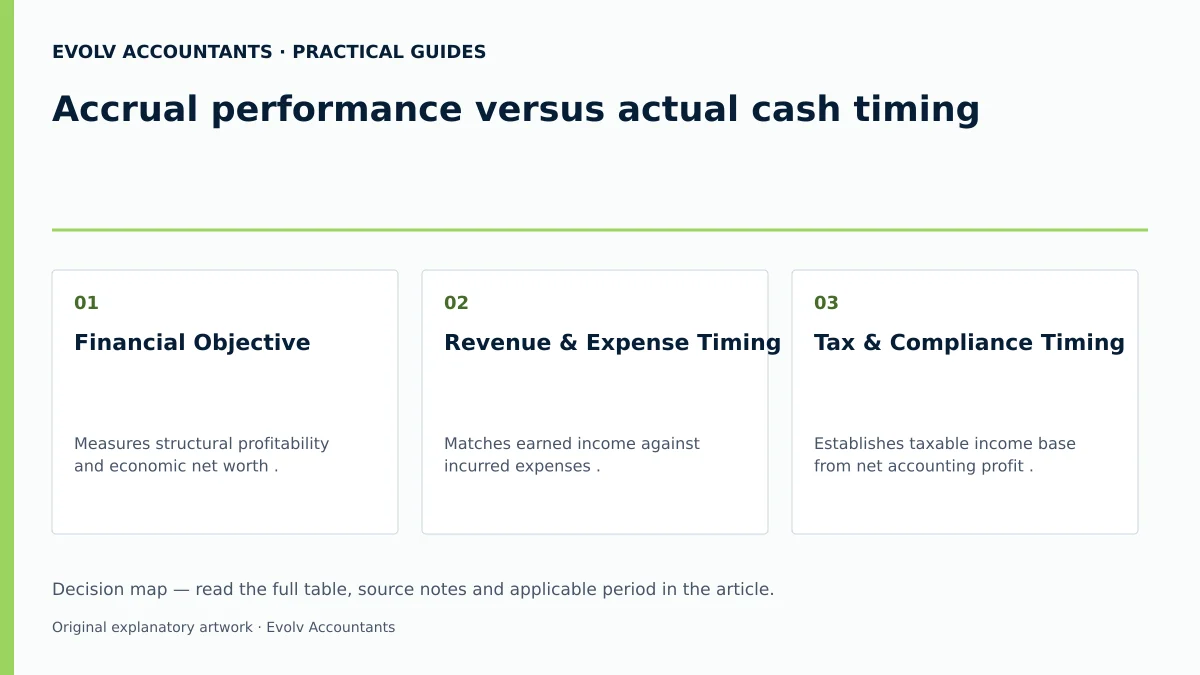
| Financial Objective | Measures structural profitability and economic net worth 1 2. | Projects immediate liquidity and operational solvency 3 4. | IFRS Conceptual Framework & IAS 7 2 3. | Profitability does not guarantee liquid cash to meet obligations. |
| Revenue & Expense Timing | Matches earned income against incurred expenses 1 6. | Tracks physical receipts and cash disbursements 4. | Net profit formula & IAS 7 cash flows 4 6. | Credit sales create profit immediately but cash only upon settlement. |
| Tax & Compliance Timing | Establishes taxable income base from net accounting profit 7. | Dictates cash required for provisional tax payments 13. | Income Tax Act Fourth Schedule & SBC tax rates 11 13. | Tax liabilities generate fixed cash outflows on specific statutory dates. |
| Statutory Governance | Requires fair presentation of financial position 5. | Governs statutory solvency and liquidity evaluations 14. | Companies Act 71 of 2008 sections 4 and 29 5 14. | Directors must verify 12-month cash liquidity before authorising distributions. |
How the obligations differ: actual cash timing
South African SMEs must distinguish strict statutory law and regulator guidance from professional bookkeeping recommendations.
Statutory law and regulator requirements
- Accounting record retention: Section 28(1) of the Companies Act 71 of 2008 mandates that every company keep accurate and complete accounting records in an official South African language 15. Section 24(1) requires these records and annual financial statements to be retained for seven completed financial years 16.
- Financial statement preparation: Section 30(1) of the Companies Act requires companies to prepare annual financial statements within six months after the end of their financial year 17.
- Value-Added Tax (VAT) accounting: Under the Value-Added Tax Act, vendors with taxable turnover exceeding R2.3 million must register for VAT 18. VAT vendors generally account for output tax on the invoice basis, declaring VAT when an invoice is issued or payment is received, whichever occurs earlier 19. Qualifying natural persons or partnerships with turnover under R2.5 million may apply to account on the payments basis 20. Standard rated supplies attract 15% VAT 21.
- Provisional tax schedules: Taxpayers earning business income must submit two compulsory provisional tax payments during each year of assessment (the first within six months of commencement, the second on or before the last day of the assessment year), with an optional third top-up payment 13.
Evolv professional recommendations
To bridge statutory compliance and cash management, Evolv Accountants recommends:
- Implementing a rolling 13-week cash flow forecast to track weekly liquid movements against fixed vendor and statutory payment obligations.
- Maintaining dual-view bookkeeping schedules that track trade receivables by aging category alongside accrued revenue balances.
- Reconciling bank balances monthly to separate clear cash funds from outstanding customer cheques or uncleared deposits.
Two business situations with different outcomes: accrual performance
The practical divergence between accrual performance and cash timing is illustrated through two hypothetical SME scenarios. All values are illustrative figures.
Scenario A: The rapid-growth trading entity
Consider a wholesale trading company that secures a large commercial order in Month 1.
- Illustrative transaction terms: The entity delivers R2 000 000 in goods on 60-day credit terms. Cost of sales is R1 200 000, payable to suppliers in 30 days. Monthly operational overheads (salaries, rent, utilities) total R300 000, payable immediately.
- Accrual performance outcome: In Month 1, the income statement reflects gross sales of R2 000 000, cost of sales of R1 200 000, and operating expenses of R300 000 6. The business reports an immediate accrual net profit of R500 000 6.
- Actual cash timing outcome: In Month 1, cash receipts are R0, while overheads create a cash outflow of R300 000. In Month 2, supplier payments create a cash outflow of R1 200 000, alongside R300 000 in overheads, yielding a cumulative cash deficit of R1 800 000. Cash inflow of R2 000 000 arrives only in Month 3.
- Analysis: Although accrual accounting shows a profitable enterprise, actual cash timing reveals an operational liquidity deficit in Months 1 and 2. Without cash reserves or credit facilities, the entity risks failing the statutory liquidity test under section 4(1)(b) of the Companies Act 14.
Scenario B: The upfront retainer service provider
Consider a professional consultancy securing a six-month service project.
- Illustrative transaction terms: The client pays an advance cash retainer of R600 000 in Month 1 for services to be delivered evenly over six months (R100 000 per month). Monthly operational costs are R80 000, paid as incurred.
- Accrual performance outcome: Revenue is recognised at R100 000 per month as performance obligations are satisfied 1. Matched against R80 000 in monthly expenses, the business reports a steady monthly net profit of R20 000 6.
- Actual cash timing outcome: In Month 1, net cash inflow is R520 000 (R600 000 receipt less R80 000 expenses). In Months 2 through 6, cash inflows are R0 while cash outflows continue at R80 000 monthly.
- Analysis: Cash timing generates a large initial cash surplus that tapers over time. Mistaking Month 1 cash inflow for earned profit would lead to premature capital distributions, leaving the business unable to cover operational expenses in subsequent months.
When the comparison needs specialist input: actual cash timing
Certain complex accounting, statutory, and legal scenarios require professional evaluation from Evolv Accountants:
- Capital asset allowances and wear-and-tear: Capital expenditure reduces cash immediately, but income tax write-offs occur over time. Qualifying Small Business Corporations can claim immediate 100% write-offs on manufacturing plant or structured depreciation allowances under section 12E 22, while renewable energy plant may qualify for specialized deduction schedules 23 24. Reconciling tax depreciation with cash outflows requires specialist tax guidance 7.
- Statutory solvency and liquidity tests: As stated in section 4(1)(b) of the Companies Act 71 of 2008, liquidity requires that the entity be "able to pay its debts as they become due in the ordinary course of business" 14. Directors must formally apply this test before authorising share capital distributions 25, providing financial assistance 26, or executing corporate mergers 27.
- Complex financing and non-cash items: Under IAS 7, non-cash investing or financing transactions (such as debt-to-equity conversions or supplier finance arrangements) are excluded from statement of cash flows presentation but require separate disclosure and reconciliation 28 29.
- VAT registration and accounting basis transitions: Moving from the payments basis to the invoice basis upon exceeding statutory turnover thresholds requires adjusting output tax timing and managing transitional cash liabilities 19 20 30.
Next steps for Cash flow forecasting
To establish robust financial control, SME directors should execute the following decision framework:
- Audit accounting record compliance: Verify that current bookkeeping practices satisfy section 28 record-keeping rules and section 24 document retention mandates 15 16.
- Map statutory tax schedules: Plot compulsory provisional tax due dates and bi-monthly or monthly VAT return deadlines against projected bank balances 13 31.
- Separate accrual and cash schedules: Establish independent tracking for trade receivables aging and monthly revenue recognition 1 6.
- Build a rolling 13-week cash forecast: Model weekly liquid cash receipts, operational expenses, and supplier credit terms 3 4.
- Conduct pre-distribution liquidity checks: Formalize board resolution records verifying 12-month debt-paying ability prior to declaring dividends or capital withdrawals 14 25.
- Engage specialist advisory support: Reconcile internal forecasting models against statutory tax rates and financial reporting standards with Evolv Accountants.
For detailed operational templates, review Evolv's internal guide: Evolv SME Financial Record Management & Forecasting Framework.
Frequently Asked Questions
Can a business be profitable while experiencing a cash flow shortage?
Yes. Profit measures revenue earned less expenses incurred under accrual principles 1 6. If revenue is tied up in uncollected trade receivables while expenses and tax liabilities demand immediate cash, a business will experience a severe liquid cash deficit despite reporting net accounting profits 4 6.
How does the VAT accounting basis affect cash flow forecasting?
Under the invoice basis, output VAT is payable to SARS in the tax period an invoice is issued, regardless of whether the customer has paid 19. This creates a cash outflow prior to cash collection. Under the payments basis, VAT is declared only when payment is physically received 20.
What is the statutory retention period for South African financial records?
Section 24(1) of the Companies Act 71 of 2008 requires companies to retain written accounting records, annual financial statements, and general ledger records for seven completed financial years 16 32.
How do provisional tax deadlines impact cash timing for SMEs?
Provisional tax requires two compulsory cash payments during the year of assessment (at month six and the final day of the financial year) 13. These lump-sum cash outflows must be factored into cash forecasts to prevent liquidity distress 13.
What is the solvency and liquidity test under the Companies Act?
Under section 4(1) of the Companies Act 71 of 2008, an enterprise satisfies the test if its fairly valued assets equal or exceed liabilities (solvency) and it remains able to pay its debts as they become due in the ordinary course of business for 12 months (liquidity) 14 33. Ask Evolv about accrual performance versus actual cash timing. Share the relevant records so the support required can be scoped.
Related guides
- Building a 13 week cash flow forecast
- Starting a cash forecast from bank balances
- Reading the Financials: Cash Flow and the Balance Sheet for Directors