
Starting a cash forecast from bank balances
21 March 2026

Starting a cash forecast from bank balances requires separating unencumbered funds from restricted obligations to establish an accurate operating baseline.
Establishing a reliable cash flow forecasting model enables South African small and medium enterprises (SMEs) to translate cleared bank account balances into an operational management tool. By systematically isolating available liquid cash from restricted balances—such as statutory tax reserves and client trust funds—SME directors can ground their short-term decision-making in verified accounting records.
This draft provides a practical framework for building base-case projections, stress-testing cash timing risks, reconciling forecast variances against accounting net profit, and maintaining statutory compliance under South African law and international reporting frameworks.
Available bank cash versus restricted amounts
Distinguishing unencumbered liquidity from statutory and contractual obligations
For an SME director or financial manager, the primary decision when evaluating a bank balance is determining how much of the cleared cash is genuinely unencumbered and available for daily operational deployment. A cash forecast is an internal management tool derived from primary evidence and historical assumptions; it is neither a guarantee of future financial performance nor a prediction of guaranteed solvency.
— Practical point from this guide
Under international accounting standards, "Cash comprises cash on hand and demand deposits" 1. Demand deposits represent liquid funds held in bank accounts that are accessible immediately for operational disbursements 1. However, demand deposits often contain amounts that are subject to legal, regulatory, or contractual restrictions, which prevent them from being deployed for general operating expenses 2.
Legal standards for solvency and corporate liquidity
Under section 4 of the Companies Act 71 of 2008, a South African company satisfies the solvency and liquidity test only if its fairly valued assets equal or exceed its liabilities and it appears that the company will be able to pay its debts as they become due in the ordinary course of business for a period of 12 months following the test 3 4. To comply with this statutory requirement, directors must base their financial evaluations on accurate accounting records that satisfy section 28 of the Companies Act 4 5.
Evolv recommends that SMEs establish a strict bookkeeping distinction between general operational bank cash and restricted reserves. While statutory law under section 110(7) of the Companies Act specifically mandates that regulated companies holding transaction consideration must deposit such funds into a separate interest-bearing trust account 6, general trading SMEs are not statutorily forced to open separate physical bank accounts for VAT or Pay-As-You-Earn (PAYE) withholdings.
Nevertheless, ring-fencing these statutory liabilities is a crucial Evolv advisory recommendation to prevent accidental insolvency.
Build assumptions from actual records: available bank cash
Grounding forecast inputs in primary accounting evidence
To build a reliable cash forecast baseline, inputs must be drawn directly from primary source documents, including bank statements, sales registers, supplier contracts, and statutory tax schedules 5 7. Relying on unverified verbal estimates or optimistic revenue expectations undermines the mathematical integrity of the forecast.
Key operational cash outflow drivers that must be mapped from actual business records include:
- Provisional tax schedules: Under the Fourth Schedule to the Income Tax Act, provisional taxpayers must remit two compulsory payments during each year of assessment 8. The first payment is due within six months of the commencement of the year of assessment, and the second payment is due on or before the last day of the year of assessment, with an optional third payment permitted within six or seven months after year-end depending on the financial year-end 8.
- Employees' tax (PAYE): Employers registered for PAYE must deduct employees' tax from taxable remuneration and pay these funds over to the South African Revenue Service (SARS) on a monthly basis 9. Registration with SARS is mandatory within 21 business days of becoming an employer 9.
- Value-Added Tax (VAT): Registered vendors making taxable supplies in excess of the compulsory VAT threshold of R2.3 million (or the voluntary registration threshold of R120 000) must calculate net VAT liabilities on form VAT 201 at the end of each tax period 10 11 12.
Document retention and evidence accountability
SMEs must align their record-keeping workflows with statutory retention requirements. Section 29 of the Tax Administration Act 28 of 2011, as outlined in SARS regulator guidance, requires taxpayers to retain all books of account, bank statements, invoices, and ledger records for five years from the date of return submission 13 14 15.
In contrast, section 24 of the Companies Act 71 of 2008 establishes a stricter statutory requirement, mandating that companies retain accounting records, general ledgers, and annual financial statements for seven years 16 17. Accountable owners within the business must ensure that forecast assumptions are fully cross-referenced to retained primary documents.
Construct the base scenario: restricted amounts
Mathematical framework for baseline cash forecasting
Constructing a baseline cash forecast requires a transparent schedule based on verified starting cash balances. The mathematical formula for determining net available starting cash and projected ending liquidity is expressed as follows:
Net Available Starting Cash = Total Cleared Bank Balance - Restricted Funds
Forecast Ending Available Cash = Net Available Starting Cash + Projected Inflows - Projected Outflows
Worked hypothetical scenario and calculation methodology
Consider a hypothetical South African trading company evaluating its 30-day cash position for a given operating period (all values are labelled illustrative estimates and do not represent actual historical or predicted performance):
- Total cleared bank balance: R500 000 (verified via bank statement) 5.
- Identified restricted funds: R70 000 in collected output VAT net liability payable on the next VAT 201 return 10, plus R30 000 in accrued PAYE withholdings due to SARS 9. Total restricted funds equal R100 000.
- Net available starting cash: R500 000 - R100 000 = R400 000.
- Projected 30-day operational inflows: R250 000 in expected trade receivables collections, based on contractual payment terms and verified customer credit profiles 7.
- Projected 30-day operational outflows: R200 000, comprising R120 000 in trade supplier payments, R50 000 in net salaries, and R30 000 in fixed overhead disbursements.
- Base case ending available cash: R400 000 + R250 000 - R200 000 = R450 000.
This schedule transparently demonstrates that while the bank account holds R500 000 initially, only R400 000 is available for general operational commitments once statutory reserves are set aside.
Test the downside and timing changes: available bank cash
Stress-testing timing delays and customer collection defaults
An optimistic single-point forecast conceals financial risk. Downside scenario planning requires testing specific timing disruptions, such as delayed customer collections or sudden increases in direct operational costs.
Applying downside risk assumptions to the hypothetical baseline scenario demonstrates the vulnerability of operational liquidity:
- Downside receivables assumption: Assume 40% of expected trade receivables (R100 000) are delayed past the 30-day window due to customer payment defaults, reducing realized collections to R150 000.
- Downside expense assumption: Assume unexpected supply chain cost increases inflate 30-day disbursements by 10%, raising operational outflows from R200 000 to R220 000.
- Downside ending available cash: R400 000 + R150 000 - R220 000 = R330 000.
Under this downside stress test, the company's ending unencumbered cash buffer contracts from R450 000 to R330 000. This highlights the importance of maintaining an explicit liquidity cushion to absorb cash timing shifts without breaching statutory tax or debt obligations 4.
Actionable checklist for downside cash flow scenario analysis
SME management should follow a structured five-step review process when testing forecast assumptions:
- Reconcile bank balances: Match total cleared bank balances against the general ledger and verify that all uncleared cheques or electronic deposits are properly accounted for 5.
- Isolate restricted cash: Deduct all accrued statutory tax obligations (VAT, PAYE, provisional tax) and contractual client trust reserves to determine true unencumbered starting cash 1 8 9 10.
- Audit trade receivables aging: Review outstanding customer invoices, categorise debtors by payment history, and apply realistic delay percentages to major customer accounts 7.
- Incorporate fixed statutory deadlines: Map exact calendar dates for upcoming SARS provisional tax payments, monthly PAYE submissions, and supplier contractual terms 8 9.
- Establish liquidity review triggers: Set an internal operational threshold (e.g., available cash falling below 1.5 times monthly fixed expenses) that automatically triggers credit control escalation and expenditure restrictions.
Compare forecast with actual results: restricted amounts
Establishing version control and weekly review rhythms
Cash forecasting is an iterative management process. SMEs must maintain strict version control (e.g., naming model updates sequentially as Forecast_2026_V1, Forecast_2026_V2) and establish a disciplined weekly or bi-weekly review rhythm to evaluate actual performance against projected figures.
Reconciling cash flow variances against accounting net profit
A critical task for SME management is understanding why accounting net profit differs significantly from net cash flow. Under general accounting principles, net profit is calculated by deducting cost of sales and operating expenses from gross sales 7 18. However, accounting net profit includes non-cash items, credit sales where payment has accrued but not yet been collected, and capital allowance deductions such as wear-and-tear depreciation 7 19 20.
In contrast, as prescribed by IAS 7, cash flow reflects actual physical inflows and outflows classified into operating, investing, and financing activities 21. Operating activities represent the principal revenue-producing activities of the business 21. A business can display a positive accounting net profit on its income statement while simultaneously experiencing severe operational cash distress if cash is tied up in uncollected trade receivables or restricted tax reserves 19 21.
Regular variance analysis identifies whether cash shortfalls stem from operational inefficiency, delayed customer invoicing, or unrecorded statutory commitments.
Next steps for Cash flow forecasting
Linking cash insights to operational decision-making
When variance analysis reveals an unexpected cash surplus or impending shortfall, management must take immediate operational action. Identified shortfalls require tightening customer credit terms, pausing non-essential capital expenditure, or reviewing supplier credit agreements. Conversely, verified headroom allows the business to schedule planned asset purchases or optimise working capital allocation safely.
Artefact: Scenario and variance schedule
The table below illustrates a structured scenario and variance review schedule using labelled hypothetical values:
| Period or driver | Evidence based input | Base case | Downside assumption | Action or review trigger |
|---|---|---|---|---|
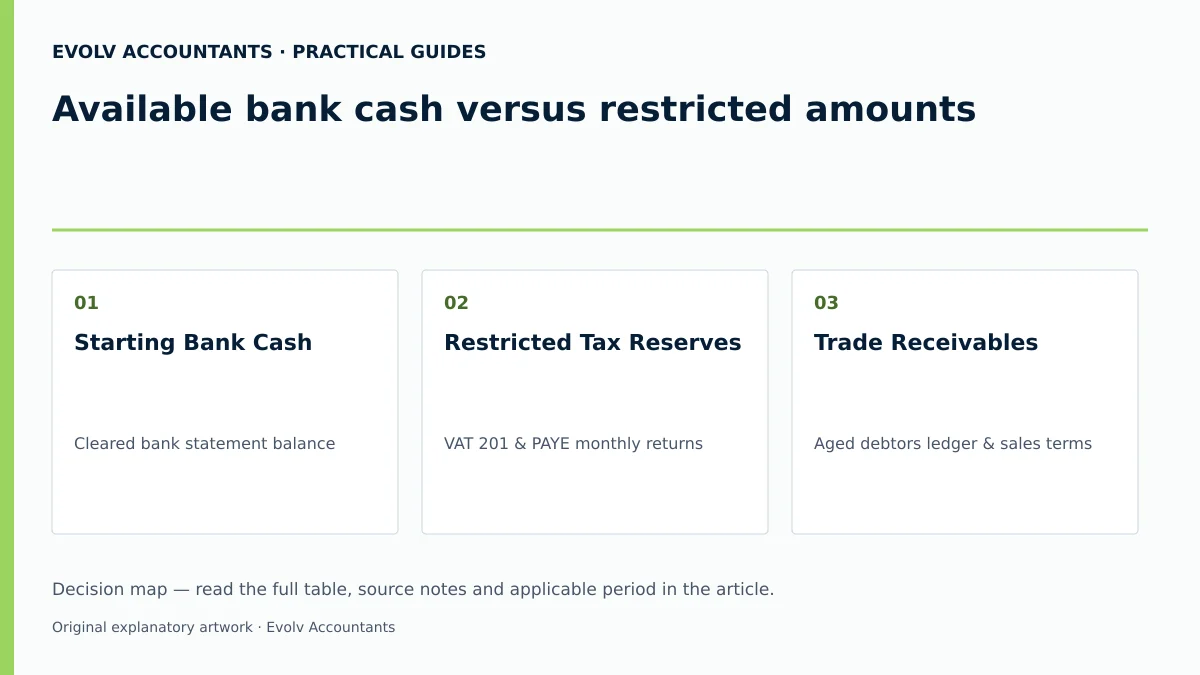
| Starting Bank Cash | Cleared bank statement balance 5 | R500 000 | R500 000 | Reconcile daily against general ledger accounts 5. |
| Restricted Tax Reserves | VAT 201 & PAYE monthly returns 9 10 | (R100 000) | (R100 000) | Ring-fence restricted tax funds in a separate account 1. |
| Trade Receivables | Aged debtors ledger & sales terms 7 | R250 000 | R150 000 (40% delay) | Issue payment reminders when receivables exceed 15 days overdue 7. |
| Operating Expenses | Supplier contracts & payroll run 7 9 | (R200 000) | (R220 000) (10% inflation) | Freeze non-essential disbursements if outflows exceed budget by 5%. |
| Ending Available Cash | Calculated net operational buffer | R450 000 | R330 000 | Trigger executive cash review if available liquidity falls below R350 000 4. |
Frequently Asked Questions
What is the legal difference between available bank cash and restricted cash for a South African SME?
Available bank cash consists of unencumbered demand deposits that are immediately available for general operational disbursements 1. Restricted cash includes funds encumbered by statutory obligations—such as collected output VAT and employee PAYE withholdings—or contractual trust conditions 2 9 10. Under Companies Act section 4, directors must ensure the company retains sufficient unencumbered liquidity to satisfy the 12-month solvency and liquidity test 3 4.
How long must a South African company retain financial records supporting its cash forecast assumptions?
Under section 29 of the Tax Administration Act 28 of 2011, SARS regulator guidance requires tax records and supporting documents to be kept for five years from the date of return submission 13 14 15. However, section 24 of the Companies Act 71 of 2008 imposes a broader statutory requirement, mandating that companies retain accounting records, general ledgers, and annual financial statements for seven years 16 17.
Why does a profitable SME still experience cash flow shortages?
Accounting net profit measures revenue earned less expenses incurred under accrual accounting principles, which includes credit sales not yet collected in cash and non-cash depreciation deductions 7 19 20. Cash flow, as governed by IAS 7, tracks actual liquid receipts and payments across operating activities 21. A company can be profitable on paper but cash-starved if working capital is locked in unpaid trade receivables or restricted statutory set-asides 19 21.
What statutory tax schedules must be factored into an SME cash forecast?
An SME cash forecast must incorporate three main SARS tax payment schedules: provisional tax payments (due twice yearly under the Fourth Schedule) 8, monthly PAYE withholdings (remitted by the 7th of each month) 9, and periodic VAT 201 net liabilities (submitted monthly or bi-monthly depending on vendor category) 10 22.
Are SMEs statutorily required to maintain separate bank accounts for restricted tax reserves?
General trading SMEs are not statutorily mandated by the Companies Act to maintain separate sub-accounts for VAT or PAYE funds, unlike regulated companies holding client consideration under section 110(7) 6. However, ring-fencing statutory tax liabilities in a designated bank account is a strongly recommended Evolv advisory practice to prevent accidental misallocation of tax reserves. Ask Evolv about available bank cash versus restricted amounts. Share the relevant records so the support required can be scoped.
Related guides
- Building a 13 week cash flow forecast
- Forecasting customer receipts from unpaid invoices
- Reading the Financials: Cash Flow and the Balance Sheet for Directors