
Forecasting customer receipts from unpaid invoices
8 February 2026

Forecasting customer receipts from unpaid invoices requires analysing invoice due dates and weighted collection probabilities to estimate cash inflows.
Unpaid customer invoices represent contractual rights to future economic benefits, but they do not guarantee cash availability until funds are settled in a business bank account. For South African small and medium enterprises (SMEs), bridging the gap between billed revenue and actual cash receipts is critical for maintaining daily operational liquidity, fulfilling payroll obligations, and meeting statutory tax commitments.
This practical draft outlines how SME owners and financial managers can build an evidence-based receipt forecast using open accounts receivable ledgers, objective collection probabilities, and scenario analysis.
Invoice due date likely collection and probability
A cash receipt forecast is an operational management tool designed to estimate the timing and magnitude of future bank inflows. It must be explicitly distinguished from a formal financial prediction, budget commitment, or funder guarantee. While an accounting budget sets revenue targets, a cash receipt forecast models expected liquidity based on observed customer payment behavior and contractual invoice terms.
From a regulatory and accounting perspective, cash receipts differ fundamentally from accrued accounting profit. Under International Accounting Standard (IAS) 7 Statement of Cash Flows, cash flows are categorised into operating, investing, and financing activities 1. Operating cash flows represent actual collections from "the principal revenue-producing activities of the entity" 1.
In contrast, general accounting standards and profit calculations record revenue when earned on an accrual basis, regardless of whether the customer has settled the outstanding invoice 2 3.
— Practical point from this guide
Distinguishing legal duties, regulatory guidance, and professional advisory recommendations is vital when managing credit:
- Statutory Law: Under section 28 of the Companies Act 71 of 2008, every company must maintain accurate and complete accounting records to support its financial statements 4. Furthermore, section 4 of the Companies Act mandates that a company satisfies the solvency and liquidity test only if it appears capable of paying its debts as they become due in the ordinary course of business for 12 months 5 6.
- Regulator Guidance: The South African Revenue Service (SARS) Tax Guide for Small Businesses outlines statutory tax requirements 7. Under standard VAT regulations, vendors registered on the invoice basis must account for output VAT when an invoice is issued, creating an immediate tax liability even if the customer has not yet paid 3 8.
- Evolv Recommendations: Designing customer credit scoring systems, establishing aging-bracket probability factors, and performing weekly cash forecast reconciliations are Evolv Accountants advisory practices rather than statutory legal mandates.
Build assumptions from actual records: invoice due date likely collection
Building reliable receipt assumptions requires extracting objective data from primary accounting records rather than relying on unverified estimates. Managers should audit open invoice balances, customer sales agreements, credit terms, and historical settlement records.
To establish a traceable cash forecasting model, accountable managers must compile the following primary inputs:
- Source Balances and Due Dates: Verify individual unpaid invoice amounts against customer general ledgers and official tax invoices.
- Contractual Credit Terms: Document agreed payment windows (such as 30, 60, or 90 days from statement date).
- Historical Payment Delays: Calculate the average historical delay per customer category (for example, trade clients settling an average of 14 days past the contractual due date).
- Accountable Owners: Assign specific internal personnel (such as credit controllers or account managers) to monitor each debtor account.
Statutory record-keeping rules govern the retention of these source documents. Section 24 of the Companies Act 71 of 2008 mandates that accounting records and annual financial statements must be retained for seven years 9 10. Similarly, section 29 of the Tax Administration Act 28 of 2011 requires taxpayers to maintain books of account, ledgers, and supporting documents for five years from the date a tax return is submitted 11 12.
Understanding tax obligations is equally important when projecting cash net of tax liabilities. For companies subject to the standard corporate tax rate of 27% 13 or progressive Small Business Corporation (SBC) tax rates (ranging from 0% on taxable income up to R95 750, up to 27% on amounts exceeding R550 000) 13, tax payments require cash reserves that depend directly on reliable customer collections.
Similarly, micro businesses operating under the turnover tax regime face progressive rates starting above R335 000 of taxable turnover 14, while businesses with taxable turnover exceeding the compulsory R2.3 million threshold must register for VAT and manage bi-monthly or monthly VAT remittances 15 16.
Construct the base scenario: probability
The base scenario translates raw invoice amounts into expected cash inflows by applying weighted collection probabilities based on invoice due date likely collection profiles. Invoices should be categorised into aging brackets, with probability factors reflecting historical recovery rates.
To construct a transparent base scenario schedule, apply the following reproducible formulas:
- Expected Receipt Amount = Gross Invoice Value × Collection Probability Factor (%)
- Expected Receipt Period = Contractual Invoice Due Date + Average Historical Customer Delay (Days)
For illustrative purposes, consider a hypothetical SME with an open receivables ledger totalling R500 000 across four aging brackets:
- Bracket A (Current / Not Overdue): Gross invoice value of R300 000 with a contractual due date in Period 1. Historical data shows a 95% collection probability. Expected receipt = R300 000 × 0.95 = R285 000.
- Bracket B (1–30 Days Overdue): Gross invoice value of R120 000 due in Period 1. Based on credit follow-ups, apply an 80% collection probability in Period 2. Expected receipt = R120 000 × 0.80 = R96 000.
- Bracket C (31–60 Days Overdue): Gross invoice value of R50 000. Apply a 50% collection probability expected in Period 2. Expected receipt = R50 000 × 0.50 = R25 000.
- Bracket D (>60 Days Overdue): Gross invoice value of R30 000 subject to legal dispute. Apply a conservative 20% collection probability expected in Period 3. Expected receipt = R30 000 × 0.20 = R6 000.
Under this hypothetical base case, total expected cash receipts equal R412 000 across Periods 1 to 3 against gross outstanding receivables of R500 000.
Test the downside and timing changes: invoice due date likely collection
Single-point optimistic forecasts create significant liquidity risks. To safeguard business continuity, financial managers must stress-test base scenario assumptions against downside events, such as key customer defaults, extended settlement delays, or industry-wide economic downturns.
Downside testing involves applying two specific stress variables to the unpaid invoice portfolio:
- Probability Reduction: Lowering the collection probability weighting across overdue brackets to reflect elevated default risk.
- Timing Slipped: Delaying expected collection dates by an additional 30 to 60 days.
Applying these stress parameters to our hypothetical scenario illustrates the potential cash impact:
- Current Invoices (Bracket A): Downside probability reduced from 95% to 80%, with receipt timing shifted from Period 1 to Period 2. Expected receipt drops to R240 000 (R300 000 × 0.80).
- 31–60 Days Overdue (Bracket C): Downside probability reduced from 50% to 25%, with receipt timing shifted from Period 2 to Period 3. Expected receipt drops to R12 500 (R50 000 × 0.25).
- >60 Days Overdue (Bracket D): Downside probability reduced to 0% (full write-off assumption). Expected receipt = R0.
Under this downside scenario, total projected receipts fall significantly, and the timing of cash inflows slips into later periods. Identifying these cash shortfalls in advance enables management to adjust operating expenditure, negotiate extended supplier terms, or arrange temporary working capital facilities, ensuring the entity continues to meet the Companies Act liquidity test of paying obligations as they fall due 6.
Compare forecast with actual results: probability
A cash receipt forecast must function as a dynamic, rolling schedule updated on a strict weekly or monthly rhythm. Establishing version control (for example, Version 1.0 vs Version 1.1) allows management to measure forecast accuracy and identify underlying variance drivers.
When comparing projected receipts against actual bank statements, use the standardized variance formula:
- Receipt Variance (%) = [(Actual Bank Receipts − Forecast Receipts) ÷ Forecast Receipts] × 100
Variance analysis must separate timing differences from permanent credit losses:
- Timing Variances: Occur when a solvent customer settles an invoice 14 days later than projected. The cash inflow shifts to a subsequent period, but the total expected value remains intact.
- Permanent Variances: Occur when a customer enters liquidation, disputes an invoice successfully, or defaults entirely. The expected receipt must be removed from future forecast schedules.
Management must also separate bank cash movements from accounting profit. Cash receipts increase bank balances (defined under IAS 7 as cash on hand and demand deposits 17), providing liquidity to settle operational obligations. Accounting profit, however, remains unchanged on the income statement until an uncollectible invoice is formally written off as an impaired debt expense under applicable accounting standards 2 18.
Next steps for Cash flow forecasting
To establish an effective receipt forecasting process, SME managers should execute the following structured action steps:
- Reconcile Receivables Ledger: Perform weekly reconciliations between customer general ledgers and actual bank deposits to verify open invoice balances.
- Audit Credit Terms: Review contractual due dates, credit limits, and historical payment delays for all active clients.
- Establish Aging Brackets: Group open invoices into standard aging categories (Current, 1–30 days, 31–60 days, and >60 days overdue).
- Assign Probability Weightings: Apply objective collection probabilities based on historical customer payment behavior and credit assessments.
- Run Downside Stress Tests: Model the financial impact of customer payment delays and potential defaults on 12-month operational liquidity.
- Review TaxRemittances: Calculate output VAT and corporate provisional tax obligations to align cash reserves with SARS payment deadlines 3 19.
Artefact: Scenario and variance schedule
The following schedule illustrates a standardized framework for tracking evidence-based inputs, base case expectations, downside risks, and operational action triggers.
| Period or driver | Evidence based input | Base case | Downside assumption | Action or review trigger |
|---|---|---|---|---|
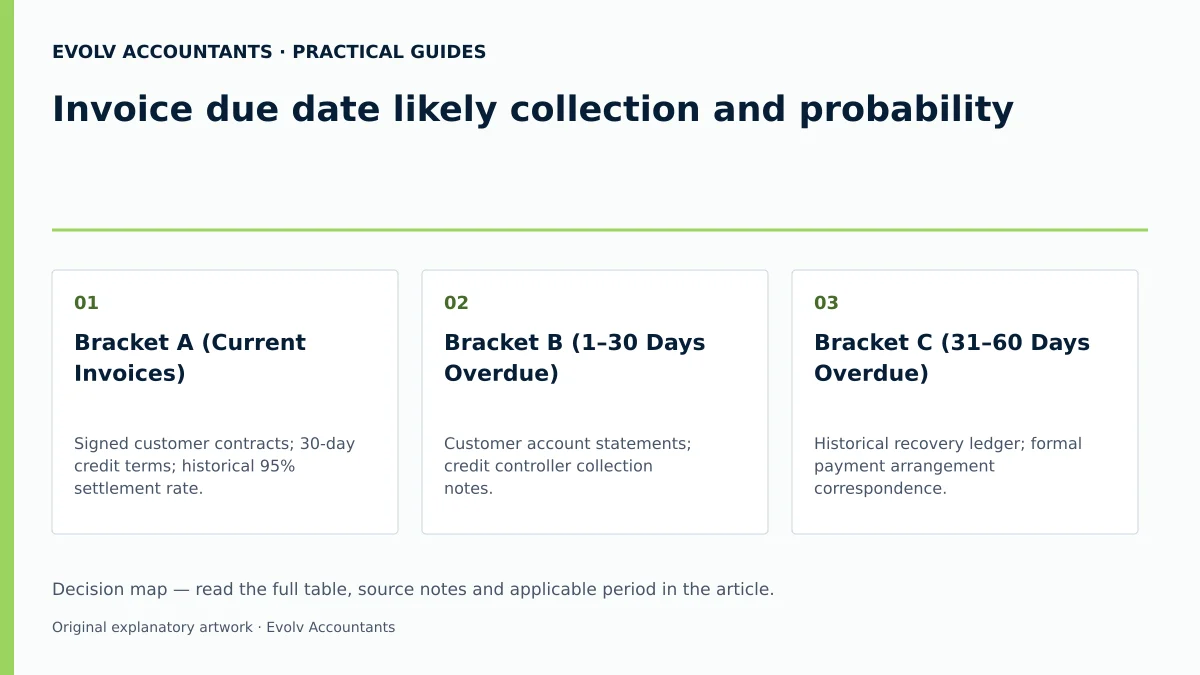
| Bracket A (Current Invoices) | Signed customer contracts; 30-day credit terms; historical 95% settlement rate. | 95% collection probability in Period 1 (R285 000 expected inflow). | Probability drops to 80%; receipt delayed to Period 2 (R240 000 expected). | Variance > 5%: Review credit limits and send automated payment reminders 5 days before due date. |
| Bracket B (1–30 Days Overdue) | Customer account statements; credit controller collection notes. | 80% collection probability in Period 2 (R96 000 expected inflow). | Probability drops to 60%; receipt delayed to Period 3 (R72 000 expected). | Overdue > 14 days: Issue formal demand notice and place temporary hold on new credit orders. |
| Bracket C (31–60 Days Overdue) | Historical recovery ledger; formal payment arrangement correspondence. | 50% collection probability in Period 2 (R25 000 expected inflow). | Probability drops to 25%; receipt delayed to Period 3 (R12 500 expected). | Overdue > 30 days: Hand over to legal collections; require executive sign-off for workout plans. |
| Bracket D (>60 Days Overdue) | Dispute logs; legal counsel advice; debtor insolvency notices. | 20% collection probability in Period 3 (R6 000 expected inflow). | 0% collection probability (full bad debt provision / write-off assumption). | Overdue > 60 days: Initiate debt recovery litigation; evaluate bad debt tax deduction eligibility. |
| VAT remitting obligation | Tax invoices issued under invoice-basis VAT rules 3. | Full output VAT payable on tax return due date regardless of collection. | Output VAT remains due to SARS despite customer payment default 8. | Unpaid > 12 months: File required output VAT adjustment on SARS eFiling per VAT regulations 8. |
Worked Example: Reproducible Cash Receipt Calculation
A South African IT service provider holds an open receivable balance of R200 000 across two key clients:
- Client X: Invoice value R150 000, 30-day terms, contractual due date 15 October. Historical records show Client X pays 10 days late. Base collection probability = 90%.
- Base Calculation: Expected receipt = R150 000 × 0.90 = R135 000, projected for receipt on 25 October.
- Downside Calculation: Assume 30-day delay and probability reduction to 70%. Expected receipt = R150 000 × 0.70 = R105 000, projected for receipt on 24 November.
- Client Y: Invoice value R50 000, 60 days overdue. Payment arrangement agreed for 50% settlement. Base collection probability = 50%.
- Base Calculation: Expected receipt = R50 000 × 0.50 = R25 000, projected for receipt on 30 October.
- Downside Calculation: Customer defaults on workout plan. Downside probability = 0%. Expected receipt = R0.
Summary Result: Total base projected cash receipt = R160 000 (R135 000 + R25 000). Total downside projected cash receipt = R105 000 (R105 000 + R0), revealing a potential operational cash deficit of R55 000 that management must plan for in advance.
Frequently Asked Questions
What is the fundamental difference between an invoice receipt forecast and accounting profit?
Accounting profit is calculated on an accrual basis, recognizing revenue when invoices are issued regardless of payment 2 3. An invoice receipt forecast measures actual future bank cash inflows under IAS 7 operating activities ("the principal revenue-producing activities of the entity" 1), reflecting true liquid fund availability.
How long must small businesses retain accounting records used in receipt forecasting?
Under section 24 of the Companies Act 71 of 2008, companies must keep accounting records and financial statements for seven years 9 10. Section 29 of the Tax Administration Act 28 of 2011 mandates a five-year retention period for ledgers and supporting documents from the date a tax return is submitted 11 12.
Why does invoice-basis VAT present liquidity risks for unpaid customer invoices?
Vendors registered for VAT on the invoice basis must account for output VAT in the tax period an invoice is issued, even if the customer has not paid 3 8. This creates an immediate cash drain to SARS before cash is collected from the customer.
How should collection probabilities be assigned to overdue invoice brackets?
Collection probabilities should be derived from historical customer payment records, credit risk profiles, and active collection correspondence. Current invoices typically carry high probabilities (for example, 90%–95%), while aging brackets carry progressively lower factors to account for default risk.
How does cash forecasting support statutory compliance under the Companies Act?
Section 4 of the Companies Act 71 of 2008 requires directors to ensure their company satisfies the solvency and liquidity test by remaining capable of paying debts as they become due over a 12-month period 5 6. Regular receipt forecasting provides the primary evidence needed to verify ongoing liquidity. Describe the cash decisions you need to make and the records available. Ask Evolv about the forecasting support required. Ask Evolv about invoice due date likely collection and probability. Share the relevant records so the support required can be scoped.
Related guides
- Building a 13 week cash flow forecast
- The Importance of Financial Forecasting for Business Growth
- Reading the Financials: Cash Flow and the Balance Sheet for Directors