
Calculating a company public interest score
24 July 2025

Calculating a company public interest score requires summing points for employees, liabilities, turnover, and beneficial interest holders at each financial year end.
Audit and assurance qualification. Regulation 28’s R5 million fiduciary-assets trigger concerns assets held in the ordinary course of the company’s primary activities for people unrelated to the company. The public-interest-score triggers also depend on whether statements are compiled internally or independently, and other statutory or MOI requirements can apply. Assess the complete tests rather than treating a low score as an automatic audit exemption.
See Companies Regulations, regulations 26–29. SAICA’s APB/FRSC notice records the withdrawal of SA GAAP for periods starting from December 2012; a legacy reference in the Regulations does not make it a current framework option.
The public interest score evaluates the broader economic and social footprint of both profit and non-profit companies operating in South Africa 1. Established under the governing statutory framework, this score determines whether a business requires a full statutory audit or an independent review, dictates which financial reporting framework applies to its annual financial statements, and indicates whether mandatory governance committees must be established 2 3 4.
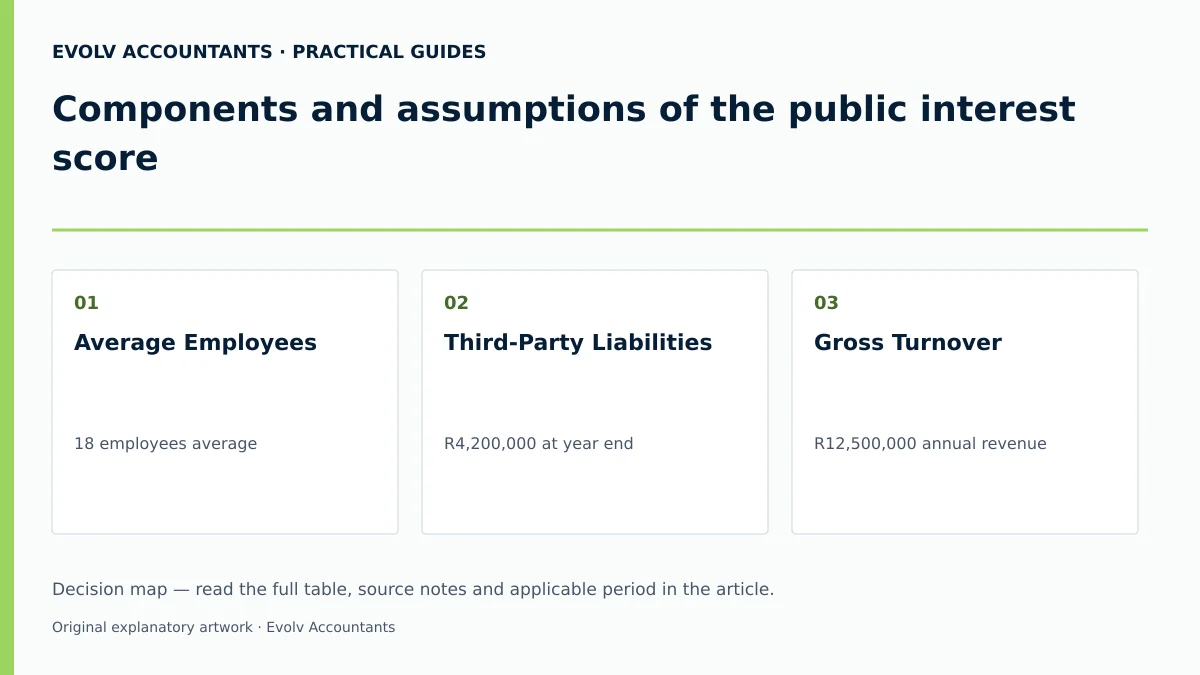
Components and assumptions of the public interest score
Purpose, output and measurement period
The Public Interest Score (PIS) produces a single numerical point value calculated at the conclusion of every financial year 1. It serves as a statutory yardstick to measure a company's financial exposure and social reach, balancing corporate transparency against regulatory compliance burdens 1 5. Under South African law, the score must be calculated using figures derived directly from accounting records and annual financial statements covering that specific financial period 6 7.
— Practical point from this guide
Distinguishing accounting records from tax reporting
A crucial distinction must be drawn between statutory company accounting under the Companies Act and tax return reporting managed by tax authorities 6 7. The public interest score is exclusively an accounting and corporate compliance metric governed by the Companies Act 71 of 2008 and the Companies Regulations 2011 1 5. It does not impact income tax computations or tax return liability directly, nor should tax-specific concepts like taxable income be substituted for turnover or liability values when determining the score 1 8.
Legal status, regulator guidance and Evolv recommendations
The fundamental obligation to compute a public interest score and submit annual financial statements is derived from primary legislation 5. Specific calculation rules, point allocations, and reporting thresholds are established by ministerially issued regulations 1 2.
To ensure governance alignment, Evolv Accountants recommends performing a preliminary score calculation three months before the financial year end, enabling directors to plan for audit arrangements, compilation engagements, and financial reporting standards well in advance 3 9.
Inputs rates periods and exclusions: components
The four statutory components
Regulation 26(2) prescribes that every company must calculate its public interest score at the end of each financial year by calculating "the sum of the following" 1:
- Average employees: A point count equal to the average number of employees employed by the company during the financial year 1.
- Third-party liabilities: One point for every R1 million (or portion thereof) in third-party liabilities owed by the company at the financial year end 1.
- Turnover: One point for every R1 million (or portion thereof) in gross turnover generated during the financial year 1.
- Beneficial interest holders or members: One point for every individual who, at the end of the financial year, is known to directly or indirectly hold a beneficial interest in the company's issued securities (or, for a non-profit company, one point per member or member association) 1.
Primary rates, thresholds and statutory boundaries
The statutory calculation relies on specific monetary increments and threshold boundaries established by law:
- R1 million increments: Both liabilities and turnover yield one full point for every R1 million or fraction thereof 1. For instance, a liability balance of R1.1 million yields 2 points because the fraction above R1 million triggers a full additional point 1.
- Fiduciary assets threshold (R5 million): Any company holding assets in a fiduciary capacity for non-related persons in the ordinary course of primary business exceeding R5 million at any point during the year requires a mandatory audit regardless of its score 10.
- Score threshold 100: Scores of 100 or higher determine whether independent reviews require higher professional qualifications or whether internally compiled statements trigger a mandatory audit 3 11.
- Score threshold 350: A score of 350 or above mandates an annual financial statement audit for all profit and non-profit companies 3.
- Score threshold 500: A score exceeding 500 in any two of the preceding five years mandates the establishment of a Social and Ethics Committee 4.
Exclusions and missing inputs
When gathering inputs, certain financial elements are explicitly excluded under regulation:
- Turnover exclusions: Under Regulation 164(5), turnover represents gross revenue from the sale of goods, rendering of services, and asset yields (interest, royalties, dividends), adjusted to exclude direct taxes (such as Value Added Tax) and rebates 8 12.
- Third-party liabilities: Liabilities must be owed to third parties at financial year end 1. Internal accounting balances between a company and its wholly owned subsidiaries or internal capital allocations do not represent external third-party obligations unless incurred to independent third parties 1 13.
- Beneficial interest vs tax filings: Beneficial interest counts individuals who hold ultimate beneficial rights in securities 1 14. Statutory company ownership registers under Section 56 are distinct from external tax partnership filings 14.
The calculation in a worked example: assumptions of the public interest score
To demonstrate the reproducible arithmetic of the public interest score, consider a hypothetical South African private profit company during a standard 12-month financial year. All figures in this worked example are illustrative sample values and do not represent statutory limits.
Scenario profile (illustrative values)
- Employee headcount: The company maintained an average of 18 employees across the 12-month period.
- Year-end third-party liabilities: Statement of Financial Position shows trade payables of R1,800,000, bank overdraft of R400,000, and an external equipment loan of R2,000,000 (total R4,200,000).
- Annual turnover: Statement of Comprehensive Income reflects gross revenue of R12,500,000 (excluding VAT).
- Beneficial ownership: The share register confirms 4 individual natural persons holding beneficial interests in issued shares.
Reproducible calculation table
| Input | Value or verified-source placeholder | Formula or step | Result | Independent check |
|---|---|---|---|---|
| Average Employees | 18 employees average | 1 point per employee average | 18 points | Verified against monthly payroll summary records 1 |
| Third-Party Liabilities | R4,200,000 at year end | 1 point per R1m or portion (R4.2m / R1m = 4 full + 1 portion) | 5 points | Verified against balance sheet payables and loan balances 1 |
| Gross Turnover | R12,500,000 annual revenue | 1 point per R1m or portion (R12.5m / R1m = 12 full + 1 portion) | 13 points | Verified against income statement revenue excluding VAT 1 12 |
| Beneficial Interest Holders | 4 individual shareholders | 1 point per individual beneficial interest holder | 4 points | Verified against Section 56 securities register 1 14 |
| Total Public Interest Score | Combined inputs | Sum of all four component points (18 + 5 + 13 + 4) | 40 points | Confirmed total score below statutory threshold of 100 1 15 |
In this worked example, the total score is 40 points 1. Because the score is under 100, the company is exempt from a mandatory statutory audit unless its Memorandum of Incorporation requires one or it holds fiduciary assets above R5 million 3 10.
Reconcile the answer to the underlying records: components
Payroll and human resource reconciliation
To substantiate the employee average input, accountants must reconcile monthly payroll reports and employment contracts across all 12 months of the financial year 1 7. The total worker count across all pay periods is divided by the number of active months in the financial period to calculate the true average headcount 1.
Statement of Financial Position liability reconciliation
Third-party liabilities must be reconciled against the final Statement of Financial Position 1 13. Every liability line item—including trade payables, accrued expenses, bank debt, director loans from third parties, and provisions—must be summed 13. Internal equity and reserves are strictly excluded 1.
Revenue and general ledger turnover reconciliation
Gross turnover is verified by inspecting general ledger income accounts and financial statements 7 8. Turnover includes sales of goods, service fees, interest, royalties, and dividends received 8. Value Added Tax, revenue rebates, and trade discounts must be subtracted to ensure accurate gross turnover alignment 12.
Securities register and beneficial ownership reconciliation
The individual shareholder count relies on the company's securities register maintained under Section 50 and Section 56 14 16. Where shares are held by nominees or holding entities, companies must trace ownership to the ultimate natural individuals who hold beneficial interests 1 14.
Annual Return filings
When filing Annual Returns (Form CoR 30.1) with the Companies and Intellectual Property Commission (CIPC), companies must record the calculated public interest score alongside turnover figures 17 18. Companies exempt from filing audited statements must file a Financial Accountability Supplement (Form CoR 30.2) reconciling these record totals 19.
Edge cases that change the calculation: assumptions of the public interest score
Variable and short financial periods
When a company operates for a short financial period—such as its initial incorporation period or following a change in financial year-end under Section 27—turnover and employee averages apply to that actual operational period 1 7. Liabilities and beneficial interest holders are evaluated strictly as at the financial year-end date 1.
Fiduciary assets overriding PIS thresholds
A critical statutory edge case occurs when a company holds assets in a fiduciary capacity for non-related parties 10. If the aggregate value of fiduciary assets exceeds R5 million at any time during the financial year, Regulation 28(2)(a) mandates a full statutory audit regardless of whether the public interest score is below 100 10.
The compilation method shift at score 100
For companies scoring between 100 and 349 points, the compilation method creates a significant legal distinction 3 15:
- Internally compiled statements: If annual financial statements are prepared internally, Regulation 28(2)(c)(ii) mandates a full statutory audit 3.
- Independently compiled statements: If statements are independently compiled and reported by an independent accounting professional, the company requires only an independent review under ISRE 2400 11 20.
Score 500 and Social and Ethics Committee obligations
Companies scoring above 500 points in any two of the previous five years fall under enhanced accountability rules, requiring the appointment of a Social and Ethics Committee under Regulation 43 4.
Next steps for Annual financial statements
Pre-filing review method and checks
Before finalising annual financial statements and submitting annual returns to the CIPC, directors and accounting officers should execute a systematic compliance review:
- Verify primary inputs: Reconcile all employee, liability, turnover, and beneficial ownership figures to verified accounting records 1 7.
- Compute final PIS: Calculate the exact public interest score and document the calculation methodology 1.
- Determine assurance level: Check whether the score triggers a mandatory audit (PIS >= 350, or PIS >= 100 internally compiled) or permits an independent review 3 11.
- Confirm financial reporting standard: Apply the correct financial framework (full IFRS or IFRS for SMEs, where the framework’s scope requirements are met) based on the score and compilation status 2.
- Inspect statement notices: Ensure the first page of the financial statements carries the required prominent notice stating whether statements are audited or reviewed, alongside the preparer's name and designation 21.
- File annual returns: Submit Form CoR 30.1 within 30 business days after the incorporation anniversary, attaching audited/reviewed statements or Form CoR 30.2 17 19.
Frequently Asked Questions
How is the average number of employees calculated for the public interest score?
The employee component is calculated by determining the average number of employees employed by the company across all months of the financial year 1. Each employee contributes to the overall monthly headcount, and the aggregate total is divided by the number of months in the financial year to produce the average point score 1.
What liabilities count towards third-party liabilities in the public interest score?
Third-party liabilities include all external debts, trade payables, bank loans, overdrafts, and third-party financial obligations reflected on the Statement of Financial Position at financial year end 1 13. Internal equity and reserves are excluded, while every R1 million or portion thereof in external liabilities adds one point 1.
How does internal compilation alter audit obligations at a public interest score of 100?
If a company's public interest score is between 100 and 349 points, internally compiled financial statements trigger a mandatory statutory audit under Regulation 28(2)(c)(ii) 3. Conversely, if statements are independently compiled by an independent accounting professional, the company is subject only to an independent review 11 20.
Does holding fiduciary assets change a company's audit requirements?
Yes. If a profit or non-profit company holds assets in a fiduciary capacity for non-related persons exceeding R5 million in aggregate at any point during the financial year, it must undergo a mandatory audit regardless of its public interest score 10.
Which financial reporting standards apply when a private company scores below 100?
A private company scoring below 100 points whose statements are independently compiled may adopt full IFRS or IFRS for SMEs, subject to the latter’s scope limits 15. If its statements are internally compiled, the financial reporting standard may be determined by the company itself 22.
Related guides
- What annual financial statements contain
- IFRS for SMEs versus full IFRS for a private company
- Reading the Financials: Cash Flow and the Balance Sheet for Directors