
What annual financial statements contain
27 September 2025

A set of annual financial statements is a report on a South African company’s financial position and performance under its applicable reporting framework.
Audit and assurance qualification. Regulation 28’s R5 million fiduciary-assets trigger concerns assets held in the ordinary course of the company’s primary activities for people unrelated to the company. The public-interest-score triggers also depend on whether statements are compiled internally or independently, and other statutory or MOI requirements can apply. Assess the complete tests rather than treating a low score as an automatic audit exemption.
See Companies Regulations, regulations 26–29.
Statements notes comparative information and purpose
Primary Financial Statements and Supporting Notes
Every company must prepare annual financial statements within six months after the end of its financial year 4. A complete set of annual financial statements includes primary balance sheets (statements of financial position), income statements (statements of comprehensive income), cash flow statements, and statements of changes in equity, together with explanatory notes 3 5.
While primary statements provide aggregated financial totals, the supporting notes form an integral part of the document by setting out accounting policies, detailed breakdowns of line items, commitments, contingent liabilities, and director remuneration 3 7 8.
Comparative Information and Statutory Purpose
In terms of Section 29 of the Companies Act, annual financial statements must specify the accounting period and include comparative information from the prior financial period 3. Displaying comparative numbers side by side allows stakeholders to evaluate operational trends, monitor capital structure changes, and test historical performance 3 9.
The statutory purpose of annual financial statements is twofold: providing internal governance accountability for directors and providing external assurance to creditors, shareholders, and regulatory authorities such as the Companies and Intellectual Property Commission (CIPC) 3 9 10.
Distinguishing Statutory Jurisdictions and Framework Boundaries
A strict legal distinction exists between CIPC corporate transparency obligations and tax filing obligations 10 11. Beneficial ownership disclosures submitted to CIPC under Section 56(7)(aA) and Regulation 32A pertain to company security holdings 11 12 13, which are distinct from South African Revenue Service (SARS) partnership IT3(BO) filings.
While the public overview of the IFRS for SMEs Accounting Standard establishes framework scope, Edition 2015 vs 2025 effective dates (effective 1 January 2027) 14, and five core simplifications—omitted topics, reduced policy options, simplified recognition rules, fewer disclosures, and plain English 14—this overview defines standard applicability rather than substituting for the full standard text 14 15.
Read the fields and definitions correctly: statements notes comparative information
Core Technical Terms and Accounting Period Rules
To interpret financial statements correctly, directors must understand key legal and accounting definitions 1 2:
- Financial Statements: Any formal annual, provisional, or interim financial information prepared for creditors, security holders, or regulators 1.
- Accounting Records: All underlying books of account, invoice vouchers, bank statements, daily cashbooks, asset registers, and liability records kept in an official language for seven years 2 8 16 17.
- Financial Year: The annual accounting period of the company established in its Notice of Incorporation or subsequent CoR 25 filing 18 19.
- Comparative Period: The immediately preceding completed financial year against which current period metrics are measured 20 21.
Audit, Independent Review, and Compilation Classifications
Determining the required level of assurance requires applying the Companies Act, the Companies Regulations 2011, compilation methods, and statutory exemptions 4 22 23 24:
- Compilation Method: Statements may be internally compiled or independently compiled and reported by an independent accounting professional 23 25.
- Public Interest Score (PIS): Calculated under Regulation 26(2) as the sum of average employees (1 point each), R1 million third-party liability (1 point per R1m), R1 million annual turnover (1 point per R1m), and individual security holders/beneficial owners (1 point each) 26.
- Audit Thresholds: Under Regulation 28, an audit is mandatory if PIS is 350 or more, or if PIS is 100 or more with internal compilation, or if fiduciary assets exceed R5 million 24.
- Independent Review: Required under Regulation 29 (conducted under ISRE 2400) for companies not requiring an audit, unless exempted 27 28.
- Statutory Exemptions: Under Section 30(2A), a private company is exempt from audit or review if one person holds all beneficial interest or if every security holder is also a director 22.
Avoiding Universal Ratio Fallacies
Financial ratios derived from statements and notes (such as current ratio or debt-to-equity) do not possess a single universal ideal value 3. Benchmark ratios vary across trading sectors, operational models, and working capital requirements 3 8.
Work through an example: purpose
Transparent SME Model and Arithmetic
Consider a hypothetical South African private manufacturing entity, Apex Industrial (Pty) Ltd, evaluating its reporting obligations for Financial Year 2 (FY2) alongside comparative Financial Year 1 (FY1). All security holders are active directors.
Selected Underlying Financial Facts (FY2):
- Gross Assets (Plant, Inventory, Receivables): R5,000,000 (FY1: R4,000,000) 8 29
- Third-Party Liabilities (Trade Payables, Bank Loans): R3,000,000 (FY1: R2,000,000) 30
- Annual Turnover (Revenue from Goods Sold): R10,000,000 (FY1: R8,000,000) 26 31
- Average Workforce: 20 employees (FY1: 15 employees) 26
- Beneficial Security Holders: 2 natural persons (both directors) 22 26
Step-by-Step Public Interest Score Calculation
Using Regulation 26(2) arithmetic 26:
- Average employees: 20 points
- Third-party liabilities (R3,000,000 / R1,000,000): 3 points
- Annual turnover (R10,000,000 / R1,000,000): 10 points
- Security holders: 2 points
- Total Public Interest Score (FY2): 35 points 26.
Applying Assurance and Reporting Standards
- Assurance Mandate: PIS is 35 (< 100) 24 26. Because all shareholders are directors, Apex Industrial (Pty) Ltd is fully exempt from audit and independent review under Section 30(2A)(b)(BB) 22.
- Financial Reporting Standard: Under Regulation 27(4), a private company with PIS < 100 compiling internally may select its financial reporting standard as determined by the company 32.
- First-Page Notice: In terms of Section 29(1)(e), the first page must explicitly state that the AFS have not been audited or independently reviewed, and specify the name and designation of the preparer 33.
Reconcile it with related records: statements notes comparative information
Linking AFS Line Items to Underlying Ledgers
Every line item presented in the AFS must reconcile directly to underlying accounting records maintained under Regulation 25 2 19:
— Practical point from this guide
- Property, Plant, and Equipment: Reconciles to the asset register recording acquisition dates, cost, revaluations, and disposals 8.
- Liabilities and Shareholder Loans: Reconciles to loan agreements detailing interest rates, repayment terms, and guarantees 30.
- Revenue and Cash Accounts: Reconciles to daily bank statements, credit sales invoices, and reconciled cashbooks 17 31.
Statutory and Regulatory Reconciliations
- CIPC Annual Return (CoR 30.1): Annual returns filed within 30 business days after incorporation anniversary must disclose the calculated PIS score and attach AFS (if audited) or a Financial Accountability Supplement (Form CoR 30.2) 10 34 35.
- SARS Income Tax Reconciliations: Net accounting profit in the AFS forms the baseline for calculating taxable income on corporate tax returns.
Common misinterpretations and limits: purpose
Analytical Boundaries and Stale Data
- What AFS Cannot Infer: AFS reflect historical performance and cannot predict future operational solvency or market shifts 3 4.
- Stale Information: Because AFS are finalised up to six months after year-end 4, operational liquidity may change substantially between year-end and presentation dates 4 6.
Contextual and Regulatory Differences
- Summary Statements: Providing a financial summary under Section 29(3) requires a prominent first-page notice detailing how to obtain full AFS 36. A summary does not replace full AFS 3 36.
- Tax vs Corporate Statutory Purpose: Statutory AFS present fair company position under reporting frameworks 3, whereas tax filings adjust accounting profit for tax legislation.
Next steps for Annual financial statements
Actionable SME Compliance Checklist
- Reconcile all trial balance accounts to underlying bank statements, asset registers, and loan agreements 2 8 17.
- Calculate the company's Public Interest Score under Regulation 26(2) at financial year-end 26.
- Determine statutory assurance requirements (Audit, Independent Review, or Section 30(2A) exemption) 22 24 28.
- Verify that the first page bears the mandatory Section 29(1)(e) notice indicating audit/review status and preparer identity 33.
- File CIPC Annual Return (CoR 30.1) along with AFS or Form CoR 30.2 within 30 business days of anniversary date 10 34 35.
Relevant Business Question for Evolv
How does Evolv assist South African SMEs in compiling compliant annual financial statements, verifying Public Interest Scores, and structuring comparative disclosures across bookkeeping, tax advisory, payroll, and statutory compliance workflows?
Annotated Document and Metric Example
| Field or measure | Meaning | Underlying record | Illustrative result | Limit or question |
|---|---|---|---|---|
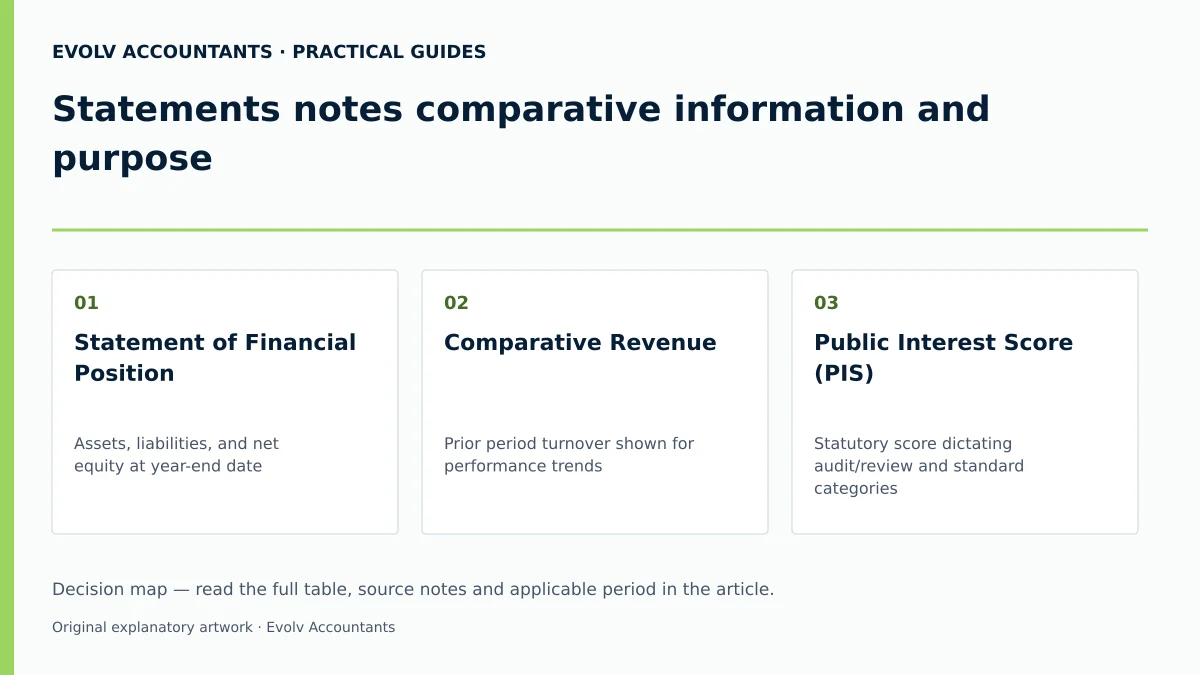
| Statement of Financial Position | Assets, liabilities, and net equity at year-end date 3 | Asset register, bank reconciliations, ledger liabilities 8 17 30 | Assets: R5m; Liabilities: R3m; Equity: R2m | Reflects historical position on specific date; not daily cash flow 3 4 |
| Comparative Revenue | Prior period turnover shown for performance trends 3 26 | Sales general ledgers and monthly tax returns 31 | Current: R10m; Prior: R8m (+25%) | Revenue growth does not guarantee equivalent cash collection 3 31 |
| Public Interest Score (PIS) | Statutory score dictating audit/review and standard categories 26 | Payroll records, turnover, liability totals, share register 26 | 35 points (SME illustrative model) | Must be recalculated annually at year-end date 26 |
| Section 29(1)(e) Notice | Mandatory first-page statement of assurance and preparer 33 | Board approval resolution and preparer designation 9 33 | "Unaudited, Prepared by J. Smith CA(SA)" | Notice must appear prominently on the first page 33 |
| Director Remuneration Note | Mandatory AFS disclosure of fees, salaries, and benefits for audited AFS 7 | Director service contracts, payroll, and board minutes 7 | Disclosed in AFS Note 14 | Required for audited companies under Section 30(4) 7 |
Frequently Asked Questions
What core documents form a complete set of annual financial statements?
A complete set of annual financial statements includes primary statements (statement of financial position, statement of comprehensive income, statement of cash flows, and statement of changes in equity) alongside comprehensive supporting notes and comparative prior-year figures 3 5.
When must a private company's annual financial statements be audited?
An audit is mandatory if required by the company's Memorandum of Incorporation, or if the company holds fiduciary assets exceeding R5 million, or if its Public Interest Score is 350 or more (or 100 or more if internally compiled) 24.
How does Section 30(2A) exempt certain private companies from audit or independent review?
Section 30(2A) exempts a private company from audit or independent review if one person holds all beneficial interest or if every person holding security beneficial interest is also a director 22.
What information must appear on the first page of financial statements?
Under Section 29(1)(e), the first page must prominently indicate whether the statements have been audited, independently reviewed, or neither, and state the name and professional designation of the individual who prepared or supervised them 33.
What is the deadline for preparing annual financial statements and filing CIPC returns?
Companies must prepare annual financial statements within six months after financial year-end 4. CIPC Annual Returns (CoR 30.1) must be filed within 30 business days after the anniversary date of incorporation 10 34. Ask Evolv about statements notes comparative information and purpose. Share the relevant records so the support required can be scoped. [#article-enquiry]
Related guides
- When a small company needs an independent review
- When a private company needs an audit
- Reading the Financials: Cash Flow and the Balance Sheet for Directors