
When a private company needs an audit
5 May 2026

Determining whether a South African private company requires an annual audit is dictated by statutory thresholds, compilation methods, and Memorandum of Incorporation provisions.
Audit and assurance qualification. Regulation 28’s R5 million fiduciary-assets trigger concerns assets held in the ordinary course of the company’s primary activities for people unrelated to the company. The public-interest-score triggers also depend on whether statements are compiled internally or independently, and other statutory or MOI requirements can apply. Assess the complete tests rather than treating a low score as an automatic audit exemption.
See Companies Regulations, regulations 26–29.
A South African private company must undergo a statutory audit if its Public Interest Score (PIS) reaches 350 or more, if its score is at least 100 and its financial statements are internally compiled, or if it holds fiduciary assets exceeding R5 million in the ordinary course of primary business 1 2. Conversely, a private company may choose a voluntary audit if required by its Memorandum of Incorporation (MOI), a board or shareholder resolution, or external stakeholder agreements 3 4.
Private companies that fall below these statutory thresholds and prepare independently compiled statements generally qualify for an independent review or, under owner-managed criteria where all beneficial shareholders serve as directors, a complete exemption from both audit and independent review requirements 3 5 6.
Statutory versus voluntary audit requirements
Defining statutory obligations under South African law
A private company incorporated under section 8(2)(b) of the Companies Act 71 of 2008 is defined as a profit company whose Memorandum of Incorporation prohibits public security offerings and restricts share transferability 7. Directors must distinguish between basic company registration and annual audit eligibility: registration creates a corporate body, whereas audit eligibility is evaluated at the conclusion of each financial year 8 9.
The applicable period for compliance covers the annual accounting period following the financial year-end 8 9.
Distinguishing statutory mandates from voluntary choices
Statutory audit mandates arise directly under section 30(2)(b)(i) of the Companies Act 71 of 2008 and Regulation 28(2) of the Companies Regulations, 2011 3 5. These obligations are mandatory based on public interest considerations 3 5. Voluntary audits occur when a company is not statutory bound but elects to be audited pursuant to section 30(2)(b)(ii)(aa), a voluntary Chapter 3 MOI election under section 34(2), or contractual financing covenants 3 4 10.
A critical evidence boundary separates CIPC company beneficial ownership register records maintained under section 56(7) and Regulation 32A/32B 11 12 from SARS partnership IT3(BO) filings. Audit and independent review determinations rely strictly on the Companies Act, the Companies Regulations 2011, the financial statement compilation method, and statutory owner-managed exemptions 2 3 5 13.
— Practical point from this guide
Financial reporting framework scope
South African law differentiates statutory acts, regulator guidance, and Evolv recommendations. Regarding accounting standards, the public IFRS overview is admitted strictly for framework scope and edition facts: the International Accounting Standards Board (IASB) publishes the IFRS for SMEs Accounting Standard 14. The IASB issued the updated Third Edition in February 2025, which is effective for financial reporting periods starting on or after 1 January 2027, with early adoption permitted alongside the 2015 edition 15 16 17.
The qualification tests to check: statutory
The Public Interest Score (PIS) framework
Every South African private company must calculate its Public Interest Score at the end of each financial year in terms of Regulation 26(2) 18. The calculation aggregates four specific operational metrics:
- Employee score: One point for each individual corresponding to the average number of employees during the financial year 18.
- Liability score: One point for every R1 million (or portion thereof) in third-party liabilities at the financial year-end 18.
- Turnover score: One point for every R1 million (or portion thereof) in turnover generated during the financial year 18.
- Beneficial interest score: One point for every individual who, at financial year-end, is known to directly or indirectly hold a beneficial interest in the company's issued securities 18.
The statutory audit criteria
Under Regulation 28(2), a private company must undergo a statutory audit if it meets any of the following independent tests:
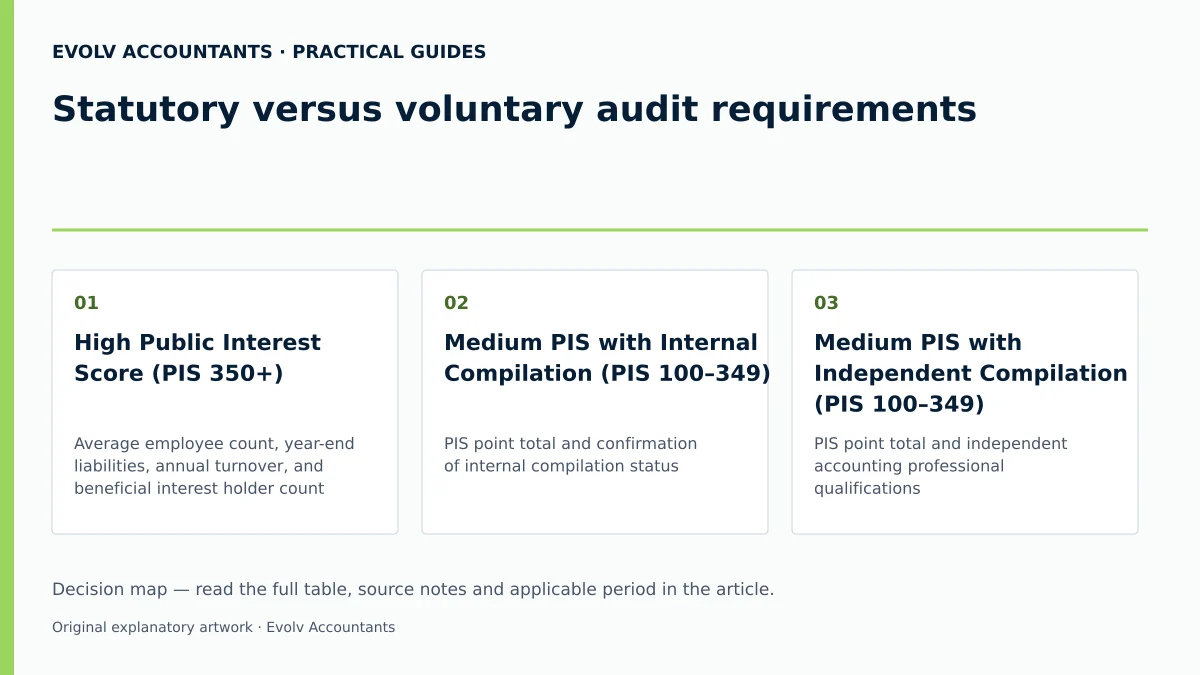
- High Public Interest Score: A Public Interest Score of 350 or more in the applicable financial year 2.
- Medium Public Interest Score with Internal Compilation: A Public Interest Score of at least 100 but less than 350, if its annual financial statements for that year were internally compiled 2.
- Fiduciary Asset Threshold: Holding assets in a fiduciary capacity for non-related persons in the ordinary course of primary activities, where the aggregate value exceeds R5 million at any time during the financial year 1.
Compilation method definitions and owner-managed exemptions
Under Regulation 26(1)(e) and Regulation 27(1)–(2), financial statements are classified as "independently compiled and reported" only if prepared by an independent accounting professional in accordance with prescribed accounting standards 19 20.
An independent accounting professional must be a registered auditor, a member of an accredited professional body, or a qualified close corporation accounting officer who has no personal financial interest, is not involved in the day-to-day management of the entity, and was not an executive employee or prescribed officer during the preceding three financial years 13 21. Statements prepared outside these independence criteria are classed as internally compiled 20.
Under section 30(2)(b)(ii)(AA)–(BB), a private company is granted a statutory exemption from independent review and statutory audit if:
- One person holds, or has all of the beneficial interest in, all issued securities 22; or
- Every person who holds or has a beneficial interest in issued securities is also a director of the company (unless the sole director is disqualified under section 69(12)) 22.
Evidence behind the eligibility decision: voluntary audit requirements
Primary evidentiary records
To support the statutory versus voluntary audit decision, company directors must compile verifiable evidence records linked to specific regulatory provisions:
- Public Interest Score records: Form CoR 30.1 accountability schedules, annual payroll summaries, audited trial balances, balance sheets, and turnover computations under Regulation 26(2) 18 23 24. Responsible person: Designated director or compliance officer under section 33(3) 25.
- Voluntary MOI elections: Form CoR 15.1B (Article 1.4) or custom Memorandum of Incorporation reflecting a voluntary election to apply Chapter 3 accountability requirements under section 34(2) 4 10. Responsible person: Company board of directors 26.
- Compilation engagement records: Professional engagement letters, independence declarations, and first-page notices reflecting the preparer's professional designation under section 29(1)(e) 13 27. Responsible person: Independent accounting professional 13.
- Beneficial interest registers: Securities registers and beneficial interest disclosure records established under section 50 and section 56(7) 11 28. Responsible person: Company secretary or designated compliance officer 25 29.
Eligibility decision table
| Test | Facts to obtain | Evidence | Applicable source | Result or unresolved question |
|---|---|---|---|---|
| High Public Interest Score (PIS 350+) | Average employee count, year-end liabilities, annual turnover, and beneficial interest holder count | Payroll records, year-end balance sheet, income statement, and securities register 18 24 | Companies Regulations, 2011 Regulation 26(2) & 28(2)(c)(i) 2 18 | Statutory audit required if total score equals or exceeds 350 points 2. |
| Medium PIS with Internal Compilation (PIS 100–349) | PIS point total and confirmation of internal compilation status | Form CoR 30.1, CoR 30.2 Financial Accountability Supplement, internal trial balance 20 23 30 | Companies Regulations, 2011 Regulation 27(2) & 28(2)(c)(ii) 2 20 | Statutory audit required if score is 100–349 and statements are internally compiled 2. |
| Medium PIS with Independent Compilation (PIS 100–349) | PIS point total and independent accounting professional qualifications | Engagement letter, preparer independence declaration, and s29(1)(e) notice 13 19 27 | Companies Regulations, 2011 Regulation 27(2) & 29(3)–(4) 20 31 32 | Independent review required unless voluntary audit is elected 3 31. |
| Fiduciary Asset Threshold | Aggregate value of non-related third-party assets held in fiduciary capacity | Fiduciary bank account statements, trust registers, asset valuation schedules 1 33 | Companies Regulations, 2011 Regulation 28(2)(a) 1 | Statutory audit required if fiduciary assets exceed R5 million 1. |
| Owner-Managed Exemption | Direct and indirect shareholding identities and director appointments | Securities register, CIPC director records (Form CoR 39), shareholder identity files 3 28 | Companies Act 71 of 2008 section 30(2)(b)(ii)(AA)–(BB) 3 22 | Exempt from review and audit if all beneficial shareholders are directors 3 22. |
| Voluntary MOI Election | MOI accountability provisions and shareholder special resolutions | Registered Memorandum of Incorporation (Form CoR 15.1B) and resolution minutes 4 10 | Companies Act 71 of 2008 section 34(2) & 30(2)(b)(ii)(aa) 3 4 | Voluntary audit mandatory if required by MOI or resolution 3 4. |
A qualifying case and an excluded case: statutory
Hypothetical fact pattern: Company A (Qualifying Statutory Audit)
Consider Apex Industrial Supplies (Pty) Ltd, an operating private profit company 7:
- Workforce: Employs an average of 120 staff members during the financial year (120 points) 18.
- Liabilities: Holds R45 million in total third-party liabilities at financial year-end (45 points) 18.
- Turnover: Generates R180 million in annual turnover (180 points) 18.
- Beneficial interest holders: Owned by 10 individual shareholders (10 points) 18.
- Public Interest Score calculation: 120 + 45 + 180 + 10 = 355 points 18.
Conclusion: Because its Public Interest Score equals 355 (exceeding the statutory 350-point threshold under Regulation 28(2)(c)(i)), Apex Industrial Supplies (Pty) Ltd is required by law to have its annual financial statements audited by a registered auditor, regardless of whether its statements are compiled internally or independently 2 34.
Hypothetical fact pattern: Company B (Excluded / Exempt Case)
Consider Beacon Tech Solutions (Pty) Ltd, a technology consulting private profit company 7:
- Workforce: Employs an average of 15 staff members during the financial year (15 points) 18.
- Liabilities: Holds R8 million in third-party liabilities at financial year-end (8 points) 18.
- Turnover: Generates R25 million in annual turnover (25 points) 18.
- Beneficial interest holders: Owned by 2 individual shareholders, both of whom serve as active executive directors (2 points) 3 18.
- Public Interest Score calculation: 15 + 8 + 25 + 2 = 50 points 18.
- Compilation status: Statements are independently compiled by a qualified accounting professional 13 19.
Conclusion: Beacon Tech Solutions (Pty) Ltd records a Public Interest Score of 50 (below the 100-point threshold). Furthermore, because every shareholder is also a appointed director of the company, it satisfies the owner-managed exemption criteria under section 30(2)(b)(ii)(BB) 22. Consequently, the company is legally excluded from both statutory audit and independent review requirements 3 5 6.
What changes the answer: voluntary audit requirements
Dynamic triggers altering compliance status
A private company's audit requirements are not static; changes in ownership, operational scale, or compilation choices can immediately alter its legal standing:
- Ownership and board restructuring: If an owner-managed company introduces a passive non-director shareholder (such as an employee share trust or outside investor), it immediately forfeits the section 30(2)(b)(ii)(BB) owner-managed exemption 22. It must then undergo an independent review or audit based on its Public Interest Score 2 3 31.
- Scalability of operations: Increases in employee headcount, borrowings, or revenue that push a company's Public Interest Score above 100 or 350 automatically change its category under Regulation 28(2) for that financial year 2 18.
- Shift in compilation methods: A private company with a Public Interest Score between 100 and 349 that transitions from independent compilation to internal compilation becomes subject to a mandatory statutory audit under Regulation 28(2)(c)(ii) 2 31.
- Contractual and MOI amendments: Shareholders may pass a special resolution or amend the MOI under section 34(2) to introduce voluntary Chapter 3 audit requirements 4. Similarly, commercial lenders or credit providers may insert contractual covenants requiring audited statements as a condition of debt financing 3.
Next steps for Annual financial statements
Decision checklist for company directors
- Confirm financial year-end: Verify the company's annual accounting period and financial year-end date established under section 27 8.
- Calculate the Public Interest Score: Sum the four points categories under Regulation 26(2) using average employee numbers, liabilities, turnover, and beneficial interest holder records 18.
- Verify owner-managed status: Inspect securities registers and CIPC director records to check whether all beneficial shareholders are directors under section 30(2)(b)(ii) 22 28.
- Determine compilation method: Confirm whether annual financial statements will be compiled internally or independently by an independent accounting professional under Regulation 26(1)(e) 13 19.
- Inspect Memorandum of Incorporation: Review Form CoR 15.1B to confirm whether the company has voluntarily elected Chapter 3 audit compliance under section 34(2) 4 10.
- Confirm the reporting framework: Check Regulation 27 and the framework’s scope requirements separately from the public-interest-score calculation 20 38.
- Appoint audit or review professional: Engage a registered auditor under section 90 or an independent reviewer under Regulation 29 prior to finalising statements 32 34.
- File CIPC Annual Return: Submit Form CoR 30.1 within 30 business days of the incorporation anniversary, attaching audited statements or Form CoR 30.2 Financial Accountability Supplement 35 36 37.
Frequently Asked Questions
Can a private company choose to be audited if its Public Interest Score is below 100?
Yes. Under section 30(2)(b)(ii)(aa) and section 34(2), a private company may voluntarily elect to undergo an annual audit through a board resolution, shareholder resolution, or Memorandum of Incorporation provision 3 4.
What occurs if a private company with a Public Interest Score of 150 compiles its statements internally?
Under Regulation 28(2)(c)(ii), any company with a Public Interest Score of at least 100 whose annual financial statements are internally compiled is subject to a mandatory statutory audit 2.
How does the owner-managed exemption affect independent review obligations?
Under section 30(2)(b)(ii) and Regulation 29(2)(a), if all holders of beneficial interest in a private company are also directors, the entity is exempt from independent review and statutory audit, provided it does not exceed fiduciary asset thresholds or hold a voluntary MOI mandate 1 3 6 22.
Is CIPC beneficial ownership disclosure identical to SARS IT3(BO) filing?
No. CIPC beneficial interest disclosures under section 56(7) and Regulation 32A/32B govern corporate securities registers 11 12. SARS IT3(BO) reporting applies to tax oversight. Audit decisions rely strictly on CIPC securities registers and Companies Act definitions 3 11.
Which accounting standard applies to a private company with a Public Interest Score of 400?
Under Regulation 27(4), a profit company with a Public Interest Score of 350 or more must adopt either full IFRS or the IFRS for SMEs Accounting Standard (provided it meets IFRS for SMEs scoping requirements) 38 39. Tell Evolv about your company’s reporting period, records and financial-statement question. Ask Evolv about statutory versus voluntary audit requirements. Share the relevant records so the support required can be scoped.
Related guides
- What annual financial statements contain
- Calculating a company public interest score
- Reading the Financials: Cash Flow and the Balance Sheet for Directors