
When a small company needs an independent review
2 March 2026

An independent review is a statutory engagement that requires an independent evaluation of a private company's financial statements under Companies Regulation 29 1 2.
Audit and assurance qualification. Regulation 28’s R5 million fiduciary-assets trigger concerns assets held in the ordinary course of the company’s primary activities for people unrelated to the company. The public-interest-score triggers also depend on whether statements are compiled internally or independently, and other statutory or MOI requirements can apply. Assess the complete tests rather than treating a low score as an automatic audit exemption.
See Companies Regulations, regulations 26–29. SAICA’s APB/FRSC notice records the withdrawal of SA GAAP for periods starting from December 2012; a legacy reference in the Regulations does not make it a current framework option.
Under South African corporate law, a private company must undergo an independent review of its annual financial statements unless it is subject to a statutory audit or qualifies for an owner-managed exemption 3 4. The Companies Act 71 of 2008 and the Companies Regulations, 2011 establish specific quantitative thresholds—primarily the Public Interest Score and fiduciary asset levels—and qualitative ownership criteria that govern assurance requirements 3 4 5 6.
Company directors are required to determine these obligations annually at the end of each financial year 4 5.
Applicability exemptions and review engagement scope
South African private companies incorporated under the Companies Act 71 of 2008 are subject to clear statutory frameworks governing financial statement assurance 3 7. Registration with the Companies and Intellectual Property Commission (CIPC) and the filing of annual returns under Section 33 are general statutory compliance obligations for all active companies 8 9. However, registration and annual return filings must be strictly separated from financial statement assurance eligibility 3 8.
While every private company must account for its financial activities, the specific level of assurance required—whether a statutory audit, an independent review, or an owner-managed exemption—depends upon explicit statutory tests rather than mere registration status 3 4 6.
These assurance frameworks have been effective since 1 May 2011 under the Companies Regulations, 2011 10 11. When preparing annual financial statements, private companies choose an applicable accounting framework, such as the International Financial Reporting Standard for Small and Medium-sized Enterprises (IFRS for SMEs Accounting Standard) 12 13. The IFRS for SMEs Accounting Standard provides simplified accounting principles, restricted policy options, and reduced disclosures 14 15.
Note that while the IASB issued an updated edition in February 2025 effective for financial years beginning on or after 1 January 2027 (with early adoption permitted), public standard overviews serve only to confirm framework scope and edition timelines rather than replacing statutory reporting rules 13 15.
Statutory requirements are enacted by Parliament through the Companies Act 71 of 2008 16 17. Regulatory requirements and administrative mechanisms are promulgated by the Minister via the Companies Regulations, 2011 10 18. Evolv Accountants recommends best-practice procedures for record-keeping and evidence gathering to support board decisions regarding assurance engagements.
— Practical point from this guide
Regarding company disclosures, CIPC beneficial ownership declarations under Section 56 and Regulation 32A/32B pertain strictly to corporate shareholding registers and legal entity governance 10 19. They are distinct from SARS partnership income tax declarations, such as the IT3(BO) filings required for tax administration.
The qualification tests to check: applicability exemptions
To determine whether a private company is exempt from an independent review or requires an audit or review, directors must apply a sequence of independent statutory tests 3 4 6. Size labels such as "small" or "medium" business must never replace these explicit statutory calculations 4 5 6.
The Owner-Managed Exemption Test
Under Section 30(2A) and Section 30(2)(b)(ii) of the Companies Act, a private company is fully exempt from having its annual financial statements audited or independently reviewed if it meets one of the following criteria 3:
- Single Beneficial Holder: One person holds, or has all of the beneficial interest in, all securities issued by the company 3; or
- Shareholder-Directors: Every person who holds or has a beneficial interest in any securities issued by the company is also a director of the company (unless the sole director is a disqualified person under Section 69) 3 20.
If a private company meets either condition, it is exempt from independent review by operation of law, provided no other statutory requirement or Memorandum of Incorporation (MOI) provision mandates an audit 3 4 21.
Mandatory Statutory Audit Thresholds
If a private company does not qualify for the owner-managed exemption, or if it holds third-party assets, it must check whether a statutory audit is compulsory under Regulation 28 6 11. An audit is required if:
- The company holds assets in a fiduciary capacity for non-related persons in the ordinary course of its primary activities, and the aggregate value exceeds R5 million at any time during the financial year 6;
- The company's Public Interest Score (PIS) for the financial year is 350 or more 1;
- The company's PIS is at least 100 and its annual financial statements were internally compiled 1; or
- The company's MOI voluntarily requires an audit 2 3 21.
Independent Review Requirement
A private company that is not required to be audited under Regulation 28, and is not exempt under the owner-managed rule, must have its annual financial statements independently reviewed under Regulation 29(3) 2 4. This applies to:
- Private companies with a PIS of at least 100 but less than 350 whose financial statements are independently compiled 2 22; and
- Private companies with a PIS of less than 100 that are not owner-managed 4 23.
Public Interest Score (PIS) Calculation
Under Regulation 26(2), the Public Interest Score is calculated at the end of each financial year as the sum of 5:
- One point for every average employee during the financial year 5;
- One point for every R1 million (or portion thereof) in third-party liability at financial year end 5;
- One point for every R1 million (or portion thereof) in turnover during the financial year 5; and
- One point for every individual who, at financial year end, is known to directly or indirectly hold a beneficial interest in the company's issued securities 5.
Evidence behind the eligibility decision: review engagement scope
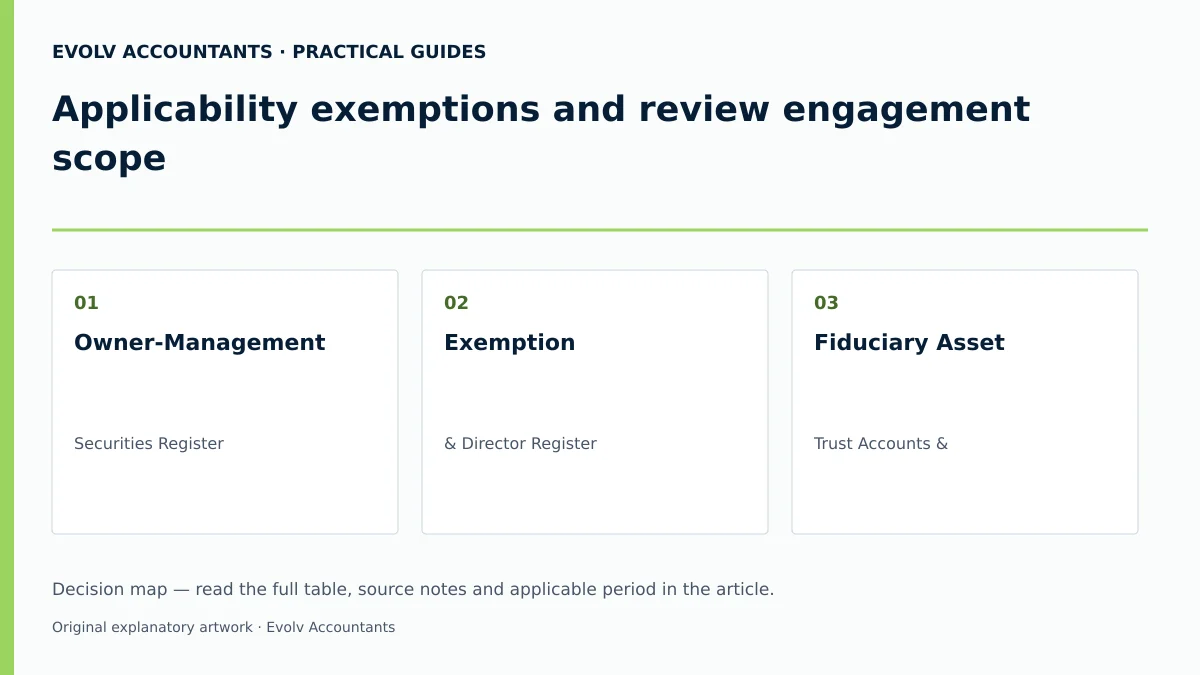
Every eligibility determination must be supported by primary evidence records maintained by designated responsible persons 8 24 25. EVIDENCE LOCATOR FRAMEWORK
| Statutory Test | Primary Record | Responsible Person |
|---|---|---|
| Owner-Management | Securities Register | Compliance Officer / |
| Exemption | & Director Register | Company Secretary |
| Fiduciary Asset | Trust Accounts & | Chief Financial |
| Threshold (>R5m) | Asset Registers | Officer / Director |
| PIS Employee Score | Payroll Records & EMP201 Summaries | Human Resources / Payroll Manager |
| PIS Turnover Score | Audited/Verified Income Statement | Financial Manager / Accountant |
| PIS Liability Score | Balance Sheet & Loan Agreements | Financial Manager / Director |
| Compilation Method | AFS First-Page Notice (s29(1)(e)) | Independent Accounting Person |
The preparer of the financial statements must place a prominent notice on the first page of the statements indicating whether they were audited, independently reviewed, or unaudited, along with the preparer's name and professional designation 26.
Under Regulation 26(1)(e), financial statements are "independently compiled and reported" only if prepared by an independent accounting professional on financial records provided by the company 27 28. Under Regulation 29(5), an independent review cannot be carried out by the independent accounting professional who prepared or compiled those statements 29.
Professional Qualifications for Independent Reviewers
Under Regulation 29(4), independent reviews must be performed by 2 23:
- PIS of 100 to 349: A registered auditor or a member in good standing of a professional body accredited under Section 33 of the Auditing Profession Act 23.
- PIS of less than 100: A registered auditor, an accredited professional body member, or a person qualified as an accounting officer for a close corporation under the Close Corporations Act 1984 23.
Under Regulation 29(6), if an independent reviewer identifies or suspects a reportable irregularity—defined as an unlawful act or omission causing material financial loss, fraud, theft, or insolvent trading—they must report it to the CIPC without delay and notify the board within three business days 1 29 30.
A qualifying case and an excluded case: applicability exemptions
To demonstrate the application of these rules, consider two hypothetical private companies evaluating their financial year-end compliance obligations.
Case A: Excluded Entity (Owner-Managed Exemption)
- Entity Profile: Apex Engineering (Pty) Ltd is a private company with two shareholders who both serve as active executive directors 3 7.
- Financial Facts: 12 average employees during the year (12 points); R18 million turnover (18 points); R14 million third-party liabilities (14 points); 2 beneficial shareholders (2 points) 5.
- PIS Calculation: 12 + 18 + 14 + 2 = 46 points 5.
- Fiduciary Assets: R0 held in a fiduciary capacity 6.
- Assurance Result: Although Apex Engineering has a PIS of 46, because 100% of its shareholders are directors of the company, it qualifies for the Section 30(2A) owner-managed exemption 3 20. It is exempt from both mandatory audit and independent review 3 4.
Case B: Qualifying Entity (Mandatory Independent Review)
- Entity Profile: Beacon Retail (Pty) Ltd is a private company with three shareholders 7. Two shareholders are directors, but the third is a passive external investor who is not a director 3.
- Financial Facts: 25 average employees (25 points); R42 million turnover (42 points); R28 million liabilities (28 points); 3 beneficial shareholders (3 points) 5.
- PIS Calculation: 25 + 42 + 28 + 3 = 98 points 5.
- Compilation Status: Financial statements are independently compiled by an external accounting professional 28.
- Assurance Result: Beacon Retail does not qualify for the owner-managed exemption because not all shareholders are directors 3. Because its PIS is 98 (less than 100) and its statements are independently compiled, it is not subject to a compulsory audit under Regulation 28 1. However, under Regulation 29(3), it is legally required to undergo an independent review conducted in accordance with ISRE 2400 2. The review must be performed by an independent reviewer who did not compile the financial statements 23 29.
What changes the answer: review engagement scope
A company's assurance classification is not static; changes in corporate structure or financial position require annual reassessment 4 5.
- Changes in Share Ownership or Board Composition: Introducing a non-director shareholder or issuing shares to a trust immediately terminates the Section 30(2A) owner-managed exemption 3. The company must then determine whether its PIS requires an independent review or audit 1 2 3.
- Changes in Fiduciary Asset Holdings: If a company begins holding third-party assets in the ordinary course of business and the aggregate value exceeds R5 million at any time during the financial year, it automatically shifts from review status to a mandatory statutory audit under Regulation 28(2)(a) 4 6.
- Fluctuations in Turnover, Staff, or Debt: An increase in turnover, staff, or debt that pushes the PIS to 100 or above will alter assurance requirements 1 5. If financial statements are internally compiled, a PIS of 100 triggers a mandatory audit under Regulation 28(2)(c)(ii) 1. If independently compiled, a PIS between 100 and 349 requires an independent review by a registered auditor or accredited professional accountant 22 23. A PIS of 350 or more mandates an audit regardless of compilation method 1.
- Changes to the MOI: Shareholders may pass a special resolution to amend the MOI to voluntarily require an audit, overriding review status 2 3 21.
- Accounting Framework Updates: Transitioning between financial reporting frameworks (such as adopting IFRS for SMEs) alters disclosure requirements, though statutory review boundaries remain governed by the Companies Act and Regulations 13 15.
Next steps for Annual financial statements
Numbered Compliance Checklist
- Verify Ownership & Governance Structure: Inspect the securities register and director register to confirm whether 100% of shareholders are directors 3 24.
- Calculate Year-End Public Interest Score: Compute total points across employees, turnover, third-party liabilities, and beneficial interest holders 5.
- Assess Fiduciary Assets: Confirm whether third-party assets exceeded R5 million at any point in the financial year 6.
- Determine Compilation Independence: Establish whether financial statements will be internally compiled or independently compiled under Regulation 26(1)(e) 28 31.
- Confirm Assurance Category: Apply Section 30(2) and Regulations 28/29 to determine if the company is exempt, requires an independent review, or mandates an audit 3 4 6.
- Engage an Independent Reviewer: Ensure the reviewer possesses the required professional qualifications and was not involved in compiling the financial statements 23 29.
- Complete Statutory Filings: Submit CIPC Annual Returns (Form CoR 30.1) alongside the reviewed AFS or Financial Accountability Supplement (Form CoR 30.2) 8 9 32.
Eligibility Decision Table
| Test | Facts to Obtain | Evidence | Applicable Source | Result or Unresolved Question |
|---|---|---|---|---|
| Owner-Managed Exemption | Shareholder and director identities | Securities register, CIPC CoR 39 records, MOI 3 24 | Companies Act Section 30(2A) 3 | If 100% of shareholders are directors, exempt from review 3. |
| Fiduciary Assets | Maximum value of client/third-party assets held | Trust account bank statements, ledger records 6 | Companies Regulation 28(2)(a) 6 | If >R5 million, mandatory statutory audit required 6. |
| Public Interest Score (PIS) | Staff count, turnover, liabilities, shareholder count | Payroll summaries, trial balance, debt schedules 5 | Companies Regulation 26(2) 5 | Calculates total score to set audit or review threshold 1 5. |
| Compilation Independence | Relationship between preparer and company | Preparer engagement letter, AFS first-page notice 26 28 | Companies Regulation 26(1)(e) 28 | Determines if statements are independently compiled 28. |
| Reviewer Qualification | Professional registration & compiler separation | Practice number, independence declaration 23 29 | Companies Regulation 29(4)-(5) 23 29 | Reviewer must be qualified and cannot be the compiler 23 29. |
Frequently Asked Questions
Does a private company with two equal shareholder-directors need an independent review?
No. Under Section 30(2A) of the Companies Act, if every shareholder is also a director, the company is exempt from independent review unless its MOI or another statute requires an audit 3 21.
What is the difference between internal and independent compilation of financial statements?
Financial statements are internally compiled if prepared by an employee or director 27 31. They are independently compiled under Regulation 26(1)(e) only when prepared by an independent accounting professional with no management role or financial interest in the company 27 28.
Can the same accounting professional compile the financial statements and conduct the independent review?
No. Regulation 29(5) explicitly prohibits an independent review from being carried out by the independent accounting professional who prepared or compiled the financial statements 29.
Which accounting standards apply to a private company undergoing an independent review?
Under Regulation 27(4), a private company with a PIS between 100 and 349 (or under 100 with independent compilation) may choose full IFRS or IFRS for SMEs, where the framework’s scope requirements are met 22.
How does beneficial ownership registration differ between CIPC statutory compliance and SARS tax declarations?
CIPC beneficial ownership filings under Section 56 deal with corporate share registers and legal entity control 10 19, whereas SARS IT3(BO) filings relate strictly to tax compliance and partnership income declarations. Ask Evolv about applicability exemptions and review engagement scope. Share the relevant records so the support required can be scoped.
Related guides
- What annual financial statements contain
- When a private company needs an audit
- Reading the Financials: Cash Flow and the Balance Sheet for Directors