
IFRS for SMEs versus full IFRS for a private company
23 June 2026

Selecting an accounting framework for a private company requires evaluating regulatory criteria and public accountability 1 2.
Audit and assurance qualification. Regulation 28’s R5 million fiduciary-assets trigger concerns assets held in the ordinary course of the company’s primary activities for people unrelated to the company. The public-interest-score triggers also depend on whether statements are compiled internally or independently, and other statutory or MOI requirements can apply. Assess the complete tests rather than treating a low score as an automatic audit exemption.
See Companies Regulations, regulations 26–29. SAICA’s APB/FRSC notice records the withdrawal of SA GAAP for periods starting from December 2012; a legacy reference in the Regulations does not make it a current framework option.
Private companies in South Africa must choose between International Financial Reporting Standards (full IFRS) and the IFRS for SMEs Accounting Standard based on their public interest score, compilation method, and public accountability obligations 1 2 3. While full IFRS provides comprehensive global disclosures suitable for public interest entities, IFRS for SMEs delivers tailored simplifications across recognition, measurement, and disclosure rules for qualifying private businesses 2 3 4.
Eligibility accountability and reporting framework choice
Defining Full IFRS and IFRS for SMEs
Full IFRS consists of comprehensive international accounting standards developed by the International Accounting Standards Board (IASB) to serve as a global financial language for general-purpose reporting 5. It mandates complete recognition principles, extensive note disclosures, and specific accounting policy choices designed primarily for listed entities and institutions with public accountability 3 5.
In contrast, the IFRS for SMEs Accounting Standard is a self-contained standard designed specifically for small and medium-sized entities that do not have public accountability 3 4. It incorporates five major types of simplifications compared to full IFRS 3 4:
- Omitted topics: Complex accounting topics not typical for private SMEs are excluded 4.
- Restricted policy options: Simplified methods are mandated where full IFRS permits complex choices 4.
- Simplified recognition and measurement: Revaluation and measurement principles are streamlined 4.
- Substantially reduced disclosures: Required note disclosures are significantly fewer 4.
- Plain English drafting: Language is structured for straightforward interpretation and application 4.
Under global IASB rules, the 2015 edition of IFRS for SMEs remains in effect, while an updated third edition issued in February 2025 becomes effective for financial periods beginning on or after 1 January 2027, with early adoption permitted 4 6.
Statutory Eligibility Scoping in South Africa
South African company law does not declare a universal winner between the two standards; rather, eligibility and obligation depend on statutory categories under the Companies Act 71 of 2008 and the Companies Regulations 2011 1 2. Under Companies Regulation 27(4), listed public companies must apply full IFRS 7. Unlisted public companies and private profit companies may adopt either full IFRS or IFRS for SMEs, provided the entity satisfies the scoping conditions of IFRS for SMEs 7 8.
Compare the criteria that matter: eligibility accountability
Control and Ownership Structure Constraints
The governance structure of a private company directly influences its statutory reporting path 9. Under Section 30(2A) of the Companies Act, an owner-managed private company—where every shareholder is also a director, or where a single individual holds all issued securities—is statutorily exempt from mandatory independent review or audit, unless an audit is required by its Memorandum of Incorporation (MOI) or statutory public interest thresholds 9 10.
Liability and Financial Exposure Constraints
Financial liabilities owed to third parties significantly impact compliance obligations 11. In calculating a company's Public Interest Score (PIS) under Companies Regulation 26(2), every R1 million (or portion thereof) in third-party liabilities at financial year-end contributes exactly one point to the total score 11. Higher liability levels elevate the PIS, potentially moving a private company into a higher reporting category that mandates audited financial statements 11 12.
Reporting, Tax, and Cash Flow Constraints
Operational scale and workforce size form core metrics in framework evaluation 11. The statutory PIS formula aggregates four distinct operational points at year-end 11:
- One point for every average employee employed during the financial year 11.
- One point for every R1 million (or portion thereof) in third-party liabilities 11.
- One point for every R1 million (or portion thereof) in annual turnover 11.
- One point for every individual holding a direct or indirect beneficial interest in the company's securities 11.
The resulting score determines whether the business faces mandatory audit requirements and restricts which accounting frameworks are legally permissible 2 7 8 10 12 13 14 15 16 17.
How the obligations differ: reporting framework choice
Sourced Statutory Rules Versus Professional Recommendations
It is essential to distinguish statutory requirements established by the Companies Act and Regulations from professional practice recommendations and operational accounting capabilities:
— Practical point from this guide
- Statutory Law and Regulator Rules:
- Preparation Period: Section 30(1) of the Companies Act requires every company to prepare annual financial statements within six months after the end of its financial year 18.
- Framework Matrix (Regulation 27): Profit companies with a PIS of 350 or more must adopt either full IFRS or IFRS for SMEs 7. Profit companies with a PIS between 100 and 349, or a PIS below 100 whose statements are independently compiled, may choose full IFRS or IFRS for SMEs, subject to the latter’s scope limits 8. Profit companies with a PIS below 100 whose statements are internally compiled may determine their own financial reporting standard as long as none is prescribed 13.
- Audit Mandates (Regulation 28): Private companies must have audited financial statements if their PIS is 350 or more, or if their PIS is 100 or more and their statements are internally compiled 12. An audit is also mandatory if the company holds assets in a fiduciary capacity for non-related persons exceeding R5 million in aggregate at any time during the financial year 16.
- Independent Review (Regulation 29): Private companies not subject to a mandatory audit or exempt under Section 30(2A) must undergo an independent review in accordance with ISRE 2400 9 19 20.
- CIPC Reporting Boundary: Filing annual returns with the Companies and Intellectual Property Commission (CIPC) under Section 33 and Regulation 30 requires attaching audited statements or a Financial Accountability Supplement (Form CoR 30.2), along with beneficial ownership register filings under Regulation 30(1A) 21 22 23 24. This CIPC beneficial ownership requirement is distinct from SARS tax reporting for partnerships under IT3(BO) forms.
Two business situations with different outcomes: eligibility accountability
To illustrate how statutory criteria dictate accounting framework selection and audit obligations, consider two reproducible hypothetical private company scenarios under South African law:
Case Study A: Small Internally Compiled Family Entity
- Hypothetical Facts: Alpha Proprietary Limited is an unlisted private manufacturing company with 8 average employees, R12 million annual turnover, R2 million in third-party bank loans, and 2 individual shareholders who both serve as directors. The financial statements are compiled internally by an internal bookkeeper.
- PIS Calculation (Regulation 26(2)):
- Employees: 8 points 11.
- Turnover (R12m): 12 points 11.
- Liabilities (R2m): 2 points 11.
- Beneficial Interest Holders: 2 points 11.
- Total Public Interest Score: 24 points 11.
- Application of Rules: Because the PIS is below 100 and statements are internally compiled, Regulation 27(4) allows Alpha Proprietary Limited to apply a financial reporting standard determined by the company 13. Furthermore, because both shareholders are directors, Section 30(2A) exempts the entity from mandatory independent review or audit 9 10 19.
Case Study B: Growing Internally Compiled Commercial Entity
- Hypothetical Facts: Beta Proprietary Limited is an unlisted private logistics firm employing 55 average workers, generating R75 million in annual turnover, carrying R18 million in third-party debts, and owned by 4 non-director shareholders. Financial statements are compiled internally.
- PIS Calculation (Regulation 26(2)):
- Employees: 55 points 11.
- Turnover (R75m): 75 points 11.
- Liabilities (R18m): 18 points 11.
- Beneficial Interest Holders: 4 points 11.
- Total Public Interest Score: 152 points 11.
- Application of Rules: Because the PIS is 152 (falling between 100 and 349) and statements are compiled internally, Regulation 28(2)(c)(ii) mandates a statutory audit 12. Under Regulation 27(4), Beta Proprietary Limited must adopt full IFRS or IFRS for SMEs, subject to the latter’s scope limits 8.
Summary of Difference
Crossing the 100-point PIS threshold while compiling statements internally alters the legal outcome: it converts an optional review environment into a mandatory statutory audit and eliminates the freedom to use unprescribed internal standards 8 12 13.
When the comparison needs specialist input: reporting framework choice
Specialist technical accounting and legal guidance is required when an entity encounters complex statutory triggers or excluded circumstances:
- Fiduciary Asset Triggers: Holding assets in a fiduciary capacity exceeding R5 million in aggregate at any point in the financial year automatically triggers a mandatory audit under Regulation 28(2)(a), regardless of total PIS 16.
- Group and Consolidation Structures: Holding companies, subsidiaries, or entities undergoing fundamental transactions, schemes of arrangement, or capital restructuring under Chapter 4 or 5 of the Companies Act require specialized framework scoping 7 25 26.
- Reportable Irregularities: During an independent review under Regulation 29, an independent reviewer who identifies a suspected reportable irregularity must immediately report the particulars in writing to CIPC, initiate board discussions, and submit a follow-up report within 20 business days 27 28 29.
- Restricted Accounting Standards: Public listed companies and state-owned entities are legally excluded from using IFRS for SMEs or internal standards and must apply full IFRS 7.
Next steps for Annual financial statements
SME Leadership Action Checklist
- Calculate the Financial Year-End PIS: Aggregate employee averages, total turnover, third-party liabilities, and individual beneficial interest holders under Regulation 26(2) 11.
- Determine Statement Compilation Status: Confirm whether financial statements are internally compiled or independently compiled and reported by an independent accounting professional 30 31.
- Verify Audit versus Independent Review Mandate: Check whether the company exceeds the 350-point PIS threshold, the 100-point internal compilation threshold, or the R5 million fiduciary asset limit under Regulation 28 12 16.
- Select the Authorised Accounting Framework: Apply Regulation 27(4) to adopt full a currently available framework, including a company-determined standard only where permitted appropriate to the PIS and compilation category 2 7 8 13.
- Ensure Statutory Board Approvals: Present approved annual financial statements, signed by an authorised director, to shareholders within prescribed timeframes 18 32.
- Complete CIPC Annual Return Filings: Submit Form CoR 30.1 within 30 business days after the anniversary of incorporation, including audited statements or Form CoR 30.2, and file beneficial ownership updates 21 22 23 24.
Decision Comparison Matrix
| Criterion | Option A: Full IFRS | Option B: IFRS for SMEs | Evidence or Assumption | Implication for This Reader |
|---|---|---|---|---|
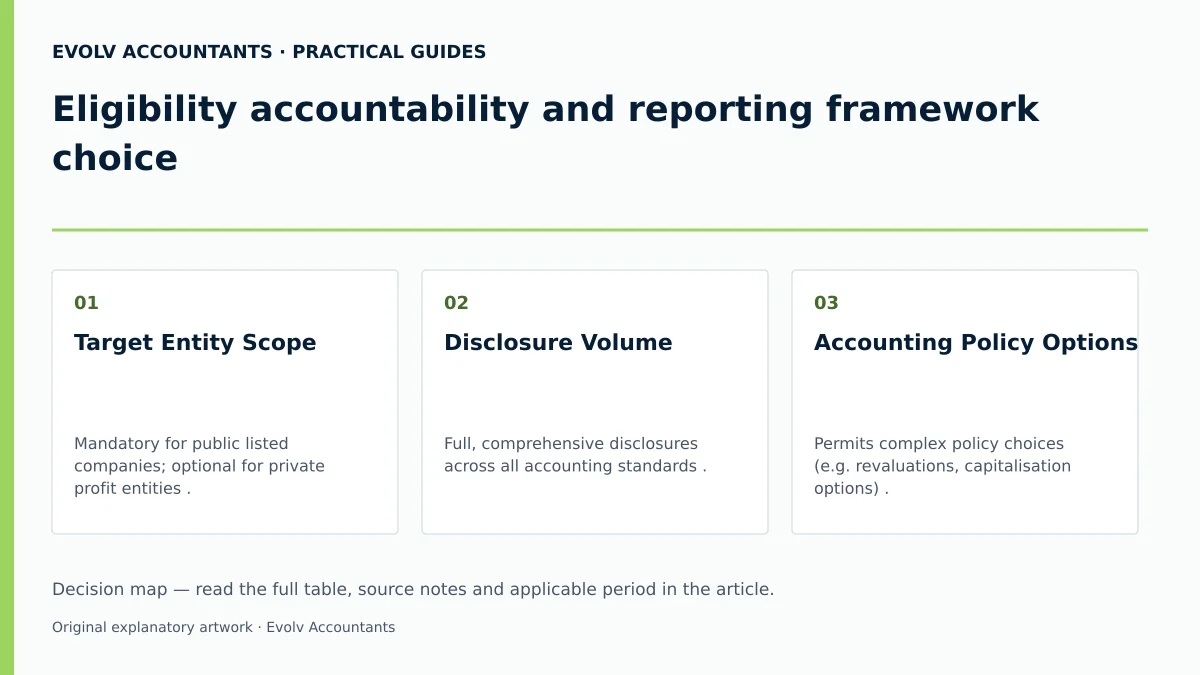
| Target Entity Scope | Mandatory for public listed companies; optional for private profit entities 7. | Designed for entities without public accountability; optional for qualifying private profit entities 3 8. | Companies Regulation 27(4) 7 8. | Private SMEs can adopt IFRS for SMEs unless listed or mandated otherwise by MOI 1 8. |
| Disclosure Volume | Full, comprehensive disclosures across all accounting standards 3 5. | Substantially fewer note disclosures tailored for smaller entities 4. | IFRS Standard Overview 3 4. | IFRS for SMEs significantly reduces financial statement preparation time and administrative overhead 4. |
| Accounting Policy Options | Permits complex policy choices (e.g. revaluations, capitalisation options) 3 5. | Restricts complex policy choices to simplified standard methods 4. | IFRS Standard Simplifications 3 4. | Simplifies ongoing bookkeeping and valuation adjustments for private finance teams 4. |
| Applicability at PIS ≥ 350 | Permitted for profit companies with PIS ≥ 350 7. | Permitted for profit companies with PIS ≥ 350 if scoping met 7. | Companies Regulation 27(4) 7. | High-PIS private companies retain framework choice but face mandatory statutory audit 7 12. |
| Applicability at PIS < 100 (Internal) | Permitted 2 13. | Permitted 2 13. | Companies Regulation 27(4) 13. | Small internally compiled entities may use any framework or an unprescribed company standard 13. |
Frequently Asked Questions
1. What is the statutory deadline for preparing annual financial statements under the Companies Act?
Section 30(1) of the Companies Act mandates that every company prepare its annual financial statements within six months after the end of its financial year 18.
2. Does a private company with a Public Interest Score below 100 require a mandatory audit?
No. A private company with a PIS below 100 is not required to have an audit unless it holds fiduciary assets exceeding R5 million, its MOI specifically requires an audit, or its shareholders voluntarily elect to conduct an audit 9 12 16.
3. How does internal compilation affect financial reporting standard choices?
If a private company has a PIS of 100 or more and compiles its statements internally, Regulation 28(2)(c)(ii) triggers a mandatory audit, and Regulation 27(4) restricts its framework choices to full IFRS or IFRS for SMEs, subject to the latter’s scope limits 8 12.
4. Can a private company early-adopt the 2025 edition of IFRS for SMEs?
Yes. Entities applying IFRS for SMEs may choose to adopt the updated third edition (issued in February 2025) early or continue applying the 2015 edition until the effective date of 1 January 2027 4 6.
5. How does CIPC beneficial ownership filing differ from SARS IT3(BO) reporting?
CIPC beneficial ownership filings under Regulations 30(1A) and 32A/32B establish statutory company registry disclosure under the Companies Act 23, whereas SARS IT3(BO) filings relate to tax reporting requirements for trusts and partnerships.
Related guides
- What annual financial statements contain
- When a small company needs an independent review
- Reading the Financials: Cash Flow and the Balance Sheet for Directors