
Calculating employer and employee UIF contributions
2 February 2026

Calculating Unemployment Insurance Fund contributions requires applying a total two per cent rate to eligible remuneration up to statutory earnings ceilings.
South African small and medium enterprises must deduct one per cent of an employee's qualifying remuneration and match it with a one per cent employer contribution, yielding a total statutory liability of two per cent payable monthly 1 2 3. Statutory exclusions remove independent contractors, workers employed for under 24 hours monthly, commission-only earners, and public office holders from the contribution base 4 5 6 7.
Remuneration calculations cap monthly eligible earnings at R17,712 per month, setting the maximum deduction per employee at R177.12 and the combined monthly contribution at R354.24 1 8 9. Compliance requires accurate deduction, monthly declaration via SARS EMP201 returns or uFiling, and separate monthly employee record reporting to the Unemployment Insurance Commissioner 5 8 10 11 12.
Contribution basis rate and two parties
Operational Scope and Accounting Treatment
Under South African legislation, Unemployment Insurance Fund (UIF) contributions represent a mandatory statutory levy providing short-term financial relief to workers during unemployment, illness, maternity, adoption, or parental leave, and to dependants of deceased contributors 13 14 15. The calculation yields two ZAR outputs: the employee deduction and employer contribution 1 2.
In commercial accounting, the employer portion is a payroll expense in profit and loss, whereas the employee portion is a withholding tax liability deducted from gross remuneration 1 2 16. Both portions accrue as a monthly statutory liability until remitted to SARS or the fund commissioner 8 17.
Hierarchy of Rules: Law, Guidance and Evolv Recommendations
SMEs must distinguish between governing law, regulator guidance, and Evolv recommendations:
- Statutory Law: Set by the Unemployment Insurance Act 63 of 2001 (UI Act) and Unemployment Insurance Contributions Act 4 of 2002 (UIC Act), administered under the Tax Administration Act 28 of 2011 (TA Act) and Fourth Schedule to the Income Tax Act 58 of 1962 13 15 18 19. Law sets mandatory rules, deadlines, interest, penalties, and offences 12 20 21 22.
- Regulator Guidance: SARS External Guide UIF-GEN-01-G01 and Department of Employment and Labour guides detail declaration procedures 8 11 18 23.
- Evolv Recommendations: Evolv Accountants advises SMEs to standardise payroll processing, execute monthly reconciliations, and maintain integrated ledgers to prevent reporting errors.
Inputs rates periods and exclusions: contribution basis rate
Primary Evidence Rates and Thresholds
The UIC Act stipulates that contributions are evaluated against remuneration using primary statutory rates and thresholds 2 9:
- Employee Rate: 1.0% of qualifying remuneration, withheld from employee earnings 1 2 16.
- Employer Rate: 1.0% of qualifying remuneration, paid directly by the employer 1 2.
- Total Rate: 2.0% of qualifying remuneration remitted monthly 1 3.
- Earnings Ceiling: R17,712 per month (R212,544 annually), effective 1 June 2021 1 8 9.
- Maximum Monthly Deduction: R177.12 employee deduction and R177.12 employer contribution (R354.24 total) 1 8 24.
Statutory Exclusions
Statutory law explicitly excludes specific employment relationships and earnings components 4 6 7 25:
- Excluded Workers: Staff employed under 24 hours monthly 4 6, public service officers 4 6, political office holders 4 6, and independent contractors 5 26.
- Excluded Remuneration: Pensions/retiring allowances 7 25, section 1 gross income lump sums 7 25, pure commission payments 7 25, and earnings above R17,712 monthly 1 8 9.
Missing or Unverified Inputs
Where payroll records lack verification of hours worked, commission structures, or tax classifications, inputs must be flagged as unverified 4 6.
— Practical point from this guide
The calculation in a worked example: two parties
Calculation Methodology
UIF calculation follows a three-step statutory process 9 25:
- Step 1: Determine gross remuneration paid or payable for the pay period 9 25.
- Step 2: Subtract statutory exclusions and cap remuneration at R17,712 per month 1 8 25.
- Step 3: Multiply qualifying base by 1.0% for employee portion and 1.0% for employer portion 1 2 25.
Reproducible Worked Example Table
The table demonstrates the calculation for Employee A (below ceiling) and Employee B (above ceiling).
| Input | Value or placeholder | Formula or step | Result | Independent check |
|---|---|---|---|---|
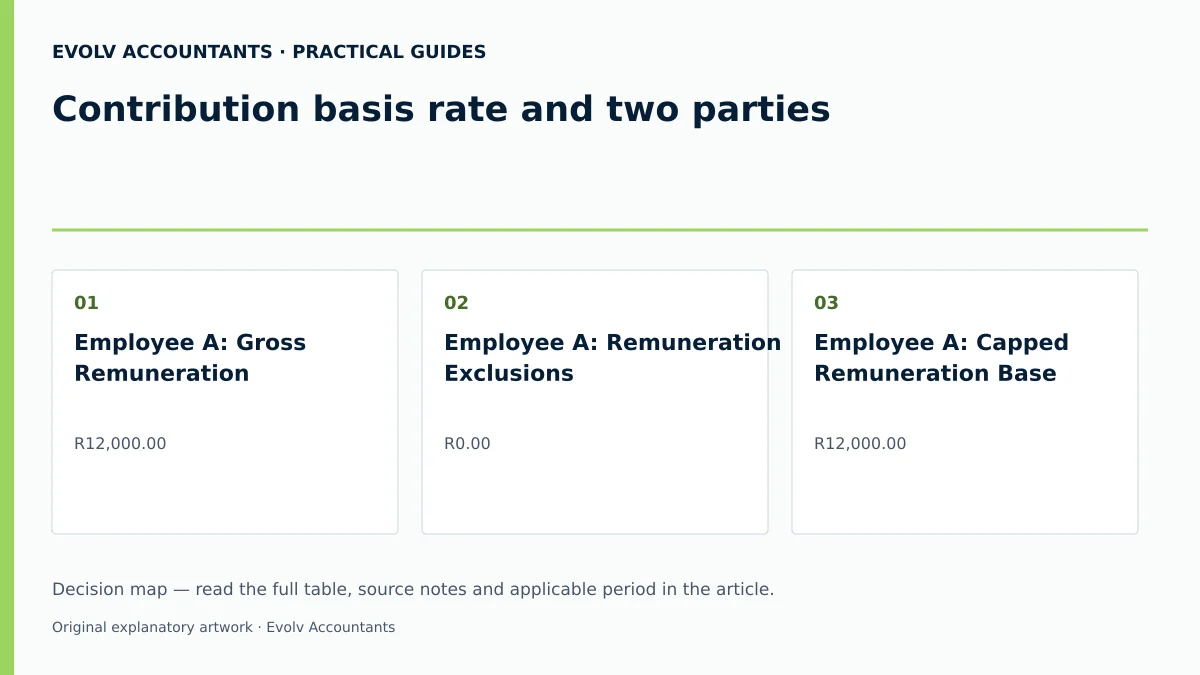
| Employee A: Gross Remuneration | R12,000.00 | Verified salary input 9 | R12,000.00 | Base gross earnings |
| Employee A: Remuneration Exclusions | R0.00 | Less pensions & commission 7 25 | R0.00 | No exclusions |
| Employee A: Capped Remuneration Base | R12,000.00 | Min(R12,000.00, R17,712.00) 1 8 | R12,000.00 | Below R17,712 cap |
| Employee A: Employee Contribution (1%) | R12,000.00 × 1% | Base × 1% 1 2 | R120.00 | R120.00 withheld |
| Employee A: Employer Contribution (1%) | R12,000.00 × 1% | Base × 1% 1 2 | R120.00 | R120.00 employer cost |
| Employee A: Total Monthly Remittance | R120.00 + R120.00 | Employee + Employer 1 3 | R240.00 | R12,000.00 × 2% = R240.00 |
| Employee B: Gross Remuneration | R25,000.00 | Verified salary input 9 | R25,000.00 | Base gross earnings |
| Employee B: Remuneration Exclusions | R0.00 | Less pensions & commission 7 25 | R0.00 | No exclusions |
| Employee B: Capped Remuneration Base | R17,712.00 | Min(R25,000.00, R17,712.00) 1 8 | R17,712.00 | Excess R7,288.00 excluded 8 |
| Employee B: Employee Contribution (1%) | R17,712.00 × 1% | Base × 1% 1 2 8 | R177.12 | Max R177.12 reached 8 |
| Employee B: Employer Contribution (1%) | R17,712.00 × 1% | Base × 1% 1 2 8 | R177.12 | Max R177.12 reached 8 |
| Employee B: Total Monthly Remittance | R177.12 + R177.12 | Employee + Employer 1 3 8 | R354.24 | R17,712.00 × 2% = R354.24 24 |
Reconcile the answer to the underlying records: contribution basis rate
Ledger, EMP201 and PRN Matching
Administrators must execute monthly reconciliations across ledgers, EMP201 declarations, and bank records 8 11:
- Ledger Matching: Ensure employee withholdings equal 1% deductions, and employer contributions equal matching 1% liabilities 1 2.
- EMP201 Reconciliation: Verify total UIF declared on EMP201 returns equals combined payroll portions 8 11.
- PRN Audit: Confirm payments quote the exact 19-digit PRN pre-populated on the EMP201 declaration 8 11 27. Incorrect references cause misallocation and arrears 8 21.
Rounding, Excess Refunds and Annual Reconciliation
- Rounding: Round to two decimal places per employee before aggregating totals.
- Employee Refunds: Excess deductions must be refunded to employees immediately by the employer 28.
- Annual Reconciliation: Employers must submit an EMP501 declaration to SARS annually, reconciling monthly EMP201 declarations with IRP5/IT3(a) certificates 29 30.
- Record Keeping: Remuneration records, registers, and returns must be retained for 5 years 31 32.
Edge cases that change the calculation: two parties
Non-Monthly Payroll Frequencies
For weekly payrolls, contributions must be deducted at intervals coinciding with pay dates 16. Remittances to SARS remain due monthly 16 17. Weekly earnings limits must be proportionally evaluated against the monthly ceiling of R17,712 8 9 16.
Directors and Dual Reporting
- Company Directors: Executive directors receiving remuneration are classified as employees subject to compulsory UIF contributions unless explicitly excluded 26 33.
- Commercial vs Domestic Employers: Commercial employers liable for PAYE/SDL register with SARS to pay contributions 34 35 36.
- Dual Reporting: Employers registered with SARS for payment must still register with the UI Commissioner to submit monthly employee information returns (UI-19 forms) to update the national database 5 10 12 37.
Next steps for UIF employer duties
Step-by-Step Compliance Checklist
SME owners should complete these sequential actions:
- Verify Registration: Confirm registration with SARS for PAYE/SDL (paying UIF to SARS) or UI Commissioner 34 35 36, and ensure UI Commissioner registration for employee database reporting 10 38.
- Audit Tax Profiles: Review contracts to identify independent contractors, short-hour staff (<24 hours/month), and commission-only earners 4 5 6 7.
- Configure Payroll: Set payroll software to apply 1% employee and 1% employer rates, capped at R17,712 monthly (max R177.12 each) 1 2 8.
- Submit EMP201 Declarations: Calculate and submit monthly EMP201 returns to SARS within 7 days following month-end 8 17 27.
- Release Remittances: Pay contributions to SARS by the 7th day of the following month (or preceding business day) using the 19-digit PRN 8 11 17 27.
- Submit UI-19 Declarations: Submit employee information returns to the UI Commissioner via uFiling or payroll upload by the 7th monthly 5 12 39 40.
- Perform EMP501 Reconciliations: Reconcile monthly EMP201 submissions against IRP5/IT3(a) certificates annually 29 30.
- Archive Records: Retain deduction registers, EMP201s, EMP501s, and payment proofs for at least 5 years 31 32.
Frequently Asked Questions
What are the exact percentage rates for employer and employee UIF contributions?
Statutory law requires an employee contribution of 1% of qualifying remuneration and a matching employer contribution of 1%, creating a total combined monthly contribution of 2% remitted to SARS or the Unemployment Insurance Commissioner 1 2 3.
What is the maximum monthly earnings ceiling for UIF calculations?
Effective 1 June 2021, the maximum earnings ceiling for UIF calculations is R17,712 per month (R212,544 annually) 1 8 9. Earnings above this ceiling are excluded, capping the maximum monthly deduction per party at R177.12 (total R354.24) 1 8.
Are independent contractors required to contribute to the UIF?
No. Independent contractors are explicitly excluded from the definition of an employee under the UIC Act and section 57(2) framework, and therefore no UIF deductions apply 5 26.
When is the monthly UIF payment due to SARS?
UIF contributions deducted during a month must be paid to SARS within 7 days after month-end 17 27. If the 7th day falls on a weekend or public holiday, payment must be completed on the last business day prior 17 27.
What penalties apply if an employer fails to pay UIF contributions on time?
If an employer fails to pay contributions by the due date, a 10% penalty is imposed on the unpaid amount, alongside interest calculated at the prescribed rate 21 22. Continued non-compliance constitutes an offence punishable by fines or imprisonment up to two years 12 19 20 41.
Related guides
- When a small business must register for UIF
- UIF contribution ceiling and payroll checks
- Compliance and Regulations: Keeping Your Business on Track
Sources
- Unemployment Insurance Fund | South African Revenue Service
- https://www.sars.gov.za/wp-content/uploads/Ops/Guides/UIF-GEN-01-G01-Guide-for-Employers-in-respect-of-the-Unemployment-Insurance-Fund-External-Guide.pdf
- https://www.labour.gov.za/DocumentCenter/Publications/Unemployment%20Insurance%20Fund/uFiling%20System%20User%20Guide.pdf
- Unemployment Insurance Fund