
When a small business must register for UIF
3 November 2024

Registering a South African small business for the Unemployment Insurance Fund requires verifying specific employer and employee inclusion tests under statutory tax and labour legislation.
Every commercial or domestic employer paying remuneration to at least one qualifying employee who works 24 hours or more per month must register for Unemployment Insurance Fund (UIF) contributions 1 2 3.
Dual registration obligations apply: employers liable for Employees' Tax (Pay-As-You-Earn or PAYE) or Skills Development Levy (SDL), or voluntarily registered with the South African Revenue Service (SARS), must register with SARS for payment of UIF contributions 2 4, while all employers—regardless of SARS registration status—must also register with the Unemployment Insurance Commissioner to submit monthly employee declarations 5 6. Exclusions apply to short-hour staff, public office holders, and public service officers 1 3.
Employer and employee inclusion tests
South African small and medium-sized enterprises (SMEs), including private companies, close corporations, partnerships, and sole proprietors, must distinguish between statutory registration and contribution eligibility 4 7 8. Registration establishes the formal compliance interface with revenue and labour authorities, whereas eligibility dictates the monthly financial liability to deduct and remit contributions 2 9.
Under the governing legislative framework—comprising the Unemployment Insurance Act 63 of 2001 (UI Act) 7 10, the Unemployment Insurance Contributions Act 4 of 2002 (UIC Act) 7 11, and the Tax Administration Act 28 of 2011 (TA Act) 12 13—the current operating period reflects two key statutory effective dates:
- Registration Framework (Effective 1 February 2020): All employers must register with the Unemployment Insurance Commissioner to maintain employee records, irrespective of whether they remit funds to SARS or the UI Commissioner 5 6.
- Maximum Earnings Ceiling (Effective 1 June 2021): The statutory remuneration ceiling for UIF contribution calculations is R17,712 per month (R212,544 per annum) 14 15 16.
Evolv Accountants advises SME leadership that compliance is mandatory from the first day an entity qualifies as an employer paying remuneration to an eligible worker 2 17.
The qualification tests to check: employer
Employer qualification does not depend on business size labels, headcount thresholds, or turnover metrics 2 4. Instead, registration requirements depend on three independent statutory tests:
Remuneration liability test
Any person or entity that pays or is liable to pay any natural person an amount by way of remuneration for services rendered is classified as an employer 2 8 18. This includes representative employers such as public officers of companies, liquidators, managers, or local agents of non-resident employers 19 20. Non-natural persons and independent contractors are expressly excluded from being employees 8 10.
SARS tax portal registration test
An employer MUST register with SARS for UIF contribution payments if the employer meets any of the following criteria:
- Is required to register or deduct PAYE under the Fourth Schedule to the Income Tax Act 2 4 21;
- Is required to pay the Skills Development Levy (SDL) 2 4 21; or
- Has voluntarily registered as an employer with SARS 2 4 21.
Employers who are not required to register with SARS for PAYE or SDL, and have not registered voluntarily, must register directly with the UI Commissioner's office to pay UIF contributions 2 4.
UI Commissioner database registration test
Regardless of where contributions are paid (SARS or UI Commissioner), section 10 of the UIC Act requires every employer to register with the UI Commissioner 5 22. This database captures employment history records used to process employee benefit claims under section 57(2) of the UI Act 10 22.
— Practical point from this guide
Evidence behind the eligibility decision: employee inclusion tests
To establish whether an individual worker must be included in monthly UIF calculations, SME management must evaluate four factual tests against physical records:
| Test | Facts to obtain | Evidence | Applicable source | Result or unresolved question |
|---|---|---|---|---|
| 24-Hour Monthly Threshold Test | Total hours worked by worker per month | Timesheets, attendance registers written employment contract | UIC Act s4(1)(b) 1 3 | Included if >=24 hours/month; excluded if <24 hours/month. |
| Statutory Exclusion Category Test | Employment sector and public officer status | Appointment letters, public organ founding documents | UIC Act s4(1) 1 3 | Excluded if public service officer or designated public office holder |
| Common-Law Employee Status Test | Nature of service agreement (employee vs independent contractor) | Contract for service vs contract of service, invoices, tax status | UIC Act s1 8 10 | Included if common-law employee; excluded if independent contractor |
| Remuneration Structure Test | Total gross pay minus statutory exclusions (pension, commission) | Payroll ledgers, payslips, commission breakdown schedules | UIC Act s1 14 19 23 | Included; cap calculations at R17,712/month ceiling. |
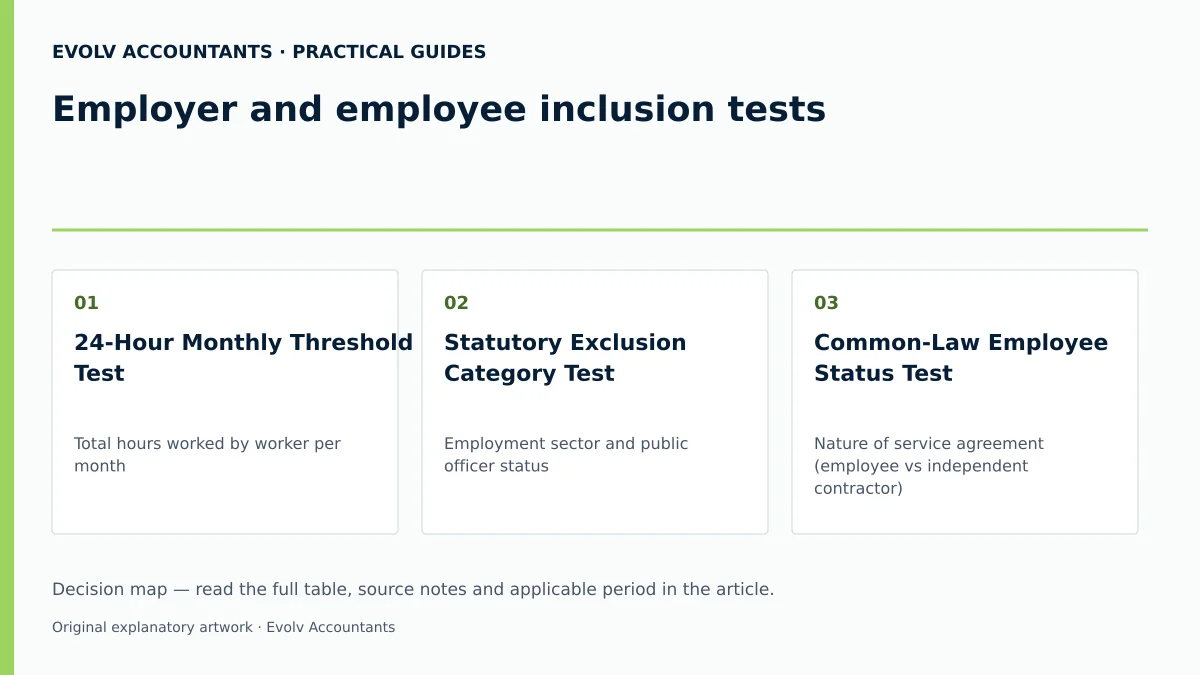
Each inclusion test relies on specific documentation overseen by designated officers:
- Monthly Hours Record: Verified via signed timesheets and payroll logs by the Payroll Administrator 1 3.
- Contractual Status: Verified via written employment agreements and independent contractor assessments by the HR Manager or Public Officer 8 10.
- Remuneration Breakdown: Verified via itemised pay slips excluding pension allowances, statutory gross income exclusions, and commission by the Financial Accountant 19 23.
A qualifying case and an excluded case: employer
To illustrate the practical application of employer and employee inclusion tests, consider the following reproducible hypothetical fact patterns for a South African SME, Apex Logistics (Pty) Ltd.
Scenario A: Qualifying commercial employer and included staff
Apex Logistics (Pty) Ltd employs two staff members:
- Operations Director: Earns a monthly gross salary of R30,000 for 160 hours worked per month.
- Workshop Cleaner: Earns a monthly gross wage of R4,500 for 60 hours worked per month.
Inclusion Analysis:
- Employer Assessment: Apex Logistics is registered for PAYE with SARS. Consequently, it must pay UIF contributions directly to SARS via its monthly EMP201 declaration 2 4 15. It must also register with the UI Commissioner to submit monthly employee declarations 5 6.
- Operations Director: Works >=24 hours per month 1 3. Remuneration exceeds the R17,712 monthly ceiling 14 15 16. The 1% employee deduction is capped at R177.12, and the 1% employer contribution is capped at R177.12, totalling a R354.24 monthly contribution 14 15.
- Workshop Cleaner: Works >=24 hours per month 1 3. Remuneration (R4,500) is below the ceiling 14 15. The 1% employee deduction is R45.00, and the 1% employer contribution is R45.00, totalling a R90.00 monthly contribution 14 24.
Scenario B: Excluded worker categories
Apex Logistics also engages two additional individuals:
- External IT Specialist: Engaged under an independent contract for services, issuing monthly business invoices for network maintenance.
- Ad-Hoc Event Worker: Hired for 12 hours during a single weekend to assist with office relocation, receiving R1,200 total pay.
Exclusion Analysis:
- External IT Specialist: Excluded under section 1 of the UIC Act as an independent contractor 8 10. No UIF deductions or contributions apply.
- Ad-Hoc Event Worker: Excluded under section 4(1)(b) of the UIC Act because total employment hours with Apex Logistics are under 24 hours in the calendar month 1 3. No UIF liability arises.
What changes the answer: employee inclusion tests
An initial determination of UIF liability is not permanent. Evolv Accountants recommends ongoing reassessments when operational or contractual changes occur:
Fluctuations in working hours
If a casual or seasonal worker's monthly hours increase from 18 hours to 24 hours or more in a given calendar month, the worker transitions immediately from exempt status to an included employee 1 3. The employer must deduct 1% from their remuneration and match it with a 1% employer contribution for that period 14 24.
Remuneration restructuring and commission shifts
Remuneration for UIF purposes excludes commission payments, retirement allowances, and pensions 19 23. If an employee's pay structure shifts from a fixed salary to pure commission, the portion constituting commission must be removed from the UIF wage base 19 23. If earnings cross the R17,712 per month ceiling, contributions must be capped at R177.12 each for the employer and employee 14 15 16.
Corporate restructuring and cessation
If a company changes ownership, appoints a new Public Officer, or changes registered details, SARS must be notified within 21 business days 20 25. If an employer ceases business or stops paying remuneration, written notice and final returns must be rendered within 14 days 26 27.
SARS registration status shifts
If a business small enough to pay UIF directly to the UI Commissioner grows and becomes liable for PAYE or SDL, it must migrate its contribution payment channel to SARS 2 4 6. Conversely, if an employer deregisters from SARS with no prospect of future PAYE liability, payment duties shift to the UI Commissioner 6.
Next steps for UIF employer duties
SME directors and owners should execute the following checked action sequence to ensure full legal compliance:
- Audit Monthly Worker Hours: Review payroll registers to separate staff working 24 hours or more per month from exempt casual workers 1 3.
- Confirm Statutory Tax Status: Check whether the entity is registered or liable for PAYE or SDL to determine whether UIF payments belong to SARS or the UI Commissioner 2 4.
- Complete UI Commissioner Registration: Register the entity with the Unemployment Insurance Commissioner to establish portal access for monthly declarations 5 6.
- Configure Payroll Parameters: Ensure payroll systems calculate a 1% employee deduction and 1% employer contribution, capped strictly at R177.12 per month per employee (based on the R17,712 ceiling) 14 15 28.
- Remit Monthly Payments On Time: Pay total 2% contributions to SARS (or the UI Commissioner) within 7 days following the end of the month, adjusting for weekends and public holidays 29 30.
- Submit Monthly UI-19 Declarations: Submit accurate employee declarations to the UI Commissioner by the 7th of every month via uFiling or electronic payroll file upload 10 31 32.
- Perform Annual Reconciliations: Complete and submit the annual EMP501 reconciliation statement as required by SARS 27 33.
- Maintain Five-Year Records: Retain all remuneration registers, payslips, and declaration receipts for at least 5 years 34 35.
Frequently Asked Questions
What is the maximum remuneration ceiling for monthly UIF calculations?
Effective 1 June 2021, the statutory maximum remuneration ceiling for UIF contributions is R17,712 per month or R212,544 annually 14 15 16. For employees earning above this ceiling, contributions are calculated strictly on R17,712, resulting in a maximum employee deduction of R177.12 per month and a matching employer contribution of R177.12 (totalling R354.24 per month) 14 15.
Does an employer registered for PAYE pay UIF contributions to SARS or the UI Commissioner?
An employer required to register for PAYE or SDL with SARS, or voluntarily registered with SARS, must remit all UIF payments directly to SARS using the monthly EMP201 declaration 2 4 15. However, the employer must also register with the UI Commissioner to submit monthly employee information returns (UI-19) 5 32.
Are independent contractors required to contribute to the UIF?
No. Independent contractors are explicitly excluded from the definition of an "employee" under section 1 of the UIC Act and section 57(2) of the UI Act 8 10. Remuneration paid to bona fide independent contractors under a contract for services is not subject to UIF deductions or employer contributions 8 10.
What is the deadline for submitting monthly UIF payments and declarations?
UIF payments to SARS must be received within 7 days after the end of the calendar month 29 30. If the 7th falls on a Saturday, Sunday, or public holiday, payment is due on the last business day prior 29 30. Monthly employee declarations (UI-19) must be submitted to the UI Commissioner by no later than the 7th of every month 10 32.
What penalties apply if an employer fails to deduct or pay UIF contributions?
An employer who fails to pay contributions on time is subject to a statutory penalty of 10% on the unpaid amount 36, as well as interest calculated at the prescribed rate from the day following the due date until payment is received 36 37. Failure to submit returns or keep records constitutes an offence under Chapter 17 of the Tax Administration Act, carrying potential fines or imprisonment for up to two years 32 38 39 40. Ask Evolv about employer and employee inclusion tests. Share the relevant records so the support required can be scoped.
Related guides
- Registering an employer with the UIF
- Calculating employer and employee UIF contributions
- Compliance and Regulations: Keeping Your Business on Track
Sources
- Unemployment Insurance Fund | South African Revenue Service
- https://www.sars.gov.za/wp-content/uploads/Ops/Guides/UIF-GEN-01-G01-Guide-for-Employers-in-respect-of-the-Unemployment-Insurance-Fund-External-Guide.pdf
- https://www.labour.gov.za/DocumentCenter/Publications/Unemployment%20Insurance%20Fund/uFiling%20System%20User%20Guide.pdf