
UIF contribution ceiling and payroll checks
12 May 2026

Calculating Unemployment Insurance Fund contributions requires applying statutory rates to eligible remuneration up to the prescribed maximum monthly ceiling.
Under South African tax legislation administered by the South African Revenue Service (SARS) and the Department of Employment and Labour, employers must deduct a 1% Unemployment Insurance Fund (UIF) contribution from employee remuneration and match it with a 1% employer contribution, subject to the statutory monthly earnings ceiling 1 2. Where employee earnings exceed the maximum monthly threshold, contributions are capped at 1% of the statutory ceiling for the employee and 1% for the employer 1 3.
Employers are legally required to submit monthly EMP201 declarations and make full payments within seven days following the end of each calendar month to avoid statutory penalties and interest 3 4 5 6.
Current ceiling and capped contribution example
Statutory Purpose and Definition of Capped Contributions
The Unemployment Insurance Fund provides short-term financial relief to workers facing unemployment, illness, maternity, adoption, or parental leave, as well as benefits to dependants of deceased contributors under the Unemployment Insurance Act 63 of 2001 (UI Act) and the Unemployment Insurance Contributions Act 4 of 2002 (UIC Act) 7 8 9. Statutory contributions are calculated as a percentage of gross remuneration paid or payable by an employer 1 2.
To prevent disproportionate burdening of higher earners and to standardize fund liability, the law imposes a maximum remuneration ceiling 1 3 10.
The statutory maximum earnings ceiling is gazetted by the Minister of Finance 10. Effective from 1 June 2021, the maximum earnings ceiling is R17,712.00 per month, which translates to R212,544.00 per annum 1 3 11. For any employee earning above this threshold, the monthly contribution calculation is capped at R17,712.00 1 3.
Consequently, the maximum statutory employee deduction is capped at R177.12 per month (1% of R17,712.00), and the employer's matching contribution is capped at R177.12 per month (1% of R17,712.00), yielding a combined maximum monthly contribution of R354.24 per employee 1 2 3.
Accounting Treatment versus Tax Compliance Requirements
From a financial accounting perspective, payroll processing requires splitting the total 2% UIF contribution into two distinct accounting entries:
- Employee Deductions (Payroll Liability): The 1% portion withheld from the employee's gross remuneration is credited to a statutory liability account (SARS/UIF Payable) on the balance sheet 1 2 12.
- Employer Contribution (Operating Expense): The 1% matching contribution is recognised as an operational payroll expense on the income statement and credited to the statutory liability account 1 2.
For tax compliance, SARS acts as the primary collection authority for employers registered for Pay-As-You-Earn (PAYE) or Skills Development Levy (SDL) 13 14 15. Contributions withheld and employer liabilities are reported collectively on the monthly EMP201 payment declaration and remitted as a single liability within seven days after month-end 3 4 5 16.
Inputs rates periods and exclusions: current ceiling
Primary Rates and Historical Statutory Thresholds
Determining correct UIF liabilities requires applying verified statutory rates to eligible remuneration bases across defined legislative periods 1 11. The statutory contribution rates established under Section 6 of the UIC Act are 1 2:
- Employee Contribution Rate: 1.00% of remuneration paid or payable 1 2.
- Employer Contribution Rate: 1.00% of remuneration paid or payable 1 2.
- Total Combined Rate: 2.00% of remuneration paid or payable 1 2.
The monthly and annual maximum earnings ceilings established by the Minister of Finance across primary legislative updates include 10 11:
- Effective 1 April 2002: R8,099.00 per month (R97,188.00 annually) 10 11.
- Effective 1 April 2003: R8,836.00 per month (R106,032.00 annually) 11.
- Effective 1 October 2005: R10,966.00 per month (R131,592.00 annually) 11.
- Effective 1 July 2006: R11,662.00 per month (R139,944.00 annually) 11.
- Effective 1 February 2008: R12,478.00 per month (R149,736.00 annually) 11.
- Effective 1 October 2012: R14,872.00 per month (R178,464.00 annually) 1 11.
- Effective 1 June 2021: R17,712.00 per month (R212,544.00 annually) 1 3 11 17.
Remuneration Definition and Statutory Exclusions
"1% of the remuneration paid" 1 is deducted from employee earnings, where remuneration is defined in Paragraph 1 of the Fourth Schedule to the Income Tax Act 11 18. Under Section 1 of the UIC Act, specific earnings are statutory exclusions and must be deducted from gross remuneration before calculating UIF contributions 18 19:
- Payments by way of pension, superannuation allowance, or retiring allowance 18 19.
- Lump sum amounts contemplated in paragraphs (a), (cA), (d), (e), or (eA) of the definition of gross income in Section 1 of the Income Tax Act 18 19.
- Remuneration paid by way of commission 18 19.
Section 4 of the UIC Act explicitly excludes specific categories of workers from contributing to the fund 20 21 22:
- Employees who work less than 24 hours a month for a specific employer 20 22.
- Public service employees in the national or provincial spheres of government as defined in the Public Service Act, 1994 20 22.
- Specified public office holders, including the President, Deputy President, Ministers, Members of Parliament, Premiers, MECs, municipal councillors, and traditional leaders 2 20 22.
Explicitly Identified Missing Inputs
Any potential changes or updates to the statutory ceiling enacted by government notices after the 1 June 2021 revision (R17,712.00 per month) are not contained in the provided primary evidence documents 1 11 17. Employers must verify current gazetted notices before finalising payroll runs 10 11.
— Practical point from this guide
The calculation in a worked example: capped contribution example
Step-by-Step Payroll Calculation Methodology
To ensure accurate payroll processing, employers must follow a three-step statutory calculation process 11 19:
- Determine Total Remuneration: Calculate gross employee earnings under Paragraph 1 of the Fourth Schedule 11 18.
- Apply Statutory Exclusions: Deduct exempt income components, such as pensions, retiring allowances, qualifying lump sums, and commission payments 18 19.
- Apply Capped Threshold and Calculate Percentage: Compare net eligible remuneration against the monthly ceiling of R17,712.00 1 3 11. Apply the 1% employee rate and 1% employer rate to the lesser of net remuneration or R17,712.00 1 2 3.
Reproducible Worked Example and Verification Matrix
Consider two hypothetical employees in a South African small business during a monthly pay period:
- Employee A: Earns a monthly basic salary of R10,000.00 with no exclusions. Because earnings are below the R17,712.00 ceiling, contributions apply to the full R10,000.00 1 3. The employee deduction is R100.00 (1%), and the employer contribution is R100.00 (1%), totalling R200.00 1 2.
- Employee B: Earns a monthly basic salary of R25,000.00 with no exclusions. Because earnings exceed the R17,712.00 ceiling, the calculation base is capped at R17,712.00 1 3. Excess earnings of R7,288.00 are excluded from UIF calculations 3. The employee deduction is capped at R177.12 (1% of R17,712.00), and the employer contribution is capped at R177.12 (1% of R17,712.00), totalling R354.24 1 2 3.
| Input | Value or verified-source placeholder | Formula or step | Result | Independent check |
|---|---|---|---|---|
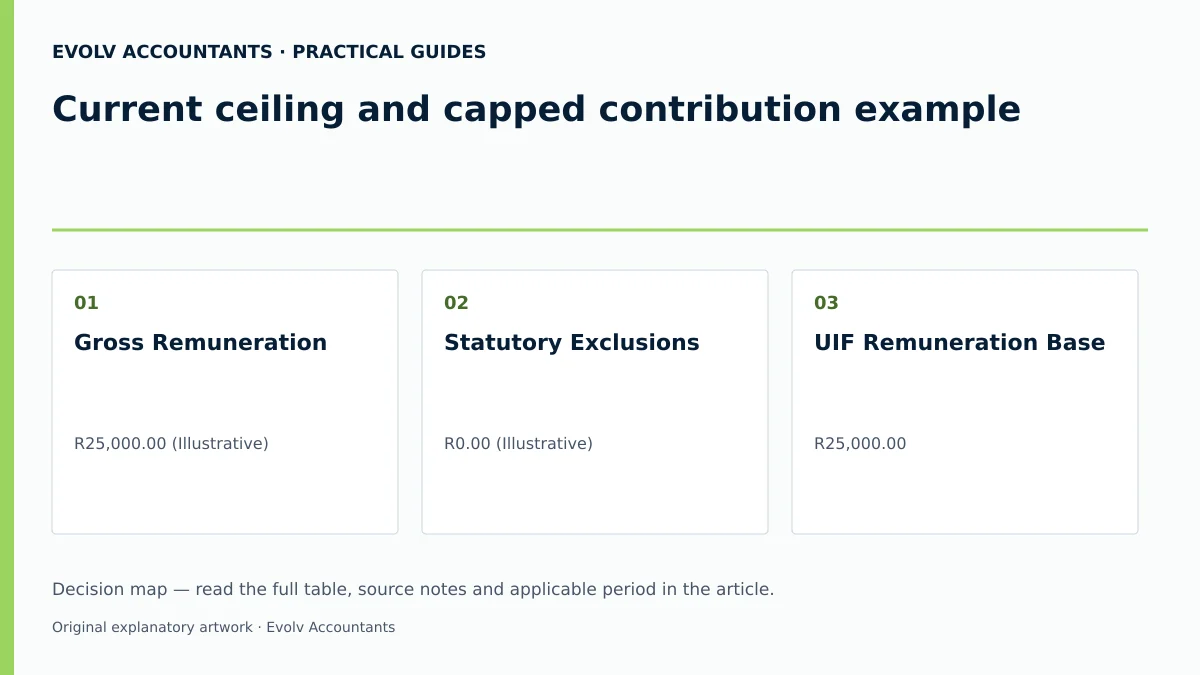
| Gross Remuneration | R25,000.00 (Illustrative) | Gross monthly salary before deductions | R25,000.00 | Verified against employment contract |
| Statutory Exclusions | R0.00 (Illustrative) | Subtract pensions, commission & lump sums 18 19 | R0.00 | Confirm wage components against UIC Act definitions 18 19 |
| UIF Remuneration Base | R25,000.00 | Gross Remuneration minus Statutory Exclusions 19 | R25,000.00 | Verify Fourth Schedule remuneration definition 11 18 |
| Statutory Monthly Ceiling | R17,712.00 per month 1 3 11 | Minister of Finance gazetted threshold 10 11 | R17,712.00 | SARS External Guide UIF-GEN-01-G01 effective 1 June 2021 1 17 |
| Capped Calculation Base | R17,712.00 | Minimum(UIF Remuneration Base, Statutory Ceiling) 1 3 | R17,712.00 | Excess R7,288.00 correctly excluded from base 3 |
| Employee Contribution | 1.00% 1 2 | Capped Base × 1% 1 2 | R177.12 | Cap check: Max employee deduction R177.12 3 |
| Employer Contribution | 1.00% 1 2 | Capped Base × 1% 1 2 | R177.12 | Match check: Equal to employee deduction 1 2 |
| Total Monthly Contribution | 2.00% 1 2 | Employee Contribution + Employer Contribution 1 2 | R354.24 | Total cap check: Max monthly liability R354.24 2 3 |
Reconcile the answer to the underlying records: current ceiling
Monthly EMP201 Payment Reconciliation
Employers must implement systematic internal controls to reconcile payroll deductions with monthly tax returns before making payments to SARS 3 16.
- Calculate total gross payroll and apply statutory exclusion filters (removing commission and pension allowances) to establish the net UIF remuneration base 18 19.
- Apply individual employee capping rules, ensuring no single employee deduction exceeds R177.12 per month 2 3.
- Sum individual employee deductions and verify that the company's matching employer contribution exactly equals the total employee deductions 1 2.
- Request the monthly EMP201 declaration via eFiling or e@syFile, ensuring total PAYE, SDL, and UIF liabilities are pre-populated with a unique 19-digit Payment Reference Number (PRN) 3 16.
- Remit full payment to SARS using online banking, EFT, or approved banking channels within seven days after month-end 4 5 16.
- Confirm payment processing by verifying bank receipts against the PRN allocated to the monthly EMP201 return 3 16.
- Archive payroll summary sheets, EMP201 receipts, and bank payment confirmations in accessible records for a mandatory minimum period of 5 years 23 24.
Annual EMP501 Reconciliation and Payroll Audit Trail
At the close of each tax year, employers are legally obligated to submit an Employer Reconciliation Declaration (EMP501) 25 26. The EMP501 reconciles total monthly UIF contributions declared and paid across twelve EMP201 returns against the aggregate UIF values declared on individual employee tax certificates (IRP5/IT3(a)) 25 26. Discrepancies between EMP201 payments and IRP5 totals trigger audit queries, estimated assessments, and potential administrative penalties 6 25 27.
Edge cases that change the calculation: capped contribution example
Non-Monthly Pay Frequencies and Variable Pay Intervals
When employees are paid weekly or fortnightly, employers must deduct UIF contributions at intervals matching pay dates 12. However, total contributions remain payable to SARS on a monthly basis 12. Weekly or fortnightly thresholds must be pro-rated against the monthly ceiling of R17,712.00 to prevent over-deduction or under-deduction across payroll cycles 3 12.
Specific Employment Categories and Multiple Employers
- Under 24 Hours Per Month: Workers employed for less than 24 hours in a calendar month with a specific employer are exempt from UIF contributions 20 22.
- Commission-Only Earnings: Employees whose remuneration consists entirely of commission payments are excluded from UIF deductions 18 19.
- Multiple Concurrent Employers: Where an employee works for more than one employer simultaneously, each employer is legally considered a separate entity and must independently apply the 1% contribution rate and the R17,712.00 ceiling to remuneration paid by that specific employer 1 2 28.
- Company Directors and Executive Officers: Directors receiving remuneration are treated as employees for UIF purposes under Fourth Schedule definitions, unless specific statutory exemptions apply 18 28.
- Dual SARS and UI Commissioner Registrations: Employers liable for PAYE or SDL must register and pay UIF contributions to SARS 13 14 15. Employers exempt from PAYE/SDL registration must register and pay directly to the UI Commissioner 13 15 29. Crucially, all employers—regardless of where they pay—must submit monthly employee declarations (UI-19 forms or uFiling declarations) to the UI Commissioner to keep the national employee database up to date 29 30 31.
Next steps for UIF employer duties
Framework for Statutory Compliance
To ensure compliance with South African labor and tax legislation, SME employers should adopt a structured monthly compliance routine:
- Conduct pre-payroll reviews to ensure commission earnings and exempt lump sums are excluded from UIF bases 18 19.
- Verify that payroll software accurately caps employee deductions at R177.12 and total monthly contributions at R354.24 per individual 1 3.
- Submit EMP201 declarations and release payments prior to the 7th day of each month 4 5.
- Update employee status details on uFiling or via UI-19 submissions monthly 29 30 31.
Distinguishing Law, Regulator Guidance, and Evolv Recommendations
Understanding statutory duties requires distinguishing legislative mandates, administrative guidance, and professional advisory practice:
- Law (Legislation): Governed by the Unemployment Insurance Act, 2001, the Unemployment Insurance Contributions Act, 2002, the Income Tax Act, 1962 (Fourth Schedule), and the Tax Administration Act, 2011 7 9. Legislation imposes mandatory registration, sets contribution duties, dictates 10% late payment penalties, and establishes criminal prosecution for non-compliance 1 6 31 32 33.
- Regulator Guidance (SARS & UI Commissioner): Issued via SARS External Guide UIF-GEN-01-G01 and the uFiling System User Guide 17 34 35. Regulator guides specify operational workflows for EMP201 filings, PRN payment linking, eFiling procedures, and UI-19 reporting 3 16 30 31.
- Evolv Recommendations: Practical compliance strategies developed for South African SMEs by Evolv Accountants (providing bookkeeping, accounting, tax advisory, payroll, and corporate statutory compliance). Evolv recommends monthly payroll exception checks, automated ceiling verification, and routine cross-reconciliations between eFiling ledger balances and internal accounting records.
Frequently Asked Questions
What is the current statutory UIF ceiling and maximum monthly deduction?
Effective 1 June 2021, the statutory maximum remuneration ceiling is R17,712.00 per month (R212,544.00 per annum) 1 3 11. The maximum employee deduction is capped at R177.12 per month (1%), matched by an employer contribution of R177.12 (1%), giving a maximum total monthly contribution of R354.24 per employee 1 2 3.
When must monthly UIF contributions be paid to SARS?
Contributions must be paid within seven days after the end of the calendar month during which deductions were made 4 5. If the 7th day falls on a Saturday, Sunday, or public holiday, payment is due on the last business day prior to the weekend or holiday 4 5.
Which earnings are excluded from UIF remuneration calculations?
Under Section 1 of the UIC Act, excluded earnings include pension allowances, superannuation or retiring allowances, qualifying gross income lump sums, and payments made purely by way of commission 18 19.
Must employee details be submitted to the UI Commissioner if paying SARS?
Yes. Employers paying UIF to SARS via EMP201 must still submit monthly employee declarations (UI-19 forms or uFiling upload files) directly to the UI Commissioner to update the national employee benefit registry 29 30 31.
What penalties apply if an employer fails to pay UIF contributions on time?
A default penalty of 10% is automatically charged on unpaid contribution balances 6. In addition, interest is levied at the prescribed rate under the Income Tax Act from the due date until full payment is received 33. Ask Evolv about current ceiling and capped contribution example. Share the relevant records so the support required can be scoped.
Related guides
- When a small business must register for UIF
- UIF obligations for part time employees
- Compliance and Regulations: Keeping Your Business on Track