
UIF obligations for part time employees
15 June 2026

UIF compliance for part-time workers requires South African employers to register, deduct contributions, and submit monthly declarations for staff working 24 hours or more per month.
South African small and medium-sized enterprises (SMEs) employing part-time personnel must determine Unemployment Insurance Fund (UIF) applicability based strictly on monthly hours worked and remuneration structure 1 2. While full-time staff automatically fall within the statutory net, part-time staff qualify as contributors once they cross the statutory 24-hour monthly threshold with a specific employer 1 2.
Employers bear the legal duty to deduct the employee's contribution, match it with an employer contribution, declare employee employment details, and remit payments to either the South African Revenue Service (SARS) or the Unemployment Insurance Commissioner within prescribed deadlines 3 4 5 6.
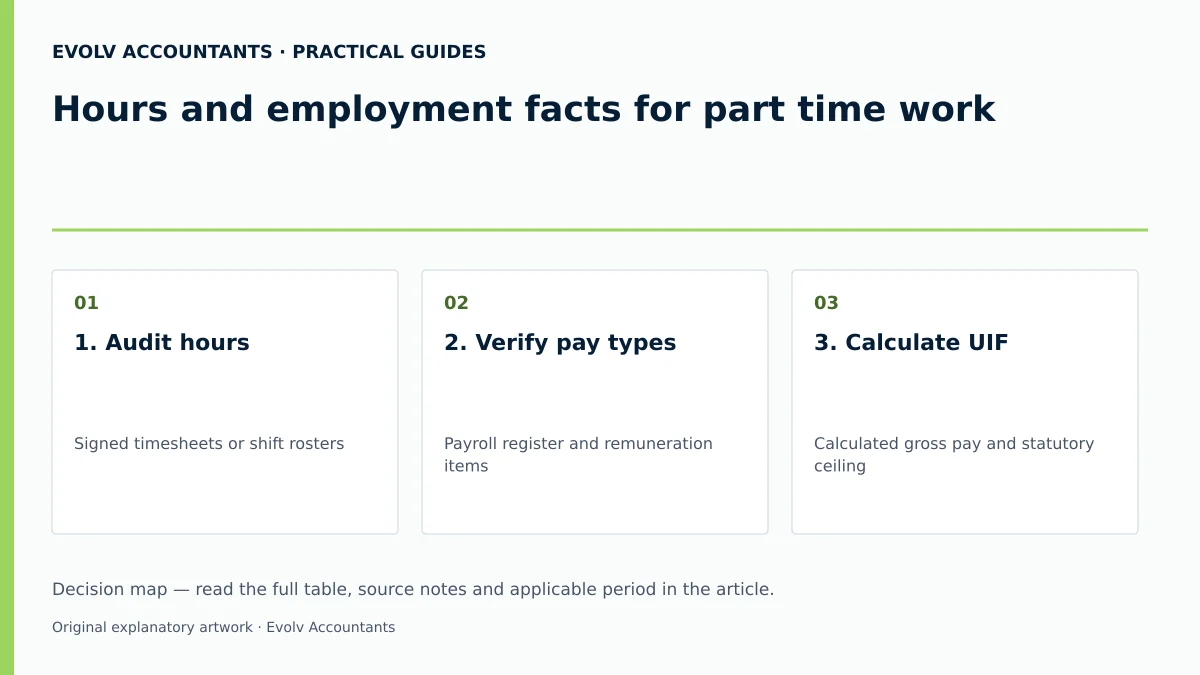
Hours and employment facts for part time work
For South African SMEs navigating payroll compliance, managing part-time staff requires a clear distinction between statutory law, regulatory guidance, and practical advisory recommendations.
— Practical point from this guide
Legal framework and jurisdiction
The statutory framework governing unemployment insurance in South Africa is established under two primary statutes: the Unemployment Insurance Act, 2001 (UI Act) 7 8 and the Unemployment Insurance Contributions Act, 2002 (UIC Act) 7 8. Under section 4 and section 5 of the UIC Act, contributions are compulsory for all eligible employers and employees across South Africa 2 9. Statutory exclusions are limited 1 2.
Specifically, an employee is excluded from contributing to the UIF if he or she "is employed by the employer for less than 24 hours a month" 1. Additional exclusions apply to national and provincial public servants, as well as specified public office holders 1 2.
Regulator guidance versus professional recommendations
Regulator guidance issued by SARS (such as external guide UIF-GEN-01-G01) 8 10 and the Department of Employment and Labour (via uFiling portal documentation) 11 12 establishes the technical mechanics of registration, deduction, and reporting. While statutory law establishes the obligation to pay and report 7 9, regulator guidance clarifies the operational channels 13 14.
Evolv Accountants recommends that SMEs establish rigorous monthly time-tracking systems to monitor part-time hours continuously, ensuring that temporary fluctuations above 24 hours per month are captured immediately to prevent non-compliance penalties 15.
Applicable period and contribution rates
For the current tax period, contribution calculations are governed by statutory thresholds effective from 1 June 2021 4 16. The total contribution payable is 2% of the employee's qualifying remuneration 4 17. This is split equally:
- Employee deduction: 1% of remuneration, withheld by the employer 4 17.
- Employer contribution: 1% of remuneration, paid from employer funds 4 17.
The statutory maximum earnings ceiling is R17 712 per month (or R212 544 annually) 4 16 18. For part-time employees earning above R17 712 in a given month, the 1% deduction and 1% contribution are capped at R177,12 each per month, yielding a combined maximum monthly contribution of R354,24 18.
Prepare the information and authority: hours
Fulfilling UIF duties for part-time workers requires assembling specific primary evidence and establishing appropriate administrative authority before processing payroll.
Required documentation and inputs
SMEs must gather and verify the following operational inputs for each part-time worker:
- Employment contract and time records: Documented working hours, shift rosters, or signed timesheets establishing the total hours worked per calendar month 1 19.
- Employee identification details: Certified copies of South African identity documents or valid foreign passport details, alongside personal address details 20 21.
- Remuneration breakdowns: Payslips or payroll reports categorising gross pay, basic wages, allowances, and excluded pay types 19 22.
- Registration references: The enterprise's SARS PAYE reference number or UI Commissioner reference number 3 13 23.
Defining qualifying remuneration
For UIF purposes, statutory remuneration is defined in accordance with Paragraph 1 of the Fourth Schedule to the Income Tax Act, subject to specific exclusions under Section 1 of the UIC Act 16 22 24. Qualifying remuneration includes basic salary, wages, over-time pay, and taxable allowances 16 22. However, the UIC Act explicitly excludes the following from UIF remuneration:
- Pension, superannuation, or retiring allowances 22 24.
- Lump-sum payments contemplated in paragraphs (a), (cA), (d), (e), or (eA) of the definition of gross income under the Income Tax Act 22 24.
- Earnings paid purely by way of commission 22 24.
Administrative permissions and delegation
To file monthly declarations and make payments on behalf of an SME, designated internal staff or external tax practitioners require formal authority 25 26. On the uFiling system, a commercial employer can assign delegate permissions to a third party, allocating specific roles such as "Capture Declarations", "Submit Declarations", "Pay", or "Administrator" 26. On SARS eFiling, third-party tax practitioners require a valid Special Power of Attorney (such as Form TPPOA) to act on the employer's tax profile 27.
Complete the task step by step: employment facts for part time work
Executing UIF compliance for part-time employees involves a structured, sequential workflow matching statutory and portal requirements 3 13 18 28.
Step 1: Assess the monthly 24-hour threshold
At the close of each payroll cycle, review the time records for every part-time worker 1 19. If an employee worked fewer than 24 hours in that calendar month, no UIF deduction is made and no employer contribution is due for that specific person 1 2. If the employee worked 24 hours or more, proceed to calculate contributions 1 4.
Step 2: Determine the correct registration and payment destination
Identify whether the business is required to pay UIF contributions to SARS or directly to the UI Commissioner 3 5 13:
- SARS payment path: Mandatory if the employer is registered or liable for Pay-As-You-Earn (PAYE) employees' tax, Skills Development Levy (SDL), or has voluntarily registered with SARS 3 5 13.
- UI Commissioner payment path: Applicable only if the employer is NOT liable for PAYE or SDL and has NOT voluntarily registered with SARS 3 5 29.
Note on employee database declarations: Regardless of whether UIF contributions are paid to SARS or the UI Commissioner, all employers must submit monthly employee declarations (UI-19 information) to the UI Commissioner to update the national worker database 28 29 30.
Step 3: Calculate employee deduction and employer contribution
Calculate the qualifying remuneration for each eligible part-time worker 16 22:
- Calculate gross remuneration less excluded amounts (e.g., commission) 22 24.
- Apply the monthly remuneration ceiling of R17 712 4 18.
- Multiply qualifying remuneration (up to R17 712) by 1% to determine the employee deduction 4 17.
- Multiply qualifying remuneration (up to R17 712) by 1% to determine the employer contribution 4 17.
Step 4: Submit monthly return and remit payment by the 7th
- For SARS-registered employers: Submit the Monthly Employer Declaration (EMP201) via SARS eFiling, e@syFile, or branch channels 18 31. The EMP201 pre-populates a 19-digit Payment Reference Number (PRN) 18 31. Remit payment within seven days after the end of the month 6 32. If the 7th falls on a weekend or public holiday, payment must be received by the last business day prior 6 32.
- For UI Commissioner-registered employers: File monthly declarations and pay online via the uFiling portal by the 7th of the month 11 14.
Step 5: Submit UI-19 employee details to the UI Commissioner
Submit the monthly UI-19 declaration detailing employee names, ID numbers, hours worked, gross salary, and employment start/termination dates to the UI Commissioner via uFiling or electronic file upload by the 7th of every month 11 21 28 30.
Reproducible hypothetical example
To illustrate the monthly calculation, consider a small business employing two part-time workers in a calendar month:
- Employee A (Part-time Assistant):
- Hours worked in month: 18 hours.
- Gross wages: R1 800.
- Calculation: Excluded from UIF because monthly hours are under 24 hours 1 2. Employee deduction = R0.00; Employer contribution = R0.00.
- Employee B (Part-time Specialist):
- Hours worked in month: 60 hours.
- Gross remuneration: R20 000 (basic salary).
- Calculation: Qualifies for UIF (worked ≥ 24 hours) 1 2. Remuneration exceeds the monthly ceiling of R17 712 4 18. Capped remuneration = R17 712 4 18.
- Employee deduction (1% of R17 712) = R177,12 4 18.
- Employer contribution (1% of R17 712) = R177,12 4 18.
- Total monthly UIF remittance for Employee B = R354,24 4 18.
Check the result against the evidence: hours
Submission of a payroll file or online return does not guarantee statutory completion; employers must verify processing against independent system evidence 18 33 34.
Primary verification evidence
Employers must confirm task completion by inspecting the following official records:
- SARS eFiling PRN payment matching: Verify that the 19-digit PRN on the EMP201 matches the electronic funds transfer receipt and reflects as fully settled on the SARS account statement 18 31.
- uFiling return status: In the uFiling Declarations Manager, inspect the employer returns dashboard to verify that the return status displays as "Submitted" and payment status displays as "PAID" 33 35.
- UI-19 database confirmation: Confirm that employee records reflect active status and accurate monthly hours on the UI Commissioner database 11 36.
- Bi-annual EMP501 reconciliation: Submit the Employer Reconciliation Declaration (EMP501) bi-annually to reconcile monthly EMP201 declarations against employee IRP5/IT3(a) tax certificates 34 37.
Statutory record-keeping mandate
Under Paragraph 14(1) of the Fourth Schedule to the Income Tax Act and Chapter 4 of the Tax Administration Act, employers are legally obligated to retain all payroll registers, time logs, remuneration records, and UIF declarations for a minimum period of 5 years from the return submission date 19 38. These records must be readily accessible for inspection by SARS or Department of Employment and Labour officials 38.
Handle exceptions and unresolved cases: employment facts for part time work
Part-time employment frequently involves complex operational edge cases that require specialised handling 1 13 15.
Fluctuating monthly hours
When a part-time worker's hours fluctuate above and below 24 hours in consecutive months:
- In months where hours reach or exceed 24 hours, contributions are mandatory 1 2.
- In months where hours fall below 24 hours, no UIF contribution is deducted or paid 1 2.
- The monthly UI-19 declaration submitted to the UI Commissioner must accurately reflect the actual hours worked and qualifying remuneration for each specific month 11 21 28.
Employees with multiple part-time employers
The statutory 24-hour exemption threshold applies independently to each employer 1 2. If a worker is employed by two separate businesses, working 15 hours per month at Company X and 30 hours per month at Company Y:
- Company X does not deduct or pay UIF because hours with Company X are under 24 hours 1 2.
- Company Y must deduct 1% and contribute 1% because hours with Company Y equal or exceed 24 hours 1 2 4.
Non-compliance interest, penalties, and offences
Failing to fulfill UIF obligations triggers severe administrative and statutory penalties:
- Default penalty: A mandatory 10% penalty is imposed on late or unpaid contributions under Section 13 of the UIC Act 15.
- Interest: Interest accrues on outstanding amounts at the statutory prescribed rate from the due date until full payment is received 39.
- Estimated assessments: SARS may issue estimated contribution assessments if returns are missing or inaccurate 40.
- Criminal liability: Under Chapter 17 of the Tax Administration Act, failing to deduct, pay, or declare UIF contributions constitutes an offence punishable by a fine or imprisonment for up to two years 30 41 42 43.
Next steps for UIF employer duties
To maintain clean compliance across all part-time employment arrangements, SMEs can utilise the actionable checklist below.
Task and completion checklist
| Step | Input or evidence | Responsible person | Completion check | Exception or next action |
|---|---|---|---|---|
| 1. Audit hours | Signed timesheets or shift rosters | Payroll Administrator | Verify whether monthly hours worked equal or exceed 24 hours 1 19 | If under 24 hours, classify as exempt for the month 1 2 |
| 2. Verify pay types | Payroll register and remuneration items | Payroll Administrator | Confirm gross remuneration less excluded commission/retiring allowances 22 24 | Exclude non-qualifying income from calculation 22 24 |
| 3. Calculate UIF | Calculated gross pay and statutory ceiling | Payroll Administrator | Apply 1% employee deduction and 1% employer share (capped at R17 712 ceiling) 4 18 | Cap monthly deduction at R177,12 per party 4 18 |
| 4. Submit declaration | EMP201 form (SARS) or uFiling declaration | Tax Practitioner / Accountant | Confirm EMP201 generated with 19-digit PRN by the 7th 18 31 | Adjust discrepancies before payment deadline 6 18 |
| 5. Remit payment | Bank EFT or eFiling payment release | Financial Manager | Payment cleared on or before the 7th (or preceding business day) 6 32 | Settle late balance immediately to limit penalties 15 39 |
| 6. File UI-19 details | uFiling employee record / UI-19 report | Payroll Administrator | Employee database updated with monthly hours and remuneration 11 28 | Correct vetting or profile errors via uFiling support 28 44 |
| 7. Archive records | Monthly returns, proof of payment, time logs | Compliance Officer | File stored securely for mandatory 5-year retention period 19 38 | Produce files upon request during SARS/DEL audits 38 |
Frequently Asked Questions
Are part-time employees exempt from UIF if they already have full-time employment elsewhere?
No. UIF liability is determined per employer based on hours worked and remuneration earned with that specific business 1 2. If a worker meets the 24-hour monthly threshold with your company, UIF contributions are compulsory regardless of their external employment status 1 2.
How is UIF calculated if a part-time worker is paid purely on commission?
Earnings paid solely by way of commission are explicitly excluded from the statutory definition of remuneration for UIF purposes under Section 1 of the UIC Act 22 24. Consequently, no UIF contribution is deducted or payable on pure commission pay 22 24.
What happens if an employee's remuneration exceeds the monthly ceiling?
The 1% employee deduction and 1% employer contribution are calculated strictly up to the monthly ceiling of R17 712 4 18. Earnings above R17 712 are excluded from the contribution calculation, fixing the maximum monthly deduction at R177,12 for the employee and R177,12 for the employer 4 18.
What is the deadline if the 7th of the month falls on a Sunday or public holiday?
Under statutory payment rules, if the 7th day falls on a Saturday, Sunday, or public holiday, the payment and declaration deadline moves forward to the last business day prior to the weekend or public holiday 6 32.
If our company pays UIF via SARS eFiling, do we still need to register with the UI Commissioner?
Yes. Employers paying contributions to SARS are still legally required to register their employee details with the UI Commissioner so that employee employment histories and UI-19 records are maintained on the national database 14 28 29 30.
Related guides
- When a small business must register for UIF
- Registering an employer with the UIF
- Compliance and Regulations: Keeping Your Business on Track
Sources
- Unemployment Insurance Fund | South African Revenue Service
- https://www.sars.gov.za/wp-content/uploads/Ops/Guides/UIF-GEN-01-G01-Guide-for-Employers-in-respect-of-the-Unemployment-Insurance-Fund-External-Guide.pdf
- https://www.labour.gov.za/DocumentCenter/Publications/Unemployment%20Insurance%20Fund/uFiling%20System%20User%20Guide.pdf
- Unemployment Insurance Fund