
Calculating PAYE for a weekly paid employee
30 April 2025

Calculating PAYE for a weekly paid employee requires annualising the weekly remuneration, applying the statutory tax tables and deducting applicable rebates to determine the weekly tax.
For South African small and medium enterprises (SMEs) operating a weekly payroll, deducting Pay-As-You-Earn (PAYE) is a statutory obligation governed by the Fourth Schedule to the Income Tax Act No. 58 of 1962 1 2. Rather than calculating tax on an isolated weekly figure, employers are required to gross up the employee's weekly balance of remuneration to an annual equivalent 3 4. The annual tax liability is computed using the progressive individual tax tables and adjusted for statutory rebates 3 5 6.
The resulting figure is then divided by 52 to establish the exact weekly PAYE deduction 3 7.
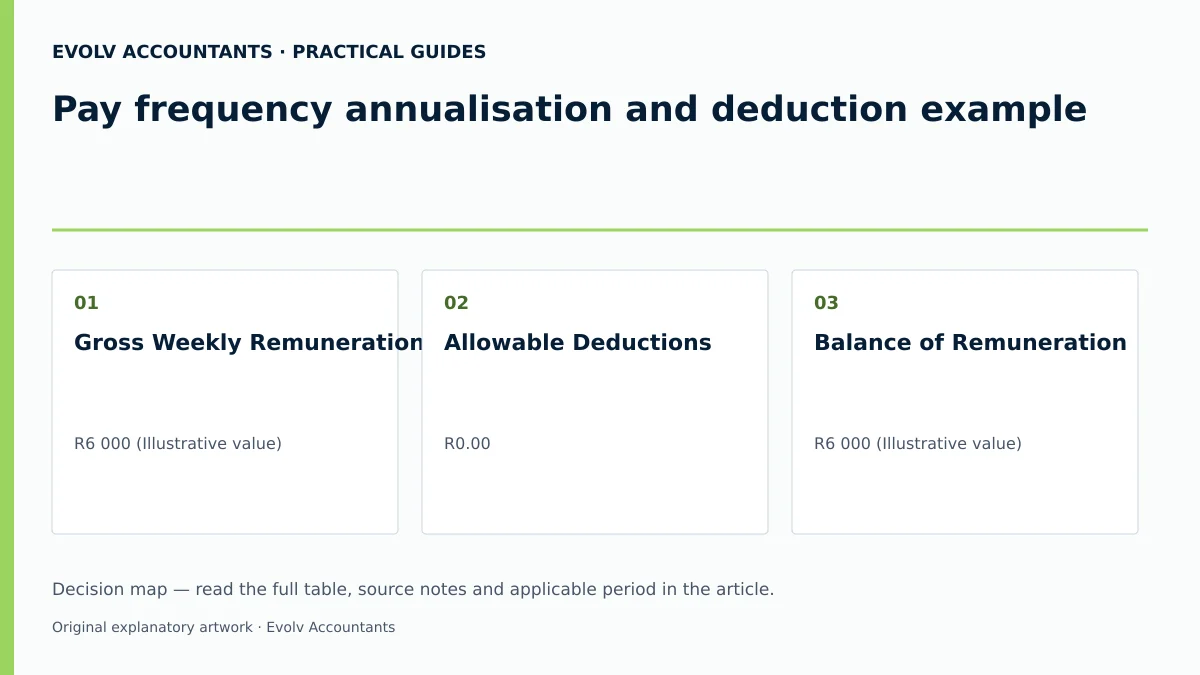
Pay frequency annualisation and deduction example
The primary output of the weekly Pay-As-You-Earn (PAYE) process is the exact Rand amount of Employees' Tax that an employer must withhold from an employee's weekly wages and remit to the South African Revenue Service (SARS) 1 8. The units are expressed in South African Rand (R), and the calculation applies to a single weekly pay period (7 days, representing 1/52nd of a full tax year) 3 9 10.
It is vital to distinguish between general accounting treatment and statutory tax compliance. In financial accounting, weekly gross wages are recognised as an operational expense, and withheld taxes are recorded as a short-term liability 1 11. For tax purposes, however, the Fourth Schedule dictates precise statutory formulas for annualising earnings, applying allowable retirement deductions, and calculating net tax liabilities 3 12 13.
Tax compliance operates under three distinct regulatory levels:
- Statutory Law: The Income Tax Act No. 58 of 1962 (Fourth Schedule), the Tax Administration Act No. 28 of 2011, and the Skills Development Levies Act No. 9 of 1999 establish the legal obligation to register, withhold, and remit tax 2 14 15 16.
- Regulator Guidance: Official publications issued by SARS—such as the Guide for Employers in Respect of Employees' Tax and the Guide for Employers in Respect of Skills Development Levy—provide administrative directives on applying tax tables and annualisation rules 16 17 18 19.
- Evolv Recommendations: Evolv Accountants recommends that employers establish automated payroll audit trails, verify employee declarations before processing weekly pay runs, and reconcile weekly withholding records against monthly declarations to eliminate compliance errors.
Inputs rates periods and exclusions: pay frequency annualisation
Accurate PAYE calculation for a weekly paid employee relies on specific statutory inputs established by the National Budget for the 2026/2027 tax year (effective 1 March 2026 to 28 February 2027) 5 20 21:
- Taxable income R1 – R245 100: 18% of taxable income 5 21.
- Taxable income R245 101 – R383 100: R44 118 + 26% of taxable income above R245 100 5 21.
- Taxable income R383 101 – R530 200: R79 998 + 31% of taxable income above R383 100 5 21.
- Taxable income R530 201 – R695 800: R125 599 + 36% of taxable income above R530 200 5 21.
- Taxable income R695 801 – R887 000: R185 215 + 39% of taxable income above R695 800 5 21.
- Taxable income R887 001 – R1 878 600: R259 783 + 41% of taxable income above R887 000 5 21.
- Taxable income R1 878 601 and above: R666 339 + 45% of taxable income above R1 878 600 5 21.
- Primary Rebate (all natural persons): R17 820 6 22.
- Secondary Rebate (persons aged 65 and older): R9 765 6 22.
- Tertiary Rebate (persons aged 75 and older): R3 249 6 22.
- Allowable Deductions and Exclusions:
- Retirement Contributions: Current contributions made by an employee to an approved pension, provident, or retirement annuity fund are allowable deductions from gross remuneration, capped at the lesser of R430 000 or 27.5% of the higher of remuneration or taxable income 12 23 24.
- Exempt Uniforms: Uniform allowances or employer-provided uniforms clearly distinguishable from ordinary clothing are exempt from tax under Section 10(1)(nA) 25.
- SDL Exclusions: For Skills Development Levy (SDL) purposes, remuneration excludes pensions, learner contracts under Section 18(3) of the Skills Development Act, and payments to exempt labour brokers 26 27 28.
Missing inputs—such as an unconfirmed date of birth (which dictates age-based rebates) or incomplete retirement contribution values—must be explicitly identified prior to finalising the pay run to avoid miscalculating tax liabilities 6 12 29.
The calculation in a worked example: deduction example
To illustrate the annualisation method, consider a hypothetical weekly paid employee under the age of 65 who earns a gross weekly wage of R6 000 (Illustrative value) during the 2026/2027 tax year 5 6 9. The employee makes no allowable retirement fund contributions 12.
- Establish Weekly Balance of Remuneration: R6 000 (Illustrative value) 9 30.
- Calculate Annual Equivalent:
Annual Equivalent = Weekly Remuneration × 52 Annual Equivalent = R6 000 × 52 = R312 000 3 9
- Determine Gross Normal Tax on Annual Equivalent:
R312 000 falls within the second tax bracket (R245 101 – R383 100) 5 21: Base Tax = R44 118 5 21 Excess over R245 100 = R312 000 - R245 100 = R66 900 5 21 Marginal Tax (26% of R66 900) = R17 394 5 21 Gross Annual Tax = R44 118 + R17 394 = R61 512 5 21
- Apply Primary Tax Rebate:
Net Annual Tax = R61 512 - R17 820 (Primary Rebate) = R43 692 6 22
- Calculate Weekly PAYE Deduction:
Weekly PAYE = (Net Annual Tax ÷ 52) Weekly PAYE = (R43 692 ÷ 52) = R840.23 3 7
| Input | Value or verified-source placeholder | Formula or step | Result | Independent check |
|---|---|---|---|---|
| Gross Weekly Remuneration | R6 000 (Illustrative value) | Base weekly earnings | R6 000.00 | Confirmed against timecards 11 |
| Allowable Deductions | R0.00 | Section 11F allowable contributions | R0.00 | Capped at 27.5% / R430 000 24 |
| Balance of Remuneration | R6 000 (Illustrative value) | Gross wage less allowable deductions | R6 000.00 | Matches taxable weekly base 30 |
| Annual Equivalent Ratio | 52 weeks | Multiply by 52 pay periods | R312 000.00 | R6 000 × 52 = R312 000 3 |
| Gross Tax Bracket Formula | Bracket 2 (R245 101 – R383 100) | R44 118 + 26% × (R312 000 - R245 100) | R61 512.00 | Verified against 2027 tax tables 5 |
| Primary Tax Rebate | R17 820 (Under age 65) | Subtract Section 6(2)(a) primary rebate | R43 692.00 | R61 512 - R17 820 = R43 692 6 |
| Weekly PAYE Withholding | 1/52nd of Net Annual Tax | Divide net annual tax by 52 | R840.23 | R43 692 ÷ 52 = R840.23 3 |
| Independent Rate Check | Effective Rate = 14.0038% | R43 692 ÷ R312 000 | R840.23 | R6 000 × 14.0038% = R840.23 3 |
Reconcile the answer to the underlying records: pay frequency annualisation
To ensure statutory payroll integrity, employers must establish a rigorous reconciliation workflow connecting individual pay slips to general ledger entries and SARS monthly returns 1 8 31:
— Practical point from this guide
- Verify Employee Age Group: Confirm the employee's date of birth against South African identity records to apply the correct rebate thresholds (under 65, 65–74, or 75+) 6 22 29.
- Determine Employment Classification: Verify that the employee is in standard employment (working 22 hours or more per week) 10 32.
- Calculate Balance of Remuneration: Subtract qualifying retirement fund contributions from gross weekly remuneration 12 30.
- Annualise the Remuneration: Multiply the weekly balance of remuneration by 52 to establish the annual equivalent 3 9.
- Apply Tax Bracket and Rebates: Calculate gross annual tax using statutory 2026/2027 brackets and subtract applicable age-based rebates 5 6 21 22.
- De-annualise to Weekly Withholding: Divide the net annual tax by 52 and round to two decimal places 3 7.
- Cross-Check Cumulative Pay Run Totals: Reconcile total weekly PAYE withheld across all weekly runs in a calendar month against the Monthly Employer Declaration (EMP201) 8 31.
- Verify Monthly Remittance: Ensure payment is made to SARS within seven days following the end of the calendar month 33 34.
- Bi-Annual Reconciliation: Validate cumulative weekly payroll figures against IRP5/IT3(a) certificates and the EMP501 reconciliation return 1 35 36.
Edge cases that change the calculation: deduction example
Payroll calculations can shift significantly based on specific worker categories, variable income components, or partial employment periods:
- Partial Week Employment: If a weekly paid employee starts mid-week or works a portion of a pay period, the annual equivalent must be calculated based on the actual ratio of days worked to prevent over-taxation 9.
- Non-Standard Employment: Casual workers rendering services for less than 22 hours per week who have not submitted a written declaration stating they work solely for one employer must be taxed at a flat non-standard rate of 25% 7 32 37.
- Overtime and Variable Remuneration: Overtime payments, bonuses, and commission are included in remuneration when actually paid under Section 7B variable remuneration rules, increasing the weekly balance of remuneration for that specific pay period 38 39.
- Travel Allowances: 80% of a employee's travel allowance is subject to weekly PAYE withholding, unless the employer is satisfied that at least 80% of the vehicle's use is for business, in which case the taxable portion reduces to 20% 40.
- Private Company Directors: Remuneration paid to directors of private companies is subject to PAYE under special Fourth Schedule provisions, including deemed remuneration rules and rights of recovery 41 42.
Next steps for PAYE and SDL
Before finalising weekly payroll and submitting monthly declarations, employers should verify that all pay frequency annualisations adhere to current statutory tax tables, age-based rebates, and allowable deduction caps 5 6 24.
It is critical to distinguish PAYE and SDL registration obligations:
- PAYE Registration: Mandatory for any employer paying remuneration to employees liable for normal tax, required within 21 business days of becoming an employer 14 53.
- SDL Registration: Required via form EMP101e whenever an employer expects total employee remuneration across all staff to exceed R500 000 over the following 12-month period 43 44 45 54.
Frequently Asked Questions
What tax rate applies if an employee works fewer than 22 hours in a week?
If an employee works fewer than 22 hours per week, they fall into non-standard employment unless they provide a written declaration confirming they render services exclusively to that employer 10 32 37. Without this declaration, tax must be withheld at a flat rate of 25% 7.
How is weekly overtime taxed under Fourth Schedule rules?
Overtime payments are added directly to the employee's weekly balance of remuneration in the pay period in which the overtime is paid 38 39. The combined total is then annualised to determine the weekly PAYE deduction 3 38.
Is an employer required to pay SDL on a weekly paid employee?
Skills Development Levy (SDL) liability depends on the employer's total annual payroll. An employer is exempt from registering for and paying SDL if there are reasonable grounds to believe the total leviable remuneration for all employees over the next 12 months will not exceed R500 000 43 44 45. If total payroll exceeds R500 000, SDL is payable at 1% of the leviable amount 13 46 47.
What should an employer do if an employee holds an IRP3 tax directive?
If an employee presents an official SARS IRP3 tax directive (e.g. for fixed percentage withholding or hardship relief), the employer must strictly apply the directive's instructions without deviation prior to calculating weekly deductions 48 49 50.
What are the consequences of late PAYE payment to SARS?
PAYE deductions must be paid over to SARS within seven days after the end of the month in which they were deducted 33 34. Late payments attract a mandatory 10% penalty plus prescribed interest under the Tax Administration Act 51 52.
Related guides
- When an employer must register for PAYE
- PAYE registration documents for a small company
- Compliance and Regulations: Keeping Your Business on Track
Sources
- Guide for Employers in Respect of Employees' Tax (2027) | South African Revenue Service
- https://www.sars.gov.za/wp-content/uploads/Ops/Guides/EMP-REG-03-G01-Guide-for-completion-of-Employer-Registration-application-External-Guide.pdf
- https://www.sars.gov.za/wp-content/uploads/Ops/Guides/SDL-GEN-01-G01-Guide-for-Employers-in-respect-of-Skills-Development-Levy-External-Guide.pdf
- Rates of Tax for Individuals | South African Revenue Service
- Skills Development Levy | South African Revenue Service