
When an employer must register for PAYE
22 September 2026

Registering for Pay-As-You-Earn (PAYE) requires a South African employer to notify SARS within 21 business days after paying remuneration to any employee liable for normal tax 1 2.
South African Revenue Service (SARS) regulations dictate that statutory payroll tax liabilities arise automatically when employee earnings reach specific threshold limits 1 3. While Employees' Tax (PAYE) registration is tied to individual employee tax thresholds, it operates as an integrated gateway that automatically enrols the entity for Unemployment Insurance Fund (UIF) contributions and establishes the baseline for Skills Development Levy (SDL) compliance 1 4 5.
Navigating these thresholds requires small and medium-sized enterprises (SMEs) to distinguish between statutory legislation, SARS operational guides, and Evolv advisory governance.
Employer registration trigger and remuneration facts
South African small and medium-sized enterprises (SMEs), including private companies, close corporations, sole proprietorships, and partnerships, must maintain clear operational boundaries between legal business entity establishment and statutory tax registration 6 7. Legal authorisation to trade or hire personnel does not automatically create an active payroll tax account; rather, registration is a mandatory compliance trigger dictated by prospective or actual remuneration payments 2 3.
The statutory tax parameters outlined in this guide apply specifically to the 2027 tax year, covering the period from 1 March 2026 to 28 February 2027 8 9. During this fiscal period, employers must evaluate workforce earnings against statutory tax brackets, primary rebates, and annual tax thresholds to determine their administrative obligations 10 11.
Statutory framing and operational context
Under South African tax legislation, the obligation to deduct PAYE arises whenever an employer pays or becomes liable to pay remuneration to an employee 3. The legal framework is governed by the Fourth Schedule to the Income Tax Act No. 58 of 1962, the Tax Administration Act No. 28 of 2011, the Skills Development Levies Act No. 9 of 1999, and the Unemployment Insurance Contributions Act No. 4 of 2002 6 12 13.
Regulator guidance issued by SARS—such as external registration manuals and employer guides—provides administrative execution details, whereas Evolv Accountants delivers practical accounting, payroll, and statutory compliance controls to safeguard business operations 6 13 14.
Distinguishing registration duty from general business eligibility
An SME may legally employ staff upon formation, but statutory PAYE registration is only required once an employee's taxable remuneration exceeds the annual tax threshold 1 15. Employers must continuously monitor payroll facts rather than relying on enterprise classification labels or turnover figures.
The qualification tests to check: employer registration trigger
To establish whether payroll tax registration is legally mandatory, an SME must evaluate four independent statutory tests rather than relying on generic business size labels 1 16 17 18.
Test 1: Employee tax threshold and PAYE trigger
Under Paragraph 15(1) of the Fourth Schedule to the Income Tax Act, an employer must apply to SARS for PAYE registration within 21 business days of becoming an employer, unless no employee receives remuneration liable to normal tax 1 2. As noted in SARS external guidance, an employer "must apply within 21 days after becoming an Employer to the Commissioner in the prescribed form" 2. For the 2027 tax year (1 March 2026 to 28 February 2027), individual tax thresholds after applying statutory rebates are set as follows 10 11:
- Persons under 65 years: R99,000 per annum 10 11.
- Persons aged 65 to 74 years: R153,250 per annum 10 11.
- Persons aged 75 years and older: R171,300 per annum 10 11.
If an SME employs even one worker whose annual remuneration exceeds the applicable threshold (taking into account the primary rebate of R17,820 for individuals under 65), the employer is legally obligated to register for PAYE 1 10 11.
Test 2: Projected annual payroll and SDL liability
Under Sections 4 and 5 of the Skills Development Levies Act, an employer becomes liable for SDL if there are reasonable grounds to believe that the total leviable remuneration paid or payable to all employees over the expanding 12-month period will exceed R500,000 15 16 19 20. The SDL rate is set at 1% of total leviable remuneration 21 22 23.
If an employer's total 12-month payroll is reasonably projected to be R500,000 or less, the business is legally exempt from paying SDL and is not required to register for SDL purposes, even if it is registered for PAYE 15 16 24.
Test 3: Hours worked and UIF contribution mandatory thresholds
Under the Unemployment Insurance Contributions Act, an employer and employee must each contribute 1% (2% total) of remuneration to the UIF 25. An employer is exempt from UIF contributions only in respect of employees who work less than 24 hours per month for that employer 17. When an employer registers with SARS for PAYE or SDL via eFiling or Form EMP101, UIF registration is effected automatically 4 5 26. If an employer is exempt from PAYE and SDL registration, it must register directly with the Unemployment Insurance Commissioner 17.
Test 4: Representative Employer appointment and residency requirements
Under Paragraph 16 of the Fourth Schedule, every employer that is a corporate body or juristic entity must appoint a natural person residing in South Africa as its Representative Employer 18 27 28. In the case of a company, this duty falls upon the Public Officer; for a municipality or body corporate, it falls upon the accounting officer or treasurer 18 27 28. The Representative Employer is personally subject to all statutory duties and liabilities imposed on the employer 12 29.
Evidence behind the eligibility decision: remuneration facts
Every payroll tax registration decision must be backed by verifiable evidentiary documentation retained in company records 30 31. Linking statutory qualification tests to specific records ensures audit readiness during SARS compliance reviews 30 32.
— Practical point from this guide
Documentation requirements for payroll tax audits
- PAYE Threshold Evidence: Employment contracts, monthly payroll journals, employee identity copies, SARS tax reference numbers, and signed employee declarations of standard employment 30 33.
- SDL Leviable Payroll Evidence: Annual salary budgets, 12-month rolling cash flow projections, gross wage registers, and approved executive remuneration schedules 5 34.
- UIF Hours and Contribution Evidence: Electronic attendance logs, signed timesheets, shift rosters, and monthly wage reconciliation sheets confirming hours worked 17 30.
- Entity and Representative Capacity Evidence: CIPC registration certificates (CoR14.3), board resolutions appointing the Public Officer, proof of South African residential address, and identity documents of the Representative Employer 6 18 35.
A qualifying case and an excluded case: employer registration trigger
The following hypothetical scenarios demonstrate how statutory tests operate in practice for South African SMEs during the 2027 tax year.
Case Study A: Apex Logistics CC (Qualifying for PAYE, SDL and UIF)
Apex Logistics CC is a newly formed freight entity operating in Gauteng. During the 2027 tax year (1 March 2026 to 28 February 2027), the entity recruits four staff members 8 9:
- Managing Member (age 42): Fixed remuneration of R30,000 per month (R360,000 per annum).
- Operations Supervisor (age 38): Salary of R12,000 per month (R144,000 per annum).
- Two Drivers (ages 29 and 31): Wages of R7,500 per month each (R90,000 per annum each).
Statutory Evaluation:
- PAYE Analysis: The Managing Member (R360,000) and Operations Supervisor (R144,000) both earn well above the under-65 individual tax threshold of R99,000 per annum 10 11. The two drivers earn R90,000 each, which falls below the R99,000 threshold 10 11. Because two employees exceed the threshold, Apex Logistics CC is legally required to apply for PAYE registration within 21 business days 1 2.
- SDL Analysis: Total projected 12-month payroll is R684,000 (R360,000 + R144,000 + R90,000 + R90,000) 5. Because total leviable remuneration exceeds R500,000, SDL registration is mandatory, and the entity must pay a 1% levy (R6,840 annually) 16 19 21 23.
- UIF Analysis: All four employees work full-time (exceeding 24 hours per month), requiring 1% employer and 1% employee UIF contributions 17 25. Registration is completed automatically through SARS upon submitting Form EMP101 4 37.
Case Study B: Beacon Design Studio (Pty) Ltd (Excluded from PAYE and SDL)
Beacon Design Studio (Pty) Ltd is a small digital agency employing two junior design assistants (both aged 23). During the 2027 tax year, each assistant works 30 hours per month at a fixed wage of R5,000 per month (R60,000 per annum each) 8 9. The director receives no salary.
Statutory Evaluation:
- PAYE Analysis: Total annual remuneration for each worker is R60,000, which is substantially below the under-65 threshold of R99,000 per annum 10 11. Because no employee is liable for normal tax, the studio is statutory exempt from registering for PAYE 1 15.
- SDL Analysis: Total projected 12-month payroll is R120,000 (R60,000 + R60,000) 5. Because total leviable remuneration is under the R500,000 threshold, the business is exempt from SDL registration and payments 15 16 24.
- UIF Analysis: Because both workers render services for 30 hours per month (exceeding the 24-hour statutory exclusion), UIF contributions are compulsory 17. Because the studio is exempt from SARS PAYE/SDL registration, it must register directly with the UI Commissioner 17.
What changes the answer: remuneration facts
Initial eligibility decisions must be reassessed continuously whenever business operational facts evolve 38 39.
Mid-year remuneration adjustments and bonus payments
- Discretionary Bonuses & Overtime: An employee previously earning below the R99,000 threshold who receives an annual bonus or overtime payment may cross the statutory threshold on an annual equivalent basis, triggering immediate PAYE withholding duties 40 41 42.
- Payroll Expansion: An SME whose initial payroll was projected at R400,000 per annum that subsequently hires additional staff, pushing 12-month remuneration past R500,000, becomes immediately liable to register for SDL 15 16 19.
Corporate restructuring, branch expansions and deregistrations
- Branch Registrations (EMP102): Where an employer establishes a separate division or branch that maintains independent accounting records, it may apply for separate branch registration using Form EMP102 43 44 45. However, the main enterprise remains ultimate guarantor in the event of branch default 44.
- Updating Particulars: Registered employers must notify SARS in writing within 21 business days of any change in physical address, banking details, representative employer, or legal name 38 39.
- Cessation of Business: An employer that ceases operations must notify SARS in writing within 14 days of ceasing to be an employer 38. Deregistration will not be processed if outstanding tax declarations or liabilities remain unresolved 46.
Next steps for PAYE and SDL
SME Compliance Checklist
- Audit Workforce Earnings: Compare all employee remuneration profiles against the 2027 tax thresholds (R99,000 for under 65s) 10 11.
- Calculate Projected Payroll: Aggregate total 12-month leviable remuneration across all workers to test against the R500,000 SDL threshold 5 16 19.
- Formalise Representative Employer: Document the appointment of a resident Public Officer or manager via board resolution 18 27.
- Submit Registration Application: Complete and submit Form EMP101 (or EMP102 for branches) via eFiling or in person at a SARS branch within 21 business days of liability 1 26 44.
- Establish Archive System: Implement payroll registers securing employee tax numbers, remuneration logs, and deduction proofs for a minimum of 5 years 30 31 47.
- Remit Monthly Declarations: File Form EMP201 and pay PAYE, SDL, and UIF within 7 days following the end of each month 22 48 49.
Eligibility decision table
| Test | Facts to obtain | Evidence | Applicable source | Result or unresolved question |
|---|---|---|---|---|
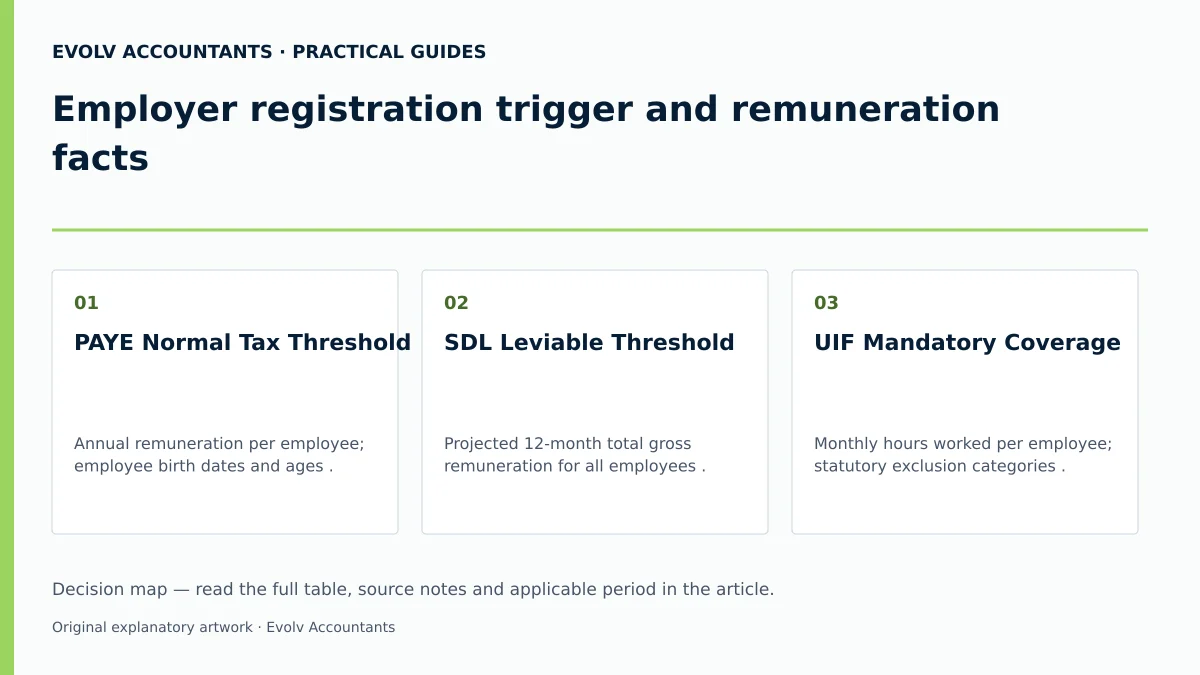
| PAYE Normal Tax Threshold | Annual remuneration per employee; employee birth dates and ages 10 11 33. | Employment contracts, ID copies, monthly payroll journals 30 33. | Paragraph 15(1), Fourth Schedule to Income Tax Act; SARS 2027 Tax Rates 1 10 11. | Register for PAYE within 21 business days if any employee earns > R99,000 (under 65) 1 2 10 11. |
| SDL Leviable Threshold | Projected 12-month total gross remuneration for all employees 5 16 19. | Approved budget forecasts, 12-month payroll projections 5 34. | Sections 4 & 5, Skills Development Levies Act No. 9 of 1999 16 20 37. | Register and pay 1% SDL if 12-month total payroll > R500,000; exempt if ≤ R500,000 15 16 21 24. |
| UIF Mandatory Coverage | Monthly hours worked per employee; statutory exclusion categories 17. | Attendance registers, shift rosters, timecards 17 30. | Unemployment Insurance Contributions Act No. 4 of 2002 1 12 17. | Compulsory if employee works ≥ 24 hours/month; SARS auto-registers via EMP101 4 5 17. |
| Representative Employer | SA residency status; executive or public officer capacity 18 27. | CIPC CoR14.3, board resolution, proof of SA residential address 6 18 35. | Paragraph 16, Fourth Schedule to Income Tax Act; SARS External Guide EMP-REG-03-G01 6 18 27. | Mandatory natural person appointment; personally liable for employer obligations 12 18 29. |
| Branch Separation (EMP102) | Independent accounting records and separate trading location facts 44. | Branch financial records, lease agreements, EMP102 form 43 44 45. | Chapter 3, Tax Administration Act No. 28 of 2011; EMP-REG-03-G01 Section 2.1 6 44 50. | Optional separate registration; main enterprise remains liable upon branch default 44. |
Frequently Asked Questions
What is the statutory deadline to register for PAYE after hiring eligible staff?
An employer must apply to SARS for PAYE registration within 21 business days after becoming an employer or incurring a PAYE liability 1 2. Application is submitted electronically via eFiling or personally at a SARS branch using Form EMP101 26 37 44.
Does an SME need to register for SDL if its total annual payroll is under R500,000?
No. An employer is legally exempt from paying SDL and is not required to register for SDL purposes if there are reasonable grounds to believe that the total leviable remuneration paid to all employees over the next 12-month period will not exceed R500,000 15 16 24.
How do PAYE, SDL, and UIF registrations interact when applying to SARS?
When an employer submits a registration application for PAYE or SDL to SARS, the employer is automatically registered for UIF contributions 4 5. If an employer is exempt from SARS registration for both PAYE and SDL, it must register directly with the UI Commissioner 17.
What happens if an employee's salary increases mid-year and crosses the tax threshold?
If a salary increase, bonus, or overtime payment causes an employee's remuneration to exceed the annual tax threshold (R99,000 for under 65s in the 2027 tax year), the employer must immediately register for PAYE (if not already registered) and calculate tax using annual equivalent formulas 1 10 11 40.
How long must an employer retain payroll registers and tax deduction records?
Under Chapter 4 of the Tax Administration Act and Paragraph 14(1) of the Fourth Schedule, employers must retain all employee records—including remuneration paid, PAYE deducted, UIF contributions, and employee tax numbers—for at least 5 years from the date of the last entry 30 31 47.
Related guides
- PAYE registration documents for a small company
- When an employer must register for SDL
- Compliance and Regulations: Keeping Your Business on Track
Sources
- Guide for Employers in Respect of Employees' Tax (2027) | South African Revenue Service
- https://www.sars.gov.za/wp-content/uploads/Ops/Guides/EMP-REG-03-G01-Guide-for-completion-of-Employer-Registration-application-External-Guide.pdf
- Rates of Tax for Individuals | South African Revenue Service
- https://www.sars.gov.za/wp-content/uploads/Ops/Guides/SDL-GEN-01-G01-Guide-for-Employers-in-respect-of-Skills-Development-Levy-External-Guide.pdf
- Skills Development Levy | South African Revenue Service