
PAYE registration documents for a small company
20 February 2025

Registering a small company as an employer with SARS requires valid entity authority documents, proof of banking, and complete liability particulars within statutory timelines.
For South African small businesses, registering for Pay-As-You-Earn (PAYE) and Unemployment Insurance Fund (UIF) contributions through the South African Revenue Service (SARS) is mandatory within 21 business days of becoming an employer 1 2 3. Skills Development Levy (SDL) registration applies if total annual employee remuneration is reasonably expected to exceed R500,000 over the next 12-month period 4 5 6.
Full statutory compliance requires establishing formal entity authority—appointing a South African resident Representative Employer (such as a Public Officer) 7 8 9—and compiling a structured evidence pack comprising corporate incorporation records, South African bank account confirmations, and completed SARS application forms 10 11 12.
Entity authority and employer application records
Establishing employer registration creates the legal framework for withholding Employees' Tax (PAYE) and remitting monthly payroll taxes to SARS 1 13 14. Verification is conducted by SARS operational officers, bank compliance teams, and Sector Education and Training Authorities (SETAs) to validate corporate governance and tax liability 10 15 16.
Legal and regulatory boundaries
- Statutory Law: Paragraph 15(1) of the Fourth Schedule to the Income Tax Act No. 58 of 1962 mandates that every employer liable for Employees' Tax must apply for registration within 21 business days of becoming an employer 1 14 17. Chapter 3 of the Tax Administration Act No. 28 of 2011 governs tax registration and taxpayer information updates 14 18. Section 5 of the Skills Development Levies (SDL) Act No. 9 of 1999 governs SDL registration obligations 14 17, and Sections 4 and 10 of the Unemployment Insurance Contributions (UIC) Act govern UIF registration 1 14.
- Regulator Guidance: SARS External Guide EMP-REG-03-G01 sets operational standards for completing forms EMP101e (main enterprise) and EMP102e (branch registration) 3 19 20. SARS Guide SDL-GEN-01-G01 outlines leviable remuneration and exemption criteria 21 22, while the SARS Guide for Employers in Respect of Employees' Tax (2027) details payroll withholding rules 23 24.
- Evolv Recommendations: Evolv advises small business directors to establish formal entity authority and representative taxpayer declarations prior to processing payroll, ensuring seamless alignment across tax advisory, bookkeeping, payroll, and statutory company compliance functions.
Documents grouped by purpose: entity authority
Group 1: Mandatory core records
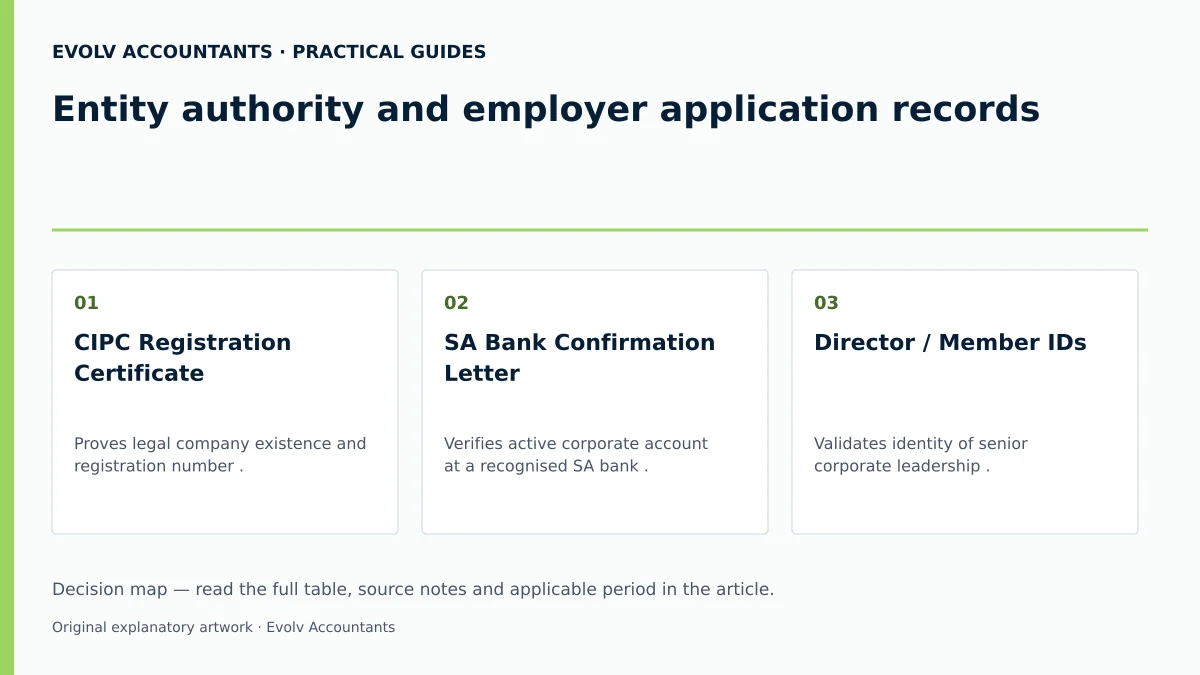
- CIPC Registration Certificate: Companies and Intellectual Property Commission (CIPC) incorporation documentation reflecting the official company registration number without spaces or dashes 25 26.
- South African Bank Account Confirmation: Proof of an active account at a recognised financial institution located in South Africa, opened in the legal name of the business entity 12 27.
- Identity Documentation for Senior Leadership: Identification details (South African ID or passport) for the two most senior directors or members 25 28.
- Representative Employer Appointment: Particulars of the Representative Employer (Public Officer for a company), who must be a natural person residing in South Africa 8 9.
- Signed SARS Application Form: A completed Form EMP101e signed directly by the applicant or Representative Employer 3 19 29.
Group 2: Conditional records
- Form EMP102e (Branch Registration): Required if a separate division or branch requires an independent PAYE registration linked to the main enterprise profile 20 30.
- Power of Attorney (Form SPPOA/TPPOA): Mandatory where an authorised registered tax practitioner or external representative presents the registration application on behalf of the entity 31.
- Tax Exemption Unit (TEU) Letter: Mandatory for Public Benefit Organisations (PBOs) claiming exemption from SDL under section 10(1)(cN) of the Income Tax Act 32 33 34.
- SETA and SIC Classification Codes: Mandatory classification details (Standard Industrial Classification / SETA codes) required to ensure correct allocation of SDL levy payments 35.
Group 3: Recommended supporting schedules
- 12-Month Projected Payroll Schedule: A detailed breakdown of estimated employee remuneration and projected headcount to verify whether the business meets or exceeds the R500,000 SDL threshold 6 28 36.
- Organisational Authority Chart: A diagram illustrating corporate management structures, director appointments, and Public Officer designations.
Check identity period and consistency: employer application records
To prevent processing delays or rejection, employer registration records must satisfy strict consistency and timing checks set by SARS 10 29.
— Practical point from this guide
- Cross-Verification Workflow:
- [CIPC Company Name] → Must match → (EMP101e Legal Name)
- [Physical Premises Address] → Must match → [No PO Box Allowed]
- [Bank Account Holder] → Must match → [Legal / Main Trading Name]
- [Supporting Documents] → Must be recent → (Under 3 Months Old)
Identity and address consistency
- Legal Entity Name: The surname or registered name in Part 1 of Form EMP101e must correspond exactly with official CIPC records 25 37. If a trading name is used, it must be explicitly written out; entering "as above" or "N/A" is prohibited 38.
- Physical Address: Address details must reflect the actual physical site where business operations are conducted; Post Office Box numbers are strictly unacceptable for physical location fields 39 40.
- Banking Particulars: The account holder name must match the registered legal name or main trading name 12 27. Third-party banking details are restricted solely to foreign entities or recognised holding/subsidiary corporate groups 27.
Timing and document freshness
- Recent Evidence Rule: SARS operational policy dictates that supporting documentation (such as bank statements or proof of address) must be "recent", defined as not more than three (3) months old 31.
- Liability Date Alignment: Liability dates for PAYE, UIF, and SDL must align with actual trading commencement and payroll start dates 41.
- SDL Exemption Threshold Assessment: Small businesses are exempt from registering for SDL only if there are reasonable grounds to believe that total leviable employee remuneration over the next 12-month period will not exceed R500,000 4 6 33.
Build a reviewer ready evidence pack: entity authority
A reviewer-ready evidence pack enables efficient verification by SARS officials and external compliance auditors 10 16.
Structured document index
- Section A: Corporate Entity Governance: CIPC Registration Certificate, Memorandum of Incorporation (MOI), and Director Resolution appointing the Public Officer 9 25.
- Section B: Representative Employer Details: Certified copy of SA ID or passport, SA residential address proof, and completed Representative Employer declaration 8 42.
- Section C: Banking & Financial Verification: Official bank account confirmation letter (under 3 months old) issued by a recognised South African bank 12 31.
- Section D: Application Forms & Calculations: Fully completed and signed Form EMP101e, projected 12-month payroll schedule, and SETA/SIC code schedule 19 35 36.
Standardised file naming and document quality
- Standardised Naming: Name digital files clearly (e.g., 01_CIPC_Registration.pdf, 02_Public_Officer_ID.pdf, 03_Bank_Confirmation.pdf).
- Formatting Standards: Manual forms must be completed in clear block letters using blue or black ink, with any alterations initialled by the applicant 43.
- Certification Rules: SARS guidelines clarify that copies of supporting documents do not require certification unless specifically requested, provided they are legible and complete 31.
- Quality Control: Evolv recommends conducting a comprehensive pre-submission review to ensure all fields are complete, as incomplete applications are treated by SARS as not having been submitted 10 44.
Missing or contradictory records: employer application records
Consequences of missing evidence
In terms of SARS operational rules, an application for employer registration that lacks required supporting particulars or documentation is regarded as not having been applied for until all outstanding items are provided 10 44.
Authentic reconstruction protocol
Where historical records are missing or inconsistent, employers must reconstruct evidence through official legal channels rather than substituting unverified information:
- Corporate Disclosures: Obtain fresh, updated disclosure certificates from CIPC to verify current director appointments 25 28.
- Fresh Bank Confirmations: Request a new bank account confirmation letter directly from the entity's financial institution to ensure it satisfies the 3-month freshness rule 12 31.
- Formal Resolutions: Execute a formal board resolution confirming the appointment of the Public Officer as the resident Representative Employer 8 9.
Discrepancy resolution and escalation
- Trading Name Discrepancies: Ensure trading names are explicitly stated on annexures if multiple trading names are used 38.
- Practitioner Signatures: SARS guidelines strictly prohibit tax practitioners from signing the EMP101e declaration on behalf of the applicant; the form must be signed directly by the Representative Employer 29.
- Complex Escalations: Unresolved portal errors, unlinked branch PAYE profiles, or historical unfinalised employer tax liabilities that block registration changes must be escalated to senior tax advisors or SARS branch supervisors 45 46.
Next steps for PAYE and SDL
Submission protocol: upload versus acceptance
Applications must be submitted in person at a local SARS branch by the individual owner, partner, legal representative, or authorised registered tax practitioner 16 46. Initial submission or upload does not constitute registration acceptance; formal registration is confirmed only when SARS issues an official EMP103 Registration Certificate containing the PAYE, SDL, and UIF reference numbers 16 44.
Ongoing compliance checklist
- Obtain CIPC and Banking Proof: Secure official CIPC registration disclosures and a bank confirmation letter under 3 months old 12 25 31.
- Appoint Representative Employer: Designate a resident Public Officer responsible for employer duties 8 9.
- Assess SDL Liability: Calculate projected 12-month remuneration to determine if payroll exceeds the R500,000 threshold 4 5 6.
- Complete Form EMP101e: Fill out all mandatory fields using block letters, blue/black ink, and correct SETA/SIC codes 35 43.
- Submit In-Person at SARS Branch: Present the completed application pack in person at the local SARS branch 16 46.
- Receive EMP103 Certificate: Obtain and archive the official EMP103 Registration Certificate issued by SARS 16 44.
- Maintain Statutory Records: Establish monthly EMP201 remittance routines and retain payroll registers for 5 years 47 48 49.
Statutory record-keeping and notification duties
- 5-Year Record Retention: Under Chapter 4 of the Tax Administration Act, employers must retain all remuneration records, tax withheld, UIF contributions, and SDL calculations for five (5) years from the date of return submission 47 49 50.
- 21-Day Change Notification: Employers must notify SARS in writing within 21 business days of any change in registered particulars, including physical address, banking details, or Representative Employer appointments 18 51.
- Monthly Remittances: Monthly EMP201 declarations and payments for PAYE, UIF, and SDL must be submitted by the 7th of each month (or the preceding business day if the 7th falls on a weekend or public holiday) 15 48 52 53.
Purpose mapped evidence checklist
| Record | Why it is needed | Required or conditional | Owner | Verification and reference |
|---|---|---|---|---|
| CIPC Registration Certificate | Proves legal company existence and registration number 25 26. | Mandatory | Company Directors | Cross-check CIPC entity number without spaces or dashes 26. |
| SA Bank Confirmation Letter | Verifies active corporate account at a recognised SA bank 12. | Mandatory | Finance / Public Officer | Must be under 3 months old; account name must match entity 27 31. |
| Director / Member IDs | Validates identity of senior corporate leadership 25 28. | Mandatory | Directors / Members | SA ID or passport for 2 senior directors/partners 25 28. |
| Representative Employer Proof | Confirms SA resident natural person responsible for tax duties 8. | Mandatory | Public Officer | Must be SA resident Public Officer for companies 8 9. |
| Form EMP101e Application | Official application for PAYE, SDL, and UIF registration 3 19. | Mandatory | Public Officer | Signed by applicant; practitioner signature invalid 29. |
| Form EMP102e (Branch) | Registers separate branch/division under main PAYE profile 20. | Conditional | Branch Manager | Linked to main branch PAYE reference number 20 30. |
| Power of Attorney (SPPOA/TPPOA) | Authorises registered tax practitioner to present application 31. | Conditional | Registered Tax Practitioner | Accompanied by practitioner ID and letter of authority 31. |
| TEU Exemption Letter | Confirms SDL payment exemption for qualifying PBOs 32 34. | Conditional | PBO Trustees | Issued by SARS Tax Exemption Unit under sec 10(1)(cN) 32 34. |
| SETA / SIC Classification | Ensures SDL levy payments are allocated to correct SETA 35. | Mandatory | Public Officer | Valid SETA/SIC code required even if SDL exempt 35. |
Reproducible hypothetical example: small business payroll tax calculation
*Note: All values below are illustrative and based on statutory rates and thresholds sourced from SARS guides for the 2026/2027 tax year (1 March 2026 to 28 February 2027) 54 55 56.*
Company background and projected payroll
Consider a newly incorporated South African private company, Apex Tech Solutions (Pty) Ltd, employing 5 full-time staff members.
- Monthly Gross Payroll: R45,000
- Projected 12-Month Remuneration: 12 × R45,000 = R540,000 36
Step 1: SDL registration and monthly levy determination
- Threshold Assessment: Because the projected 12-month remuneration (R540,000) exceeds the R500,000 statutory exemption threshold, Apex Tech Solutions (Pty) Ltd is legally required to register for SDL 4 5 6.
- Monthly SDL Levy: Calculated at 1% of the leviable amount (gross remuneration) 15 57 58:
Monthly SDL = 1% × R45,000 = R450 15 57
Step 2: UIF contribution calculation
- UIF Contributions: Calculated at 1% employee deduction plus 1% employer contribution on remuneration for UIF purposes 59:
Employee Deduction (1%) = R450 59 Employer Contribution (1%) = R450 59 Total Monthly UIF Remitted = R450 + R450 = R900 59
Step 3: Monthly PAYE withholding calculations (2026/2027 Tax Year)
Employee A (Under 65 years of age)
- Gross Monthly Salary: R17,500
- Annualised Taxable Income: 12 × R17,500 = R210,000
- Tax Rate Bracket (0 – R245,100): Taxed at 18% of taxable income 54:
Gross Annual Tax = 18% × R210,000 = R37,800 54
Net Annual Tax = R37,800 - R17,820 = R19,980 54 55
- Monthly PAYE Deduction:
Monthly PAYE = (R19,980 ÷ 12) = R1,665 54 55
Employee B (Under 65 years of age)
- Gross Monthly Salary: R7,500
- Annualised Taxable Income: 12 × R7,500 = R90,000
- Tax Threshold Assessment (Under 65): The annual tax threshold for taxpayers under 65 is R99,000 55 56.
- Monthly PAYE Deduction: Because annual earnings (R90,000) fall below the R99,000 threshold, no PAYE is deductible (PAYE = R0) 1 55 56.
Step 4: Summary of monthly EMP201 declaration and remittance
The total monthly payment remitted to SARS by the 7th of the following month under the pre-populated Payment Reference Number (PRN) is structured as follows 15 48 52:
PAYE Withheld (Employee A) = R1,665 54 55 UIF Contributions (Total) = R900 59 SDL Levy (Employer) = R450 15 57 Total Monthly EMP201 Payment = R3,015 15 48
Frequently Asked Questions
What is the statutory deadline to register for PAYE after employing staff?
Under Paragraph 15(1) of the Fourth Schedule to the Income Tax Act, an employer must apply to register for Employees' Tax (PAYE) with SARS within 21 business days of becoming an employer, unless no employees are liable for normal tax 1 14 17.
Is a small company with an annual payroll under R500,000 required to register for SDL?
An employer is exempt from registering for and paying SDL if there are reasonable grounds to believe that the total leviable remuneration paid to all employees over the next 12-month period will not exceed R500,000 4 6 33. However, PAYE and UIF registration obligations remain applicable if any employee earns above the tax threshold 1 6.
Who qualifies to act as the Representative Employer for a private company?
In terms of Paragraph 16 of the Fourth Schedule to the Income Tax Act, the Representative Employer for a company must be the Public Officer, who must be a natural person residing in South Africa holding a post of responsibility such as managing director, manager, or secretary 8 9.
What happens if an employer submits an incomplete registration application to SARS?
According to SARS operational guide EMP-REG-03-G01, an applicant who fails to provide all required particulars and supporting documentation is regarded as not having applied for registration until all documents are supplied 10 44.
How long must employer payroll and tax records be retained in South Africa?
Under Chapter 4 of the Tax Administration Act, employers are legally required to retain all employee remuneration registers, tax deduction records, and contribution declarations for a minimum period of five (5) years from the date of return submission 47 49 50. Ask Evolv about entity authority and employer application records. Share the relevant records so the support required can be scoped.
Related guides
- When an employer must register for PAYE
- When an employer must register for SDL
- Compliance and Regulations: Keeping Your Business on Track
Sources
- Guide for Employers in Respect of Employees' Tax (2027) | South African Revenue Service
- https://www.sars.gov.za/wp-content/uploads/Ops/Guides/EMP-REG-03-G01-Guide-for-completion-of-Employer-Registration-application-External-Guide.pdf
- Skills Development Levy | South African Revenue Service
- https://www.sars.gov.za/wp-content/uploads/Ops/Guides/SDL-GEN-01-G01-Guide-for-Employers-in-respect-of-Skills-Development-Levy-External-Guide.pdf
- Rates of Tax for Individuals | South African Revenue Service