
When an employer must register for SDL
17 January 2025

Registering for Skills Development Levy requires a South African employer to test whether its annual leviable remuneration exceeds R500 000 or whether a statutory category exemption applies.
Under South African tax administration, an employer paying remuneration to workers must determine its Skills Development Levy (SDL) liability independently from Pay-As-You-Earn (PAYE) and Unemployment Insurance Fund (UIF) obligations 1 2 3. An employer is legally required to register for SDL with the South African Revenue Service (SARS) unless there are reasonable grounds during any month to believe that the total leviable remuneration paid or payable to all employees over the following 12-month period will not exceed R500 000 3 4 5 6.
Certain categories of employers—such as public service entities, public bodies funded 80 per cent or more by Parliament, qualifying Public Benefit Organisations (PBOs), and exempted municipalities—are exempt from paying the levy 4 5 6 7 8. Public entities and PBOs remain obliged to submit an employer registration application to SARS for tracking purposes, whereas small employers falling below the R500 000 remuneration threshold are entirely relieved from both registration and levy payment duties 3 4 5.
SDL threshold and excluded employer categories
The statutory framework governing workplace skills development applies to all South African employers, including commercial companies, close corporations, partnerships, sole proprietors, trusts, non-profit institutions, and public bodies 1 2 9. An employer's obligation to register for SDL must be strictly distinguished from its ongoing liability to pay monthly levy contributions 3 4 5.
For the 2026/2027 tax year (spanning 1 March 2026 to 28 February 2027), the statutory SDL levy rate remains fixed at 1 per cent of the employer's leviable remuneration bill, a rate in force since 1 April 2001 10 11 12 13. In tax governance, distinct legal tiers must be recognised:
- Statutory Law: The Skills Development Levies Act No. 9 of 1999 (SDL Act), the Fourth Schedule to the Income Tax Act No. 58 of 1962, and the Tax Administration Act No. 28 of 2011 establish the binding legal duties, levy rates, registration timeframes, and penalties 1 14 15 16.
- Regulator Guidance: SARS external operational guides—specifically the Guide for Employers in respect of Skills Development Levy (SDL-GEN-01-G01) and the Guide for completion of Employer Registration application (EMP-REG-03-G01)—outline SARS administrative interpretation, form requirements, and payment mechanisms 17 18. SARS describes the levy as a "compulsory levy scheme for the purposes of funding education and training" 19 20.
- Evolv Advisory Recommendations: Evolv Accountants advises South African SMEs on internal payroll structuring, record retention, and proactive eligibility reviews to ensure compliance and avoid estimated assessments or interest penalties 21 22 23.
The qualification tests to check: sdl threshold
An employer must evaluate five independent statutory qualification tests rather than relying on informal company size labels 3 4 6 7:
The 12-Month Leviable Remuneration Threshold Test
An employer is not required to register for SDL if during any month there are reasonable grounds for believing that the total leviable remuneration paid or payable to all employees during the following 12-month period will not exceed R500 000 3 4 5 6. Conversely, where total remuneration is expected to exceed R500 000 over the next 12 months, the employer becomes legally liable to register and pay SDL 2 24.
The Public Service Employer Test
Public service employers in the national or provincial sphere of government are exempt from paying SDL 5 6 7. These employers are legally required to budget an amount equal to the levies payable for internal education and training 5 6 7.
The Public Entity Parliamentary Funding Test
National or provincial public entities are exempt from paying SDL if 80 per cent or more of their expenditure is paid directly or indirectly from funds voted by Parliament 5 7 8. They must similarly budget an equivalent amount for staff training 5 7 8.
The Approved Public Benefit Organisation (PBO) Test
Public Benefit Organisations exempt from Income Tax in terms of section 10(1)(cN) of the Income Tax Act are exempt from paying SDL provided they solely carry on specified welfare, humanitarian, health care, or religious public benefit activities (or solely provide funds to such PBOs) and hold a formal letter of exemption issued by the SARS Tax Exemption Unit (TEU) 4 5 8.
The Exempted Municipality Test
Municipalities in respect of which a certificate of exemption has been issued by the relevant Minister are exempt from paying SDL 3 4 5.
Statutory Remuneration Definitions and Exclusions
The leviable amount is calculated on the balance of remuneration after deducting allowable retirement fund contributions (pension, provident, and retirement annuity funds) and approved section 18A donations 11 25 26 27. For SDL calculation purposes, remuneration specifically excludes:
- Remuneration paid or payable to a labour broker holding a valid SARS exemption certificate (IRP30) 28 29 30.
- Payments made by way of any pension, superannuation allowance, or retiring allowance 28 31 32.
- Retirement fund lump sums and severance benefits contemplated in paragraphs (a), (d), (e), or (eA) of the gross income definition in section 1 of the Income Tax Act 28 31 32.
- Remuneration payable to a learner under a formal learnership contract of employment as contemplated in section 18(3) of the Skills Development Act 28 31 32.
Evidence behind the eligibility decision: excluded employer categories
To defend an SDL exemption or non-registration position during a SARS audit, the Representative Employer must compile and maintain verifiable evidence records 23 33 34 35.
— Practical point from this guide
| Test | Facts to obtain | Evidence | Applicable source | Result or unresolved question |
|---|---|---|---|---|
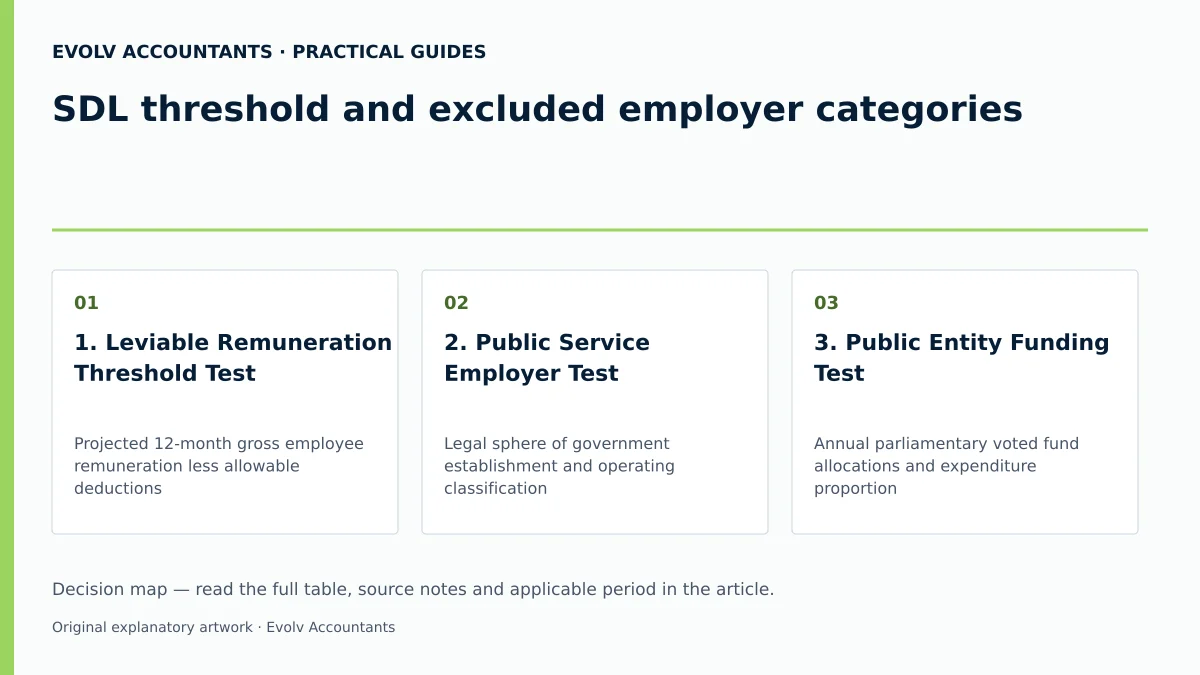
| 1. Leviable Remuneration Threshold Test | Projected 12-month gross employee remuneration less allowable deductions | 12-month payroll budget forecast, employment contracts, general ledger | SARS Guide SDL-GEN-01-G01 Section 5 3 6; SDL Act Section 3(1) 13 | Liable to register and pay if > R500 000; exempt from registration and payment if <= R500 000 |
| 2. Public Service Employer Test | Legal sphere of government establishment and operating classification | Government gazette notice, constitutional designation records | SARS Guide EMP-REG-03-G01 Section 7.7 36; SDL Act Section 4(a) 6 | Exempt from levy payment; must budget training funds and register on EMP101e 7 36 |
| 3. Public Entity Funding Test | Annual parliamentary voted fund allocations and expenditure proportion | Audited financial statements, parliamentary vote appropriation receipts | SARS Guide SDL-GEN-01-G01 Section 5 8; EMP-REG-03-G01 Section 7.7 36 | Exempt from levy payment if >= 80% parliamentary funded; must register on EMP101e 7 36 |
| 4. Approved PBO Test | PBO tax status and qualifying public benefit activity scope | SARS Tax Exemption Unit (TEU) letter of exemption, NPO registration | SARS Guide SDL-GEN-01-G01 Section 5 8; Income Tax Act Section 10(1)(cN) 4 8 | Exempt from levy payment if TEU letter held and activities qualify; must register on EMP101e 4 8 |
| 5. Exempted Municipality Test | Ministerial municipal exemption approval status | Official certificate of exemption issued by the relevant Minister | SARS Guide SDL-GEN-01-G01 Section 5 3; EMP-REG-03-G01 Section 7.7 36 | Exempt from levy payment if certificate held; must register on EMP101e 3 4 |
A qualifying case and an excluded case: sdl threshold
The operational application of the leviable remuneration test is demonstrated in the following two hypothetical SME scenarios for the 2026/2027 tax year:
Case A: Qualifying SME (Inclusion)
- Entity Facts: Company A (Pty) Ltd employs 8 staff members. Its projected gross annual payroll is R750 000.
- Payroll Breakdown:
- Gross employee remuneration: R750 000
- Less: Stipends paid to 2 registered learners under formal section 18(3) learnership contracts: R50 000 28 31 32
- Less: Allowable employer pension fund contributions under Paragraph 2(4) of the Fourth Schedule: R40 000 11 25 26
- Calculation:
Leviable Amount = R750 000 - R50 000 - R40 000 = R660 000 25 26
- Outcome: Because the projected 12-month leviable amount of R660 000 exceeds the statutory threshold of R500 000 3 4 6, Company A is legally liable for SDL. It must apply for registration on form EMP101e within 21 business days 1 2 37.
- Levy Liability:
Annual SDL (1%) = 1% × R660 000 = R6 600 (R550 monthly via EMP201) 11 13 38
Case B: Excluded SME (Threshold Exclusion)
- Entity Facts: Company B (Pty) Ltd employs 3 staff members.
- Payroll Breakdown: Gross annual remuneration is R480 000, with no learnerships or allowable deductions.
- Calculation: Leviable amount equals R480 000.
- Outcome: Because there are reasonable grounds to believe that total leviable remuneration over the next 12 months will not exceed R500 000 3 4 5, Company B is exempt from paying SDL and is legally relieved from applying for SDL registration 3 4.
What changes the answer: excluded employer categories
An initial exemption or non-registration determination is not permanent and must be reassessed when business conditions change:
- Mid-Year Payroll Expansion: If an un-registered employer expands its headcount, increases wages, or awards annual bonuses that push its projected 12-month leviable payroll above R500 000, liability arises immediately 6 24 39. The employer must submit form EMP101e to SARS within 21 business days 1 37.
- Revocation or Modification of PBO Exemption: If a PBO alters its operations outside qualifying welfare, healthcare, or religious activities, or fails to maintain its TEU exemption status, its statutory SDL payment exemption lapses 4 8.
- Reduction in Public Entity Parliamentary Grant Funding: If a public entity's funding from parliamentary votes drops below 80 per cent of total expenditure, it loses its statutory payment exemption and must commence monthly 1 per cent levy payments 7 8.
- Expiry of Learnership Contracts: When section 18(3) learnership contracts end and learners transition to permanent employment, their stipends are re-classified as standard leviable remuneration 28 31 32.
- Reassessment Frequency: SARS guidelines require employers to monitor their 12-month payroll expectations "during any month" 3 4 6. Reassessment must be performed whenever payroll adjustments occur.
Next steps for PAYE and SDL
An employer evaluating its SDL status should execute the following five-step compliance checklist:
- Conduct a 12-Month Leviable Payroll Audit: Calculate total projected employee remuneration for the upcoming 12 months, subtracting statutory learnership exclusions and allowable retirement deductions 25 26 30.
- Verify Entity Exemption Documentation: Public entities, PBOs, and municipalities must confirm they hold valid TEU exemption letters, parliamentary vote records, or ministerial certificates 4 8 36.
- Submit Form EMP101e within 21 Business Days: If leviable payroll exceeds R500 000, or if a payment-exempt entity is registering, complete form EMP101e via eFiling, e@syFile, or at a SARS branch within 21 business days 1 2 37 40.
- Select Correct SETA and SIC Codes: Ensure the application contains valid Sector Education and Training Authority (SETA) and Standard Industrial Classification (SIC) codes to enable levy allocation and grant eligibility 1 2 41.
- Implement Monthly EMP201 Declarations and Record Keeping: File monthly EMP201 returns and pay the 1 per cent levy within 7 days after month-end 31 38 42 43. Maintain payroll registers and employee records for 5 years 23 34.
For official registration procedures, employers may visit a SARS branch or contact the SARS Contact Centre 44 45 46. To obtain professional assistance with payroll audits and employer tax registrations, contact Evolv Accountants.
Frequently Asked Questions
Does registering for PAYE automatically register an employer for SDL?
No. While PAYE registration automatically includes UIF registration with SARS, SDL registration requires an explicit liability election on form EMP101e and selection of a SETA classification code 1 2 39 47.
What happens if an employer's total payroll unexpectedly exceeds R500 000 during the tax year?
As soon as reasonable grounds exist during any month to expect that 12-month leviable remuneration will exceed R500 000, the employer becomes liable and must apply for SDL registration within 21 business days 1 3 6 37.
Are Public Benefit Organisations (PBOs) automatically exempt from paying SDL?
No. Exemption applies only to PBOs exempt from Income Tax under section 10(1)(cN) that solely carry on specified welfare, humanitarian, health care, or religious activities, and hold a formal letter of exemption from the SARS Tax Exemption Unit 4 5 8.
How are learnership payments treated when calculating the SDL leviable amount?
Remuneration payable to a learner under a formal learnership contract of employment as contemplated in section 18(3) of the Skills Development Act is specifically excluded from the leviable amount calculation 28 31 32.
What penalties apply if an employer fails to pay SDL on time?
A statutory penalty of 10 per cent plus interest at the prescribed rate is imposed on late or outstanding SDL payments 48 49. If non-payment occurs with intent to evade liability, a penalty of up to twice (200 per cent) the levy amount may be charged 22 48. Ask Evolv about sDL threshold and excluded employer categories. Share the relevant records so the support required can be scoped.
Related guides
- When an employer must register for PAYE
- Calculating PAYE on a monthly salary
- Compliance and Regulations: Keeping Your Business on Track
Sources
- Guide for Employers in Respect of Employees' Tax (2027) | South African Revenue Service
- https://www.sars.gov.za/wp-content/uploads/Ops/Guides/SDL-GEN-01-G01-Guide-for-Employers-in-respect-of-Skills-Development-Levy-External-Guide.pdf
- Skills Development Levy | South African Revenue Service
- https://www.sars.gov.za/wp-content/uploads/Ops/Guides/EMP-REG-03-G01-Guide-for-completion-of-Employer-Registration-application-External-Guide.pdf
- Rates of Tax for Individuals | South African Revenue Service