
Calculating PAYE on a monthly salary
27 June 2026

Calculating Pay-As-You-Earn (PAYE) on a monthly salary requires an employer to deduct employees' tax from remuneration and remit it monthly to SARS.
For South African small and medium enterprises (SMEs), determining monthly PAYE involves identifying the employee's taxable balance of remuneration, calculating an annual equivalent, applying statutory tax rates and rebates for the 2026/2027 tax year, and dividing the resulting annual liability back into a monthly deduction 1 2. Compliance requires strict alignment with South African Revenue Service (SARS) guidelines, accurate record-keeping, and monthly reconciliation 3 4.
Verified table inputs and monthly PAYE example
Understanding PAYE on a monthly salary requires distinguishing between accounting records and tax calculations, as well as defining the expected outputs and operational units.
Output, units and period definition
The primary output of the PAYE calculation is the monthly employees' tax liability, measured in South African Rand (ZAR) per employee per pay period 5. The standard pay period for monthly employees runs on a calendar month basis within the tax year spanning 1 March to 28/29 February 5. The calculated tax figure represents a statutory withholding amount that must be deducted from the employee's gross remuneration before net cash disbursement 5 6.
Distinguishing accounting from tax treatment
In accounting, payroll management records gross remuneration expense, employer contributions, payroll liabilities, and net wages payable within the general ledger. In tax compliance, Paragraph 1 of the Fourth Schedule to the Income Tax Act governs the statutory definition of remuneration, allowable pre-tax deductions, fringe benefits, and tax credits 7 8.
— Practical point from this guide
Employers must separate financial accounting entries from statutory tax calculations to ensure that non-deductible items are not improperly subtracted from the taxable balance of remuneration 7 9.
Inputs rates periods and exclusions: verified table inputs
Statutory calculations rely on primary tax rates, rebates, thresholds, and levy parameters issued by SARS for the 2026/2027 tax year (1 March 2026 to 28 February 2027) 1.
Statutory tax brackets for the 2026/2027 tax year
SARS mandates progressive tax brackets applied to individual taxable income 1 10:
- R0 – R245,100: 18% of taxable income 1.
- R245,101 – R383,100: R44,118 + 26% of taxable income above R245,100 1.
- R383,101 – R530,200: R79,998 + 31% of taxable income above R383,100 1.
- R530,201 – R695,800: R125,599 + 36% of taxable income above R530,200 1.
- R695,801 – R887,000: R185,215 + 39% of taxable income above R695,800 1.
- R887,001 – R1,878,600: R259,783 + 41% of taxable income above R887,000 1.
- R1,878,601 and above: R666,339 + 45% of taxable income above R1,878,600 1.
Statutory rebates and tax thresholds
Annual gross tax liability is reduced by age-dependent primary rebates 11 12:
- Primary Rebate (under 65): R17,820 per annum 11.
- Secondary Rebate (65 to 74): R9,765 per annum 11.
- Tertiary Rebate (75 and older): R3,249 per annum 11.
The corresponding annual tax thresholds below which no PAYE is deductible are R99,000 (under 65), R153,250 (ages 65–74), and R171,300 (75 and older) 11 12.
Medical scheme fees tax credits
Monthly PAYE deductions are directly offset by medical scheme fees credits 11 13:
- Main Taxpayer: R376 per month 11 13.
- First Dependant: R376 per month 11 13.
- Each Additional Dependant: R254 per month 11 13.
Allowable pre-tax deductions and caps
Retirement fund contributions (pension, provident, and retirement annuity funds) are allowable deductions from gross remuneration 8 14. The allowable deduction is capped at the lesser of R430,000 per annum or 27.5% of the higher of remuneration or taxable income 15 16. Section 18A qualifying donations made via payroll are deductible up to a maximum of 5% of remuneration after retirement fund deductions 17.
Skills Development Levy (SDL) parameters
Employers whose total leviable payroll exceeds R500,000 over a 12-month period must register for and pay SDL 18 19 20. The levy is calculated at 1% of the total leviable remuneration 9 21.
Explicitly identified missing inputs
Specific statutory values for the Unemployment Insurance Fund (UIF) monthly contribution ceiling and full travel allowance scale tables are excluded from the selected primary texts and are flagged as missing inputs requiring verification against supplementary official schedules.
The calculation in a worked example: monthly paye example
To demonstrate the exact mathematical process, consider a full-time monthly employee under the age of 65 with no medical aid dependants. All monetary amounts in this example are labelled illustrative values.
Step-by-step arithmetic methodology
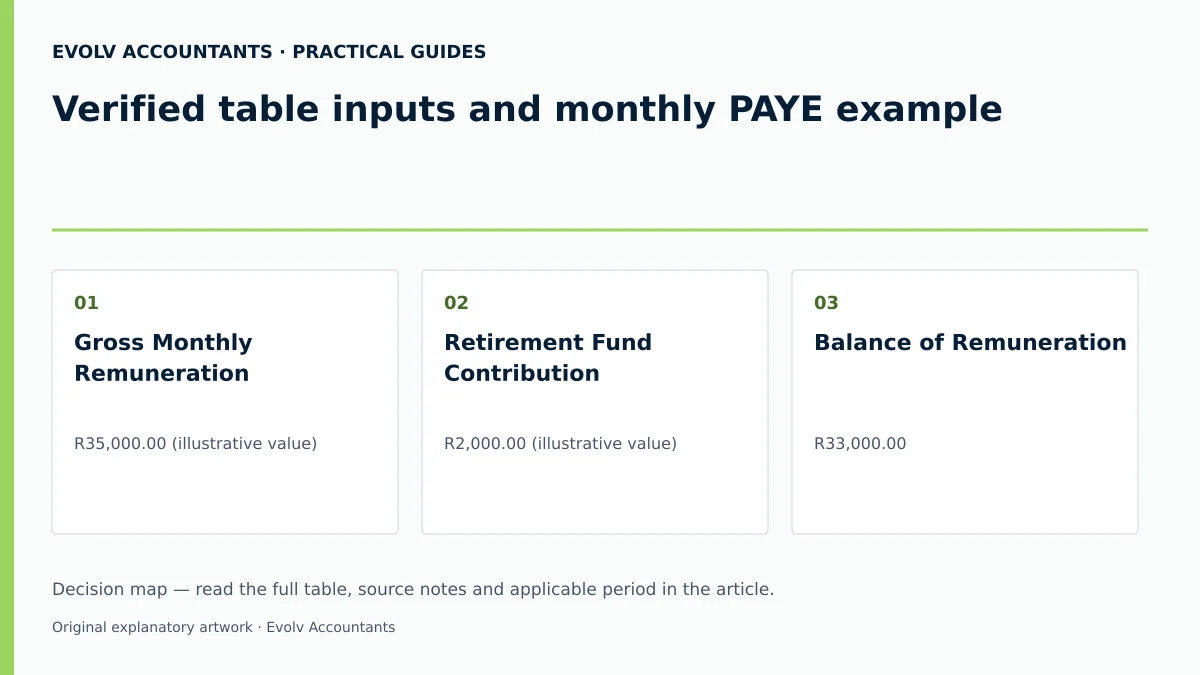
- Determine Gross Monthly Remuneration: Assume a basic monthly cash salary of R35,000.00 (illustrative value).
- Calculate Allowable Pre-Tax Deductions: Assume a monthly pension contribution of R2,000.00 (illustrative value). Verify that R2,000.00 is within the statutory 27.5% limit (27.5% of R35,000.00 = R9,625.00) and annual R430,000 cap 16.
- Determine Monthly Balance of Remuneration: Subtract allowable deductions from gross remuneration: R35,000.00 - R2,000.00 = R33,000.00 6 22.
- Calculate Annual Equivalent: Multiply the monthly balance of remuneration by 12 pay periods: R33,000.00 × 12 = R396,000.00 2.
- Compute Gross Annual Normal Tax: Apply the 2026/2027 tax brackets to R396,000.00 (bracket R383,101 to R530,200) 1:
- Base tax for bracket: R79,998.00 1.
- Marginal tax on excess: (R396,000.00 - R383,100.00) × 31% = R12,900.00 × 0.31 = R3,999.00 1.
- Total Gross Annual Tax: R79,998.00 + R3,999.00 = R83,997.00.
- Subtract Annual Primary Rebate: Deduct the primary rebate of R17,820.00 11: R83,997.00 - R17,820.00 = R66,177.00 net annual tax.
- Calculate Monthly PAYE Deduction: Divide the net annual tax by 12: R66,177.00 ÷ 12 = R5,514.75 per month.
Reproducible worked example table
| Input | Value or verified-source placeholder | Formula or step | Result | Independent check |
|---|---|---|---|---|
| Gross Monthly Remuneration | R35,000.00 (illustrative value) | Contractual monthly pay | R35,000.00 | Employment contract review |
| Retirement Fund Contribution | R2,000.00 (illustrative value) | Section 11F allowable deduction 8 | R2,000.00 | Verified under 27.5% / R430k cap 16 |
| Balance of Remuneration | R33,000.00 | Gross pay less retirement deduction 6 | R33,000.00 | R35,000 - R2,000 = R33,000 |
| Annual Equivalent | R396,000.00 | Monthly balance × 12 months 2 | R396,000.00 | R33,000 × 12 = R396,000 |
| Gross Annual Tax | R83,997.00 | R79,998 + 31% × (R396k - R383.1k) 1 | R83,997.00 | R79,998 + R3,999 = R83,997 |
| Primary Tax Rebate | R17,820.00 | 2027 statutory primary rebate 11 | R17,820.00 | Confirmed for individual under 65 11 |
| Net Annual PAYE Liability | R66,177.00 | Gross annual tax less primary rebate | R66,177.00 | R83,997 - R17,820 = R66,177 |
| Monthly PAYE Deduction | R5,514.75 | Net annual tax ÷ 12 months | R5,514.75 | R66,177 ÷ 12 = R5,514.75 |
Reconcile the answer to the underlying records: verified table inputs
To ensure payroll integrity and statutory compliance, employers must conduct structured monthly checks before remitting funds to SARS.
Required payroll reconciliation steps
- Verify Source Documents: Cross-reference payroll inputs against signed employment contracts, approved timesheets, and medical aid certificates 4 23.
- Reconcile Balances: Confirm that total gross remuneration minus verified allowable deductions equals the balance of remuneration across all employee records 4 6.
- Audit Monthly Declarations (EMP201): Match total calculated PAYE, SDL, and UIF on payroll software against the amounts declared on the monthly EMP201 return 21 24 25.
- Validate Payment Allocations: Ensure payments submitted via eFiling, e@syFile, or approved banking channels reflect the unique Payment Reference Number (PRN) to prevent misallocation 21 25 26.
Payroll compliance checklist
- Verify that all newly recruited employees have furnished full legal names, South African identity or passport numbers, and income tax reference numbers 4 23.
- Check that retirement fund deductions do not exceed the statutory monthly pro-rata limit of 27.5% or R430,000 per annum 16.
- Confirm that medical scheme tax credits are applied strictly in accordance with verified dependant numbers (R376 for taxpayer, R376 for first dependant, R254 for each additional dependant) 11 13.
- Audit variable remuneration items (such as overtime or bonuses) to ensure tax is withheld in the month of actual payment 27.
- Ensure monthly PAYE, SDL, and UIF payments are remitted on or before the 7th calendar day of the following month (or the last business day prior if the 7th falls on a weekend or public holiday) 26 28.
- Archive all payroll registers, payment proofs, and declaration returns for the mandatory five-year statutory retention period 3 29 30.
Edge cases that change the calculation: monthly paye example
Standard monthly PAYE calculations alter significantly under specific employment structures or variable pay arrangements.
Variable pay and Section 7B timing rules
Under Section 7B of the Income Tax Act, variable remuneration—including overtime, incentive bonuses, commission, night shift allowances, and leave pay encashment—is deemed to accrue only when actually paid to the employee 27. Employers must calculate PAYE on variable remuneration in the pay period during which the cash disbursement occurs rather than when earned 27 31.
Non-standard employment and casual workers
Employees working fewer than 22 hours per week who do not furnish a written declaration of sole employment fall under non-standard employment 23 32 33. PAYE on non-standard employment remuneration must be deducted at a flat rate of 25%, unless a specific SARS tax directive is provided 33.
Directors of private companies and CC members
Remuneration paid to directors of private companies and members of close corporations is subject to mandatory PAYE withholding 34. Special statutory formulas apply to determine deemed remuneration for directors to prevent tax avoidance through delayed salary drawdowns 34 35.
Motor vehicle and travel allowances
Where a travel allowance is granted, 80% of the allowance must be included in the employee's monthly balance of remuneration for PAYE calculation purposes 36. If the employer is satisfied that at least 80% of the vehicle's use during the tax year is for business purposes, the taxable inclusion rate may be reduced to 20% 36.
Shorter tax periods and annual equivalents
When an employee works for a portion of a pay period or a fraction of the tax year, an annual equivalent formula must be applied to determine the correct marginal tax bracket, preventing under- or over-withholding 2 37.
Next steps for PAYE and SDL
Maintaining an accurate payroll system requires clear operational procedures, structured methodology, and professional oversight.
Method and assumptions
Employers must establish standard operating practices that incorporate updated SARS tax tables, statutory rebate definitions, and allowable deduction caps at the start of every tax year 1 38. Systems must assume standard employment unless written declarations or formal directives dictate otherwise 23 32 33.
Distinguishing law, regulator guidance and advisory recommendations
- Legislation (Law): The Income Tax Act No. 58 of 1962, Skills Development Levies Act No. 9 of 1999, and Tax Administration Act No. 28 of 2011 mandate legal duties, registration timelines (within 21 business days), and late payment penalties (10% penalty plus interest) 39 40 41.
- Regulator Guidance (SARS Guides): External guides published by SARS detail operational completion steps for forms (EMP101, EMP102, EMP201, EMP501) and interpretation of fringe benefit rules 25 38 42 43.
- Evolv Recommendations: Evolv Accountants advises SMEs to implement dual-authorisation controls on payroll releases, conduct monthly pre-submission reconciliations, and review director remuneration structures quarterly.
Frequently Asked Questions
What is the statutory deadline for paying monthly PAYE, SDL, and UIF to SARS?
PAYE, SDL, and UIF contributions must be paid over to SARS within seven calendar days after the end of the month in which the tax was deducted 26 28. If the seventh day falls on a Saturday, Sunday, or public holiday, payment must be completed on the last business day prior to that day 26 28.
What happens if an employer submits a PAYE payment late?
A mandatory penalty of 10% is imposed on late or outstanding PAYE, SDL, and UIF payments, alongside interest charged at the prescribed rate 40 44. Intentional evasion may result in additional penalties up to twice the outstanding tax amount 40 45.
Must an SME register for SDL if its payroll is small?
An employer is exempt from registering for and paying SDL if there are reasonable grounds for believing that total leviable remuneration paid to all employees over the next 12-month period will not exceed R500,000 18 20 46.
How are medical scheme tax credits applied in payroll?
Medical scheme tax credits directly reduce the calculated annual PAYE liability 11 13. For the 2026/2027 tax year, monthly credits are R376 for the taxpayer, R376 for the first dependant, and R254 for each additional dependant 11 13.
How long must an employer keep payroll records?
Under Chapter 4 of the Tax Administration Act and the Fourth Schedule, employers must retain all employee registers, remuneration records, and tax returns for five years from the date of submission 3 29 30.
Related guides
- When an employer must register for PAYE
- Calculating PAYE for a weekly paid employee
- Compliance and Regulations: Keeping Your Business on Track
Sources
- Guide for Employers in Respect of Employees' Tax (2027) | South African Revenue Service
- Rates of Tax for Individuals | South African Revenue Service
- Skills Development Levy | South African Revenue Service
- https://www.sars.gov.za/wp-content/uploads/Ops/Guides/SDL-GEN-01-G01-Guide-for-Employers-in-respect-of-Skills-Development-Levy-External-Guide.pdf
- https://www.sars.gov.za/wp-content/uploads/Ops/Guides/EMP-REG-03-G01-Guide-for-completion-of-Employer-Registration-application-External-Guide.pdf