
Calculating taxable turnover for the VAT threshold
22 July 2026

Calculating taxable turnover requires identifying sales from enterprise activities while excluding non-taxable receipts and statutory exempt supplies.
For South African small and medium enterprises (SMEs), determining whether Value-Added Tax (VAT) registration is mandatory depends on calculating total taxable supplies across a consecutive 12-month period 1 2 3. Under current administrative guidance published on the South African Revenue Service (SARS) website, SARS administers the compulsory VAT registration threshold at R2.3 million in taxable turnover, whereas older published guides retain a reference to R1 million 1 4 5 6.
This administrative position governs registration applications and threshold testing, though it represents regulator administrative policy rather than a verified statutory amendment to section 23 of the VAT Act 5. Crucially, taxable turnover is not identical to total gross bank receipts: it encompasses standard-rated supplies (at 15%) and zero-rated supplies (at 0%), while strictly excluding exempt supplies, out-of-scope revenue, capital asset replacements, and the VAT component itself 7 8 9 10 11 12.
Evolv Accountants recommends that growing businesses perform monthly rolling 12-month reconciliations to ensure statutory compliance and avoid administrative penalties 3 13.
Taxable turnover versus total receipts
Defining accounting receipts and tax turnover
To evaluate VAT registration obligations correctly, SME owners must distinguish financial accounting receipts from statutory tax turnover 2 9 14.
- Output: The output of this calculation is the total monetary value of taxable supplies, expressed in South African Rand (ZAR / R) 9 15.
- Units: All supply values must be calculated exclusive of VAT 9 16.
- Period: Threshold testing is conducted across any consecutive 12-month rolling period (a historical check at month-end) or prospectively under a written contractual obligation for the next 12 months 1 3 4 17.
- Appropriate Use: This metric is used exclusively to test whether an SME has breached compulsory VAT registration thresholds, qualifies for voluntary registration, or must alter its allocated tax filing period 1 18 19.
Accounting vs tax distinctions
From a legal and accounting perspective, gross total receipts reflect every financial inflow recorded in a business bank account or income statement, including loans, owner capital injections, dividend income, exempt fees, and sales of private assets 9 12 20. In contrast, statutory tax law under the Value-Added Tax Act 89 of 1991 defines taxable turnover as the consideration received or accrued for supplying goods or services in the course or furtherance of an enterprise 9 10 14 21.
Regulator guidance from SARS confirms that non-enterprise inflows and exempt supplies do not constitute taxable turnover 7 11 22. Evolv Accountants advises clients that relying solely on total bank deposits for VAT registration leads to miscalculated thresholds, resulting in premature registration or unexpected non-compliance.
Inputs, rates, periods and exclusions: taxable turnover
Applicable tax rates and statutory thresholds
Every rate and threshold applied in South African VAT administration must be grounded in primary evidence:
— Practical point from this guide
- Standard Rate (15%): Levied on most commercial supplies of goods and services within South Africa 8 23.
- Zero Rate (0%): Applies to specific qualifying taxable supplies, including direct exports of goods, basic foodstuffs (such as brown bread, maize meal, and rice), and sales of going concerns under written agreement 8 24 25 26 27.
- Compulsory Registration Threshold (R2.3 million): Current SARS web guidance specifies that compulsory registration is triggered when taxable supplies in any consecutive 12-month period exceed R2.3 million, or where written contractual obligations require taxable supplies exceeding R2.3 million in the next 12 months 1 4. Historical SARS guides (such as VAT 404) cite a threshold of R1 million 6. SARS currently administers applications based on the R2.3 million administrative position 5.
- Voluntary Registration Threshold (R120,000 / R4,200 monthly average): Current SARS web guidance allows voluntary registration if taxable supplies exceeded R120,000 in a past 12-month period, or if taxable supplies for 1 month exceeded R4,200, or if average monthly taxable supplies across 2–11 months exceeded R4,200 per month 18 28. Older guides cite a historical R50,000 minimum 29 30.
- Commercial Accommodation Enterprise Threshold (R120,000): Commercial lodging activities constitute an enterprise only if annual turnover exceeds or is reasonably expected to exceed R120,000 in a 12-month period 7 31 32.
- Payments Basis Eligibility Threshold (R2.5 million): Natural persons and sole-member partnerships may account for VAT on the payments (cash) basis if taxable turnover does not exceed R2.5 million in a 12-month period 33 34.
- Category C Monthly Tax Period Threshold (R30 million): Vendors with annual taxable turnover exceeding R30 million are required to register under Category C for monthly VAT return submissions 19 35.
Inclusions, exclusions and missing inputs
To establish taxable turnover accurately, SMEs must categorise all enterprise transactions 9:
- Inclusions: Local sales and service fees charged at 15% 9 23; exported goods and zero-rated services at 0% 9 24; deemed supplies such as insurance indemnity payments received or trading stock taken for private use 9 36 37; and sales generated across all internal branches, operating divisions, or separate trading names belonging to the same legal entity 2 9 38 39.
- Exclusions: Statutory exempt supplies including financial services (credit interest, life policy fees), residential dwelling rentals, and public road/rail passenger transport 7 20; out-of-scope receipts such as private asset sales, government grants not tied to specific supplies, and unconditional donations 12 40; sales of capital plant, machinery, or property (unless closing down or permanently scaling back the enterprise) 9; and any VAT levied on supplies 9 16.
- Identifying Missing Inputs: When an SME presents accounting records with unallocated bank deposits, mixed sales where standard and exempt items are aggregated, or missing sales invoices, these missing inputs prevent verified threshold calculations. Evolv Accountants recommends isolating unclassified receipts immediately to verify tax status before finalising threshold submissions.
The calculation in a worked example: total receipts
Step-by-step calculation methodology
To demonstrate how an SME converts total receipts into verified taxable turnover, consider a hypothetical South African business, Apex Retail and Consulting Services (Pty) Ltd, operating in the domestic market. The company reviews its bank statement inflows and accounting ledgers for the 12-month period ending 30 September 2026.
Total gross bank deposits recorded for the 12-month period equal R3,150,000 [Illustrative]. This figure includes diverse financial transactions that must be systematically adjusted under tax rules 9.
Reproducible worked example
The worked example below illustrates the step-by-step arithmetic required to isolate taxable turnover and test against the R2.3 million administrative compulsory registration threshold 1 4 9:
| Input | Value or verified-source placeholder | Formula or step | Result | Independent check |
|---|---|---|---|---|
| Gross Bank Receipts | R3,150,000 [Illustrative] | Total bank deposits over 12 consecutive months | R3,150,000 | Reconcile to 12 monthly bank statements 3 |
| Owner Capital Injection | R250,000 [Illustrative] | Subtract non-enterprise financial inflow 9 12 | R2,900,000 | Verify bank credit against loan/capital agreement 12 |
| Exempt Financial Services Interest | R120,000 [Illustrative] | Subtract exempt supply receipts under section 12 7 9 20 | R2,780,000 | Confirm bank interest income ledger 20 |
| Sale of Delivery Van (Capital Asset) | R180,000 [Illustrative] | Subtract sale of old capital asset being replaced 9 | R2,600,000 | Inspect fixed asset register and invoice 9 |
| Standard-Rated Domestic Sales (incl. VAT) | R2,070,000 [Illustrative] | Isolate VAT component: R2,070,000 × (15 / 115) = R270,000 VAT; Net = R1,800,000 8 9 16 | R1,800,000 (excl. VAT) | Cross-check sales invoice register 9 41 |
| Zero-Rated Export Sales | R650,000 [Illustrative] | Add zero-rated taxable supplies at 0% 9 24 27 | R2,450,000 | Inspect SARS customs release notifications 24 27 |
| Total Taxable Turnover | R2,450,000 | Sum of standard-rated (excl. VAT) and zero-rated supplies 1 9 | R2,450,000 | Total Taxable Turnover = R1,800,000 + R650,000 9 |
| Registration Threshold Test | R2,300,000 [Administrative Threshold] | Compare Taxable Turnover (R2,450,000) against SARS administrative threshold (R2,300,000) 1 4 5 | Exceeds threshold by R150,000 | Compulsory registration required within 21 business days 4 17 |
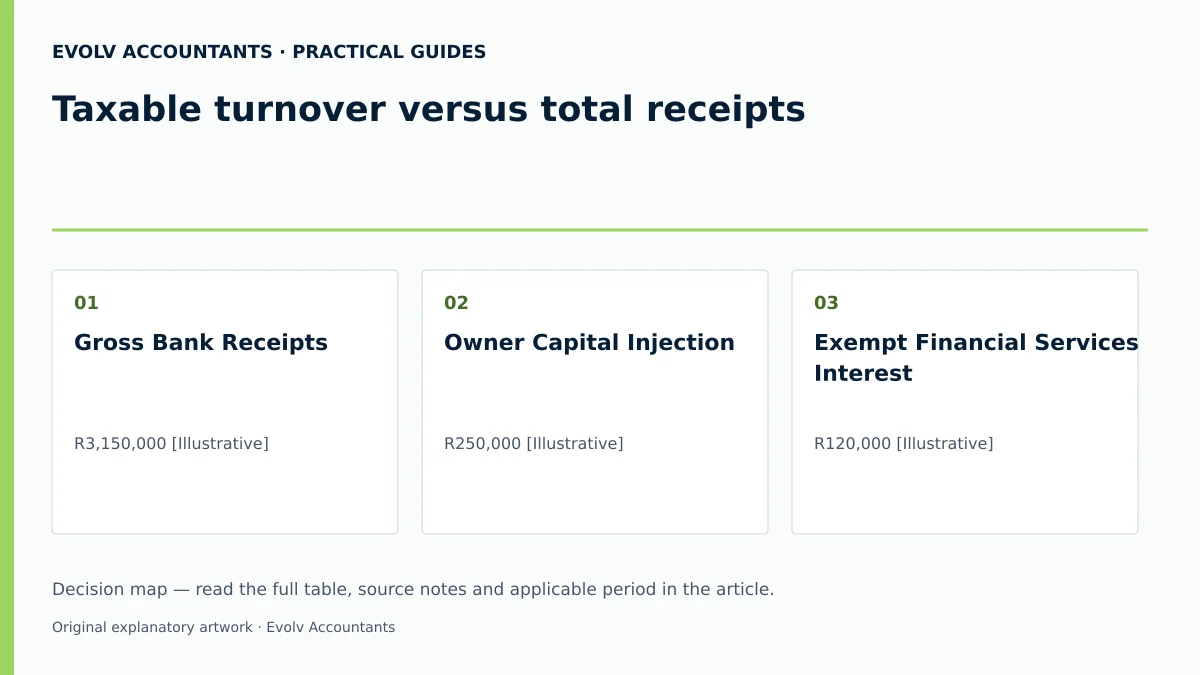
Arithmetic Verification: Gross receipts (R3,150,000) less non-enterprise capital (R250,000), exempt interest (R120,000), capital asset sale (R180,000), and output VAT collected (R270,000) equals total taxable turnover of R2,450,000 (comprising R1,800,000 standard-rated net sales + R650,000 zero-rated exports) 9 16. Because R2,450,000 exceeds the SARS administrative threshold of R2,300,000, compulsory registration is required 1 4.
Note: Illustrative values are sample amounts used for calculation demonstration and do not establish statutory limits 1.
Reconcile the answer to the underlying records: taxable turnover
Audit trail and record retention
South African tax legislation and SARS guidance mandate that every vendor or prospective applicant maintain comprehensive accounting records forming a verifiable audit trail 13 42 43. All supporting records—including tax invoices, credit/debit notes, bank statements, bills of entry, and sales registers—must be retained for at least 5 years 13 42 44.
Key reconciliation controls
Evolv Accountants recommends executing five core reconciliation controls before submitting a threshold application to SARS 2 13 45 46:
- Gross Receipts vs Invoice Registers: Reconcile total bank deposits against issued sales invoices to eliminate non-revenue inflows (such as director loans or internal transfers) and ensure uncollected credit sales are accounted for under the invoice accounting basis 9 47 48.
- Standard-Rated vs Zero-Rated vs Exempt Segmentation: Verify that zero-rated supplies (e.g. exports) possess mandatory documentary proof (such as Customs release notifications) 24 27. If export documentation is missing, SARS requires the supply to be treated as standard-rated 24 49.
- Credit and Debit Note Adjustments: Ensure that cancelled sales, returned goods, or price adjustments are supported by valid credit or debit notes, and that turnover calculations reflect net adjusted amounts 45 50 51.
- Cash Transaction Rounding: Check that cash transaction rounding differences applied on cash sales do not lead to miscalculated gross turnover figures 52 53.
- Invoice Limits and Details: Ensure tax invoices issued for standard-rated supplies satisfy statutory content requirements. Full tax invoices are required for consideration of R5,000 or more (reflecting recipient name, address, and VAT number), while abridged tax invoices are permissible for supplies under R5,000 46 54.
Edge cases that change the calculation: total receipts
Variable periods, multiple branches, and going concerns
Specific legal and operational edge cases modify how total receipts are evaluated for threshold testing:
- Multiple Branches and Separately Identified Divisions: A sole proprietor or corporate entity operating multiple business activities under separate trading names or branches cannot evaluate turnover individually to avoid registration 2 38 39. SARS requires combining the taxable turnover of all branches and divisions under the single person 2 39. While separate VAT numbers may be requested for distinct branches maintaining independent accounting systems, liability is established at the aggregated entity level 38 39 55.
- Acquisition of a Going Concern: When an SME acquires an existing enterprise or part of a business as a going concern, the purchasing entity must include the taxable turnover generated by the seller in the preceding 12 months when determining registration liability 18 26 56 57.
- Written Contractual Obligations: If a business enters into a binding written contractual agreement that guarantees taxable supplies exceeding R2.3 million over the next 12 months, compulsory registration is triggered immediately at the commencement of the month in which the contract becomes effective, without waiting for historical sales to accumulate 3 4 17.
- Commercial Accommodation: Short-term lodging activities are excluded from the enterprise definition unless annual receipts exceed or are reasonably expected to exceed R120,000 in a consecutive 12-month period 7 31 32. Receipts below R120,000 cannot form part of taxable turnover 7 31.
- Non-Resident Electronic Services: Non-resident suppliers of electronic services and digital intermediaries supplying South African recipients are subject to compulsory registration when taxable supplies exceed the statutory/administrative threshold 4 17 58.
Next steps for VAT registration
Actionable compliance checklist
When an SME's rolling 12-month taxable turnover approaches or exceeds the R2.3 million administrative threshold, the business should follow a structured action plan 1 4 17 59:
- Calculate Rolling Taxable Turnover Monthly: Perform a formal monthly reconciliation isolating standard-rated and zero-rated sales from exempt income and capital asset sales 3 9.
- Determine Exact Liability Date: Identify the precise date on which total taxable supplies exceeded or will contractually exceed R2.3 million 3 4 60.
- Assemble Prescribed Supporting Documentation: Gather acceptable proof of turnover, including signed financial statements, copies of issued sales invoices, signed contracts, or lease agreements 59 61 62. Note that projected business plans, unawarded tender proposals, and non-factual cash flow projections are strictly rejected by SARS as proof of turnover 63.
- Submit Application Within 21 Business Days: Complete and submit the VAT registration application (via SARS eFiling or by booking a virtual appointment via the eBooking system) within 21 business days of becoming liable 4 17 59.
- Prepare Representative Taxpayer Details: Appoint a local South African resident as representative vendor (e.g. public officer or director) and ensure bank account details match the entity name 60 64.
- Respond to Validation Notices: If SARS issues a Registration Application Review Notice, submit requested supporting documents within 21 business days to avoid application rejection 65 66.
Frequently Asked Questions
What is the difference between compulsory and voluntary VAT registration?
Compulsory VAT registration is legally required when an enterprise's taxable turnover exceeds or is contractually obligated to exceed R2.3 million in a 12-month period 1 4. Voluntary VAT registration is optional for enterprises whose taxable turnover is below R2.3 million, provided they meet the minimum voluntary threshold (exceeding R120,000 in a 12-month period or an average of R4,200 per month) and meet SARS record-keeping requirements 18 28 67.
Should I include the sale of company equipment or property in my threshold calculation?
No, sales of old plant, machinery, delivery vehicles, or other capital assets being replaced are explicitly excluded from taxable turnover calculations 9. Capital asset sales are only included if the transaction represents a permanent shutdown or substantial reduction in the overall scale of the enterprise 9.
How quickly must I apply for VAT registration once my business hits the threshold?
SARS regulations mandate that an enterprise must submit its compulsory VAT registration application within 21 business days from the end of the month in which the R2.3 million taxable turnover threshold was exceeded or contractually established 4 17.
Can I choose whether to account for VAT on the cash received basis?
Most vendors are legally required to account for VAT on the invoice (accrual) basis 47 48. Accounting on the payments (cash) basis is restricted to natural persons or sole-member partnerships with annual taxable supplies not exceeding R2.5 million, public authorities, welfare organisations, or non-resident electronic service providers, and requires formal written application and approval from SARS 33 34 68.
What supporting documents does SARS accept to verify my business turnover?
SARS accepts signed financial statements, copies of issued tax invoices, signed commercial contracts, registered property lease agreements, and sale agreements 61 62. SARS explicitly rejects business plans, projected cash flow forecasts, orders placed without proof of delivery, and unawarded tender proposals as proof of taxable turnover 63. Ask Evolv about taxable turnover versus total receipts. Share the relevant records so the support required can be scoped.
Related guides
- When a South African business must register for VAT
- Voluntary VAT registration requirements for a new business
- The Proactive SARS Audit Guide: Keeping Your Business Ledger Sanitised
Sources
- Register for VAT | South African Revenue Service
- https://www.sars.gov.za/wp-content/uploads/Ops/Guides/Legal-Pub-Guide-VAT404-VAT-404-Guide-for-Vendors.pdf
- Obligations of a VAT vendor | South African Revenue Service
- https://www.sars.gov.za/wp-content/uploads/Ops/Guides/VAT-REG-02-G01-Guide-for-Completion-of-VAT-Application-External-Guide.pdf