
Voluntary VAT registration requirements for a new business
20 June 2025

Voluntary VAT registration requires South African businesses carrying on an enterprise to satisfy South African Revenue Service threshold rules and present compliant primary evidence.
New South African businesses that have not reached compulsory turnover limits can access voluntary Value-Added Tax (VAT) registration to claim legitimate input tax deductions on startup costs and meet commercial client requirements 1 2 3. To secure registration, an enterprise must demonstrate actual or expected taxable supplies using verified primary documentation acceptable to the South African Revenue Service (SARS) 2 4 5 6. Unbacked financial projections and unawarded tender proposals are explicitly rejected during SARS verification 7 8.
Voluntary registration routes and supporting evidence
This practical guide assists directors, financial managers, and sole proprietors operating small to medium enterprises (SMEs) across the Republic of South Africa. It covers the administrative requirements for voluntary VAT registration, detailing what complete and verified submission entails.
Under South African tax administration, registration completion requires obtaining an official SARS Notice of Registration and establishing verified vendor status on eFiling 9 10 11. Simply submitting an application form or receiving an automated system reference number does not constitute legal registration 9 10.
Legal and administrative threshold positions
South African tax law distinguishes between statutory provisions, regulator guidance, and professional advisory recommendations 2 12 13 14. While the statutory compulsory registration threshold of R1 million is retained in historical guides 15, current SARS online registration guidance administers a compulsory threshold of R2.3 million in taxable supplies made or expected within a consecutive 12-month period 1 12.
— Practical point from this guide
This reflects the administrative position currently implemented by SARS on eFiling rather than an unqualified statutory amendment 12 16.
For voluntary registration, older reference guides set the baseline minimum taxable turnover at R50,000 17 18. Current SARS registration guidance administers voluntary registration based on an increased threshold of R120,000 in taxable supplies 2 4. Under current administrative rules, a new business qualifies for voluntary registration through one of five primary routes 2 4:
- Historical turnover: Making actual taxable supplies exceeding R120,000 in the preceding 12 months 2.
- Short-term average turnover: Demonstrating taxable supplies exceeding R4,200 in a single month prior to application, or an average of R4,200 per month over 2 to 11 months 4.
- Written contractual obligations: Holding a binding written agreement to make taxable supplies exceeding R120,000 within 12 months following registration 4.
- Finance agreements: Entering a credit or finance agreement with a registered financial provider where 12-month repayments exceed R120,000 4.
- Capital expenditure: Incurring expenses or acquiring capital assets for commencing an enterprise where total payments exceed R120,000 4.
Prepare the information and authority: voluntary registration routes
Before initiating an electronic or branch application, applicants must assemble all statutory corporate particulars and verified primary financial evidence 5 19 20.
Statutory definitions and enterprise qualifications
A business can only register for VAT if it carries on an "enterprise" 21 22. An enterprise is defined as any activity carried on continuously or regularly in or partly in South Africa, where goods or services are supplied to another person for a consideration, whether for profit or not 21 22. The statutory definition of a "person" includes natural individuals, private companies, close corporations, partnerships, trust funds, and municipalities 21 23.
Primary supporting documents and acceptable proof
SARS mandates specific primary evidence to substantiate financial metrics 5 6:
- Acceptable financial evidence: Signed commercial contracts, tax invoices issued to clients, signed lease agreements, bank statements reflecting client payments, signed financial statements, or awarded tender letters accompanied by executed contracts 6.
- Unacceptable evidence: Business plans, cash flow projections, purchase orders without proof of supply, or tender proposals prior to official award 7 8.
- Representative vendor particulars: Every corporate entity must appoint a representative taxpayer residing in South Africa (such as the CIPC-registered Public Officer) 24 25 26.
- Power of Attorney (POA): If an authorised tax practitioner submits the application on behalf of the enterprise, a formal SARS Power of Attorney must accompany the submission 24 27.
- Banking evidence: Proof of an operational bank account in the Republic opened in the name of the vendor 28 29. Third-party bank details are strictly restricted to holding or subsidiary companies within a registered group structure and require a signed form VAT119i indemnity 29 30.
Complete the task step by step: supporting evidence
Applicants should follow a structured sequence when completing the voluntary registration task on SARS eFiling 20 31 32:
- Establish eligibility and select the registration route: Identify whether the enterprise qualifies under historical turnover, monthly average sales, written contracts, finance agreements, or capital expenditure 4 33.
- Navigate to SARS Registered Details: Log into the enterprise eFiling profile, navigate to Organisations, select SARS Registered Details, and choose Maintain SARS Registered Details (Form RAV01) 31 32.
- Complete the VAT container details:
- Select Add new product registration for VAT 20 32.
- Enter the requested liability date (for voluntary registrations, this is set to the application date; backdating is strictly disallowed without prior written SARS approval and justification) 9 20 34.
- Specify the correct 4-digit Business Activity Code derived from the VAT 403 Trade Classification Guide 20 35.
- Select the preferred accounting basis (the standard Invoice/accrual basis applies automatically unless eligibility for the Payments/cash basis is formally approved) 20 36 37 38.
- Select the tax period category (Category A or Category B two-monthly cycles are standard) 20 39.
- Perform biometric authentication: The representative taxpayer must complete facial biometric authentication via the eFiling system or SARS MobiApp when prompted 10 32.
- Submit supporting documents: Upon submission, if SARS issues a Registration Application Review Notice, upload all requested primary documents via eFiling or the SARS Online Query System within 21 business days 10 40.
Check the result against the evidence: voluntary registration routes
Submission of form RAV01 does not guarantee immediate registration 9 10. SARS evaluates application risk before issuing a VAT registration number 10 41.
Independent verification of VAT vendor status
Applicants must independently confirm that voluntary registration has been successfully granted 11 42:
- Download official Notice of Registration: Log into eFiling, navigate to SARS Registered Details, select Notice of Registration, and generate the official VAT Notice of Registration document 11.
- Public Vendor Search: Perform an independent search on the official SARS website using the VAT Vendor Search portal to confirm that the business trading name and 10-digit VAT number are listed as active 11 41 42.
- Verify tax period and obligations: Ensure the Notice of Registration accurately reflects the allocated tax period (Category A or B) and accounting basis 11 37 39.
Upon confirmation, the vendor is legally obligated to charge 15% output tax on standard-rated supplies, quote inclusive prices in all advertising, issue full tax invoices for supplies exceeding R5,000, submit periodic VAT201 declarations on time, and retain all accounting records for at least five years 3 43 44 45 46 47.
Handle exceptions and unresolved cases: supporting evidence
Specific operational scenarios require careful handling to prevent application rejection 7 28:
- Unawarded tenders: An enterprise intending to submit a tender cannot register for VAT in anticipation of winning the contract 7. SARS will refuse voluntary registration until the tender outcome is final and the contract is officially awarded 7 8.
- Nature of activity regulation (GN 446): Businesses engaging in specific long-term activities (such as agriculture, mining, property development, or plant manufacturing) where taxable supplies are made only after a period of time may register voluntarily before making supplies, provided regulatory permits or licenses are produced 2 16 48.
- Acquisition of a going concern: When purchasing an operational enterprise, voluntary registration is permissible if the seller's historical taxable turnover exceeded the voluntary threshold in the preceding 12 months 2 49 50.
- Grounds for refusal: SARS is statutorily empowered to refuse a voluntary application if the applicant lacks a fixed business or residential address, fails to keep proper accounting records, lacks a South African bank account, or previously defaulted on vendor duties 28.
- Specialist boundaries: Accounting and tax advisory support assists with documentation preparation and eFiling navigation; however, formal legal disputes regarding rejected registrations require legal counsel or official administrative appeals via form DISP01 51 52.
Next steps for VAT registration
To execute a voluntary VAT registration efficiently, follow this practical checklist:
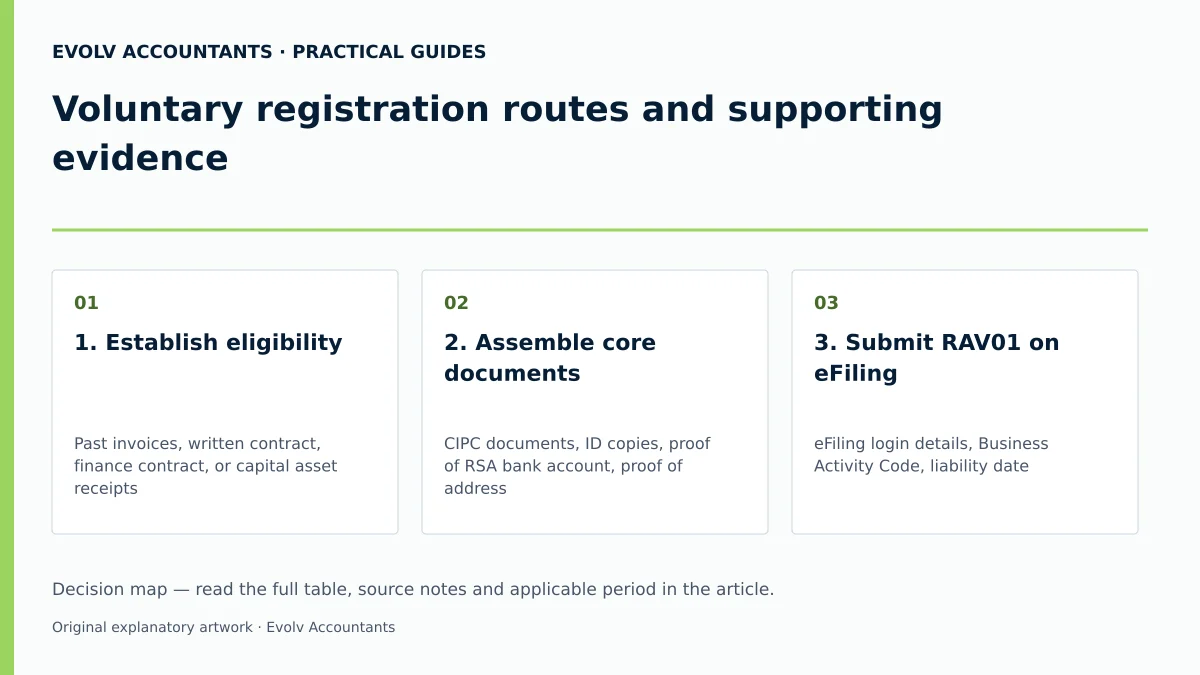
| Step | Input or evidence | Responsible person | Completion check | Exception or next action |
|---|---|---|---|---|
| 1. Establish eligibility | Past invoices, written contract, finance contract, or capital asset receipts 4 6 | Public Officer / Finance Manager | Verified turnover or expenditure exceeds R120,000 threshold 2 4 | If threshold is not met, evaluate GN 446 nature of activity rules 2 48 |
| 2. Assemble core documents | CIPC documents, ID copies, proof of RSA bank account, proof of address 5 19 28 29 | Representative Taxpayer | All supporting documents are less than 3 months old 5 53 | Complete form VAT119i if using group third-party bank details 29 |
| 3. Submit RAV01 on eFiling | eFiling login details, Business Activity Code, liability date 20 31 | Authorised Representative or Tax Practitioner | System confirmation and case reference number generated 32 40 | Complete biometric authentication if requested 10 32 |
| 4. Upload primary evidence | Primary contract, client tax invoices, bank statements 6 40 | Representative Taxpayer / Practitioner | All files uploaded to SARS eFiling within 21 business days 40 | Ensure no unapproved files (e.g. business plans) are submitted 8 |
| 5. Verify registration status | eFiling profile / SARS VAT Vendor Search 11 41 | Finance Manager | Official Notice of Registration downloaded and archived 11 | Update sales invoicing systems to levy 15% VAT on supplies 3 43 |
Reproducible hypothetical example
Consider Apex Engineering (Pty) Ltd, a newly incorporated South African enterprise providing industrial maintenance services 21 23. During its first two months of trading, Apex Engineering earned R25,000 in Month 1 and R35,000 in Month 2 from taxable client services 4 54.
- Turnover calculation: Total 2-month taxable sales = R60,000 4 54. Monthly average = R30,000 per month 4 54.
- Threshold check: The monthly average of R30,000 comfortably exceeds the SARS administrative voluntary threshold of R4,200 per month for multi-month trading 4 54.
- Initial tax calculation:
- Standard-rated maintenance fees billed to clients = R100,000 (excluding VAT) 3 55.
- Output tax levied at 15% = R15,000 3 55. Total billed = R115,000 3.
- Input tax incurred on workshop equipment purchases = R60,000 (VAT inclusive at 15%) 3 56. Input tax claimable = R60,000 × (15 / 115) = R7,826.09 44 56.
- Net VAT liability payable to SARS for the period = R15,000 (Output) - R7,826.09 (Input) = R7,173.91 44 56.
Frequently Asked Questions
1. What is the minimum threshold required for voluntary VAT registration in South Africa?
While older guide references mention a R50,000 baseline 17 18, current SARS registration guidance administers voluntary registration based on an increased threshold of R120,000 in taxable supplies (or an average of R4,200 per month for 2 to 11 months) 2 4.
2. Can a new SME register for VAT voluntarily using cash flow projections or business plans?
No. SARS explicitly lists cash flow projections, business plans, unfulfilled orders, and unawarded tender proposals as unacceptable evidence for proving taxable turnover 8.
3. How long does SARS take to issue a VAT reference number after application submission?
Where no risk is identified, SARS issues a VAT reference number immediately upon application 31 41. If risk validation is triggered, SARS issues a Review Notice requesting supporting documents within 21 business days 10 40.
4. What accounting basis applies to a newly voluntarily registered VAT vendor?
By default, all vendors account for VAT on the Invoice (accrual) basis 20 36 37. Natural persons or sole proprietors with annual turnover under R2.5 million can apply to account on the Payments (cash) basis 38.
5. Can a business register voluntarily for VAT before a tender contract is officially awarded?
No. SARS will deny VAT registration applications submitted in anticipation of being awarded a tender 7 8. Application is permitted only after the tender outcome is final and the contract is formally awarded 6 7.
Related guides
- When a South African business must register for VAT
- VAT registration documents for a private company
- The Proactive SARS Audit Guide: Keeping Your Business Ledger Sanitised
Sources
- Register for VAT | South African Revenue Service
- https://www.sars.gov.za/wp-content/uploads/Ops/Guides/Legal-Pub-Guide-VAT404-VAT-404-Guide-for-Vendors.pdf
- https://www.sars.gov.za/wp-content/uploads/Ops/Guides/VAT-REG-02-G01-Guide-for-Completion-of-VAT-Application-External-Guide.pdf
- FAQs for VAT vendors | South African Revenue Service
- Obligations of a VAT vendor | South African Revenue Service