
When a South African business must register for VAT
24 August 2026

VAT registration is compulsory under current SARS guidance when taxable supplies exceed R2.3 million in a rolling 12-month period.
Under current South African Revenue Service (SARS) administrative policy, value-added tax (VAT) registration becomes mandatory when an enterprise's total value of taxable supplies exceeds or is contractually obligated to exceed R2.3 million within any consecutive 12-month period 1 2.
While older SARS operational documents—such as the VAT 404 Guide for Vendors—reflect a historical statutory threshold of R1 million 3, SARS actively administers new and current VAT registration applications based on the R2.3 million threshold published on its official registration portal 1 4. This guidance distinction represents the prevailing SARS administrative position rather than an unqualified statutory amendment claim 4.
To determine liability, South African small and medium-sized enterprises (SMEs) must evaluate their specific supply types, historical revenue records, and binding written agreements 2 5 6.
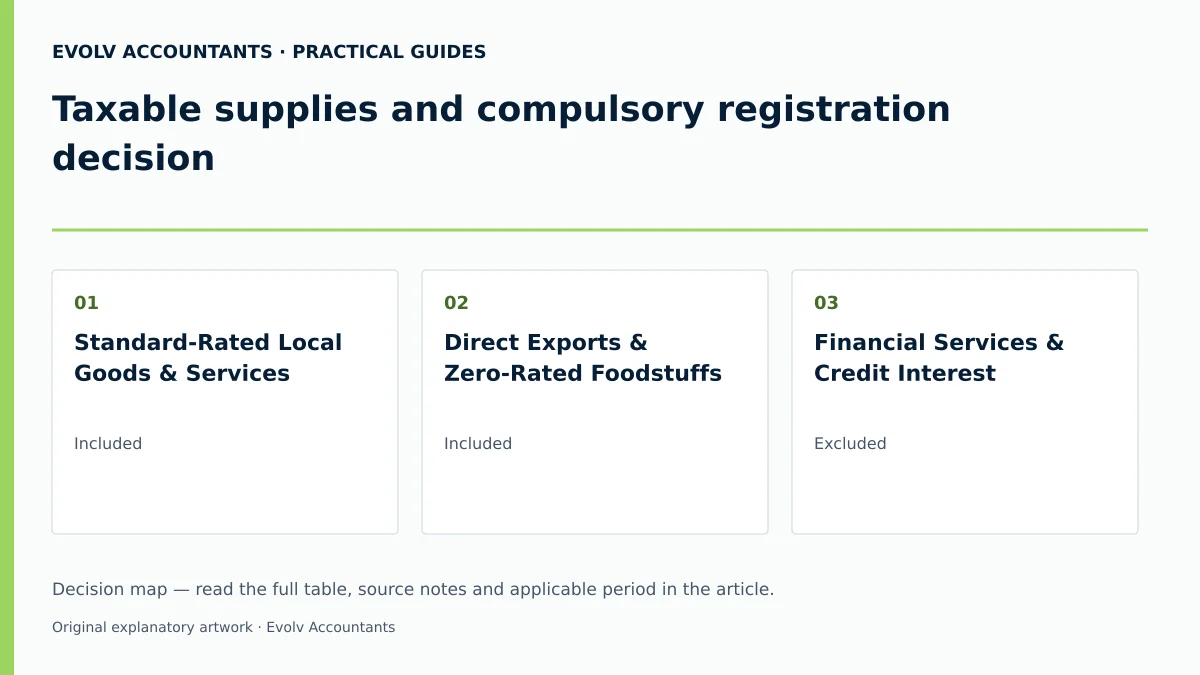
Taxable supplies and compulsory registration decision
To make an accurate compulsory registration decision, a business owner or management team must separate basic eligibility from statutory obligation 1 7. Every business structure in South Africa—including sole proprietors, private companies (Pty Ltd), close corporations (CC), partnerships, trust funds, and municipalities—is defined as a "person" for VAT purposes 7 8. However, a person is only eligible to enter the VAT system if that person is actively carrying on an "enterprise" 7.
As stated by the South African Revenue Service, "[a] person can only register for VAT if they are carrying on an enterprise" 7. An enterprise is defined as any activity carried on continuously or regularly in or partly in South Africa, where goods or services are supplied to another person for consideration, whether or not for profit 7.
Once enterprise activity is established, the compulsory registration decision is governed by the total value of taxable supplies generated over a rolling timeframe 1 2 9:
- Historical Threshold: Compulsory registration is triggered if the total value of taxable supplies made in any consecutive period of 12 months has exceeded R2.3 million 2.
- Contractual Forward Threshold: Compulsory registration is triggered if a person enters into a binding written contractual obligation to make taxable supplies exceeding R2.3 million in a 12-month period 2.
- Statutory Timeline: Once the R2.3 million threshold is reached or contractually established, the enterprise must submit a formal VAT registration application to SARS within 21 business days 2 10.
While historical guides cite R1 million 3, SARS currently enforces the R2.3 million administrative threshold on registration applications submitted via eFiling and SARS branches 1 4.
The qualification tests to check: taxable supplies
Determining whether a business has met the compulsory threshold requires testing all supplies against statutory definitions rather than relying on total accounting turnover or business size labels 9 11.
Test 1: The Enterprise Test
The entity must perform an activity continuously or regularly within South Africa that supplies goods or services for consideration 7. Activities that fall outside the enterprise definition include private hobbies, occasional private sales of personal assets, and earning a salary or wage as an employee 12.
Test 2: The Taxable Supplies Test
Taxable supplies encompass all sales and fees charged in the course of an enterprise that attract VAT at either the standard rate (currently 15%) or the zero rate (0%) 11 13 14 15:
- Standard-Rated Supplies (15%): Commercial sales of local goods, professional services (such as accounting, legal, and engineering advice), commercial property rentals, and construction work 16 17 18.
- Zero-Rated Supplies (0%): Direct exports of goods to foreign countries, fuel levy goods, international passenger transport, and designated basic foodstuffs such as brown bread, maize meal, and fresh fruit 15 19 20 21. Zero-rated supplies must be included when calculating the R2.3 million threshold 22 23.
Test 3: Exclusions and Non-Taxable Supplies
The following revenue streams are strictly excluded when assessing the compulsory registration threshold 12 22 24:
- Exempt Supplies: Revenue derived from financial services (such as credit interest and life insurance), residential accommodation rentals in a dwelling, public road and rail passenger transport, and approved educational services 12 25 26 27.
- Out-of-Scope Activities: Private asset sales, unconditional donations to non-profit bodies, and statutory supplies by un-notified public authorities 25 28 29.
- Commercial Accommodation Special Threshold Rule: The supply of short-term commercial accommodation (such as guest houses or holiday lets) is excluded from enterprise activity unless total annual receipts exceed, or are reasonably expected to exceed, R120,000 in a 12-month period 12 30 31.
| Supply Category | Included in R2.3m Threshold Calculation? | Applicable VAT Rate Upon Registration |
|---|---|---|
| Standard-Rated Local Goods & Services | Included 22 | 15% 16 |
| Direct Exports & Zero-Rated Foodstuffs | Included 22 23 | 0% 15 |
| Financial Services & Credit Interest | Excluded 22 25 | Exempt (No VAT) 24 32 |
| Residential Dwelling Letting | Excluded 12 22 | Exempt (No VAT) 24 27 |
| Disposal of Old Capital Equipment | Excluded 22 | Standard 15% on sale if vendor 22 |
Evidence behind the eligibility decision: compulsory registration decision
SARS subjects all VAT registration applications to rigorous risk validation 33. The representative taxpayer—such as the public officer of a private company, the main member of a CC, or the main trustee of a trust—is legally responsible for verifying all submitted documentation 34 35.
To substantiate a compulsory registration decision, the representative taxpayer must assemble primary evidence that proves actual or contractually guaranteed turnover 6 36:
— Practical point from this guide
- Compulsory Revenue Evidence: Copies of tax invoices issued, signed annual financial statements, signed customer contracts, or official written notifications confirming the award of a tender 6 36.
- Going Concern Evidence: In the case of an enterprise acquired as a going concern, formal proof of the taxable supplies generated by the seller must be submitted 6 37.
- Banking and Entity Verification: Proof of an active South African business bank account in the applicant's name 38 39. Where a subsidiary company uses a holding company bank account, a signed VAT119i indemnity form is mandatory 39 40 41.
- Disallowed Non-Factual Documentation: SARS explicitly rejects non-factual submissions, including cash flow projections, unfulfilled purchase orders without proof of delivery, business plans, and tender proposals prior to contract award 42.
A qualifying case and an excluded case: taxable supplies
The practical application of the compulsory registration criteria is illustrated in the following two hypothetical cases:
Hypothetical Example A: Apex Engineering CC (Qualifying Case)
Apex Engineering CC provides mechanical repairs and industrial equipment maintenance in Gauteng. Between November 2025 and August 2026 (a 10-month period), Apex Engineering CC issues standard-rated invoices totalling R2,450,000 to local manufacturing clients.
- Analysis: Apex Engineering CC carries on an enterprise supplying standard-rated services 7 16. Because its total taxable supplies exceeded the R2.3 million threshold within a consecutive 12-month period 2, compulsory registration is triggered.
- Required Action: Apex Engineering CC's representative taxpayer must submit a VAT registration application via eFiling within 21 business days of crossing the threshold 2 43.
Hypothetical Example B: Beacon Haven Properties (Pty) Ltd (Excluded Case)
Beacon Haven Properties (Pty) Ltd owns a residential apartment complex in Cape Town and earns R3.2 million annually strictly from long-term residential leases.
- Analysis: Under section 12(c) of the VAT Act, the letting of a dwelling for residential accommodation is an exempt supply 12 27. Exempt supplies are not taxable supplies and cannot be counted toward the R2.3 million threshold 22 24.
- Required Action: Because Beacon Haven Properties (Pty) Ltd makes exclusively exempt supplies, it does not carry on an enterprise for VAT purposes and is legally prohibited from registering as a VAT vendor, regardless of its revenue magnitude 24 44.
What changes the answer: compulsory registration decision
A business's VAT registration status is not static. Operational and structural changes require immediate reassessment by management 45:
- Winning Binding Contracts: If a non-vendor business signs a written contract guaranteeing taxable supplies exceeding R2.3 million over the next 12 months, the liability date arises immediately upon contract execution 2 5.
- Changes in Activity Mix: If an exempt business (such as a residential lessor) introduces commercial property rentals or consulting services, those new taxable supplies must be monitored separately against the registration threshold 16 27.
- Business Reorganisation: Converting a sole proprietorship into a private company creates a distinct legal entity 46. The new company cannot inherit the sole proprietor's VAT number and must submit a fresh registration application if threshold requirements are met 47.
- Turnover Surges (Category C Transition): If an existing VAT vendor's taxable supplies exceed R30 million in any consecutive 12-month period, the vendor must notify SARS in writing within 21 days to move from two-monthly tax returns (Category A or B) to monthly tax returns (Category C) 48 49 50.
- Duty to Update Details: Vendors must notify SARS within 21 business days of any change in registered particulars, representative taxpayer, business address, or banking details 45 51.
Next steps for VAT registration
SME leadership teams should follow this step-by-step checklist to prepare for and execute a compliant VAT registration:
- Audit Historic Revenue: Calculate the exact total of standard-rated and zero-rated supplies generated over the preceding 12 months 2 22.
- Review Forward Contracts: Identify any signed, legally binding agreements that mandate taxable supplies exceeding R2.3 million over the next 12 months 2 5.
- Purge Non-Taxable Streams: Deduct all exempt financial services, residential rentals, and capital asset replacement sales from the threshold calculation 12 22.
- Compile Primary Records: Gather signed sales invoices, financial statements, bank statements, CIPC entity documents, and identity documents for the representative taxpayer 6 36 52.
- Formally Authorise Representation: If using an external tax practitioner, execute a formal SARS Power of Attorney (POA) and complete eFiling access approvals 43 53.
- Submit Application & Verify: Submit form RAV01 via eFiling or attend a virtual SARS appointment 54 55. Upload all requested supporting documents within 21 business days of receiving a review notice to prevent application rejection 33 56.
Frequently Asked Questions
Can a business register for VAT if its turnover is under R2.3 million?
Yes. A business may apply for voluntary VAT registration if its historical taxable supplies exceeded R120,000 in the past 12 months 57 58. Under specific regulations (such as GN R447 and GN R446), voluntary registration is also permitted if average monthly sales exceeded R4,200 over at least two months, or if contractual commitments, financial agreements, or capital expenditure exceed prescribed levels 57 59 60.
What is the deadline for submitting supporting documents to SARS?
Supporting documents requested in a SARS Registration Application Review Notice must be submitted within 21 business days 33 56. Failure to submit complete, acceptable evidence within this timeframe will result in the immediate rejection of the VAT application 56.
How far back can a compulsory VAT registration be backdated?
On the SARS eFiling system (RAV01 form), compulsory registration can be backdated up to 6 months from the date the R2.3 million threshold was exceeded 61. If compulsory liability arose more than 6 months prior, the applicant must schedule a virtual or branch appointment with SARS and present historical financial records 54 61.
Does zero-rated turnover count toward the compulsory threshold?
Yes. Zero-rated supplies (such as direct exports or basic foodstuffs) are classified as taxable supplies under the VAT Act 11 15. They must be included in the turnover calculation when determining whether a business has met the R2.3 million threshold 22 23.
What happens if a business applies for VAT registration based on a tender?
SARS will not register a business for VAT in anticipation of being awarded a tender 62 63. A VAT registration application will only be considered once the tender outcome is finalised and the contract is officially awarded 62.
Related guides
- Voluntary VAT registration requirements for a new business
- VAT registration documents for a private company
- The Proactive SARS Audit Guide: Keeping Your Business Ledger Sanitised