
VAT registration documents for a private company
23 October 2025

Registering a private company for Value-Added Tax in South Africa requires submitting statutory entity records, verified banking particulars, and proof of taxable turnover to SARS.
South African private companies must assemble an entity-specific evidence pack for South African Revenue Service (SARS) Value-Added Tax (VAT) registration 1 2 3. Compulsory registration applies when taxable turnover exceeds or is contractually obligated to exceed the threshold, which current SARS online registration guidance administers at R2.3 million within a 12-month period 4 5, whereas older official VAT guides reference a R1 million statutory threshold 6 7 8.
Voluntary registration remains available under specific statutory rules, such as exceeding R120 000 in taxable supplies or meeting threshold conditions for expenses, written contracts, or financial agreements 9 10 11. Submitting complete statutory, financial, and identity documentation prevents delays and administrative rejection 12 13 14.
Entity specific application document matrix
When preparing a VAT registration application for a private company (Pty Ltd), small and medium enterprises (SME managers) must identify the exact filing, verification, and financing purpose of each requested document 3 15 16. Documents are evaluated by SARS operational risk systems, verification auditors, and financial reviewers to confirm legal identity, operational authenticity, and tax threshold compliance 17 18 19.
Regarding the compulsory registration threshold, current SARS web guidance administers the threshold at R2.3 million in any consecutive 12-month period 4 5, whereas historical guides reflect a R1 million threshold 6 7 8. This represents SARS's administrative position under current registration guidance rather than an unqualified statutory amendment 5 25.
Documents grouped by purpose: entity specific application document matrix
SARS categorises application evidence into mandatory statutory records, conditional financial records, and recommended supporting schedules 3 11 26.
— Practical point from this guide
Mandatory Statutory Records
Every private company applying for VAT registration must submit core entity and identity documentation 3 27:
- CIPC Registration Documents: Certificate of Incorporation (CoR14.3) and Memorandum of Incorporation confirming company registration details 3 28.
- Notice of Registered Office (CoR21.1): Proving the physical operational location of the enterprise in South Africa 29.
- Identity Documents: Uncertified ID copies or passport copies for all active directors and the appointed representative taxpayer 2 3 30.
- Bank Details Verification: Bank confirmation letter or original bank statement not older than three months, confirming an active local business account in the company's name 31 32 33.
Conditional Financial Records
Depending on whether the application is for compulsory or voluntary registration, specific turnover proof must be submitted 11 26 34:
- Compulsory Registration Evidence: Copies of issued tax invoices, signed commercial contracts, or an awarded tender letter confirming taxable supplies exceeding R2.3 million 5 26.
- Voluntary Registration Evidence: Signed agreements, finance contracts, or expense records proving taxable supplies or capital expenditure exceeding R120 000 (or R4 200 per month for preceding periods) 9 10 11.
- Group or Foreign Branch Documentation: A Section 23(2A) branch registration structure or a third-party bank indemnity form (VAT 119i) where a holding or subsidiary company bank account is utilised 33 35 36.
Purpose Mapped Evidence Checklist
| Record | Why it is needed | Required or conditional | Owner | Verification and reference |
|---|---|---|---|---|
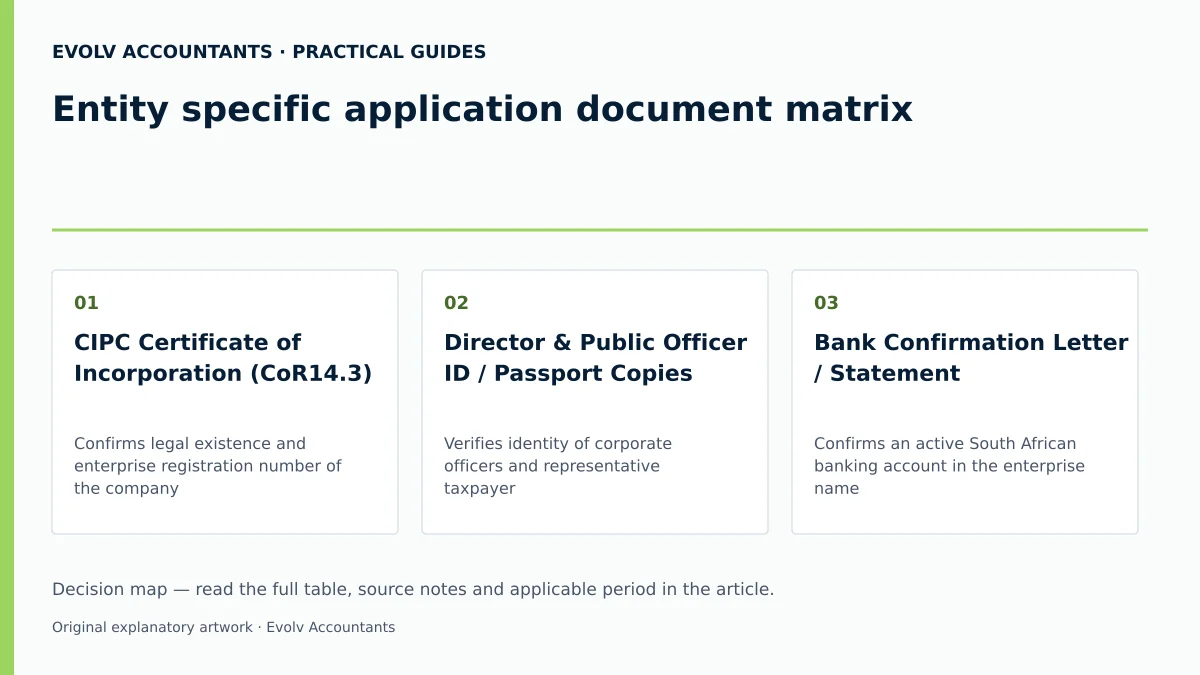
| CIPC Certificate of Incorporation (CoR14.3) | Confirms legal existence and enterprise registration number of the company 3 28 | Required | Public Officer / Director | Cross-checked against CIPC database and SARS income tax register 3 |
| Director & Public Officer ID / Passport Copies | Verifies identity of corporate officers and representative taxpayer 2 30 | Required | Representative Taxpayer | Matched against Home Affairs records and eFiling profile 30 37 |
| Bank Confirmation Letter / Statement | Confirms an active South African banking account in the enterprise name 31 33 | Required | Financial Controller | Must be issued within the last 3 months 32 33 |
| Proof of Physical Business Address | Validates local operational location and fixed place of business 29 31 | Required | Operations Manager | Utility bill or lease agreement not older than 3 months 29 32 |
| Issued Tax Invoices / Signed Contracts | Proves actual or contractually committed taxable turnover exceeding threshold 5 26 | Conditional | Finance Manager | Verified against bank deposits and customer confirmation 26 |
| Form VAT 119i Bank Indemnity | Indemnifies SARS when using group holding/subsidiary banking accounts 33 36 | Conditional | Group Treasurer | Required only for group structures or foreign entity branches 33 35 |
Check identity period and consistency: documented completion and exceptions
Before submitting documents through SARS eFiling or at a branch, private companies must execute strict document consistency checks 12 32 38. Inconsistent entity details are a primary cause of registration delay or rejection 12 13.
Identity and Name Matching
The registered company name, trading name, CIPC enterprise number, and SARS Income Tax reference number must match across all documents 3 28. If a company undergoes a formal name change, CIPC documentation confirming the change must be maintained 39. Invoices issued under the former legal name prior to the CIPC update remain valid supporting proof when accompanied by official CIPC documentation 39.
Validity Periods and Dates
- Recent Document Rule: Bank letters, statements, and utility bills must not be older than three months from the application date 32.
- Effective Liability Date: For compulsory registration, the liability date is the start of the month in which the threshold was or will be exceeded 36 40. For voluntary registration, backdating is restricted, and liability is set according to the application date 40.
Pre-Incorporation Expenses
Under statutory rules, VAT incurred on goods or services acquired prior to CIPC incorporation may be claimed as input tax once the company is formed, provided the company fully reimburses the founder and the purchases were made solely for enterprise operations 41 42.
Build a reviewer ready evidence pack: entity specific application document matrix
To ensure rapid processing by SARS verification officers, private companies should compile an indexed, logically structured evidence pack 3 17.
Structured Folder Indexing
Evolv recommends organizing digital evidence into four numbered sub-folders:
- 01_Statutory_and_CIPC/: CoR14.3, CoR21.1, MOI, and SARS Public Officer appointment letter 3 30.
- 02_Identity_and_Governance/: Uncertified ID/passport copies of all directors and Public Officer 2 30.
- 03_Banking_and_Address/: Bank confirmation letter, stamped bank statement, and lease agreement/utility bill 29 32 33.
- 04_Turnover_Evidence/: Monthly turnover summary schedule, signed customer contracts, and historical sales invoices 26 43.
File Naming Convention
Files should be named cleanly without special characters: [Company_Name]_[Document_Type]_[YYYYMMDD].[ext] (e.g., Apex_Pty_BankLetter_20261019.pdf) 27.
While Evolv assists clients in building reviewer-ready evidence packs following SARS guidelines, SARS retains full independent statutory authority to review, audit, or request additional documentation without official endorsement of any private submission 17 19 44.
Missing or contradictory records: documented completion and exceptions
Where primary records are lost, incomplete, or contradictory, companies must follow authentic reconstruction protocols rather than inventing replacement evidence 26 38 45.
Acceptable vs. Unacceptable Proof
SARS explicitly defines acceptable and unacceptable sources of financial information 14 26 45:
- Acceptable Evidence: Issued tax invoices, signed customer agreements, bank statements reflecting cleared receipts, signed lease agreements, and awarded tender notifications 26.
- Unacceptable Evidence: Non-factual plans, draft business plans, cash flow projections, unfulfilled purchase orders without supply proof, or pending tender proposals prior to formal award 45.
Reconstruction and Escalation Protocol
If sales records or invoices are missing, companies should obtain signed customer confirmations, re-issue certified statements of account, or pull historical bank statements paired with delivery notes 26 46. If material discrepancies exist between bank deposits and sales ledgers, a written reconciliation signed by the Public Officer must be included 30 38. Where complex disputes or missing records persist, companies can book a formal virtual or branch appointment with SARS to present alternative proof 1 12.
Next steps for VAT registration
Following document assembly, the company must execute the registration workflow through approved SARS channels 12 47.
Standard Registration Sequence
- eFiling Application: Access the SARS Registered Details container (WRAV01) on eFiling, select VAT product registration, and complete financial and trading details 37 47 48.
- Biometric Authentication: The registered Public Officer or representative taxpayer must complete facial biometric authentication if prompted by eFiling 17 37.
- Review Notice & Upload: If SARS issues a Registration Application Review Notice, the company has 21 business days to upload the required evidence pack via eFiling or the SARS Online Query System 13 17.
- Notice of Registration: Upon successful validation, SARS issues an official Notice of Registration containing the unique 10-digit VAT number 49 50.
Distinction Between Upload and Acceptance
Uploading documents via eFiling generates an administrative submission receipt but does not constitute formal VAT registration approval 13 17. SARS verification algorithms review the submitted pack for risk factors before issuing the Notice of Registration 17 47.
Record Retention Obligation
Once registered, the vendor is statutorily obligated under the TA Act and VAT Act to retain all accounting records, tax invoices, bank records, and registration documents in their original format for at least five years 22 46 51.
Practical Step-by-Step SME Checklist
- [ ] Confirm company Public Officer appointment is updated and active on SARS records 23 30.
- [ ] Obtain a fresh bank confirmation letter (less than 3 months old) for the business account 32 33.
- [ ] Compile CIPC incorporation documents (CoR14.3, CoR21.1) and clear ID copies of all directors 2 3.
- [ ] Calculate 12-month historical or contractual taxable turnover to confirm registration category 5 9 43.
- [ ] Gather acceptable turnover evidence (signed contracts, tax invoices, bank statements) 26.
- [ ] Name and index all files into structured PDF sub-folders 3 27.
- [ ] Complete the eFiling WRAV01 VAT registration application 37 47.
- [ ] Complete biometric facial authentication via eFiling when prompted 17 37.
- [ ] Upload the indexed evidence pack within 21 business days if a Review Notice is issued 13 17.
- [ ] Download and archive the official Notice of Registration once issued 50.
Reproducible Hypothetical Example
Scenario: Apex Industrial Solutions (Pty) Ltd is a South African manufacturing firm incorporated in Johannesburg.
Turnover Calculation:
- Historical Supplies: Over the past 10 months, Apex generated standard-rated sales averaging R180 000 per month (Total: R1 800 000) 10 43.
- New Contract: On 15 October 2026, Apex signed a written commercial supply contract valued at R900 000 over 3 months 5 26.
- Total 12-Month Projected Turnover: R1 800 000 + R900 000 = R2 700 000 5 43.
Threshold Evaluation: Apex's combined 12-month taxable turnover of R2.7 million exceeds the R2.3 million compulsory threshold administered under current SARS registration guidance (as well as the historical R1 million reference) 4 5 6.
Application Staging: Apex's Public Officer prepares the application within 21 business days 5 30:
- Liability Date: 01 October 2026 36 40.
- Evidence Pack: CoR14.3, Director ID copies, Bank Confirmation Letter dated 02 October 2026, utility bill, signed R900 000 supply contract, and 10 months of historical tax invoices 3 26 32.
- Submission Outcome: Submitted via eFiling WRAV01 37 47. Review Notice issued; evidence pack uploaded on day 3 13 17. Notice of Registration issued allocating VAT number 4112345678 50.
Frequently Asked Questions
What is the current compulsory VAT registration threshold for a private company?
Current SARS online registration guidance administers compulsory VAT registration when taxable turnover exceeds or is contractually expected to exceed R2.3 million in a 12-month period 4 5. Private companies must apply within 21 business days of reaching or exceeding this threshold 5. Older SARS guides cite a R1 million threshold, reflecting historical statutory references 6 7.
What financial documents are accepted by SARS to prove taxable turnover?
SARS accepts signed commercial contracts, issued tax invoices, cleared bank statements, awarded tender notifications, signed lease agreements, and property development plans 26. Draft business plans, cash flow projections, non-factual proposals, and unawarded tenders are explicitly unacceptable 45.
Can a company use a holding company or director's bank account for VAT registration?
No, SARS requires an active South African bank account opened in the name of the vendor entity 31 33. Third-party bank accounts are only permitted for foreign companies or subsidiaries within an established group of companies, requiring a completed Form VAT 119i bank indemnity declaration 33 36.
How long does a company have to submit supporting documents if SARS issues a Review Notice?
When eFiling flags an application for manual verification, SARS issues a Registration Application Review Notice 17. The vendor has exactly 21 business days from the notice date to upload all requested supporting documents, failing which the application will be rejected 13.
How long must a company retain its VAT registration and accounting records?
Under the Tax Administration Act and Value-Added Tax Act, registered vendors must retain all primary records—including tax invoices, credit/debit notes, bank statements, and registration schedules—for a minimum of five years 22 46 51. Ask Evolv about entity specific application document matrix. Share the relevant records so the support required can be scoped.
Related guides
- When a South African business must register for VAT
- VAT registration for a sole proprietor
- The Proactive SARS Audit Guide: Keeping Your Business Ledger Sanitised
Sources
- FAQs for VAT vendors | South African Revenue Service
- https://www.sars.gov.za/wp-content/uploads/Ops/Guides/VAT-REG-02-G01-Guide-for-Completion-of-VAT-Application-External-Guide.pdf
- Register for VAT | South African Revenue Service
- https://www.sars.gov.za/wp-content/uploads/Ops/Guides/Legal-Pub-Guide-VAT404-VAT-404-Guide-for-Vendors.pdf
- Obligations of a VAT vendor | South African Revenue Service