
VAT registration for a sole proprietor
28 October 2024

VAT registration for a sole proprietor requires submitting identity, trading, and South African bank account evidence to SARS.
A sole proprietor carrying on an enterprise in South Africa becomes legally obligated to register for Value-Added Tax (VAT) when their taxable turnover exceeds or is expected to exceed the compulsory threshold within a consecutive 12-month period 1 2 3. Registration transforms an individual trader into a vendor responsible for levying 15% output tax on standard-rated supplies, issuing prescribed tax invoices, filing periodic VAT201 returns, and maintaining a verifiable five-year audit trail 4 5 6.
Successful registration requires establishing three distinct pillars of primary evidence: personal identity details, verified trading activity generating taxable supplies, and a valid South African bank account held directly in the sole proprietor's name 7 8 9 10.
Sole proprietor identity trading and banking evidence
Scope, Jurisdiction, and Completion Parameters
For South African small and medium enterprises (SMEs) operating as sole proprietorships, VAT administration falls under the national jurisdiction of the South African Revenue Service (SARS) 1 11. A sole proprietor is a natural person who trades in their personal capacity, regardless of whether they operate under a distinct trading name 7 12.
Completing the VAT registration process means obtaining an official Notice of Registration from SARS containing an allocated 10-digit VAT reference number 13 14 15. Submission of an online registration form or presentation of supporting documents does not constitute completion; official acceptance occurs only when SARS validates the primary evidence and issues the registration notice 14 16 17.
Legislative Foundations and Administrative Thresholds
Under South African tax law, an enterprise is defined as any continuous or regular activity carried on in or partly in the Republic where goods or services are supplied for consideration 1 18. Statutory law and historical guidebooks (such as the SARS VAT 404 Guide) record the compulsory registration threshold at R1 million of taxable supplies in a 12-month period 19. However, current SARS administrative guidance applies an increased compulsory threshold of R2.3 million 2 3 20.
It is important to note that this reflects SARS administrative policy applied from 1 April 2026, rather than an unqualified statutory amendment to Section 23 of the Value-Added Tax Act 3 19 20.
Voluntary registration remains available for sole proprietors whose taxable turnover is below the compulsory threshold but has exceeded R120,000 in a preceding 12-month period 21 22. Alternatively, voluntary registration can be sought where average monthly taxable supplies exceeded R4,200 over at least two months, or where formal contractual or financial obligations demonstrate that turnover will exceed R120,000 within 12 months 23 24 25. (Historical registration forms referenced a R50,000 voluntary baseline 26 27).
- VAT REGISTRATION THRESHOLDS
- Compulsory Registration:
- - Current SARS Administrative Guidance: R2.3 million turnover 2 3
- - Older Statutory Guide Reference (VAT 404): R1.0 million turnover 19
- - Application Window: Within 21 business days of liability 3 28
- Voluntary Registration:
- - Current Guidance Baseline: R120,000 historical/contracted turnover
- or R4,200/month average 21 22 23 24
- - Older Guidance Reference: R50,000 turnover 26 27
Prepare the information and authority: sole proprietor identity trading
Mandatory Primary Evidence Categories
Before accessing the SARS registration portal, a sole proprietor must assemble verified primary documentation across three core operational areas:
- Sole Proprietor Identity Evidence:
- Green barcoded South African Identity Document or smart ID card (or valid passport for non-South African citizens resident in the Republic) 7 29 30.
- Full legal names, surname, initials, date of birth, and identity/passport number matching SARS master files 7 29 30.
- Verified residential address and physical business location details 7 31 32.
- Contact information including landline or mobile telephone number and direct email address 7 32.
- Trading Activity and Taxable Supply Evidence:
- Copies of tax invoices issued demonstrating historical taxable supplies 10 33.
- Signed commercial contracts or formal written agreements obligating future supplies 3 33.
- Signed lease agreements for commercial premises (where the lessor and lessee are separate legal entities) 33.
- Signed annual financial statements or management accounts detailing gross trading income 10 33.
- Proof of acquiring an operational business as a going concern, including seller turnover evidence 21 33 34.
- Unacceptable Trading Inputs:
SARS explicitly rejects speculative or subjective materials as evidence of taxable supplies. Sole proprietors must avoid submitting:
- Ambitious non-factual business plans or narrative proposals 35.
- Unsubstantiated cash flow projections 35.
- Purchase orders received without accompanying proof of actual fulfillment 35.
- Tender applications or proposals prior to a formal, written contract award 35 36.
- ACCEPTED TRADING EVIDENCE REJECTED INPUTS
- [x] Issued tax invoices 33 [ ] Subjective business plans 35
- [x] Awarded, signed contracts 33 [ ] Cash flow projections 35
- [x] Signed commercial leases 33 [ ] Unfulfilled purchase orders 35
- [x] Signed financial statements 33 [ ] Pending tender proposals 35 36
Representation and Professional Authority
A sole proprietor may complete the application personally or authorise a registered tax practitioner 37 38. If a tax practitioner handles the submission, a formal SARS Power of Attorney (POA) must accompany the application 39 40. While a tax practitioner can present the file, the declaration itself must be signed or authorised directly by the sole proprietor; third-party signatures on the registration form are legally invalid 10 41 42.
Complete the task step by step: banking evidence
Establishing Bank Account Eligibility
SARS maintains strict anti-fraud verification controls regarding vendor banking details 9 43. For a sole proprietor, the bank account must meet exact statutory and administrative criteria:
- Local Account Requirement: The account must be an active transactional account with a registered South African banking institution 8 9 44.
- Entity Name Alignment: The account must be held directly in the legal name of the sole proprietor or their registered trading name 9.
- Third-Party Disallowance: Third-party bank accounts are strictly prohibited for individual sole proprietors 45 46. (Third-party account concessions apply exclusively to corporate group structures or foreign companies using a VAT119i indemnity form 45 46 47).
Sequenced Application Process
Sole proprietors register through SARS eFiling using the Registration, Amendments and Verification (RAV01) form, or via a scheduled SARS branch appointment 37 48 49.
- STEP-BY-STEP EFILING REGISTRATION PATH
- STEP 1: Log on to SARS eFiling profile 48.
- STEP 2: Navigate to 'SARS Registered Details' > 'Maintain Details' 48 50.
- STEP 3: Accept authority declaration to access container menu 50.
- STEP 4: Select 'My Tax Products' > 'VAT' > 'Add New Product' 7 50.
- STEP 5: Complete trading name, liability date, and activity codes 7.
- STEP 6: Input turnover figures, accounting basis, and tax period 7.
- STEP 7: Enter verified South African bank account details 7 9.
- STEP 8: Perform individual facial biometric authentication 16 50.
- Accessing Registered Details: Log into eFiling, navigate to Home > SARS Registered Details, and select Maintain SARS Registered Details 48 50.
- Selecting Product Container: Select My Tax Products, choose VAT, and click Add New Product Registration 7 50.
- Capturing Operational Particulars: Enter the trading name, economic business activity code (derived from the VAT 403 Trade Classification Guide), and effective liability date 7 51.
- Selecting Accounting Basis and Tax Period: Select either the invoice (accrual) basis or payments (cash) basis 7 52 53. Natural persons with taxable turnover under R2.5 million qualify for the payments basis upon application 53 54. Choose the assigned tax period category (typically Category A or B two-monthly cycles) 55 56.
- Capturing Financials and Banking Details: Record actual and expected 12-month taxable turnover figures 7 57. Input bank account particulars (bank name, branch code, account number, and account type) 7 9.
- Biometric Authentication and Submission: Upon submitting the RAV01, individual sole proprietors may be prompted to complete facial biometric authentication 16 50.
Check the result against the evidence: sole proprietor identity trading
Distinguishing Submission from Completion
Submitting the eFiling application does not imply immediate registration approval 16. SARS evaluates applications through automated risk engines 13 16 58.
- SUBMISSION (RAV01) → RISK ENGINE REVIEW → NOTICE OF REGISTRATION
- (Application sent) (21-day audit window) (Official VAT103 Issued)
- Immediate Allocation: If no risk flags are triggered, SARS issues a VAT reference number immediately upon submission 13 48.
- Registration Application Review Notice: If selected for risk verification, eFiling generates a Review Notice containing a specific case number and listing required supporting documents 16 59.
- 21-Business-Day Rule: Supporting evidence must be uploaded via eFiling, submitted through the SARS Online Query System, or presented at a branch within 21 business days 16 59. Failure to meet this deadline leads to automatic application rejection 59.
Validating Final Registration
Independent proof of completed registration is established solely by obtaining a SARS Notice of Registration 14 17 60. Sole proprietors can confirm registration status by:
- Downloading the Notice of Registration directly from the eFiling profile menu 14.
- Using the public "VAT Vendor Search" tool on the SARS website 13 14 60.
- Requesting a confirmation statement at a local SARS branch 60 61. (SARS officials are prohibited from confirming VAT numbers verbally over the telephone) 60.
Handle exceptions and unresolved cases: banking evidence
Title-Specific Edge Cases and Verification Delays
- Unverified Banking Details: If SARS cannot automatically verify bank account details with the registered financial institution, the registration is suspended pending manual verification 16 43. The sole proprietor must upload a bank-stamped account confirmation letter (less than three months old) or an official bank statement 62 63.
- Changing Bank Account Details Post-Registration: To prevent refund fraud, bank detail updates are tightly restricted 43 64. Updates can only be executed via eFiling or in person at a SARS branch 64. Telephonic or email requests are rejected 43.
- Backdating Registration Liabilities: For voluntary registrations, backdating is not permitted; liability commences from the application date 65. For compulsory registrations, eFiling permits automated backdating up to six months from the date the R2.3 million threshold was crossed 65. Backdating beyond six months requires a formal SARS branch appointment with supporting historical financial records 65.
Specialist Boundaries and Professional Guidance
While routine VAT registrations can be handled directly via eFiling, complex operational structures require specialist tax advisory input:
- Micro Business Turnover Tax: Sole proprietors registered for Turnover Tax under the Income Tax Act may elect to enter the VAT system provided voluntary registration conditions are met 66 67.
- Separate Branch/Division Registrations: Where a sole proprietor operates multiple distinct trading divisions, separate VAT numbers may be requested for individual branches provided independent accounting systems are maintained 68 69.
- Legal Interpretations and Rulings: Where statutory treatment is ambiguous, sole proprietors must submit a formal VAT Ruling application (Form VAT301) to SARS Legal Counsel rather than relying on informal advice 70 71 72.
Next steps for VAT registration
Task and Completion Checklist
| Step | Input or evidence | Responsible person | Completion check | Exception or next action |
|---|---|---|---|---|
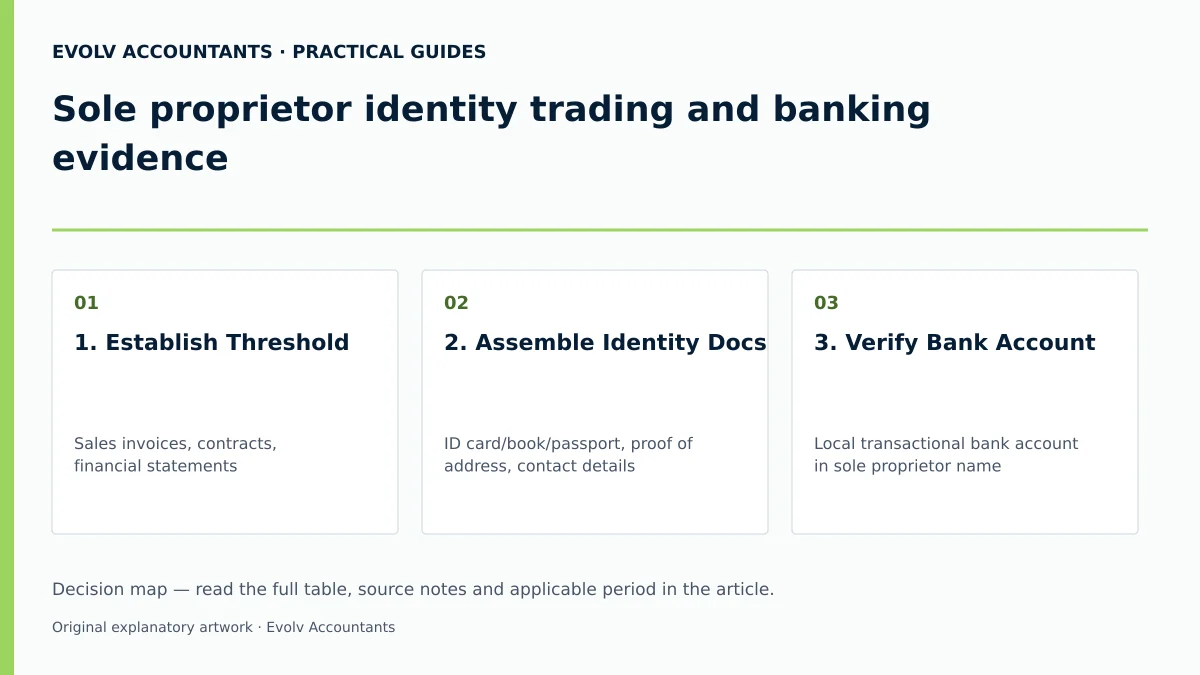
| 1. Establish Threshold | Sales invoices, contracts, financial statements 33 | Sole proprietor / Tax advisor | Turnover exceeds R2.3m compulsory or R120k voluntary baseline 3 21 | Identify specific voluntary category if under R120k 21 23 |
| 2. Assemble Identity Docs | ID card/book/passport, proof of address, contact details 7 30 | Sole proprietor | Details match SARS master record 7 31 | Update SARS personal details prior to registration 31 |
| 3. Verify Bank Account | Local transactional bank account in sole proprietor name 9 | Sole proprietor | Account active and verified by bank 9 | Obtain stamped bank account confirmation letter 62 63 |
| 4. Submit RAV01 Application | Captured details on eFiling maintain container 7 48 | Sole proprietor / Tax practitioner | Biometric authentication completed 16 50 | Check eFiling inbox for Review Notice 16 |
| 5. Resolve Verification | Upload requested supporting invoices/contracts 16 59 | Sole proprietor | Documents submitted within 21 business days 59 | Book SARS branch appointment if eFiling fails 37 59 |
| 6. Obtain Confirmation | SARS Notice of Registration 14 | Sole proprietor | 10-digit VAT number issued and active 13 14 | Perform VAT Vendor Search on SARS website 13 60 |
Illustrative Hypothetical Example
Note: The values below are illustrative and sourced from applicable regulatory thresholds.
Scenario:
Person J operates a sole proprietorship providing IT consulting services in Johannesburg. Over the preceding 10 months, Person J issued standard-rated sales invoices totalling R2,450,000 (excluding VAT).
Analysis & Application:
1. Threshold Assessment: Person J has exceeded the current administrative compulsory threshold of R2.3 million within a 12-month period 2 3. Person J is legally required to apply for VAT registration within 21 business days of crossing the threshold 3 28.
2. Evidence Assembly: Person J gathers their South African Smart ID card, physical commercial lease, historical sales ledger with corresponding invoices, and bank statements for an account opened in Person J's personal trading name 7 9 30 33.
3. Execution: Person J logs onto eFiling, completes the RAV01 form under Category A (two-monthly tax period), inputs the Consulting Trade Activity Code, and completes facial biometric authentication 7 48 50 55.
4. Outcome: SARS risk engine issues an automated Review Notice 16. Person J uploads the contract files and sales invoices within 14 days 59. SARS validates the submission and issues a formal Notice of Registration containing Person J's new 10-digit VAT number 14 15.
5. Ongoing Obligations: Person J must now quote prices inclusive of 15% VAT, issue valid tax invoices for all supplies exceeding R50, file two-monthly VAT201 returns, and remit net output tax by the last business day of the month following each tax period 4 5 44 73 74.
Frequently Asked Questions
Can a sole proprietor use a personal bank account for VAT registration?
Yes, provided the bank account is an active South African transactional account held directly in the legal name or registered trading name of the sole proprietor 8 9. However, third-party bank accounts (accounts held in another person's name) are strictly disallowed for individual sole proprietors 45 46.
What happens if taxable turnover exceeds R2.3 million but no written contracts exist?
Compulsory registration applies whenever actual or historical taxable supplies exceed R2.3 million in any consecutive 12-month period, regardless of whether formal written contracts exist 2 3. Historical sales invoices, bank statements showing customer receipts, and signed financial statements serve as sufficient primary evidence 33.
Does submitting the RAV01 form mean the business is immediately registered?
No. While eFiling instantly allocates a number in zero-risk cases, many applications are flagged for verification 13 16. Registration is only complete when SARS issues an official Notice of Registration 14 60. If flagged, supporting evidence must be provided within 21 business days or the application will be rejected 59.
How does the High Court ruling on ministerial VAT adjustments affect vendors?
The Western Cape High Court ruling (Democratic Alliance v Minister of Finance) regarding ministerial tax rate adjustments does not eliminate existing VAT liabilities or stop SARS compliance audits 75 76 77. Vendors must continue levying VAT, submitting VAT201 declarations, and fulfilling all statutory duties as normal 4 76.
How long must a sole proprietor retain VAT documentation?
A registered vendor must retain all tax invoices, bank statements, accounting ledgers, and credit/debit notes for at least five years from the date of the relevant tax period 4 6. Documentation must be made available to SARS upon request for compliance verification or audit 4 63.
Related guides
- When a South African business must register for VAT
- Calculating taxable turnover for the VAT threshold
- The Proactive SARS Audit Guide: Keeping Your Business Ledger Sanitised
Sources
- Register for VAT | South African Revenue Service
- Obligations of a VAT vendor | South African Revenue Service
- https://www.sars.gov.za/wp-content/uploads/Ops/Guides/Legal-Pub-Guide-VAT404-VAT-404-Guide-for-Vendors.pdf
- https://www.sars.gov.za/wp-content/uploads/Ops/Guides/VAT-REG-02-G01-Guide-for-Completion-of-VAT-Application-External-Guide.pdf
- FAQs for VAT vendors | South African Revenue Service