
Capital expenses versus revenue expenses for tax
26 November 2024

Distinguishing capital expenses from revenue expenses requires analysing asset creation against operational expenditure for South African corporate tax returns. 1
Rules reviewed: 20 October 2026. Read the linked primary sources for the applicable period, commencement dates and conditions.
Understanding the distinction between capital character and ordinary operating expenditure is essential for South African small and medium enterprises (SMEs) compiling annual financial statements and Corporate Income Tax (CIT) returns (ITR14). 1 2 Accounting net profit calculated under financial reporting frameworks rarely equals taxable income for South African Revenue Service (SARS) assessment. 3 4 In statutory tax computation, accounting expenditure of a capital nature—such as asset purchases, permanent improvements, and commercial depreciation—is not directly deductible against gross income and must be added back under credit adjustments on the ITR14. 4 5 6 Tax Relief or cost recovery for capital items is granted separately through specific statutory allowances (such as wear-and-tear under section 11(e) or Small Business Corporation accelerated depreciation under section 12E), whereas ordinary operating expenses incurred in the production of income for trade are fully deductible in the assessment year incurred. 1 7 8 9
Capital character versus ordinary operating expense
Fundamental Legal Definitions
Under South African income tax law, the classification of expenditure determines whether an outlay is immediately deductible in full or subjected to capital allowance rules and Capital Gains Tax (CGT) regimes. 1 4 The statutory baseline rests upon section 11(a) of the Income Tax Act 58 of 1962 (the general deduction formula) and section 23(g), which allow deductions for expenditure actually incurred in the Republic in the production of income, provided such amounts are not of a capital nature and are incurred wholly or exclusively for the purposes of trade. 1 10
Determining whether an outlay possesses a capital character or constitutes an ordinary operating expense relies on established tax law principles. 1 As noted in official SARS guidance, the "determination of whether an accrual or receipt is revenue or capital in nature is tested under existing jurisprudence (of which there is no shortage)". 1
- Capital Character: Refers to expenditure incurred to acquire, create, or enhance an asset, structure, or enduring advantage for the business. 1 4 Capital expenses create the income-earning structure itself. 1 Examples include purchasing land, constructing buildings, buying heavy machinery, acquiring intellectual property, or making structural alterations that extend an asset's useful life or utility. 11 12 13
- Ordinary Operating Expense (Revenue Expense): Refers to expenditure incurred in running the day-to-day business operations and maintaining existing income-producing assets. 1 11 Revenue expenditure relates to the operational process rather than the underlying apparatus. 1 Examples include day-to-day repairs, routine maintenance, salaries and wages, municipal utilities, consumable stock, and rental payments. 11 13
Regulatory Framework and Returns Mapping
On the eFiling ITR14 company income tax return, SARS enforces a strict separation between financial accounting entries and tax adjustments. 4 7 14 When completing the ITR14 Income Statement container, businesses declare raw accounting debit items, including depreciation, accounting loss on asset disposals, and general repairs or maintenance. 11 13 15 In the Tax Computation container, the company must perform explicit reconciliations: 3 4 14
— Practical point from this guide
- Credit Adjustments (Added Back): Accounting depreciation and expenses or losses of a capital nature debited to the income statement are added back to net profit, increasing taxable income. 4 5 6
- Debit adjustments (allowable deductions): Deduct substantiated tax allowances, such as section 11(e) wear-and-tear or qualifying section 12E allowances, in the reconciliation. For section 12BA, the qualifying new and unused asset must first have entered use on or after 1 March 2023 and before 1 March 2025. Do not confuse that historical incentive with other capital allowances. SARS IT39: renewable-energy allowances and first-use conditions
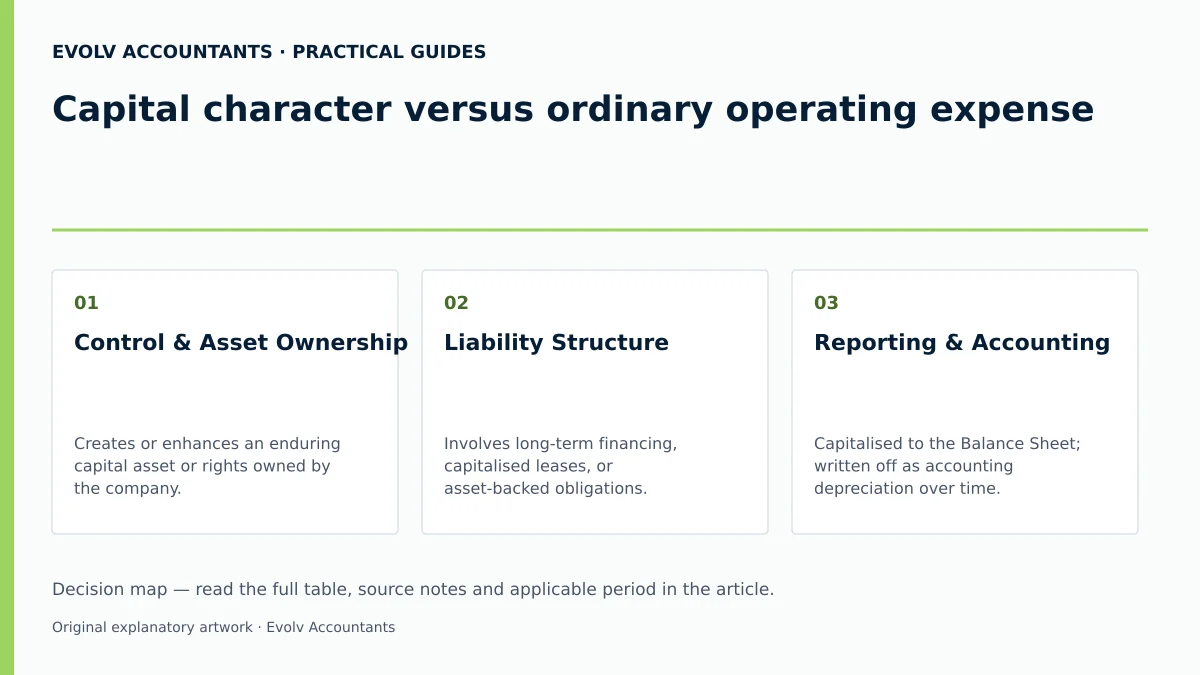
Compare the criteria that matter: capital character
Evaluating whether an expense carries a capital character requires checking financial, structural, and legal constraints across six key operational criteria: 1 4 18
Decision Comparison Matrix
| Criterion | Option A: Capital Character | Option B: Ordinary Operating Expense | Evidence or Assumption | Implication for this Reader |
|---|---|---|---|---|
| Control & Asset Ownership | Creates or enhances an enduring capital asset or rights owned by the company. 1 12 | Maintains existing assets without creating new enduring legal rights. 1 11 | Asset recorded on ITR14 Balance Sheet under Non-Current Assets. 12 18 | Capital assets require balance sheet disclosure and wear-and-tear schedules. 7 18 |
| Liability Structure | Involves long-term financing, capitalised leases, or asset-backed obligations. 19 20 | Short-term trade payables, operational accruals, and immediate supplier settlement. 19 20 | Debt disclosed under Non-Current vs Current Liabilities on ITR14. 19 20 | Capital finance charges may be subject to specific interest limitations. 21 22 |
| Reporting & Accounting | Capitalised to the Balance Sheet; written off as accounting depreciation over time. 15 18 | Expensed directly to the Income Statement in the financial year incurred. 11 13 | Accounting treatments governed by IFRS / GAAP reporting standards. 14 23 | Financial statement depreciation must be added back on tax computation. 4 5 |
| Tax Treatment | Non-deductible initially under section 11(a); claimed via capital allowances or CGT base cost. 1 4 7 | Fully deductible under section 11(a) in the year of assessment incurred. 1 10 | Section 11(a) prohibition on capital items; section 11(e) wear-and-tear allowances. 1 7 10 | Deduction timing shifts from single-year deduction to multi-year tax allowances. 1 7 |
| Cash Flow Constraints | Requires substantial upfront cash outlay or structured long-term capital deployment. 18 19 | Ongoing, predictable operational working capital cash flow requirements. 18 19 | Cash and cash equivalents impact on current asset balance sheet reporting. 18 24 | Tax relief for capital outlay is deferred across future assessment years. 1 7 |
| Operational Constraints | Expands operational capacity, replaces apparatus, or introduces new technology. 12 25 | Keeps existing business operations at current operational capacity. 1 11 | ITR14 disclosures regarding new technology or capacity expansion. 25 26 | Distinguishes capital improvement from deductible repair and maintenance. 11 13 |
How the obligations differ: ordinary operating expense
Distinguishing legal statutory obligations from SARS administrative guidance and Evolv professional recommendations ensures complete compliance without forfeiting allowable tax relief. 1 2
- 1. Audit Financial Statements & Extract Trial Balance:
- Identify all debit items listed under repairs, maintenance, alterations, and equipment purchases. 11 15
- 2. Separate Capital Outlays from Operating Repairs:
- Isolate items that created new enduring assets or enhanced capacity from routine maintenance. 1 11
- 3. Complete ITR14 Income Statement Container:
- Enter exact accounting expenses (including depreciation and repairs) in the expense section. 11 15
- 4. Execute Credit Adjustments in Tax Computation:
- Add back accounting depreciation and non-deductible capital expenditure to net profit. 4 5
- 5. Claim Applicable Statutory Allowances in Debit Adjustments:
- Calculate the tax allowance actually available for the asset and period. Section 12BA requires qualifying first use on or after 1 March 2023 and before 1 March 2025; consider section 12B separately for other renewable-energy cases. SARS IT39: renewable-energy allowances and first-use conditions
- 6. Retain Supporting Schedules & Asset Registers:
- Store asset registers, tax allowance calculations, and supplier invoices for five years. 27 28
Statutory Law Requirements
The Income Tax Act mandates that all income and expenditure declared must reflect actual financial transactions of the assessment year. 2 29 Capital expenditure cannot be claimed under section 11(a). 1 4 Taxpayers claiming statutory wear-and-tear allowances under section 11(e) or Small Business Corporation allowances under section 12E must ensure that the asset is owned by the taxpayer or acquired under a qualifying agreement and used in the production of trade income. 1 7 9 Furthermore, section 23(k) explicitly restricts expense deductions for Personal Service Providers. 30 31
Regulator Guidance (SARS External Guides)
SARS specifies via external filing guides (IT-GEN-04-G01 and IT-ELEC-03-G01) how company classifications determine return customisation. 32 33
- Micro Business: Gross income up to R1 million and total assets up to R5 million. 34 35
- Small Business: Gross income up to R20 million (for financial years ending on or after 30 April 2013) and total assets up to R10 million. 34 36 37
- Medium to Large Business: Gross income exceeding R20 million or total assets exceeding R10 million. 38 39 40
SARS requires signed Annual Financial Statements (AFS) containing an Income Statement, Balance Sheet, and Notes to be uploaded upon first-time submission for Small and Medium to Large Businesses. 41 Asset registers and allowance schedules must be retained for five years. 27
Two business situations with different outcomes: capital character
To demonstrate how capital classification alters tax liability, consider two hypothetical SME scenarios for a private company during the 2025/2026 year of assessment (financial year ending 28 February 2026). 43 44
Scenario A: Refurbishment Characterised as Operating Repair
- Hypothetical Facts: A logistics SME spends R200,000 servicing its fleet of delivery vehicles, replacing worn tyres, changing engine oil, and repairing brake pads to maintain existing operating condition. 11 13
- Legal Application: The expenditure does not create a new asset or increase the fleet's initial structural capacity. 1 11 It constitutes routine repair and maintenance under section 11(a). 1 13
- Tax Outcome: The full R200,000 is expensed in the Income Statement and remains fully deductible in the 2025/2026 tax year, reducing taxable income by R200,000. 1 11 At the standard corporate tax rate of 27%, this yields an immediate tax saving of R54,000. 43
Scenario B: Capital Acquisition of New Machinery
- Hypothetical Facts: The same SME purchases a new automated packaging machine for R200,000 (excluding VAT) on 1 March 2025 to expand factory output capacity. 12 25
- Legal Application: The expenditure creates an enduring capital asset that expands operational apparatus. 1 12 The R200,000 cannot be deducted under section 11(a). 1 4
- Tax Outcome (Standard Company vs SBC):
- Standard Company: The R200,000 purchase price is capitalised to the Balance Sheet. 12 18 Accounting depreciation (e.g., R40,000 at 20% straight-line) debited to profit is added back on the ITR14 tax computation. 4 5 A statutory section 11(e) wear-and-tear allowance (e.g., 20% or R40,000) is deducted. 7 17 First-year net taxable income reduction is limited to R40,000 (yielding a R10,800 tax saving at 27%), with the remaining R160,000 written off across future assessment years. 7 43
- Qualifying Small Business Corporation (Section 12E): If the company qualifies under section 12E, manufacturing plant or machinery brought into use for the first time may qualify for an immediate 100% write-off under section 12E(1), providing an immediate R200,000 deduction in the 2025/2026 tax year. 8 9 45
When the comparison needs specialist input: ordinary operating expense
Certain complex commercial transactions contain blended legal and financial characteristics that require professional tax advisory before filing the ITR14: 1 2
- Leasehold Improvements (Section 11(g)): Alterations made by a lessee to rented property must be analysed to determine whether costs are capitalised, written off over the lease period, or treated as lease premiums. 10 11 46
- Renewable-energy infrastructure: Section 12BA’s enhanced 125% allowance applies only to qualifying new and unused assets first brought into use for the taxpayer’s trade on or after 1 March 2023 and before 1 March 2025, subject to all other requirements. A later ITR14 assessment year or a 2026 disposal/recoupment date does not extend that first-use window. Assess any section 12B entitlement separately; do not treat a newly installed 2026 asset as automatically eligible for section 12BA. SARS IT39: renewable-energy allowances and first-use conditions
- Government Grants and Assets (Section 12P / Section 10(1)(yA)): Assets acquired using tax-exempt government grants are legally barred from claiming section 11(e) wear-and-tear allowances. 21 47 48
- Personal Service Providers: Section 23(k) restricts a Personal Service Provider’s deductions but does not prohibit every premises, legal-expense or bad-debt deduction. It permits specified employee remuneration and the listed statutory categories, including qualifying legal expenses and bad debts. Specified premises, finance, insurance, repair, fuel and maintenance costs may qualify where the relevant premises or assets are used wholly and exclusively for trade. Check each category’s conditions and allocation; other expenditure remains restricted. SARS Interpretation Note 35: section 23(k) permitted PSP deductions
- Crypto Asset Transactions: Exchanging goods or services for crypto assets is classified as a barter transaction under normal income tax or Capital Gains Tax paradigms, requiring case-by-case legal jurisprudence analysis. 1 50
Next steps for Corporate income tax
To ensure full compliance on your upcoming ITR14 submission, follow these practical steps: 2 4
Decision Record Checklist
- [ ] Verify Corporate Classification: Confirm whether your business meets Micro, Small, or Medium/Large criteria on eFiling based on gross income and total assets. 34 37
- [ ] Review Asset Register & Invoices: Review all large debit items in your trial balance to ensure capital acquisitions are not misclassified as ordinary repairs. 1 11
- [ ] Reconcile Accounting Profit to Taxable Income: Ensure financial statement depreciation and capital losses are added back under credit adjustments on the ITR14. 4 5
- [ ] Calculate statutory capital allowances: Prepare the section 11(e), section 12E or other applicable schedules. Include a section 12BA claim only where the qualifying asset’s first use falls on or after 1 March 2023 and before 1 March 2025 and all remaining requirements are met. SARS IT39: renewable-energy allowances and first-use conditions
- [ ] Verify Section 12E SBC Eligibility: Confirm that shareholders are natural persons, gross income does not exceed R20 million, and investment/service income does not exceed 20%. 9 51 52
- [ ] Compile and Upload Supporting Material: Ensure signed Annual Financial Statements (Income Statement, Balance Sheet, Notes) are ready for eFiling submission. 41
Frequently Asked Questions
How does ITR14 return customisation affect capital allowance declarations?
The ITR14 wizard makes the relevant containers available from your answers. A visible section 12BA field does not itself establish eligibility: check that the qualifying asset was new and unused and first entered trade use on or after 1 March 2023 and before 1 March 2025, together with the other statutory requirements. Retain the acquisition, commissioning and use evidence. SARS IT39: renewable-energy allowances and first-use conditions
What happens if an asset is acquired using a tax-exempt government grant?
In terms of Section 12P and SARS corporate income tax enhancements, if a company acquires an asset as or with a government grant, section 11(e) wear-and-tear allowances cannot be claimed on that asset. 21 47 48 The ITR14 return contains mandatory validation questions confirming that no wear-and-tear was claimed on grant-funded assets. 21 47
How do Small Business Corporations (SBCs) claim capital machinery deductions compared to standard companies?
Standard companies claim wear-and-tear over the prescribed useful life of an asset under section 11(e). 7 17 Qualifying Small Business Corporations under section 12E can claim an accelerated 100% write-off in the year of assessment that manufacturing plant or machinery is brought into use for the first time. 8 9 45
Can personal service providers deduct ordinary operating expenses?
Section 23(k) restricts a Personal Service Provider’s deductions but does not prohibit every premises, legal-expense or bad-debt deduction. It permits specified employee remuneration and the listed statutory categories, including qualifying legal expenses and bad debts. Specified premises, finance, insurance, repair, fuel and maintenance costs may qualify where the relevant premises or assets are used wholly and exclusively for trade. Check each category’s conditions and allocation; other expenditure remains restricted. SARS Interpretation Note 35: section 23(k) permitted PSP deductions
How are crypto asset transactions treated regarding capital versus revenue character?
Crypto asset gains and losses are evaluated under existing legal jurisprudence. 1 Depending on the intention and frequency of trading, transactions are classified either as revenue income (declared under gross income) or as capital gains/losses subject to the Eighth Schedule CGT paradigm. 1 50 Ask Evolv about capital character versus ordinary operating expense. Share the relevant records so the support required can be scoped.
Related guides
- Preparing an ITR14 company income tax return
- Reconciling accounting profit to taxable income
- The Proactive SARS Audit Guide: Keeping Your Business Ledger Sanitised
Sources
- https://www.sars.gov.za/wp-content/uploads/IT-GEN-04-G01-How-to-complete-the-Income-Tax-Return-ITR14-for-Companies-External-Guide.pdf
- Corporate Income Tax | South African Revenue Service
- https://www.sars.gov.za/wp-content/uploads/Ops/Guides/IT-ELEC-03-G01-Guide-to-complete-the-Company-Income-Tax-Return-ITR14-eFiling-External-Guide.pdf
- Companies, Trusts and Small Business Corporations (SBC) | South African Revenue Service
- SARS IT39: renewable-energy allowances and first-use conditions
- SARS Interpretation Note 35: section 23(k) permitted PSP deductions