
Reconciling accounting profit to taxable income
31 March 2025

Reconciling accounting profit to taxable income requires adjusting commercial financial results for statutory tax timing differences and non-deductible expenses.
Rules reviewed: 20 October 2026. Read the linked primary sources for the applicable period, commencement dates and conditions.
Every corporate taxpayer registered in South Africa must prepare annual financial statements reflecting commercial net profit or loss under accepted accounting frameworks 1 2. However, statutory corporate income tax liability is not calculated directly on accounting profit 1 3. Instead, entities must complete the Income Tax Return for Companies (ITR14) via South African Revenue Service (SARS) eFiling, applying specific statutory debit and credit adjustments to bridge commercial results to taxable income 1 3 4.
Reconciling accounting profit to taxable income identifies permanent differences (such as non-deductible fines or exempt local dividends) and temporary timing differences (such as accounting depreciation versus statutory wear-and-tear allowances) 5 6 7 8. A rigorous reconciliation bridge provides objective audit evidence, ensures complete statutory declaration, and prevents costly SARS compliance queries or administrative penalties 1 4 9.
Accounting to taxable income reconciliation
Statutory Law, Regulator Guidance and Professional Practice
Understanding the corporate income tax reconciliation framework requires distinguishing between statutory tax law, regulatory guidance from SARS, and professional accounting practice:
— Practical point from this guide
- Statutory Law: The Income Tax Act 58 of 1962 governs the determination of gross income, exempt income, allowable deductions, and statutory allowances 1 10. The legal obligation to submit an annual company tax return applies to all resident juristic entities 1 11.
- Regulator Guidance: SARS issues operational guidebooks (such as guides IT-GEN-04-G01 and IT-ELEC-03-G01) detailing how corporate taxpayers must complete the ITR14 return containers and declare tax computation adjustments 4 12 13.
- Evolv Recommendations: Evolv recommends maintaining independent, source-verified accounting schedules that reconcile line-by-line to both the general ledger trial balance and the published annual financial statements prior to submitting the eFiling declaration 1 2 4.
Independent Records and Factual Validity
Reconciliation requires matching two independent data streams: the commercial general ledger (represented by the audited or reviewed annual financial statements) and the statutory tax computation 1 2 3. An arithmetic match between independent records confirms numerical consistency across schedules; however, a numerical match must never be confused with factual or legal validity 1 3.
For example, a debited expense may be correctly captured in the financial accounting system, but it remains non-deductible for tax purposes if it was not actually incurred in the production of income under section 11(a) 8 14.
Dynamic Return Customisation on eFiling
When requesting the ITR14 return on eFiling, the taxpayer must complete the initial return setup wizard 15 16. The system dynamically customises the required return containers based on the company's operational classification 15 16 17:
- Dormant Company: An entity that did not trade, receive income, or incur expenses during the assessment period 15 18.
- Micro Business: An entity with qualifying turnover or gross income not exceeding R1 million and total assets not exceeding R5 million 19 20 21.
- Small Business: A company (not classified as a micro business) with gross income not exceeding R20 million and total assets not exceeding R10 million for financial years ending from 30 April 2013 onwards 19 22 23.
- Medium to Large Business: An entity with gross income exceeding R20 million or total assets exceeding R10 million 24 25 26.
Prepare the opening balances and period: accounting to taxable income reconciliation
Opening Balances and Carry-Over Balances
Before matching current-period transactions, opening tax balances must be verified against the official SARS Notice of Assessment (ITA34) from the preceding year of assessment 5 27 28. Key opening tax balances include:
- Assessed Tax Losses: Unutilised balance of local or foreign assessed losses carried forward 11 29.
- Unutilised Capital Loss Carry-Overs: Local or foreign assessed capital losses carried forward under the Eighth Schedule 30 31 32.
- Prior-Year Tax Allowances Subject to Reversal: Statutory allowances granted in the prior year that must be reversed into taxable income in the current year, such as the section 11(j) doubtful debt allowance or section 24 credit agreements and lay-by allowances 5 33 34 35.
Period Cut-Off, Currency, and Identifiers
- Assessment Period Cut-Off: The reconciliation period must match the entity's financial year of assessment 11 36 37. If an entity changes its financial year-end during the assessment year, eFiling requires a single return covering the approved transitional period, supported by matching financial statements 37 38.
- Currency Standard: All monetary values declared on the ITR14 must be captured in South African Rand (R) rounded to whole numbers without cents 39 40. Foreign transactions or foreign tax credits must be translated to Rand using applicable statutory spot rates 41 42.
- Entity Identifiers and Verification: Verify entity legal names, CIPC registration details, SARS tax reference numbers, banking details, and beneficial ownership disclosures before completing the tax computation 24 43 44. Beneficial ownership disclosures are mandatory for assessment years from 2022 onwards 24.
Match transactions and explain differences: documented completion and exceptions
The Transaction-Level Reconciliation Bridge
The core mechanism of the ITR14 tax computation is the reconciliation bridge 3 45. It converts commercial Net Profit or Net Loss (as reported on the Income Statement) into statutory Taxable Profit or Taxable Loss by applying two primary categories of adjustments 3 46 47:
Credit Adjustments (Increasing Net Profit or Decreasing Net Loss)
Credit adjustments add back non-deductible accounting expenses or incorporate uncredited taxable amounts 8 14 48 49:
- Accounting Depreciation: Added back in full because statutory wear-and-tear is claimed separately 6 8.
- Accounting Loss on Disposal of Assets: Added back, as capital dispositions are governed by Eighth Schedule capital gains rules 6 8 50.
- Non-Allowable Interest (Section 11G): In terms of section 11G, interest expenses incurred in the production of non-trading interest income must be limited, requiring non-allowable interest to be added back 5 8 14.
- Provisions Not Deductible in Current Year: General accounting provisions (e.g., leave pay provisions, general bonus provisions, or unapproved doubtful debt provisions) are non-deductible and must be added back 8 51.
- Fines, Penalties, and Non-Trading Expenses: Fines or expenses not incurred in the production of trade income are non-deductible under section 11(a) 8 14 52.
Debit Adjustments (Decreasing Net Profit or Increasing Net Loss)
Debit adjustments deduct non-taxable accounting income or claim statutory tax allowances not debited to the Income Statement 7 53 54 55 56:
- Accounting Profit on Disposal of Assets: Deducted from commercial profit as capital gains are determined under capital tax rules 7 54 57.
- Exempt Income: Local exempt dividends (e.g., under section 10(1)(k)) or exempt government grants (under section 12P) are deducted 7 53 54.
- Wear-and-Tear Allowance (Section 11(e)): Statutory tax depreciation claimed on qualifying plant, machinery, or equipment 56 58.
- Small Business Corporation Allowance (Section 12E): Accelerated tax depreciation for qualifying Small Business Corporations 53 59.
- Enhanced renewable-energy allowance (section 12BA): Section 12BA’s enhanced 125% allowance applies only to qualifying new and unused assets first brought into use for the taxpayer’s trade on or after 1 March 2023 and before 1 March 2025, subject to all other requirements. A later ITR14 assessment year or a 2026 disposal/recoupment date does not extend that first-use window. Assess any section 12B entitlement separately; do not treat a newly installed 2026 asset as automatically eligible for section 12BA. SARS IT39: renewable-energy allowances and first-use conditions
Categorising Variances: Timing vs Permanent vs Errors
- Temporary (Timing) Differences: Discrepancies between the accounting period in which a transaction is recognised and the tax period in which it is deductible or taxable (e.g., section 24 lay-by allowances or doubtful debt allowances) 5 33 35. These reverse automatically in subsequent periods 5 34.
- Permanent Differences: Income or expenditure items that are permanently excluded from tax or permanently disallowed (e.g., exempt local dividends or administrative fines) 7 8 14 54.
- Accounting Mistakes and Duplications: Unreconciled variances resulting from posting errors, double-counted invoices, or misallocated trial balance lines 28 62. These must be corrected in the accounting ledger before tax completion 4 62.
Post only supported corrections: accounting to taxable income reconciliation
Objective Evidence Requirement
Journal adjustments in the accounting ledger or tax computation adjustments on the ITR14 must only be posted when backed by verifiable objective evidence 1 4. Allowable evidence includes signed contracts, third-party tax certificates (such as IRP5s or IT3(b)s), official asset registers, or SARS approval letters 4 57 63 64. Unsupported tax adjustments expose the business to tax understatement penalties upon SARS audit 1 9.
Correcting Post-Submission Filing Errors
If an error or omission is identified after submitting the ITR14 return on eFiling:
- Request for Correction (RFC): The taxpayer can initiate an RFC on eFiling, which pre-populates the form with previously submitted data and generates a new return version 28 62.
- Request for Reduced Assessment (RRA02): Where an assessment has been finalised and an error resulted in an over-assessment of tax, the company can submit an RRA02 form under section 93 of the Tax Administration Act 5 13.
Review unresolved and old items: documented completion and exceptions
Aged Exception Governance
All unreconciled differences, pended SARS queries, or unverified tax credit claims must be logged in an aged exception register 63 64 65. Each exception entry must document:
- Item Identifier: General ledger account code and transaction reference.
- Exception Owner: Assigned member of the finance or tax team.
- Root Cause: Description of why the record is unresolved (e.g., missing IRP5 certificate or outstanding SARS directive) 63 64 66.
- Action Plan and Target Date: Specific steps required to resolve the exception.
Elimination of Suspense Account Masking
Evolv strictly advises against hiding unexplained reconciliation balances or trial balance discrepancies in suspense accounts or general ledger clearing lines 1 4. SARS audit compliance routines specifically target unexplained balance sheet balances or miscellaneous ledger lines during verification 1 9 65.
Next steps for Corporate income tax
Reviewer Sign-Off and Execution
Before submitting the ITR14 return on eFiling, the Public Officer or appointed tax practitioner must perform final verification checks 4 24 67:
- Confirm that all setup wizard answers accurately reflect the entity's operational structure 15 16 17.
- Verify that total assets and gross income figures match the approved annual financial statements 2 19 24.
- Cross-check the tax computation bridge against supporting tax allowance schedules 3 45.
- Verify that beneficial ownership information has been fully declared 24.
Archiving and Period Roll-Forward
- Compliance Archiving: Save copies of the submitted ITR14 return, the eFiling submission receipt, signed financial statements, general ledger trial balance, and working papers in the permanent tax file 1 4 67.
- Opening Next Period: Roll forward ending tax balances into the new financial year, ensuring that prior-year tax allowances (such as section 11(j) doubtful debts) are flagged for mandatory add-back in the subsequent period's tax computation 5 34 35.
Summary Action Checklist for SMEs
- Retrieve Documents: Obtain the signed Annual Financial Statements, General Ledger Trial Balance, and prior-year SARS Notice of Assessment (ITA34) 1 2 5.
- Verify Entity Profile: Confirm legal details, CIPC status, banking information, and beneficial ownership records on SARS eFiling 24 43 44.
- Build the reconciliation bridge: Reverse non-deductible accounting debits and deduct the separately substantiated tax allowances. Claim section 12E only where its requirements apply; apply section 12BA only to assets satisfying its 1 March 2023–before 1 March 2025 first-use window. SARS IT39: renewable-energy allowances and first-use conditions
- Audit Supporting Schedules: Validate asset registers, tax allowance calculations, and aged exception logs 5 45 63 65.
- Submit and Archive: Capture and submit the customized ITR14 via eFiling, archive the Notice of Assessment, and schedule provisional tax obligations 1 4 28 68.
Reconciliation bridge
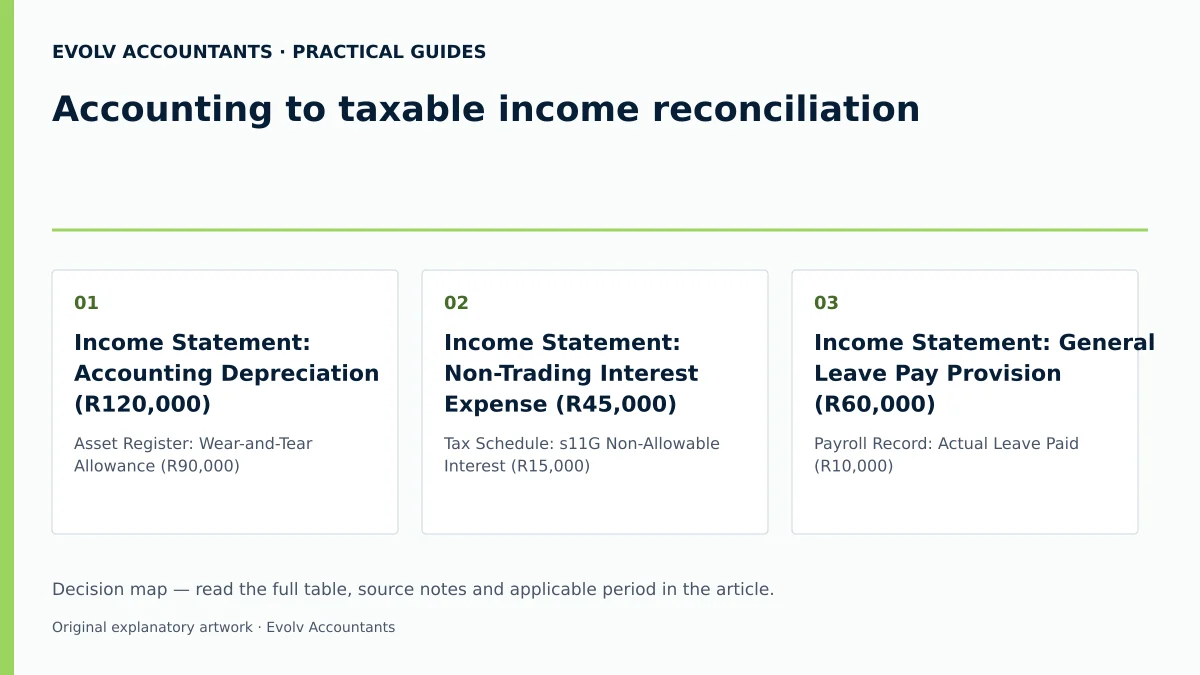
The table below illustrates a standard transaction-level reconciliation bridge converting commercial accounting profit to taxable income for a South African company.
| Independent record A | Independent record B | Difference | Reason and evidence | Action and owner |
|---|---|---|---|---|
| Income Statement: Accounting Depreciation (R120,000) 6 | Asset Register: Wear-and-Tear Allowance (R90,000) 56 58 | +R30,000 (Taxable Profit Increase) | Timing difference: Statutory wear-and-tear rate differs from accounting depreciation rate 6 56. | Add back depreciation; claim s11(e) wear-and-tear on ITR14. Tax Senior 8 56. |
| Income Statement: Non-Trading Interest Expense (R45,000) 5 | Tax Schedule: s11G Non-Allowable Interest (R15,000) 5 14 | +R15,000 (Taxable Profit Increase) | Permanent limit: Section 11G limits interest expense to non-trading interest income 5 8. | Credit adjustment: add back non-allowable s11G interest on ITR14. Tax Manager 5 8. |
| Income Statement: General Leave Pay Provision (R60,000) 51 | Payroll Record: Actual Leave Paid (R10,000) 8 51 | +R50,000 (Taxable Profit Increase) | Timing difference: Unfunded leave provisions are non-deductible until actually paid 8 51. | Add back s23(e) non-deductible provision balance on ITR14. Financial Accountant 8 51. |
| Income Statement: Accounting Profit on Asset Sale (R85,000) 57 | CGT Schedule: Capital Gains Determination (R40,000) 54 69 | -R45,000 (Net Taxable Adjustment) | Structural difference: Accounting profit removed; statutory capital gain taxed under Eighth Schedule 54 57 69. | Debit adjustment: remove accounting profit; declare capital gain on CGT schedule. Tax Senior 7 54 69. |
| Prior-Year ITA34: s11(j) Doubtful Debt Allowance (R30,000) 34 | Current-Year s11(j) Allowance Claim (R35,000) 33 56 | -R5,000 (Net Taxable Adjustment) | Timing reversal: Prior-year s11(j) allowance reversed; current-year allowance granted 33 34 56. | Add back prior s11(j) allowance; claim current s11(j) allowance on ITR14. Financial Controller 33 34 56. |
Reproducible hypothetical example: Corporate tax calculation
The following hypothetical example demonstrates the step-by-step reconciliation of accounting profit to taxable income and corporate income tax calculation for a South African SME.
Entity Profile and Assumptions
- Entity Name: Exemplar Trading (Pty) Ltd.
- Assessment Period: Year of assessment ending 28 February 2025 (2025 Year of Assessment) 11 70 71.
- Company Classification: Standard Private Company (taxed at the standard Corporate Income Tax rate of 27% for years of assessment ending on or after 31 March 2023) 19 70.
- Commercial Net Profit (before tax): R1,000,000 (as reported on the audited Income Statement) 2 3.
Reconciliation Adjustments
- Accounting Depreciation: R150,000 debited in the Income Statement 6. Added back in full (Credit Adjustment) 8.
- Statutory Wear-and-Tear Allowance (Section 11(e)): R180,000 calculated per tax asset register 56 58. Deducted in full (Debit Adjustment) 56.
- General Doubtful Debt Provision: R50,000 debited in the Income Statement 51. Added back as non-deductible (Credit Adjustment) 8.
- Section 11(j) Approved Doubtful Debt Allowance (Current Year): R20,000 qualifying tax allowance 33 56. Deducted in full (Debit Adjustment) 56.
- Non-Trading Interest Limitation (Section 11G): R10,000 non-allowable interest expense 5 14. Added back as non-deductible (Credit Adjustment) 5 8.
- Exempt Local Dividends Received: R30,000 credited in the Income Statement 7 54. Deducted as exempt income under section 10(1)(k) (Debit Adjustment) 7 54.
Step-by-Step Calculation
- Commercial Accounting Net Profit: R1,000,000 3
- Add Credit Adjustments (Add-backs):
- Accounting Depreciation: +R150,000 8
- General Doubtful Debt Provision: +R50,000 8
- Section 11G Non-Allowable Interest: +R10,000 5 8
- Total Credit Adjustments: +R210,000 8 48
- Less Debit Adjustments (Allowable Deductions / Exemptions):
- Section 11(e) Wear-and-Tear Allowance: -R180,000 56
- Section 11(j) Doubtful Debt Allowance: -R20,000 56
- Exempt Local Dividends: -R30,000 54
- Total Debit Adjustments: -R230,000 53 54 56
- Taxable Income: R1,000,000 + R210,000 - R230,000 = R980,000 29 46
Statutory Tax Liability
- Applicable Tax Rate: 27% (Standard CIT rate for 2025 Year of Assessment) 70.
- Corporate Income Tax Payable: R980,000 × 27% = R264,600 70.
Frequently Asked Questions
What is the statutory Corporate Income Tax rate for companies in South Africa?
For standard companies, the statutory Corporate Income Tax rate is 27% for any year of assessment ending on or after 31 March 2023 (including the 2024, 2025, and 2026 tax years) 70. For financial years that ended between 1 April 2022 and 30 March 2023, the statutory rate was 28% 70.
How does a business qualify as a Small Business Corporation (SBC) under section 12E?
To qualify for progressive SBC tax rates under section 12E of the Income Tax Act, a company must meet the applicable section 12E tests; key criteria include the following: it must be incorporated in South Africa as a private company, close corporation, or co-operative; all shareholders must be natural persons; gross income must not exceed R20 million; combined investment income and personal service income must not exceed 20% of total receipts/accruals; and the company must not be a personal service provider 10 72 73 74. Other ownership tests and statutory exceptions also apply. For years of assessment ending from 1 April 2026 to 31 March 2027, the SARS table has a 0% band up to R99,000; select the full table for the company’s actual year end. SARS company and Small Business Corporation tax tables
What is the difference between credit adjustments and debit adjustments on the ITR14?
On the ITR14 tax computation, credit adjustments increase taxable profit (or decrease net loss) by adding back non-deductible expenses debited to the Income Statement (such as accounting depreciation, general provisions, or non-allowable interest) 8 14 48. Debit adjustments decrease taxable profit (or increase net loss) by deducting non-taxable income credited to the Income Statement (such as exempt dividends) or claiming statutory tax allowances not debited to the Income Statement (such as section 11(e) wear-and-tear) 7 53 54 56.
How are provisional tax payments structured for South African corporate taxpayers?
Provisional tax is paid in statutory installments during and after the assessment year 68: First Payment*: Due within six months after the start of the year of assessment 68. Second Payment*: Due on or before the last business day of the year of assessment 68. Third Payment (Top-up)*: Due six months after the end of the year of assessment (or seven months after year-end for taxpayers with a February financial year-end, i.e., 30 September) 68.
What steps should a company take if an error is discovered on a submitted ITR14?
If an error is discovered after submitting an ITR14 return on eFiling, the company should lodge a Request for Correction (RFC) on eFiling 28 62. The RFC re-opens the return pre-populated with previously submitted data, allocating a new version number 28 62. If SARS has already finalised an assessment that resulted in an incorrect tax overcharge due to an error in the return, the company can lodge a Request for Reduced Assessment (RRA02 form) under section 93 of the Tax Administration Act 5 13. Describe your company return or tax reconciliation question and ask Evolv about the support required. Ask Evolv about accounting to taxable income reconciliation. Share the relevant records so the support required can be scoped. Enquire with Evolv Accountants
Related guides
- Preparing an ITR14 company income tax return
- Company income tax rates and year end considerations
- The Proactive SARS Audit Guide: Keeping Your Business Ledger Sanitised
Sources
- https://www.sars.gov.za/wp-content/uploads/IT-GEN-04-G01-How-to-complete-the-Income-Tax-Return-ITR14-for-Companies-External-Guide.pdf
- https://www.sars.gov.za/wp-content/uploads/Ops/Guides/IT-ELEC-03-G01-Guide-to-complete-the-Company-Income-Tax-Return-ITR14-eFiling-External-Guide.pdf
- Corporate Income Tax | South African Revenue Service
- Companies, Trusts and Small Business Corporations (SBC) | South African Revenue Service
- SARS IT39: renewable-energy allowances and first-use conditions