
Company income tax rates and year end considerations
19 May 2026

South African company income tax requires incorporated entities to pay tax based on their annual financial year end and entity classification.
Every business entity that is a tax resident in South Africa or conducts trade through a local branch or permanent establishment is subject to Corporate Income Tax (CIT) on its income for each year of assessment 1 2 3. For corporate entities, the statutory year of assessment corresponds directly with the business's registered financial year-end 4 5. Standard companies are subject to a flat tax rate of 27% for years of assessment ending on any date between 31 March 2023 and 31 March 2027 6.
Qualifying Small Business Corporations (SBCs) under section 12E benefit from progressive tax brackets ranging from 0% up to 27% for years of assessment ending between 1 April 2025 and 31 March 2027 7 8 9. Corporate taxpayers must submit annual Income Tax Returns for Companies (ITR14) via eFiling accompanied by compulsory Annual Financial Statements (AFS) where required 10 11 12.
Applicable year end and company rate
Defining Financial Year Ends and Tax Years of Assessment
For South African private companies, close corporations, public companies, and other juristic entities, the tax year of assessment aligns with the entity's financial year-end as registered with CIPC and SARS 4 5 13. The output of company tax computation is the net Corporate Income Tax liability or assessed loss for the specific year of assessment, measured in South African Rands (ZAR) 2 14 15.
Taxpayers must distinguish financial accounting profit from taxable income: accounting profit is derived under financial reporting standards, whereas taxable income reflects statutory tax adjustments, exempt income deductions, and allowable capital allowances prescribed by the Income Tax Act 16 17 18 19.
Standard Corporate Income Tax Rates
Standard corporate entities—including private companies (Pty Ltd), public companies (Ltd), close corporations (CC), state-owned companies, and collective investment schemes—are assessed at a flat corporate rate 6 13.
- Years of assessment ending 1 April 2020 to 30 March 2023: Standard corporate tax rate was 28% 6.
- Years of assessment ending 31 March 2023 to 31 March 2027: Standard corporate tax rate is 27% (applicable to financial years ending on any date from 31 March 2023 to 31 March 2027) 6.
Small Business Corporation (SBC) Tax Rates
Qualifying entities that satisfy all statutory requirements of section 12E are assessed under progressive tax tables rather than the standard flat rate 7 8 9.
- SBC rates for years of assessment ending between 1 April 2025 and 31 March 2026:
- R1 – R95 750: 0% of taxable income 8.
- R95 751 – R365 000: 7% of taxable income above R95 750 8.
- R365 001 – R550 000: R18 848 + 21% of taxable income above R365 000 8.
- R550 001 and above: R57 698 + 27% of the amount above R550 000 8.
- SBC rates for years of assessment ending between 1 April 2026 and 31 March 2027:
- R1 – R99 000: 0% of taxable income 8.
- R99 001 – R365 000: 7% of taxable income above R99 000 8.
- R365 001 – R550 000: R18 620 + 21% of taxable income above R365 000 8.
- R550 001 and above: R57 470 + 27% of the amount above R550 000 8.
Inputs rates periods and exclusions: applicable year end
Primary Evidence Requirements for Tax Rates and Thresholds
All tax rates, threshold brackets, and assessment periods must be verified against current SARS primary documentation 6 8 20. Historical tax guides or older legal interpretation notes provide background context but cannot prove that an old numerical threshold remains current 6 8.
Section 12E SBC Qualification Criteria
To qualify for SBC tax rate relief, a company must satisfy all six statutory criteria under section 12E(4)(a) throughout the relevant year of assessment:
- Entity Incorporation: The taxpayer must be incorporated within South Africa as a private company, close corporation, or co-operative 9.
- Natural Person Shareholders: All holders of shares or member interests must, at all times during the year of assessment, be natural persons (individuals) 9 21.
- Gross Income Ceiling: Total gross income for the year of assessment must not exceed R20 million 9 22.
- Income Composition Limit: Combined personal service income and investment income must not exceed 20% of total receipts and accruals (excluding capital receipts but including capital gains) 9 23.
- Personal Service Provider Exclusion: The company must not be a Personal Service Provider as defined in the Fourth Schedule 9 21.
- Single Company Shareholding: Shareholders must not hold any shares or member interests in any other close corporation, company, or co-operative, other than allowed under section 12E(4)(a)(ii) exceptions 21.
Separating Tax Regimes: CIT vs Micro Business Turnover Tax and Provisional Tax
- Corporate Income Tax vs Turnover Tax: Turnover tax under the Sixth Schedule is a distinct, simplified tax regime for micro-businesses with annual qualifying turnover not exceeding R1 million and total assets not exceeding R5 million 24 25. Turnover tax replaces normal corporate income tax for registered micro-businesses 24.
- Provisional Tax Payment Schedule: All corporate taxpayers are provisional taxpayers 26. Provisional tax liabilities must be settled in three scheduled installments:
- First Provisional Payment: Due within six months after the start of the year of assessment 26.
- Second Provisional Payment: Due on or before the final day of the year of assessment 26.
- Third (Top-up) Provisional Payment: Due six months after the end of the year of assessment (or seven months after year-end for entities with a February financial year-end, i.e., 30 September annually) 26.
The calculation in a worked example: company rate
Reproducible Computation Framework
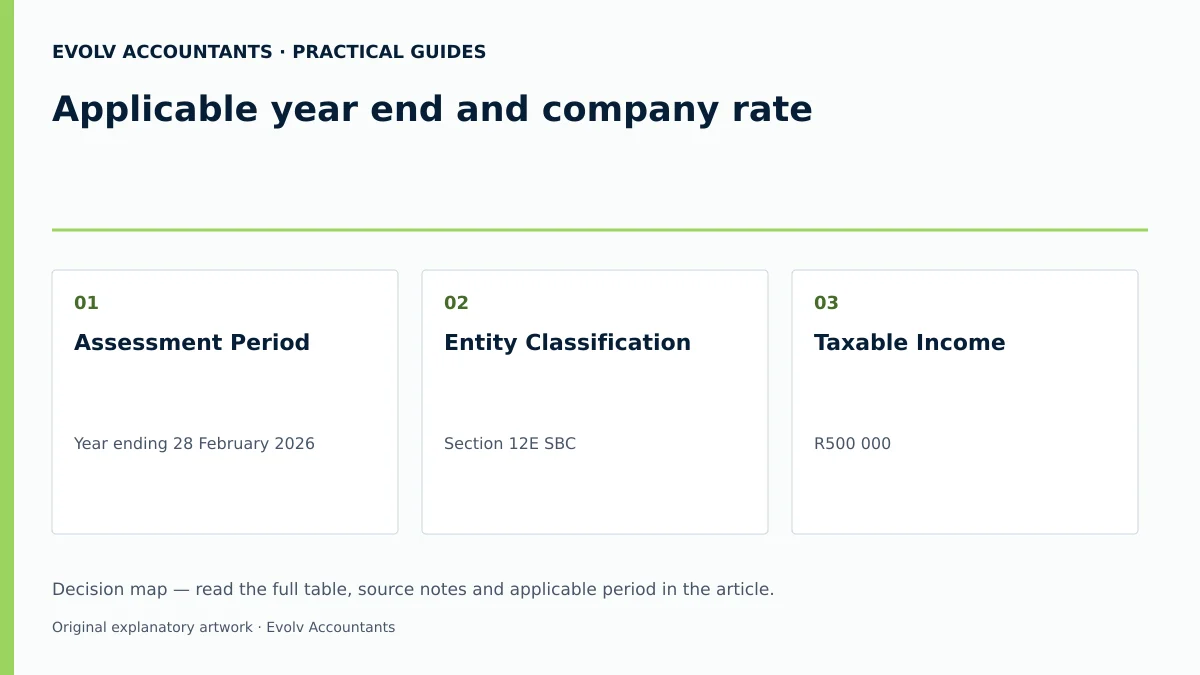
To illustrate the practical application of company tax rates, consider a hypothetical South African private company qualifying as a Small Business Corporation under section 12E with a taxable income of R500 000 for the year of assessment ending 28 February 2026. All illustrative figures represent hypothetical values to demonstrate calculation steps and must not be treated as statutory caps 8 9.
Step-by-Step SBC Calculation
- Assessment Period: Year of assessment ending 28 February 2026 (falling within the 1 April 2025 to 31 March 2026 rate period) 8.
- Taxable Income Bracket: R500 000 falls in the R365 001 – R550 000 tax bracket 8.
- Base Tax: R18 848 8.
- Variable Portion: 21% of the taxable income above R365 000 8.
- Total SBC Tax Liability: R18 848 + R28 350 = R47 198 8.
- Standard Corporate Rate Comparison: At the standard 27% corporate tax rate, tax payable would equal R135 000 (27% × R500 000) 6. SBC status delivers a net tax relief of R87 802 (R135 000 - R47 198) for this assessment period.
| Input | Value or verified-source placeholder | Formula or step | Result | Independent check |
|---|---|---|---|---|
| Assessment Period | Year ending 28 February 2026 | Match financial year end to tax rate table period 6 8 | 2025/2026 YOA | Verified against SARS tax rate table 8 |
| Entity Classification | Section 12E SBC | Confirm s12E qualification criteria met 9 21 | Qualified SBC | All 6 s12E declarations confirmed 21 23 |
| Taxable Income | R500 000 | Net profit adjusted for tax additions and deductions 17 19 | R500 000 | Reconciled to accounting profit 17 |
| SBC Base Tax | R18 848 | Fixed amount for R365 001 – R550 000 bracket 8 | R18 848 | Matches primary SARS rate table 8 |
| Income Above R365 000 | R135 000 | R500 000 - R365 000 8 | R135 000 | R365 000 + R135 000 = R500 000 |
| Marginal Rate | 21% | Applicable marginal rate above R365 000 8 | R28 350 | R135 000 × 0.21 = R28 350 |
| Total SBC Tax Payable | R47 198 | Base Tax (R18 848) + Variable Tax (R28 350) 8 | R47 198 | R18 848 + R28 350 = R47 198 |
| Standard Rate Comparison | 27% | Standard corporate tax rate (27%) 6 | R135 000 | R500 000 × 0.27 = R135 000 |
| Net Tax Relief | R87 802 | Standard Tax (R135 000) - SBC Tax (R47 198) | R87 802 | R47 198 + R87 802 = R135 000 |
Reconcile the answer to the underlying records: applicable year end
Annual Financial Statements and eFiling Disclosures
For Small Businesses (gross income up to R20 million) and Medium to Large Businesses, submitting signed off Annual Financial Statements (AFS) is compulsory upon initial ITR14 submission 11 12 27. AFS must at a minimum include an Income Statement, Balance Sheet, and Notes to the AFS, signed by the Public Officer or Company Representative 11 12. Submitting financial statements is optional for dormant entities, micro-businesses, and body corporates unless requested by SARS 12 28.
Reconciling Accounting Profit to Taxable Income
Taxable income is calculated on the ITR14 by adjusting accounting net profit or loss 17 18 19:
- Credit Adjustments (Increasing Taxable Income): Non-deductible accounting expenses, non-allowable interest under section 11G, depreciation add-backs, and taxable recoupments under section 8(4) 16 17 29.
- Debit Adjustments (Decreasing Taxable Income): Exempt income (such as exempt local dividends), accounting profit on disposal of assets, section 12E plant and machinery capital allowances, and enhanced renewable energy deductions under section 12BA 16 17 18 19.
Record Retention and Verification Checklist
All supporting documents, ledger accounts, contracts, and bank records must be retained for five years from the date of ITR14 submission 30. If a company is undergoing audit, verification, or dispute, records must be retained until the process is concluded 30.
— Practical point from this guide
- Maintain Registered Entity Details: Verify and confirm legal entity details, public officer appointments, and banking details on eFiling prior to requesting the ITR14 return 31 32.
- Confirm Financial Year End: Check the registered financial year-end and ensure the ITR14 wizard selects the correct year of assessment 4 33.
- Validate SBC Qualification: Confirm that all six section 12E requirements are satisfied before selecting "Yes" to the SBC question on the wizard 9 21 23.
- Reconcile Tax Computations: Reconcile accounting profit to taxable income, verifying all debit and credit adjustments against trial balance schedules 17 19.
- Verify Tax Credits and Provisional Payments: Verify pre-populated PAYE/IRP5 credits and provisional tax payments against SARS Statement of Account records 26 34 35.
- Sign and Upload AFS: Ensure signed Annual Financial Statements (Income Statement, Balance Sheet, Notes) are attached in PDF format before submitting 11 12.
Edge cases that change the calculation: company rate
Variable or Changed Financial Year Ends
When a company changes its financial year-end during a tax year (e.g., changing from May to December), the entity must complete a single ITR14 return covering the full adjusted period from the start date to the end date (CCYYMMDD) 5 36. Supporting financial statements covering the exact revised period must be submitted 5 36.
Personal Service Providers (PSPs)
Personal Service Providers are companies or trusts where services are rendered personally by a connected person and specific dependency conditions apply (e.g., where more than 80% of service income is derived from a single client) 37 38. PSPs are taxed at the standard corporate rate of 27% (or 45% for trusts) and are restricted from claiming trade deductions other than expenses allowed under section 23(k) 7 37 38. PSPs cannot qualify for SBC tax rates 9 21.
Special Economic Zone (SEZ) Qualifying Companies
Qualifying companies operating within designated Special Economic Zones under section 12R are taxed at a reduced rate of 15% rather than the standard 27% corporate rate 39 40. To qualify, the business must conduct an approved activity under its Standard Industrial Classification (SIC) code and incur no more than 20% of deductible expenses or receive no more than 20% of income from connected persons 39 40.
Dormant Entities
According to SARS guide IT-GEN-04-G01, a dormant entity is "not actively trading and/or did not receive any income or incur any expenses" 41. Dormant companies must submit an ITR14 return if they held assets or liabilities exceeding R1 000, derived gross income exceeding R1 000, or had capital gains/losses exceeding R1 000 during the year of assessment 10 42.
Form Wizard Classification vs Statutory SBC Status
Taxpayers must distinguish between the ITR14 Form Wizard "Small Business" classification and statutory "Small Business Corporation" status under section 12E 32 43 44:
- Form Wizard "Small Business": An administrative return classification for entities with gross income up to R20 million and total assets up to R10 million, which determines the return containers generated 43 45.
- Section 12E SBC Status: A statutory tax regime requiring full compliance with natural shareholding, income composition, and single-shareholding rules to access progressive tax rates 9 21 32 44.
Next steps for Corporate income tax
Method and Pre-Filing Review
Before submitting company income tax returns, management and public officers should complete a systematic review:
- Confirm company registered details on eFiling 31.
- Audit section 12E SBC eligibility criteria 9 21.
- Cross-check provisional tax credits against SARS Statement of Account balances 26.
- Verify tax adjustments and capital allowance schedules 17 19.
Frequently Asked Questions
What is the standard company income tax rate for South African private companies?
A1: The standard Corporate Income Tax rate is 27% for all years of assessment ending on any date between 31 March 2023 and 31 March 2027 6. For tax years ending between 1 April 2020 and 30 March 2023, the standard rate was 28% 6.
How does a company qualify for Small Business Corporation (SBC) tax rates under section 12E?
A2: A company qualifies if it is incorporated in SA as a private company, close corporation, or co-operative; all shareholders are natural persons; gross income does not exceed R20 million; investment and personal service income does not exceed 20% of total receipts/accruals; it is not a Personal Service Provider; and shareholders hold no shares in other corporate entities 9 21 23.
When are corporate provisional tax payments due to SARS?
A3: First provisional tax payments are due six months after the start of the year of assessment 26. Second payments are due on or before the last day of the year of assessment 26. Third (top-up) payments are due six months after year-end, or seven months after year-end for February year-ends (30 September) 26.
What Annual Financial Statements (AFS) must be submitted with the ITR14 return?
A4: Small Businesses and Medium to Large Businesses must submit signed Annual Financial Statements comprising an Income Statement, Balance Sheet, and Notes to the AFS 11 12. Submitting AFS is optional for dormant entities, micro-businesses, and body corporates unless requested by SARS 12.
What corporate tax rate applies to qualifying companies operating in a Special Economic Zone (SEZ)?
A5: Qualifying companies operating in an approved SEZ under section 12R are taxed at a reduced rate of 15%, provided they satisfy trade activity requirements and comply with the 20% connected person expenditure and income limitations 39 40.
Related guides
- Preparing an ITR14 company income tax return
- Deductible business expenses for a private company
- The Proactive SARS Audit Guide: Keeping Your Business Ledger Sanitised
Sources
- https://www.sars.gov.za/wp-content/uploads/IT-GEN-04-G01-How-to-complete-the-Income-Tax-Return-ITR14-for-Companies-External-Guide.pdf
- https://www.sars.gov.za/wp-content/uploads/Ops/Guides/IT-ELEC-03-G01-Guide-to-complete-the-Company-Income-Tax-Return-ITR14-eFiling-External-Guide.pdf
- Companies, Trusts and Small Business Corporations (SBC) | South African Revenue Service
- Corporate Income Tax | South African Revenue Service