
Deductible business expenses for a private company
9 June 2025

Claiming a deductible business expense for a private company requires demonstrating that expenditure was incurred in the production of income for trade.
For South African private companies (Pty Ltd) and Close Corporations (CC), tax deductibility is governed by statutory trade and income production requirements under the Income Tax Act 1962, supplemented by regulatory completion guides issued by the South African Revenue Service (SARS) 1 2.
Determining whether an operational expense is fully deductible, subject to tax allowance limitations, or completely disallowed requires evaluating the nature of the expenditure, the company's statutory entity classification, and the supporting documentary evidence retained 2 3. Small Business Corporations (SBCs) qualifying under Section 12E enjoy preferential tax rate brackets and accelerated depreciation allowances, whereas Personal Service Providers (PSPs) face strict expense disallowance rules under Section 23(k) 4 5.
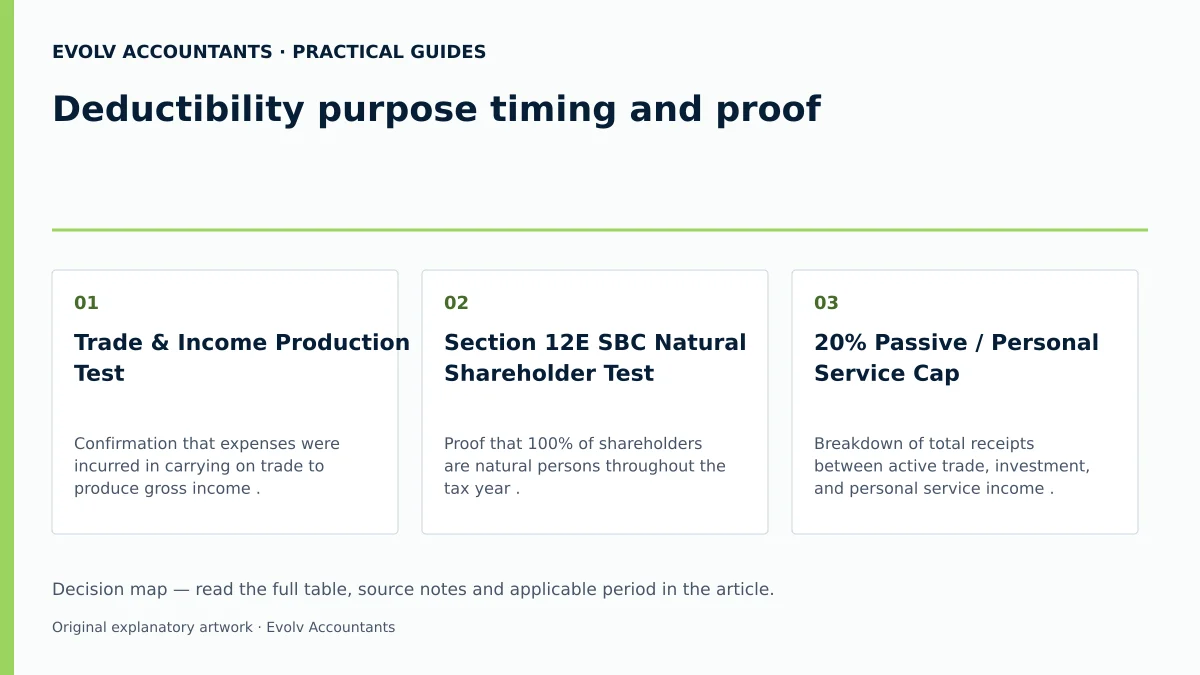
Deductibility purpose timing and proof
Entity classification and tax registration
Every private company registered with the Companies and Intellectual Property Commission (CIPC) is automatically registered for Corporate Income Tax (CIT) through a direct electronic interface with SARS 6. However, tax registration does not automatically entitle an entity to general tax deductions or special relief regimes 1 5.
Statutory tax liability applies to all resident companies on their worldwide income, whereas non-resident entities operating via a local branch or permanent establishment are taxed on South African-sourced income 2 7. Under SARS regulatory guidance (effective 2 March 2026), resident private companies deriving gross income exceeding R1 000, holding assets or liabilities over R1 000, or incurring taxable turnover or assessed losses must complete and submit an annual Company Income Tax Return (ITR14) via eFiling 6 8.
Applicable tax rate periods
Tax deductibility calculations and net tax liability must be evaluated with strict reference to the relevant financial year of assessment 9 10. For standard private companies, Corporate Income Tax is charged at a flat rate of 27% for years of assessment ending on any date between 1 April 2023 and 31 March 2027 9. Companies qualifying as Small Business Corporations under Section 12E benefit from progressive statutory tax rates 5 11:
- Year of Assessment ending between 1 April 2025 and 31 March 2026 10:
- Taxable Income R1 – R95 750: 0% 10.
- Taxable Income R95 751 – R365 000: 7% of taxable income above R95 750 10.
- Taxable Income R365 001 – R550 000: R18 848 + 21% of taxable income above R365 000 10.
- Taxable Income R550 001 and above: R57 698 + 27% of taxable income above R550 000 10.
- Year of Assessment ending between 1 April 2026 and 31 March 2027 10:
- Taxable Income R1 – R99 000: 0% 10.
- Taxable Income R99 001 – R365 000: 7% of taxable income above R99 000 10.
- Taxable Income R365 001 – R550 000: R18 620 + 21% of taxable income above R365 000 10.
- Taxable Income R550 001 and above: R57 470 + 27% of taxable income above R550 000 10.
Distinguishing statutory tax law (the Income Tax Act 1962), administrative regulator guidance (SARS external ITR14 guides), and professional advisory recommendations (Evolv Accountants' expert practices across bookkeeping, accounting, tax advisory, payroll and statutory compliance) is vital 1 2. While statutory law dictates deductibility thresholds, SARS guidance sets administrative wizard customisation parameters, and Evolv recommends rigorous pre-filing expense reconciliations to protect client audit trails.
— Practical point from this guide
The qualification tests to check: deductibility purpose timing
Core deductibility tests under corporate tax law
To determine whether an operational expense is deductible for Corporate Income Tax, private companies must satisfy several cumulative tests 2 12 13:
- Trade Requirement: The company must actively carry on a trade during the year of assessment 14 15.
- Incurred for Income Production: Expenditure must be bona fide incurred in the production of gross income 2.
- Non-Capital Nature: The cost must be an operational expense rather than a capital investment 13 16. Capital expenditures (such as machinery or property) are disallowed as direct expenses but may qualify for statutory tax allowances such as wear and tear under Section 11(e) or Section 12E accelerated depreciation 17 18.
- Prohibition of Disallowed Personal or PSP Costs: Expenses must not fall under statutory prohibitions, such as Section 23(k) restrictions for Personal Service Providers 4 19.
Statutory SBC eligibility criteria under Section 12E
Qualifying for SBC status requires meeting specific legislative criteria under Section 12E(4)(a) of the Income Tax Act throughout the entire year of assessment 5:
- Incorporation: The entity must be incorporated as a private company, close corporation, or co-operative in South Africa 5.
- Natural Person Shareholding: All shareholders or members must at all times during the year of assessment be natural persons 5 20.
- Gross Income Cap: Gross income for the year of assessment must not exceed R20 million 5 21.
- Passive and Personal Service Income Limit: Not more than 20% of total receipts, accruals (excluding capital receipts), and capital gains may collectively consist of investment income and personal service income 5 22.
- Exclusion of Personal Service Providers: The company must not be classified as a Personal Service Provider 5 20.
- Single Ownership Rule: Shareholders must not hold any shares or interest in any other private company, close corporation, or co-operative, except for permitted statutory investments like listed shares or unit trusts 20.
Return customisation categories versus Section 12E SBC status
SARS uses operational thresholds in the ITR14 form wizard to customize tax returns 14 23. It is essential not to confuse these return customisation categories with statutory Section 12E SBC tax relief 5 24:
- Micro Business Return: Qualifying turnover <= R1 million AND total assets <= R5 million 15 25.
- Small Business Return: Gross income <= R20 million AND total assets <= R10 million (applicable for financial year ends from 30 April 2013 onwards) 23 26.
- Medium to Large Business Return: Gross income > R20 million OR total assets > R10 million 27 28.
A business may complete a "Small Business" ITR14 customized return based on asset size, yet fail Section 12E eligibility if its shareholders are corporate entities or if passive income exceeds 20% 5 22 24.
Personal Service Provider (PSP) restrictions under Section 23(k)
Where a private company renders services through a connected person and is deemed a Personal Service Provider, Section 23(k) limits tax deductions strictly to 4 19:
- Remuneration paid to employees or directors 4 19;
- Expenses in respect of business premises 4 19;
- Finance charges, insurance, repairs, fuel, and maintenance for assets used wholly and exclusively for trade 4 19;
- Legal refunds of restraint of trade payments 4 19.
All other general trade deductions are statutorily disallowed 4 19.
Evidence behind the eligibility decision: proof
Mandatory Annual Financial Statements and schedules
For companies classified as Small Businesses or Medium to Large Businesses on eFiling, submitting signed Annual Financial Statements (AFS) is compulsory upon initial ITR14 submission 29 30. The AFS must be signed by the Company Representative or Public Officer and must contain at a minimum 3 29 30:
For Micro Businesses and Dormant Companies, submitting AFS on initial filing is optional, but SARS retains the right to request relevant material during verification or audit 29 30 31.
Document retention rules and audit readiness
Under SARS regulatory rules, all supporting documents and evidence records must be retained for a period of five years from the date of submission of the ITR14 return 3 32. If a company is subject to a SARS audit, verification, dispute, objection, or appeal, all records must be retained until the proceedings are fully concluded and the assessment becomes final 3.
Beneficial ownership and declaration responsibilities
From the 2022 tax year onwards, SARS mandates the disclosure of beneficial ownership details in the ITR14 return to identify natural persons who ultimately own or exercise effective control 27 33. The Public Officer or Company Representative authenticates the return submission on eFiling 34 35. Signing or submitting the ITR14 constitutes a binding legal declaration; misrepresentation, omission, or false claims may lead to criminal prosecution 35 36 37.
A qualifying case and an excluded case: deductibility purpose timing
To illustrate how purpose, timing, and evidence intersect, consider two hypothetical private companies evaluating their corporate tax obligations for the financial year of assessment ending 31 March 2026.
Qualifying case — Precision Engineering (Pty) Ltd
- Fact Pattern: Precision Engineering (Pty) Ltd is a South African company manufacturing custom machinery components. During the year of assessment ending 31 March 2026, it derived gross trading income of R8 500 000 and had total assets valued at R4 200 000. All shares are held by two natural persons who hold no shares in other private companies. Personal service and investment income accounted for 0% of total receipts.
- Deductibility & SBC Analysis: Precision Engineering meets all Section 12E statutory criteria 5 20. Its operating expenses (raw materials, wages, workshop rent) of R6 000 000 are fully deductible under general trading principles 2 12 13. In addition, it claims Section 12E accelerated wear and tear on new manufacturing plant 17.
- Tax Computation: Net taxable income is R2 500 000 (R8 500 000 gross income less R6 000 000 expenses). Applying the Section 12E SBC tax brackets for the year of assessment ending 31 March 2026 10:
- R1 – R95 750 at 0% = R0 10.
- R95 751 – R365 000 (R269 250 at 7%) = R18 847,50 10.
- R365 001 – R550 000 (R185 000 at 21%) = R38 850,00 10.
- Above R550 000 (R1 950 000 at 27%) = R526 500,00 10.
- Total Corporate Tax Payable = R584 197,50 (compared to R675 000 under the standard 27% flat rate, saving R90 802,50) 9 10.
Excluded case — Apex Advisory (Pty) Ltd
- Fact Pattern: Apex Advisory (Pty) Ltd provides IT consulting services during the year of assessment ending 31 March 2026. Gross receipts totaled R3 000 000. All services were rendered personally by a director who is a connected person, and 85% of revenue was derived from a single client. Furthermore, 30% of gross receipts consisted of interest and dividends from investment holdings.
- Deductibility & SBC Analysis: Apex Advisory fails Section 12E eligibility on two independent grounds: investment income exceeds the 20% statutory cap, and the company qualifies as a Personal Service Provider 4 5 22. Under Section 23(k), general management fees and client entertainment costs are disallowed 4 19.
- Tax Computation: After disallowance of non-qualifying operational expenses under Section 23(k), taxable income is calculated at R1 800 000 4 19. The company is taxed at the standard flat corporate income tax rate of 27% 9. Total Tax Payable = R486 000 (R1 800 000 x 27%) 9. SBC progressive rates are entirely unavailable 5 10.
What changes the answer: proof
Operational triggers requiring reassessment
A private company's tax position can change dynamically during a financial period 5 14. Public officers must reassess tax treatment whenever the following events occur:
- Ownership Changes: Issuing shares to a corporate entity or trust instantly disqualifies the company from Section 12E SBC rates 5 20.
- Income Mix Shifts: An increase in rental income, interest, or personal service fees pushing combined passive income above 20% revokes SBC status 5 22.
- Gross Income or Asset Expansion: Exceeding R20 million in gross income reclassifies the company out of Section 12E SBC tax relief and alters ITR14 form customisation requirements 5 21 23.
- Cessation of Trading or Dormancy: If a company ceases active trade or receives no income and incurs no expenses, it must be declared as dormant 14 15. SARS guidance notes that a dormant company is "a company that was not actively trading and/or did not receive any income or incur any expenses" 14 15. If a company traded for any portion of the year of assessment, it cannot be treated as dormant for that tax year 14 15.
Form wizard adjustments and Request for Correction (RFC)
Altering wizard responses during eFiling return customisation can delete previously captured return sections 38 39. If an error is identified after submission, the company may lodge a Request for Correction (RFC) on eFiling to submit a revised declaration, provided no active SARS audit, dispute, or statutory limitation period prevents it 40 41 42. Where assessment errors arise from factual misunderstandings, a Request for Reduced Assessment (RRA02) under Section 93 may be submitted alongside compulsory supporting evidence 1 43 44.
Next steps for Corporate income tax
Decision checklist for company public officers
To verify deductible expenses and confirm corporate tax compliance prior to submission, public officers should complete the following checked actions:
- Verify CIPC and SARS Registered Details: Ensure legal entity data, trading name, banking details, and Public Officer particulars are fully updated on eFiling 6 45.
- Execute Section 12E SBC Screening: Test shareholder natural person status, single shareholding rules, the 20% passive income ceiling, and PSP status 5 20.
- Perform Pre-Filing Expense Reconciliations: Distinguish capital purchases from revenue expenses, and disallow non-qualifying expenses under Section 23(k) if PSP rules apply 4 13 16.
- Compile Compulsory Annual Financial Statements: Prepare signed Income Statement, Balance Sheet, and Notes to AFS 29 30.
- Secure Five-Year Record Repositories: Organise all invoices, bank statements, contracts, and asset registers into indexed electronic storage 3.
Eligibility decision table
| Test | Facts to obtain | Evidence | Applicable source | Result or unresolved question |
|---|---|---|---|---|
| Trade & Income Production Test | Confirmation that expenses were incurred in carrying on trade to produce gross income 2 14. | Supplier invoices, proof of payment, contracts, lease agreements 3 12. | Income Tax Act 1962 s11(a); SARS Guide IT-GEN-04-G01 2 12. | Pass: Fully deductible revenue expense. Fail: Disallowed or capitalised 16. |
| Section 12E SBC Natural Shareholder Test | Proof that 100% of shareholders are natural persons throughout the tax year 5 20. | Share register, certified ID copies, beneficial ownership filings 20 27 46. | Income Tax Act 1962 s12E(4)(a)(ii); SARS Guide IT-GEN-04-G01 5 20. | Pass: SBC requirement satisfied. Fail: Taxed at standard 27% flat rate 5 9. |
| 20% Passive / Personal Service Cap | Breakdown of total receipts between active trade, investment, and personal service income 5 22. | Trial balance, income statement notes, interest/dividend certificates 22 29. | Income Tax Act 1962 s12E(4)(a)(i); SARS Guide IT-GEN-04-G01 5 22. | Pass: Eligible for SBC progressive rates. Fail: Standard corporate tax applies 5 9. |
| Section 23(k) PSP Expense Restriction | Determination whether company is a PSP and services are rendered by connected persons 4 19. | Client contracts, employee list, IRP5 certificates, ownership records 4 19. | Fourth Schedule; Income Tax Act 1962 s23(k); SARS Guide IT-GEN-04-G01 4 19. | Pass: Normal deductions allowed. Fail: Restricted strictly to s23(k) costs 4 19. |
| Five-Year Evidence Retention Test | Verification that complete supporting documentation is securely stored 3 32. | Electronic document archive, indexed tax invoices, bank statements 3. | Tax Administration Act; SARS External Guide IT-ELEC-03-G01 3 47. | Pass: Compliant for SARS audit. Unresolved: Pending audit requires extended hold 3. |
Frequently Asked Questions
1. What financial threshold determines whether a private company qualifies for SBC tax rates?
To qualify for Section 12E SBC tax rates, a company's gross income for the year of assessment must not exceed R20 million 5 21. Additionally, combined investment and personal service income must not exceed 20% of total receipts and accruals 5 22. Note that the R10 million asset threshold in the ITR14 wizard customises the return layout but does not dictate Section 12E eligibility 5 24.
2. How long must a private company retain tax invoices, bank records, and financial statements?
Under SARS regulatory rules, all supporting documents and financial records must be retained for a minimum of five years from the date the ITR14 return is submitted 3 32. If a return is selected for audit, verification, or objection, records must be kept until the matter is fully finalised 3.
3. Can a dormant private company omit submitting Annual Financial Statements on eFiling?
When completing an ITR14 for a dormant company or micro business, uploading Annual Financial Statements on initial eFiling submission is optional 29 30 31. However, the company remains legally required to submit an accurate ITR14 declaration and must produce supporting records if requested by SARS 29 34 35.
4. How does SARS treat operational expenses incurred by a Personal Service Provider company?
If a company is classified as a Personal Service Provider, Section 23(k) disallows general operating expenditure 4 19. Deductions are limited strictly to employee remuneration, premises expenses, finance charges, insurance, repairs, fuel, and maintenance for trade assets 4 19.
5. What occurs if a company alters its responses on the eFiling form wizard after capturing details?
Changing wizard responses on eFiling alters the customized return container structure 38 39. The system displays a warning message because modifying wizard answers may delete previously captured financial schedule data 38 39.
Related guides
- Preparing an ITR14 company income tax return
- Capital expenses versus revenue expenses for tax
- The Proactive SARS Audit Guide: Keeping Your Business Ledger Sanitised
Sources
- Corporate Income Tax | South African Revenue Service
- https://www.sars.gov.za/wp-content/uploads/IT-GEN-04-G01-How-to-complete-the-Income-Tax-Return-ITR14-for-Companies-External-Guide.pdf
- Companies, Trusts and Small Business Corporations (SBC) | South African Revenue Service
- https://www.sars.gov.za/wp-content/uploads/Ops/Guides/IT-ELEC-03-G01-Guide-to-complete-the-Company-Income-Tax-Return-ITR14-eFiling-External-Guide.pdf