
Checking a supplier VAT registration number
26 June 2026

Checking a supplier VAT registration number requires verifying the vendor's legal tax status with SARS to ensure valid input tax deduction claims.
For South African small and medium enterprises (SMEs), verifying a supplier's Value-Added Tax (VAT) registration involves two distinct compliance checks: confirming that the vendor is actively registered on the South African Revenue Service (SARS) database, and ensuring that the physical or electronic invoice rendered complies with Section 20 of the Value-Added Tax Act 89 of 1991 1 2 3.
While searching a supplier's 10-digit VAT number on the SARS online portal confirms their registered status, input tax claims on VAT201 returns remain strictly conditional upon holding a complete, valid tax invoice containing all prescribed statutory fields 4 5 6. Currently, SARS administers a compulsory registration threshold of R2.3 million in taxable supplies over a 12-month period as an administrative position, whereas older official guides cite R1 million 7 8 9.
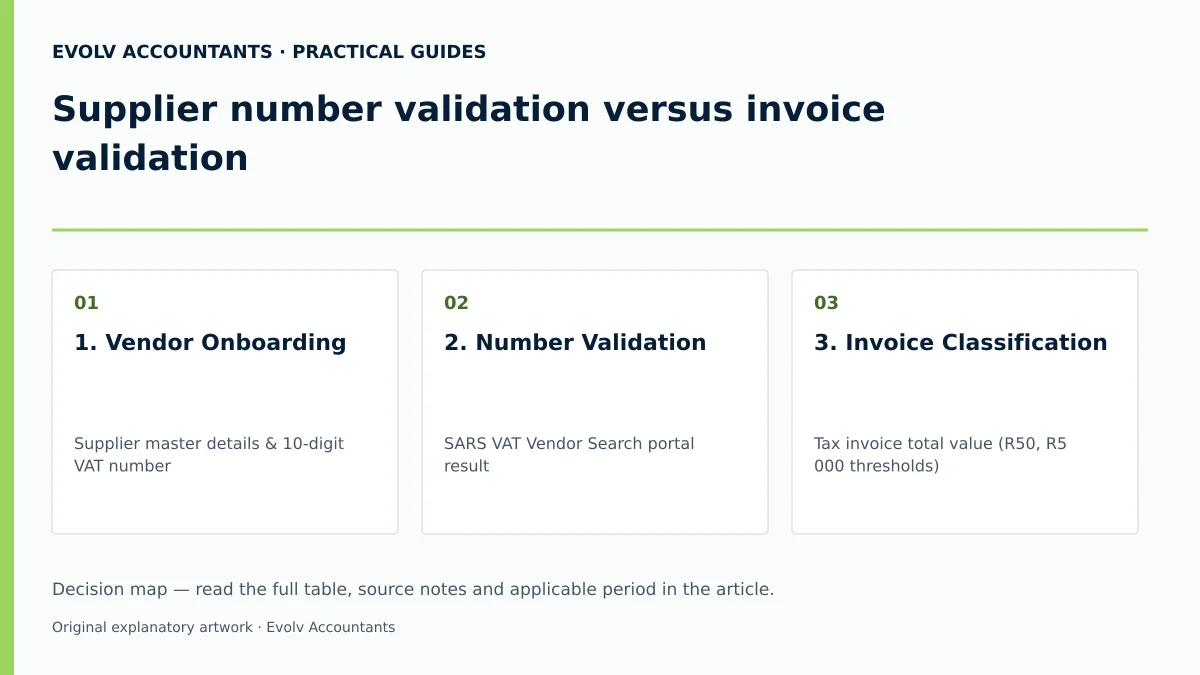
Supplier number validation versus invoice validation
Context, jurisdiction, and reader scope
This practical guidance is designed for South African SMEs, financial controllers, and accounts payable teams operating within the South African tax jurisdiction 4. Value-Added Tax is an indirect consumption tax governed by the Value-Added Tax Act 89 of 1991 and administered by SARS 11 12.
Registered vendors must account for VAT according to their assigned tax periods—typically Category A or B (two-month cycles), Category C (monthly cycles for turnover exceeding R30 million), or Category D (six-month cycles for qualifying farming operations) 13 14 15.
Understanding completion: Vendor search vs invoice validation
Completing supplier verification requires distinguishing between vendor registration validation and tax invoice validation 2 3:
- Supplier number validation confirms that the entity issuing the invoice is registered as a vendor with SARS and holds an active 10-digit VAT reference number 2 16. This check is conducted electronically via the SARS VAT Vendor Search portal on eFiling or the SARS website 2 16 17.
- Invoice validation inspects the transaction document itself to verify that it fulfills every mandatory requirement under Section 20 of the VAT Act 3 6 18.
Distinguishing statutory law, regulator guidance, and Evolv recommendations
To ensure statutory and operational alignment, SMEs must distinguish between legal obligations, administrative regulator guidance, and professional recommendations:
— Practical point from this guide
- Statutory Law: Under Section 16(2) of the VAT Act, a vendor is legally prohibited from deducting input tax unless they hold prescribed documentary proof—specifically a valid tax invoice 1 3 5.
- Regulator Guidance: SARS administrative guidance establishes digital tools such as the VAT Vendor Search portal and outlines record-keeping standards, requiring vendors to maintain complete audit trails 2 4 16.
- Evolv Recommendations: Evolv Accountants recommends performing online supplier number searches during vendor onboarding and executing automated or manual checklist reviews on every invoice before payment release or VAT201 filing 4 5.
Prepare the information and authority: supplier number validation
Mandatory inputs and documentation
To validate supplier numbers and verify incoming invoices, accounts payable personnel must gather specific inputs and primary records 6:
- Supplier Registration Particulars: The supplier's registered business name, trading name, physical address, and 10-digit VAT registration number 6 19.
- Documentary Proof: The original tax invoice, debit note, or credit note issued by the supplier 3 18.
- Official Notice of Registration: In specific cases (such as purchasing zero-rated agricultural inputs), the purchaser’s Notice of Registration showing entitlement to acquire qualifying agricultural inputs at zero rate must be presented to the supplier 20 21.
Administrative authority and access requirements
Validating a supplier's VAT number on the SARS VAT Vendor Search web portal is a public search function and does not require a formal power of attorney 2 16 17. However, where Evolv Accountants or an internal tax practitioner interacts with SARS directly to resolve vendor verification queries or disputes, a signed SARS Power of Attorney (POA) and registered tax practitioner authorisation are required 22 23.
Key statutory definitions
- Vendor: Any person who is registered or required to be registered under the VAT Act 24 25.
- Enterprise: Any activity carried on continuously or regularly in South Africa where goods or services are supplied for consideration 26 27.
- Taxable Supply: A supply of goods or services chargeable with VAT at either the standard rate (currently 15%) or the zero rate (0%) 10 28 29.
- Input Tax: VAT charged to a vendor on goods or services acquired to make taxable supplies 5 30.
Complete the task step by step: invoice validation
Sequenced invoice validation process
Accounts payable teams must execute a structured, step-by-step review grounded in current primary instructions before processing any input tax claim 5 6:
- Classify the Invoice by Value Threshold:
Determine whether the total consideration (including VAT) exceeds R5 000, is R5 000 or less, or is R50 or less 31.
- Validate Full Tax Invoice Requirements (Consideration over R5 000):
For supplies exceeding R5 000, confirm that the invoice contains all Section 20(4) statutory fields 6 31:
- The header explicitly states "Tax Invoice", "VAT Invoice", or "Invoice" 6 19.
- Name, physical address, and 10-digit VAT registration number of the supplier 6 19.
- Name, physical address, and 10-digit VAT registration number of the recipient SME 6 19.
- Individual serialised invoice number and date of issue 6 19.
- Full and proper description of the goods or services supplied 6 19.
- Quantity or volume of goods or services 6 19.
- Price and VAT charged at 15%, or total consideration with an explicit statement that VAT @ 15% is included 6 10 32.
- Validate Abridged Tax Invoice Requirements (Consideration R5 000 or less):
For supplies R5 000 or less, verify Section 20(5) fields 6 31. Abridged invoices omit recipient details and item quantities, but must contain supplier details, date, serial number, item description, and VAT calculations 6 33.
- Inspect Small Transactions (R50 or Less):
For transactions of R50 or less, a formal tax invoice is not legally required, but till slips or sales dockets reflecting VAT charged must be retained 34.
- Cross-Check Supplier Number on SARS Portal:
Access the SARS VAT Vendor Search portal and input the supplier's 10-digit registration number to confirm active vendor status 2 16 17.
- Archive for Statutory Record Retention:
File the validated tax invoice and search result in paper or electronic form for the mandatory 5-year retention period 1 4. SARS VAT 404 Guide notes that vendors must "keep records of all your documentary proof and other records of transactions for at least five years" 1.
Check the result against the evidence: supplier number validation
Independent completion evidence
A supplier verification task is complete only when independent evidence satisfies both registration status and documentary compliance 1 2:
- Registration Status Evidence: A saved PDF or printout from the SARS online VAT Vendor Search portal confirming that the supplier's 10-digit registration number is active and matches their legal or trading entity 2 16.
- Documentary Evidence: A fully compliant tax invoice meeting Section 20 requirements held in the vendor's accounting records 3 6 18.
Why ledger entry does not equal SARS acceptance
Recording an invoice in accounting software or submitting a VAT201 return does not mean SARS has accepted the claim 4 35 36. South African VAT operates on a self-assessment model 36 37. During routine SARS risk verifications or audits, auditors inspect physical or electronic tax invoices 4 37 38.
If an invoice lacks mandatory statutory fields—such as the recipient's VAT number on an invoice over R5 000—SARS will disallow the input tax deduction, issue an assessment, and levy administrative non-compliance penalties and interest 6 10 18 39.
Handle exceptions and unresolved cases: invoice validation
Title-specific edge cases and missing information
When validating supplier invoices, financial managers frequently encounter complex edge cases 40 41:
- Trading Name vs Legal Name Discrepancies:
If an invoice reflects a trading name or former entity name differing from the SARS vendor search result, the invoice is not automatically invalid 40. If a company undergoes a legal name change, tax invoices in the former name remain valid provided official CIPC registration documentation is retained on file 40.
- Backdated VAT Registrations:
Where SARS backdates the recipient vendor’s registration, the specific concession for the recipient’s VAT number on invoices for supplies received before that registration date may apply. This does not remove the need to verify the supplier’s registration and all other input-tax requirements 41.
- Invalid or Missing Supplier VAT Number:
If a supplier charges VAT but omits their registration number or provides an unverified number, the recipient cannot claim input tax 3 5. The supplier must be requested to issue a corrected tax invoice within 21 days 42.
- Self-Invoicing (Recipient-Created Tax Invoices):
In specialized industries where the recipient determines the price or measures the goods (such as agricultural produce), self-invoicing is permitted under Binding General Ruling 15 (BGR 15), provided prior written agreement exists 43 44.
Specialist boundaries and Evolv support
Where supplier validation fails, where complex transactions (such as imported services or Domestic Reverse Charge gold regulations) apply, or where SARS issues a notice of audit, SMEs should escalate the matter to Evolv Accountants for professional tax advisory support 38 45 46.
The five-year period is a minimum, not an automatic destruction date. SARS record-keeping guidance requires the relevant records to remain available; retain them beyond the ordinary minimum where an ongoing audit, investigation, objection or appeal or another applicable rule requires it.
Next steps for VAT registration
Reusable task and completion checklist
- Obtain vendor master data, including legal name, trading name, physical address, and 10-digit VAT registration number during onboarding 6.
- Validate the 10-digit VAT number using the official SARS VAT Vendor Search portal 2 16.
- Categorise incoming invoices by total value (full invoice for > R5 000; abridged for <= R5 000) 6 31.
- Confirm that full tax invoices explicitly state your SME's registered legal name, address, and VAT registration number 6 19.
- Verify mathematical correctness: net value, 15% standard rate VAT, and gross total consideration 6 10 32.
- Store verified tax invoices and search confirmation records in a secure system for 5 years 1 4.
Task and completion table
| Step | Input or evidence | Responsible person | Completion check | Exception or next action |
|---|---|---|---|---|
| 1. Vendor Onboarding | Supplier master details & 10-digit VAT number | Accounts Payable Clerk | Supplier profile created in accounting ledger | Request official proof of registration if details are incomplete 20 |
| 2. Number Validation | SARS VAT Vendor Search portal result | Finance Officer | Active registration status confirmed on SARS database 2 16 | Suspend VAT payment if number is invalid; request revised invoice 5 |
| 3. Invoice Classification | Tax invoice total value (R50, R5 000 thresholds) | Accounts Payable Clerk | Document correctly identified as full, abridged, or small transaction 31 | Enforce full tax invoice rules if total consideration exceeds R5 000 6 31 |
| 4. Field Verification | Statutory tax invoice document | Bookkeeper / Accountant | All mandatory Section 20 statutory fields present and verified 6 | Reject non-compliant document and demand corrected invoice within 21 days 42 |
| 5. Record Archiving | Verified tax invoice & SARS search proof | Records Manager / Accountant | Record filed in digital or paper repository for 5 years 1 4 | Apply for SARS ruling if original invoice is irrevocably lost 47 |
Reproducible hypothetical example
Consider a South African SME, Apex Logistics (Pty) Ltd (a registered VAT vendor), purchasing fleet maintenance services from Beacon Engineering CC 10 24.
Transaction Details (Labelled Illustrative Values):
- Base Service Fee: R10 000.00
- Standard Rate VAT (15%): R1 500.00 10
- Total Gross Consideration: R11 500.00
Validation Analysis:
- Invoice Format: Because total consideration (R11 500.00) exceeds R5 000, Section 20(4) requires a full tax invoice 6 31.
- Supplier Search: Beacon Engineering CC presents an invoice reflecting VAT registration number [hypothetical supplier VAT-number placeholder]. Apex Logistics inputs the number into the SARS VAT Vendor Search portal, confirming active registration 2 16.
- Mandatory Fields Check: The invoice contains the title "Tax Invoice", Beacon Engineering CC's particulars, Apex Logistics' legal name, address, and VAT registration number ([hypothetical recipient VAT-number placeholder]), serialised invoice number, date, detailed service description, and accurate 15% VAT calculation 6 10.
- Registration Threshold Context: Beacon Engineering CC became liable for compulsory VAT registration when its 12-month rolling turnover exceeded the statutory threshold 7 9. Under current SARS web guidance, SARS administers an increased compulsory threshold of R2.3 million in taxable supplies over a 12-month period (requiring application within 21 business days) 7 8 48. Older SARS guides cite R1 million 9 49. This reflects an administrative position administered by SARS for registration applications rather than a statutory amendment to Section 23 of the VAT Act 8.
Frequently Asked Questions
FAQ 1: Does verifying a supplier's VAT number on eFiling guarantee that SARS will allow the input tax claim?
No. Verifying a supplier's 10-digit VAT registration number on the SARS online portal confirms that the supplier is actively registered on SARS databases 2 16. However, claiming input tax requires holding a complete, valid tax invoice under Section 20 1 18. If the invoice lacks required statutory fields—such as your business's VAT number on transactions over R5 000—SARS will disallow the input tax claim upon audit 5 6.
FAQ 2: What is the difference between a full tax invoice and an abridged tax invoice?
A full tax invoice is legally required when total consideration for a taxable supply exceeds R5 000 (including VAT) 6 31. It must contain recipient details (name, address, VAT number) and item quantities 6 19. An abridged tax invoice applies to supplies R5 000 or less and omits recipient details and item quantities, though supplier details and VAT calculations remain mandatory 6 33.
FAQ 3: What should an SME do if a supplier charges VAT but omits their VAT registration number from the invoice?
You must not claim input tax on an invoice that omits the supplier's VAT registration number 3 5. Under Section 20, a vendor making a taxable supply exceeding R50 is legally required to issue a valid tax invoice within 21 days of the supply 42. You should notify the supplier immediately and request a corrected tax invoice containing their valid 10-digit VAT registration number 6 42.
FAQ 4: How long must an SME retain supplier tax invoices and validation records?
Under Section 55 of the VAT Act and the Tax Administration Act, vendors must retain all tax invoices, credit notes, debit notes, and bank records in original electronic or paper form for a minimum of five years from the date of return submission 1 4 50.
FAQ 5: What is the compulsory VAT registration threshold for South African businesses?
Current SARS web guidance administers an increased compulsory VAT registration threshold of R2.3 million in taxable supplies over any consecutive 12-month period, requiring registration within 21 business days 7 8 48. Older SARS guides retain the historical R1 million threshold 9 49. This reflects an administrative position implemented by SARS rather than a formal statutory amendment to Section 23 of the VAT Act 8.
Related guides
- Electronic tax invoices and record retention
- When a South African business must register for VAT
- The Proactive SARS Audit Guide: Keeping Your Business Ledger Sanitised
Sources
- https://www.sars.gov.za/wp-content/uploads/Ops/Guides/Legal-Pub-Guide-VAT404-VAT-404-Guide-for-Vendors.pdf
- Obligations of a VAT vendor | South African Revenue Service
- Register for VAT | South African Revenue Service
- https://www.sars.gov.za/wp-content/uploads/Ops/Guides/VAT-REG-02-G01-Guide-for-Completion-of-VAT-Application-External-Guide.pdf
- FAQs for VAT vendors | South African Revenue Service