
Electronic tax invoices and record retention
29 November 2024

Electronic tax invoicing and record retention requires South African VAT vendors to store verifiable digital records for a mandatory five-year period.
South African small and medium enterprises (SMEs) registered for Value-Added Tax (VAT) must maintain complete, unaltered electronic accounting records, tax invoices, and credit or debit notes for at least five years from the return submission date 1 2 3. Modern tax administration permits electronic invoicing without prior approval from the South African Revenue Service (SARS) Commissioner, provided systems uphold document integrity and accessibility under the Electronic Communications and Transactions Act 4 5.
Achieving full compliance requires businesses to establish systematic verification protocols, align invoice fields with statutory thresholds, and maintain audit-ready evidence packs for SARS verification requests 6 7.
Electronic integrity access and retention
Purpose and stakeholder requirements
Electronic record retention serves a dual finance and statutory purpose: it provides internal operational visibility while establishing an verifiable audit trail for SARS compliance verifications 1 8. Internal finance teams, external accounting practitioners, and SARS auditors require continuous access to electronic tax records to substantiate output tax declared and input tax claimed 1 9. As SARS outlines in its vendor guidance, "documentation is obtained and retained to evidence the liability for VAT" 1.
— Practical point from this guide
Statutory law versus regulator guidance and Evolv recommendations
Navigating Value-Added Tax compliance requires a clear distinction between binding statutory law, regulatory guidance published by SARS, and practical Evolv recommendations:
- Statutory Law: The Value-Added Tax Act 89 of 1991 (VAT Act) mandates vendor registration, tax invoice contents, debit and credit note rules, and the five-year input tax limitation period 10 11 12. The Tax Administration Act 28 of 2011 (TA Act) enforces general record-keeping duties and audit powers 13 14.
- Regulator Guidance: Official publications—such as the VAT 404 Guide for Vendors and the VAT201 External Guide—provide administrative directives on completing declarations, using eFiling, and uploading supporting documents 15 16 17.
- Evolv Recommendations: Practical accounting protocols designed by Evolv to help SMEs structure digital document archives, standardize file naming, and cross-reference eFiling submission receipts before audit queries arise.
Administrative registration threshold context
Under section 23 of the VAT Act, the compulsory VAT registration threshold historically set in statute is R1 million in total taxable turnover over a consecutive 12-month period 18. Current SARS administrative web guidance administers an updated threshold of R2.3 million for operational registration processing, whereas older published guides retain the historical R1 million statutory figure 18.
SMEs must understand that this R2.3 million figure represents an administrative position applied in practice by the revenue authority, rather than a direct statutory amendment to section 23 of the VAT Act 18.
Documents grouped by purpose: electronic integrity access
Mandatory tax documents
Every registered vendor making taxable supplies must issue and retain primary tax records 1 11:
- Full Tax Invoices: Mandatory for any taxable supply where the consideration (including VAT) is more than R5 000 6.
- Abridged Tax Invoices: Permitted for taxable supplies where the consideration is R5 000 or less 6.
- Debit and Credit Notes: Required whenever the consideration or tax charged on a supply is adjusted post-invoicing 12.
- VAT201 Declarations: The official self-assessment tax return submitted per allocated tax period 3 15.
- Customs Bills of Entry & eFiling Receipts: Mandatory proof of VAT paid on imported goods entered for home consumption 19 20.
Conditional transaction records
Depending on the nature of the transaction, specific secondary evidence must be held 9:
- VAT264 Declarations: Required when claiming a notional input tax deduction on the purchase of second-hand goods from non-vendors, supported by a copy of the seller's identity document 21 22.
- Agent Statements: Mandatory under section 54(3) when an agent purchases goods or imports items on behalf of the vendor 23 24.
- Export Documentation: Customs status release messages and commercial export paperwork substantiating zero-rated supplies 25.
- Diesel Logbooks: Mandatory usage and storage logs for vendors registered under the diesel refund scheme 26.
Recommended supporting schedules
Evolv recommends maintaining supplementary working papers to streamline verification reviews 7:
- Monthly VAT Reconciliations: Schedules linking general ledger output/input tax accounts directly to the VAT201 return fields 27.
- eFiling Audit Trail Logs: Saved copies of eFiling submission confirmation screens, Payment Reference Numbers (PRNs), and Statement of Account (VATSOA) downloads 28 29 30.
- Bank Proof of Payment: Electronic banking records cross-referenced to supplier invoices for cash-flow verification 29.
Check identity period and consistency: retention
Five-year statutory retention rule
Section 55 of the VAT Act and Section 30 of the TA Act mandate that vendors retain all accounting records, original or electronic tax invoices, and bills of entry for a minimum period of five years 1 2 14. This retention period is calculated from the date of assessment—which, for self-assessed VAT201 returns, is the date the return is submitted to SARS 3. Furthermore, any input tax deduction claimed must be made within five years from the date of first entitlement 10 31.
Identity and field consistency checks
To ensure electronic invoices remain valid for input tax deduction, vendors must systematically cross-check key document fields 6:
- Invoice Label: Must clearly reflect the words "Tax Invoice", "VAT Invoice", or "Invoice" 6.
- Supplier Details: Must display the name, physical address, and 10-digit VAT registration number of the supplier 6 32.
- Recipient Details: Full tax invoices (more than R5 000) must state the name, address, and VAT registration number of the recipient business 6.
- Serial Number and Date: A unique, sequential serial number and date of issue are required 6.
- Supply Description & Volume: A full description of the goods or services supplied, including quantity or volume 6.
- Consideration and Tax: Total price charged, standard VAT rate (currently 15%), and explicit VAT amount, or a clear statement that the total price includes VAT at 15% 6 33.
Invoice timeline and consideration rules
Vendors are statutorily required to issue a valid tax invoice within 21 days of making a taxable supply where consideration exceeds R50 34 35. For small enterprise purchases of R50 or less, a tax invoice is not required, but till slips or cash dockets showing the VAT charged must be kept in petty cash records 11 36.
Build a reviewer ready evidence pack: electronic integrity access
Evidence pack index and naming conventions
When SARS selects a VAT return for verification or audit, supporting documents must be submitted electronically via eFiling or the SARS Online Query System 7 37 38. To ensure reviewer readiness, SMEs should structure digital archives using standardized naming protocols:
- Folder naming: [Tax Period CCYYMM] / [Output_or_Input] / [Category] 32
- File naming: [YYYYMMDD]_[SupplierVATNo]_[InvoiceNo]_[Amount]
Secure digital access controls
Electronic record storage systems must maintain document integrity, prevent unauthorized alteration, and allow ready access by SARS officials upon request 4 5 14. Documents should be stored in read-only formats (such as PDF) with daily encrypted off-site backups.
Purpose-mapped evidence checklist
Follow this sequential checklist when preparing an evidence pack:
- Establish a secure, centralised digital directory indexed by allocated tax period 32.
- Standardize document file names incorporating the transaction date, vendor VAT number, and invoice serial number.
- Cross-reference every input tax deduction claimed on the VAT201 to a corresponding valid full or abridged tax invoice 6.
- Attach eFiling Payment Reference Number (PRN) payment receipts and customs status release messages for all imported goods 19 29.
- Reconcile output tax totals against general ledger revenue entries prior to return filing 27.
- Archive final evidence packs in read-only PDF format to preserve digital integrity under the ECT Act 4 5.
| Record | Why it is needed | Required or conditional | Owner | Verification and reference |
|---|---|---|---|---|
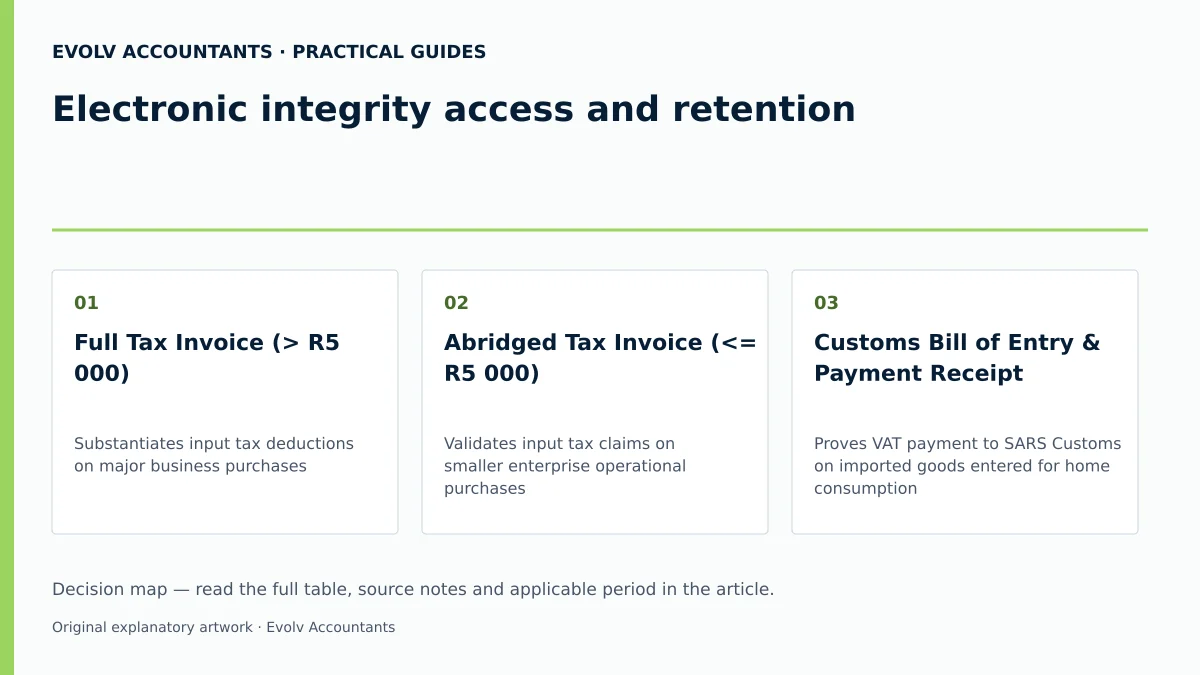
| Full Tax Invoice (> R5 000) | Substantiates input tax deductions on major business purchases | Mandatory | Finance / Accounts Payable | Section 20(4) of VAT Act 6 |
| Abridged Tax Invoice (<= R5 000) | Validates input tax claims on smaller enterprise operational purchases | Mandatory | Purchasing / Accounts Payable | Section 20(5) of VAT Act 6 |
| Customs Bill of Entry & Payment Receipt | Proves VAT payment to SARS Customs on imported goods entered for home consumption | Conditional (Importers) | Import Compliance / Logistics | Section 16(2) & Section 54(3) 19 20 |
| VAT264 Declaration & ID Copy | Substantiates notional input tax deductions on second-hand goods bought from non-vendors | Conditional (Second-hand buyers) | Procurement / Buying | Section 20(8) & Form VAT264 21 22 |
| eFiling Submission Receipt & PRN | Proves return submission date, payment allocation, and assessment status | Mandatory | Tax Practitioner / Accountant | VAT201 External Guide 28 29 |
Missing or contradictory records: retention
Authentic reconstruction and audit trails
If a supplier tax invoice is lost, missing, or contains incorrect details (such as an erroneous VAT registration number), vendors must never fabricate, backdate, or alter replacement records 39. The vendor must contact the original supplier to request an authentic duplicate invoice clearly marked "Duplicate" 39.
Section 16(2)(g) ruling requests as a last resort
Where a vendor has taken all reasonable steps to obtain a prescribed tax invoice but is unable to do so due to circumstances beyond their control, the VAT Act provides a specific legal remedy 39 40. Under section 16(2)(g), the vendor may submit a formal application to the SARS Commissioner for a specific ruling authorising the use of alternative documentary evidence to substantiate the input tax deduction 39 40. This ruling application must be submitted prior to the expiry of the five-year input tax limitation period 10 39.
The five-year period is a minimum, not an automatic destruction date. SARS record-keeping guidance requires the relevant records to remain available; retain them beyond the ordinary minimum where an ongoing audit, investigation, objection or appeal or another applicable rule requires it.
Next steps for VAT invoices
eFiling workflow: saved versus submitted status
When managing VAT declarations electronically on eFiling, vendors must distinguish between saving and submitting a return 41 42:
- Saved Status: Clicking "Save" stores the return data on the eFiling system, allowing further edits prior to finalization 42 43. A saved return is not filed with SARS and does not satisfy statutory submission obligations 42.
- Submitted / Filed Status: Clicking "Submit VAT201" automatically transmits the declaration to SARS for assessment 41 43.
- Supporting Document Upload: Uploading requested verification files updates the eFiling work page status to "Submitted" 44. However, document upload does not constitute final acceptance by SARS; official acceptance occurs only after SARS completes its audit or verification review 7 45.
Reproducible hypothetical transaction example
Consider a hypothetical South African SME—Example Trading Enterprise—operating in a standard two-month Category A tax period 46. All figures below are labelled illustrative values:
- Output Tax Collection: The business executes standard-rated commercial sales totalling R230 000 (inclusive of 15% VAT) 33.
Output Tax = R230 000 × ((15 ÷ 115)) = R30 000 27 33
- Input Tax Deductions: The enterprise incurs allowable operational purchases totalling R115 000 (inclusive of 15% VAT), supported by valid full tax invoices 6 9.
Input Tax = R115 000 × ((15 ÷ 115)) = R15 000 27 33
- Net VAT Payable: Output tax collected minus allowable input tax yields the net liability due to SARS 27:
Net VAT Payable = R30 000 - R15 000 = R15 000 27 The vendor submits the VAT201 return via eFiling before the last business day of the month and settles the R15 000 net liability using the 19-digit Payment Reference Number (PRN) pre-populated on the return 29 47.
Frequently Asked Questions
Is prior approval required from SARS before issuing electronic tax invoices?
No, vendors do not require prior approval from the SARS Commissioner to implement electronic invoicing 4. However, electronic document generation and storage systems must strictly comply with the Electronic Communications and Transactions Act 25 of 2002 and Tax Administration Act record-keeping standards 4 5.
What is the mandatory retention period for electronic VAT records and tax invoices?
Vendors must retain all accounting records, tax invoices, debit/credit notes, and bills of entry for at least five years 1 2. This period is calculated from the date the relevant VAT201 return self-assessment was submitted to SARS 3.
What is the threshold difference between a full tax invoice and an abridged tax invoice?
A full tax invoice—containing the recipient's name, address, and VAT registration number—is mandatory when the consideration for a supply is more than R5 000 6. An abridged tax invoice may be issued when consideration is R5 000 or less 6. For purchases of R50 or less, a tax invoice is not required, though till slips or dockets showing VAT must be kept 11 36.
How can a vendor claim input tax if an original supplier tax invoice is missing?
The vendor must first request an authentic duplicate invoice from the supplier 39. If obtaining a duplicate is impossible due to circumstances beyond the vendor's control, the vendor may apply to SARS for a formal section 16(2)(g) ruling to allow alternative documentary proof 39 40.
Does uploading supporting documents on eFiling mean SARS has accepted the claim?
No, uploading supporting documents updates the eFiling work page status to "Submitted" 44. Official acceptance occurs only once SARS finishes its verification review or audit and issues a formal notice of assessment or completion notification 7 45.
Related guides
- When a receipt is not enough for an input VAT claim
- What a valid South African tax invoice must contain
- The Proactive SARS Audit Guide: Keeping Your Business Ledger Sanitised
Sources
- Obligations of a VAT vendor | South African Revenue Service
- https://www.sars.gov.za/wp-content/uploads/Ops/Guides/Legal-Pub-Guide-VAT404-VAT-404-Guide-for-Vendors.pdf
- https://www.sars.gov.za/wp-content/uploads/Ops/Guides/GEN-ELEC-04-G01-Guide-for-completing-the-Value-Added-Tax-VAT201-Declaration-External-Guide.pdf