
What a valid South African tax invoice must contain
18 September 2026

A valid South African tax invoice requires the prescribed supplier, transaction and VAT details before it can support an input-tax deduction.
Under South African Value-Added Tax (VAT) legislation, a tax invoice serves as the primary legal and accounting instrument required to substantiate input tax deductions and account for output tax liabilities 1 2. For taxable supplies where the consideration exceeds R5,000 (inclusive of VAT), vendors must issue a full tax invoice containing the prescribed data fields, including the supplier and recipient's legal names, physical or postal addresses, and 10-digit SARS VAT registration numbers 3.
For supplies under R5,000 (inclusive of VAT), an abridged tax invoice is permissible, which omits the recipient's details and supply quantities, provided the transaction is not zero-rated 4 5 6. Supplies of R50 or less do not require a tax invoice, provided basic proof of purchase such as a till slip is retained 4 6.
Regarding vendor registration, SARS currently administers compulsory registration at R2.3 million in taxable supplies as reflected in current administrative guidance, whereas historical guides retain the statutory R1 million baseline set out in Section 23 of the Value-Added Tax Act 7. Vendors must issue tax invoices within 21 days of making a supply, enforce strict validation logic across general ledgers, and retain all documentation for five years 1 8.
Mandatory invoice fields and validation logic
Purpose and function of the tax invoice
In South Africa, Value-Added Tax operates on an invoice-based credit system 9. SARS notes in its VAT 404 guide that "[t]he most important document in a VAT system is the tax invoice" 2. Without a valid tax invoice complying with Section 20 of the Value-Added Tax Act, a recipient vendor is strictly prohibited from claiming input tax deductions on goods or services acquired for the enterprise 2 10. The tax invoice creates a transparent audit trail linking the supplier's output tax declaration to the purchaser's input tax deduction 1 11.
Document tiers based on supply consideration
The Value-Added Tax Act categorises document requirements into three distinct tiers based on the total consideration (inclusive of VAT) 4:
- Full Tax Invoice (Consideration exceeding R5,000): Must be issued for all standard-rated supplies exceeding R5,000 4. It requires comprehensive details for both the supplying vendor and the recipient vendor 3.
- Abridged Tax Invoice (Consideration under R5,000): Permissible for supplies where the total consideration is less than R5,000 4. It simplifies administrative compliance by excluding recipient details and item quantities 5. However, if the supply is zero-rated (such as direct exports), a full tax invoice is compulsory regardless of the monetary value 4 6.
- Low-Value Supplies (Consideration of R50 or less): A formal tax invoice is not legally required 4 6. A standard till slip, cash receipt, or sales docket reflecting the VAT charged or a statement that VAT is included at the standard rate is sufficient to substantiate input tax claims 6.
A vendor must issue a valid tax invoice to the recipient within 21 days of making a taxable supply exceeding R50 8.
Read the fields and definitions correctly: mandatory invoice fields
Full tax invoice field requirements
To qualify as a valid full tax invoice under Section 20(4) of the Value-Added Tax Act, the document must contain the following explicit fields 3:
- Document Identifier: The words "Tax Invoice", "VAT Invoice", or "Invoice" prominently displayed 3.
- Supplier Information: The legal or trading name, address, and 10-digit VAT registration number of the supplier 3.
- Recipient Information: The legal or trading name, address, and 10-digit VAT registration number of the recipient 3.
- Serial Number and Date: An individual serialised invoice number and the exact date of issue 3.
- Supply Description: A full and proper description of the goods or services supplied 3.
- Quantity or Volume: The volume or quantity of goods supplied or scope of services rendered 3.
- Financial Breakdown: The price and VAT charged structured according to an approved method 3.
Approved methods for reflecting VAT and currency rules
SARS permits three distinct accounting methods for presenting consideration and VAT on a tax invoice 12:
- Method 1 (Itemised Breakdown): Reflects the value ex-VAT, the VAT amount charged, and the total consideration inclusive of VAT 12.
- Method 2 (Rate Statement): Reflects the total consideration inclusive of VAT alongside a clear statement that the total price includes VAT at the standard rate (currently 15%) 12.
- Method 3 (Total VAT Charged): Reflects the total consideration inclusive of VAT and explicitly states the total Rand amount of VAT included 12.
Tax invoices must be issued in South African Rand (ZAR) 6. Exceptions apply only to zero-rated supplies (such as direct exports) or specific electronic services rendered by foreign suppliers 6.
Work through an example: validation logic
Practical hypothetical scenario
Consider a South African SME, Apex Logistics (Pty) Ltd (VAT registration number the purchaser’s verified VAT number), purchasing commercial office equipment from Pinnacle Office Supplies (Pty) Ltd (VAT registration number the supplier’s verified VAT number) on 12 May 2026. The transaction consists of 10 ergonomic desks priced at R1,000 each (ex-VAT).
- Subtotal Calculation: 10 desks × R1,000 = R10,000.
- Output VAT Calculation (@ 15%): R10,000 × 15% = R1,500.
- Total Consideration: R10,000 + R1,500 = R11,500.
- Tax Fraction Verification: When analysing VAT-inclusive totals, the tax fraction (15 / 115) must yield the exact VAT amount: R11,500 × (15 / 115) = R1,500.
Document validation checklist
When Apex Logistics receives the invoice, its accounts payable team must verify the following structural logic before processing input tax:
- The document title clearly reads "Tax Invoice" 3.
- Both Pinnacle Office Supplies and Apex Logistics have their legal names, business addresses, and 10-digit VAT numbers correctly listed 3.
- The consideration exceeds R5,000, confirming that an abridged invoice is legally insufficient 4.
- The serial number is unique and the issue date falls within the active tax period 3.
- The arithmetic correctly balances ex-VAT pricing, standard 15% VAT, and total consideration 3 12.
Annotated metric example
The following Markdown table illustrates the validation matrix for this hypothetical transaction:
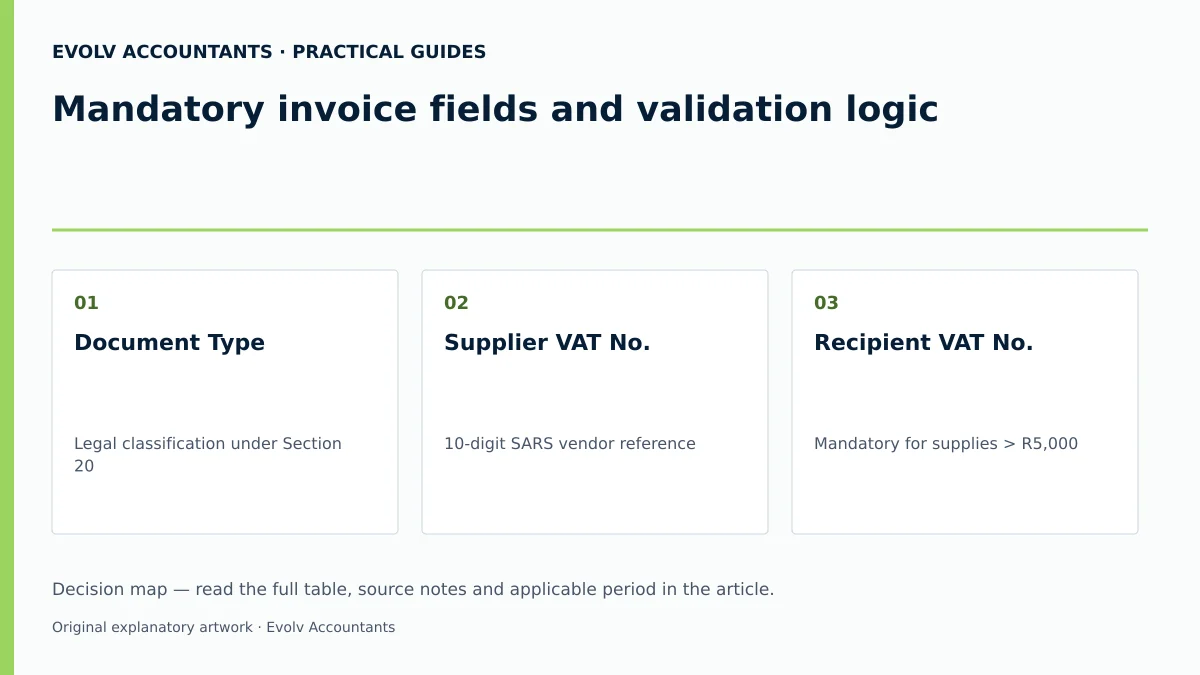
| Field or measure | Meaning | Underlying record | Illustrative result | Limit or question |
|---|---|---|---|---|
| Document Type | Legal classification under Section 20 | Invoice header | Title reads "Tax Invoice" | Must not be labelled "Pro-forma" or "Quote" 3 |
| Supplier VAT No. | 10-digit SARS vendor reference | Supplier master file | the supplier’s verified VAT number | Validated via eFiling VAT Vendor Search 3 13 |
| Recipient VAT No. | Mandatory for supplies > R5,000 | Recipient master file | the purchaser’s verified VAT number | Missing number invalidates input tax claim 3 4 |
| Supply Description | Specific nature of goods/services | Purchase order / Delivery note | 10 Ergonomic Desks | Vague descriptions risk audit queries 3 |
| Tax Fraction Test | Mathematical proof (15 / 115) | General ledger posting | R11,500 × 15/115 = R1,500 | Must match declared VAT line exactly 12 |
Reconcile it with related records: mandatory invoice fields
Linking tax invoices to the VAT201 declaration
Every valid tax invoice issued or received must reconcile directly to the general ledger and the periodic VAT201 return 14. Accounting software must route invoice data into the correct VAT201 return fields:
— Practical point from this guide
- Standard-rated supplies: Reconcile sales invoices and the related output tax to the appropriate VAT201 fields. Do not confuse the supply-value field with the calculated output-tax field 14.
- Field 14 (Capital Goods Input Tax): Full tax invoices received for capital acquisitions (e.g., machinery, office furniture) are recorded here 14.
- Field 15 (Non-Capital Input Tax): Full tax invoices received for general operational goods and services (e.g., trading stock, stationery, rent) are declared here 14.
Adjustments via credit and debit notes
If a transaction consideration is altered, cancelled, or rectified after a tax invoice has been issued, Section 20 strictly forbids issuing a second tax invoice 15. Instead, the supplier must issue a credit note or debit note under Section 21 15. These documents must be reflected in the VAT201 return as follows 16:
- Field 12 (Output Tax Adjustments): Debit notes issued to customers and credit notes received from suppliers are declared in Field 12 16.
- Field 18 (Input Tax Adjustments): Credit notes issued to customers and debit notes received from suppliers are claimed in Field 18 16.
Audit trail and 5-year retention duties
Under SARS compliance rules, VAT vendors must retain all tax invoices, credit notes, debit notes, bank statements, and eFiling Statements of Account (VATSOA) for a minimum of five years 1. Records may be stored in electronic format, provided they maintain complete integrity and remain accessible for SARS verifications and audits 17 18.
Common misinterpretations and limits: validation logic
Invalidation risks and illegal duplicate invoices
A common operational error is relying on pro-forma invoices, delivery notes, or price quotations to claim input tax. These documents do not constitute tax invoices and will result in SARS disallowing the input tax claim alongside administrative non-compliance penalties 2 19. Furthermore, issuing a second tax invoice to correct a pricing error is illegal under Section 20; vendors must issue a formal credit or debit note 15.
Statutory threshold distinctions and prohibited input claims
Vendors frequently confuse document threshold rules and registration requirements:
- Document Thresholds: The R5,000 threshold strictly dictates whether a full or abridged tax invoice is required; it does not exempt standard-rated supplies from VAT 4. Zero-rated supplies always require a full tax invoice regardless of amount 4 6.
- Registration Thresholds: SARS currently administers compulsory VAT registration at R2.3 million in taxable supplies as stated in current SARS web guidance, whereas historical guides reference the R1 million statutory threshold in Section 23 of the Value-Added Tax Act 7. Businesses must monitor turnover continuous running totals over 12 consecutive months 7.
- Denied Input Tax Claims: Input tax is generally denied on entertainment and motor cars, subject to the applicable statutory exceptions; a valid invoice does not by itself remove those restrictions 20 21.
Next steps for VAT invoices
Actionable compliance checklist for SMEs
South African SMEs should execute the following checked next actions to ensure tax invoice compliance:
- Audit Vendor Master Files: Ensure all active supplier profiles contain verified 10-digit VAT registration numbers and physical addresses 3.
- Enforce Invoice Verification at Accounts Payable: Reject supplier invoices exceeding R5,000 that lack your company's full legal name, address, or VAT number 3 4.
- Verify Document Title and Currency: Ensure every sales and purchase invoice clearly displays "Tax Invoice" and reflects ZAR currency unless explicitly zero-rated 3 6.
- Implement Credit and Debit Note Workflows: Eliminate duplicate invoicing practices and route all adjustments through VAT201 Fields 12 and 18 15 16.
- Secure 5-Year Archiving: Ensure physical and digital invoice archives satisfy SARS's mandatory five-year retention policy 1.
Reviewing your VAT records with Evolv Accountants
Are your internal invoicing workflows and accounting system validations fully aligned with SARS's mandatory tax invoice fields and VAT201 reconciliation requirements?
Describe the invoice question or record gap you want to resolve. Ask Evolv to scope the next steps.
Frequently Asked Questions
Can a business claim input tax using a pro-forma or commercial invoice?
Do not rely on a pro-forma document or quotation to establish an input-tax deduction 19. For any invoice, check the actual document against the prescribed requirements rather than relying on its commercial label 2 10. An input-tax deduction requires the prescribed documentary support and must also satisfy the other deduction conditions 2 10.
What is the threshold difference between a full tax invoice and an abridged tax invoice?
A full tax invoice is compulsory for taxable supplies exceeding R5,000 (inclusive of VAT) and must contain both supplier and recipient details 3 4. An abridged tax invoice is permitted for standard-rated supplies under R5,000 and excludes recipient information and item quantities 4 5.
Is it permissible to issue a second tax invoice if an error was made on the original?
No. Section 20 explicitly prohibits issuing more than one tax invoice per taxable supply 15. To rectify errors, price changes, or returned goods, the supplier must issue a formal credit note or debit note under Section 21 15.
What currency must be reflected on a South African tax invoice?
Tax invoices must be issued in South African Rand (ZAR) 6. Exceptions are restricted to zero-rated supplies (such as direct exports) or qualifying electronic services supplied by non-resident vendors 6.
How long must a VAT vendor retain tax invoices and supporting records?
Vendors are legally required to retain all tax invoices, credit notes, debit notes, bank records, and VAT returns for at least five years from the date of the return to which they relate 1.
Related guides
- Full tax invoices versus abridged tax invoices
- Issuing a tax invoice before you receive payment
- The Proactive SARS Audit Guide: Keeping Your Business Ledger Sanitised
Sources
- Obligations of a VAT vendor | South African Revenue Service
- https://www.sars.gov.za/wp-content/uploads/Ops/Guides/Legal-Pub-Guide-VAT404-VAT-404-Guide-for-Vendors.pdf
- https://www.sars.gov.za/wp-content/uploads/Ops/Guides/GEN-ELEC-04-G01-Guide-for-completing-the-Value-Added-Tax-VAT201-Declaration-External-Guide.pdf