
Full tax invoices versus abridged tax invoices
8 November 2025

Issuing a valid South African tax invoice requires meeting threshold criteria that determine whether full or abridged details are mandatory for VAT compliance.
Registered vendors in South Africa must issue valid tax invoices for taxable supplies to substantiate output tax declarations and enable commercial clients to claim input tax deductions 1 2 3. Under South African Revenue Service (SARS) regulatory guidance, the monetary consideration of a transaction dictates whether a full tax invoice or an abridged tax invoice is required 4 5. For supplies where consideration is R5 000 or more (inclusive of VAT), a full tax invoice under section 20(4) of the Value-Added Tax Act must be issued 4 5.
Where consideration is less than R5 000 (inclusive of VAT), an abridged tax invoice under section 20(5) is permissible, except for zero-rated supplies which always require a full tax invoice 4 6 7. Small transactions of R50 or less do not require a tax invoice, provided till slips or cash dockets are retained 4 6 8.
Regarding registration baselines, while older SARS guides retain the statutory R1 million 12-month turnover threshold for compulsory registration 9 10, current administrative practice administers a R2.3 million threshold position.
Document thresholds and full versus abridged invoice scope
Both full tax invoices and abridged tax invoices serve as lawful documentary proof to substantiate input tax claims and verify the audit trail required by SARS 1 2 11. Neither document format is universally superior; rather, each format fits specific transaction tiers and operational contexts 4 5. Full tax invoices offer comprehensive transparency for high-value business-to-business (B2B) transactions, while abridged tax invoices streamline administrative overhead for smaller commercial sales 5 12 13.
As SARS explicitly states, "Failure to issue tax invoices is therefore a contravention of the Act and vendors will be guilty of an offence" 3. To ensure ongoing statutory alignment across sales and procurement channels, South African small and medium-sized enterprises (SMEs) should execute the following checked compliance action plan:
— Practical point from this guide
- Categorise transaction value thresholds: Determine whether the VAT-inclusive consideration is R5 000 or more (mandating a full tax invoice) or less than R5 000 (permitting an abridged tax invoice) 4 5.
- Isolate zero-rated supplies: Ensure that all zero-rated supplies are billed using a full tax invoice containing the recipient's VAT registration number, regardless of total consideration 4 7.
- Capture complete recipient particulars: For transactions of R5 000 or more, verify and record the recipient’s registered name, physical or postal address, and 10-digit VAT registration number 5 12.
- Apply an approved tax calculation display: Display pricing and VAT using one of the three SARS-approved methods: showing individual exclusive price and VAT, total consideration with VAT rate, or total consideration with total VAT charged 14.
- Enforce the 21-day issuance window: Ensure all tax invoices are issued to recipients within 21 calendar days of the supply being made 15 16.
- Maintain a 5-year audit archive: Store original paper or electronic tax invoices, till slips, debit notes, and credit notes securely for at least five years 1 2 17.
Compare the criteria that matter: document thresholds
When evaluating invoicing workflows, SMEs must weigh administrative control, legal liability, reporting precision, tax audit exposure, cash flow management, and operational capacity 1 2 17.
Decision comparison matrix
| Criterion | Option A: Full Tax Invoice | Option B: Abridged Tax Invoice | Evidence or assumption | Implication for this reader |
|---|---|---|---|---|
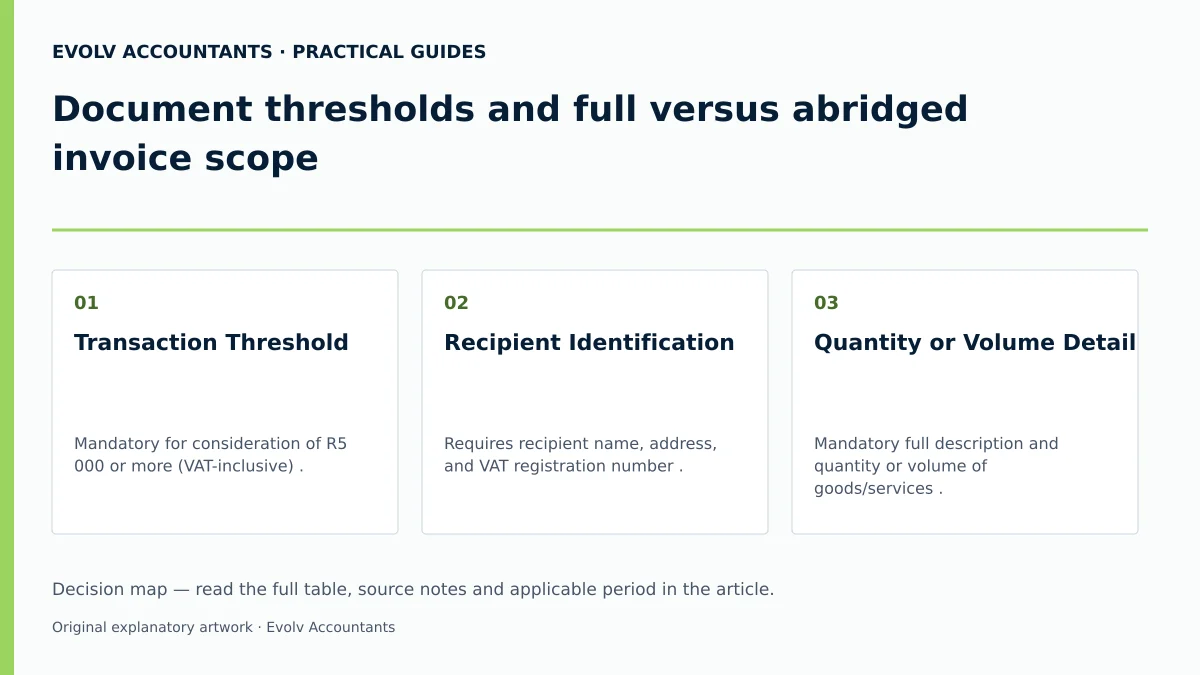
| Transaction Threshold | Mandatory for consideration of R5 000 or more (VAT-inclusive) 4 5. | Permissible for consideration under R5 000 (VAT-inclusive) 4 5. | Statutory rule under section 20(4) and 20(5) of the VAT Act 5. | SMEs must establish automated system prompts when billing reaches R5 000 4. |
| Recipient Identification | Requires recipient name, address, and VAT registration number 5 12. | Omits recipient name, address, and VAT registration number 5 13. | SARS VAT 404 Guide for Vendors specification 5. | B2B clients cannot claim input tax without full recipient details on bills >= R5 000 2 18. |
| Quantity or Volume Detail | Mandatory full description and quantity or volume of goods/services 5 12. | Requires full description but omits quantity or volume breakdown 5 13. | SARS prescribed invoice particulars 5. | Abridged invoices reduce line-item entry time for minor retail or service items 5. |
| Zero-Rated Supplies | Mandatory for all zero-rated supplies regardless of transaction value 4 7. | Strictly prohibited for zero-rated supplies 4 7. | Proviso to section 20(5) 4 7. | Export and zero-rated sales must never use abridged templates 7. |
| Input Tax Deduction Eligibility | Valid for input tax claims across all qualifying business purchases 2 18 19. | Valid for input tax claims on purchases under R5 000 2 13 18. | Section 16(2) documentation requirements 19. | Purchasing managers must reject abridged invoices for expense items >= R5 000 18. |
How the obligations differ: full versus abridged invoice scope
Understanding the distinction between statutory tax law, regulator guidance, and Evolv advisory recommendations is critical for managing corporate risk 1 2 5.
Sourced statutory rules and regulator guidance
Under section 20(4) of the VAT Act, a full tax invoice must contain seven key elements 5 12:
- The words "Tax Invoice", "VAT Invoice", or "Invoice" 5 12.
- The name, address, and VAT registration number of the supplier 5 12.
- The name, address, and VAT registration number of the recipient 5 12.
- An individual serialised invoice number and the date of issue 5 12.
- A full and proper description of the goods or services supplied 5 12.
- The quantity or volume of the goods or services supplied 5 12.
- The price and VAT charged, formatted according to one of three approved methods 5 14.
Under section 20(5), an abridged tax invoice contains the same core supplier information, serial number, date, description, and price/VAT calculation, but excludes the recipient's name, address, and VAT number, as well as the quantity or volume 5 13.
Statutory provisions dictate that vendors must issue tax invoices within 21 days of making a supply where consideration exceeds R50 15 16. When consideration is R50 or less, a formal tax invoice is not required; however, till slips or sales dockets indicating VAT charged must be retained in petty cash records to support input tax deductions 4 6 8. All tax documentation must be preserved in original form for five years to maintain a verifiable audit trail 1 2 17.
Input tax deductions must be claimed within five years from the end of the tax period in which the invoice should have been issued 18 20 21.
Professional recommendations and accounting software features
Evolv Accountants recommends that SMEs standardise accounting systems to auto-populate full tax invoice details for all registered B2B clients, regardless of transaction size. While accounting software suites frequently offer simplified point-of-sale templates, vendors must ensure software configurations enforce mandatory full invoice fields whenever billing crosses the R5 000 threshold or involves zero-rated items 4 5 7.
Two business situations with different outcomes: document thresholds
To illustrate how document thresholds function in practice, consider the following hypothetical scenarios involving a registered South African vendor charging the standard 15% VAT rate (utilising the tax fraction of 15/115) 22 23 24.
Situation A: High-value commercial equipment sale
Hypothetical Facts: A vendor supplies commercial IT hardware to a corporate client for a total consideration of R11 500 (inclusive of VAT). Calculation:
- Total VAT-inclusive consideration = R11 500.
- Output VAT levied = R11 500 × (15 / 115) = R1 500 22.
- VAT-exclusive price = R10 000.
Application and Outcome: Because the consideration of R11 500 exceeds the R5 000 threshold, section 20(4) obliges the vendor to issue a full tax invoice 4 5. The invoice must explicitly state the corporate client’s full registered name, physical address, and 10-digit VAT registration number, alongside the item quantity and description 5 12. If the vendor issues an abridged invoice lacking the recipient's VAT details, SARS will disallow the corporate client's R1 500 input tax deduction claim upon verification 2 18 19.
Situation B: Small office supply purchase and petty cash
Hypothetical Facts: A business owner purchases consumable stationery valued at R1 150 (inclusive of VAT) and later incurs a R46 petty cash courier expense. Calculation:
- Stationery output VAT = R1 150 × (15 / 115) = R150 22.
- Courier output VAT = R46 × (15 / 115) = R6 22.
Application and Outcome: For the R1 150 stationery purchase, consideration is below R5 000, permitting the supplier to issue an abridged tax invoice omitting the buyer's recipient details 4 5 13. The buyer can lawfully claim the R150 input tax deduction using this abridged invoice 2 18.
For the R46 courier fee, consideration is below the R50 petty cash threshold, meaning no formal tax invoice is required; retaining the till slip with VAT details in the petty cash log is legally sufficient to substantiate the R6 input tax deduction 4 6 8.
When the comparison needs specialist input: full versus abridged invoice scope
While standard threshold rules apply to routine sales, specialized commercial scenarios require technical tax advisory input from Evolv Accountants:
- Domestic Reverse Charge (DRC) on Valuable Metal: Transactions involving valuable metal subject to DRC regulations require specialised tax invoices showing that supply is subject to DRC, omitting the VAT charge from the total due, and explicitly stating that the recipient must account for and pay the VAT 25 26.
- Zero-Rated Exports and Electronic Services: Exported goods and cross-border services require full tax invoices showing the recipient's details and specific export documentation regardless of transaction value 4 6 7 27.
- Supply of an Enterprise as a Going Concern: Zero-rated going concern sales require specialized contractual terms and proof that taxable supplies of the business exceeded R50 000 in the preceding 12 months 28 29.
- Recipient-Created Tax Invoicing (Self-Invoicing): Generating self-invoices requires prior approval or alignment with Binding General Ruling 15 under section 20(7) 30 31.
- Agent Invoicing Arrangements: Billing through commercial agents under section 54 requires strict agent-to-principal monthly statements reflecting transaction particulars 32.
- Alternative Documentary Proof Rulings: If a vendor cannot obtain prescribed tax invoices due to circumstances beyond control, a formal section 16(2)(g) ruling application must be submitted to SARS at least two months before the five-year limitation expires 33 34.
Next steps for VAT invoices
To maintain complete compliance with SARS regulations, SMEs should maintain an internal decision record auditing invoice issue dates, threshold classifications, and recipient VAT numbers 1 5.
Frequently Asked Questions
Can an abridged tax invoice be issued for a zero-rated supply?
No. Under the proviso to section 20(5) of the VAT Act, all zero-rated supplies must be billed using a full tax invoice containing the recipient's VAT registration number, regardless of how small the transaction consideration may be 4 7.
Is a formal tax invoice required for business expenses of R50 or less?
No. When consideration for a taxable supply is R50 or less, a full or abridged tax invoice does not need to be issued 4 6 8. However, the business must retain a till slip, cash slip, or sales docket indicating the VAT charged or a statement that VAT is included to substantiate input tax claims 6 8.
How long must a vendor preserve tax invoices and accounting records?
Vendors are legally required to retain all tax invoices, debit notes, credit notes, bills of entry, and general accounting records for at least five years from the date of the return to which they relate 1 2 17.
Within what period must a supplier issue a tax invoice after making a supply?
A registered vendor must issue a tax invoice to the recipient within 21 calendar days of making a taxable supply where consideration exceeds R50 15 16.
How are pricing adjustments or cancelled sales documented for VAT?
When a sale is cancelled, goods are returned, or invoice values are altered, the vendor must issue a debit note or credit note reflecting the original invoice reference, reason for adjustment, and exact change in VAT, declaring these in Field 12 or Field 18 of the VAT201 return 35 36 37 38.
Related guides
- What a valid South African tax invoice must contain
- Issuing a tax invoice before you receive payment
- The Proactive SARS Audit Guide: Keeping Your Business Ledger Sanitised
Sources
- Obligations of a VAT vendor | South African Revenue Service
- https://www.sars.gov.za/wp-content/uploads/Ops/Guides/Legal-Pub-Guide-VAT404-VAT-404-Guide-for-Vendors.pdf
- https://www.sars.gov.za/wp-content/uploads/Ops/Guides/GEN-ELEC-04-G01-Guide-for-completing-the-Value-Added-Tax-VAT201-Declaration-External-Guide.pdf