
Issuing a tax invoice before you receive payment
9 September 2026

Issuing a tax invoice before receiving cash payment triggers an immediate VAT liability that requires accounting for output tax in that tax period.
Under South African Value-Added Tax (VAT) law, vendors operating on the standard invoice basis must account for output tax when a tax invoice is issued, regardless of whether payment has been received from the customer 1 2 3. The general time of supply rule dictates that a supply takes place at the earlier of when an invoice is issued or when any payment is received 2 4.
Consequently, issuing a tax invoice prior to receiving cash creates an immediate legal obligation to declare and pay the output tax to the South African Revenue Service (SARS) on the VAT201 return for that specific tax period 1 5 6.
Invoice timing versus cash receipt timing
This guide is written for South African small and medium-sized enterprises (SME vendors), financial managers, and internal bookkeepers operating under the jurisdiction of SARS 7 8. In South Africa, VAT compliance is structured around allocated tax periods, which are typically two-monthly cycles (Category A or Category B) for most businesses, or monthly cycles (Category C) for larger enterprises 9 10 11.
For vendors registered on the invoice (accrual) basis, completing the invoicing and return process means accurately recording all tax invoices issued during the active tax period, calculating the output tax due, submitting the VAT201 declaration by the statutory deadline, and settling any net tax liability owed to SARS 1 5 6 12.
Completion is not merely creating an invoice or sending it to a client; it requires fulfilling the full statutory accounting loop and retaining complete documentary evidence for the prescribed five-year audit trail 13 14 15 16.
— Practical point from this guide
Prepare the information and authority: invoice timing
Before issuing invoices and filing VAT returns, vendors must verify their legal authority, operational prerequisites, and transaction documentation:
- Vendor Registration & Authority: Confirm that the business is formally registered as a VAT vendor with SARS and holds an active VAT registration number 8 17.
- Accounting Basis Status: Confirm whether the business accounts for VAT on the default invoice basis or has received written approval from the SARS Commissioner to use the payments basis 18 19 20.
- Tax Invoice Particulars: Gather all source inputs required to issue a valid document. For supplies of R5 000 or more (VAT inclusive), a full tax invoice is required 21 22. It must reflect the words "tax invoice", "VAT invoice", or "invoice"; the name, address, and VAT registration number of both the supplier and the recipient; an individual serialised number; the date of issue; a full description of the goods or services; the quantity or volume; and the price and VAT charged 22 23 24. For supplies under R5 000, an abridged tax invoice may be issued 11 21 22.
- Time of Supply Definition: Understand the legal rule establishing that the time of supply occurs at the "earlier of the time an invoice is issued... or the time any payment of consideration is received" 4.
- Tax Rates and Fraction Inputs: Apply the standard VAT rate of 15% 25. Output tax on VAT-inclusive consideration is calculated using the statutory tax fraction of 15/115 26 27.
Complete the task step by step: cash receipt timing
To ensure statutory compliance when issuing a tax invoice prior to cash receipt, execute the following step-by-step process:
- Issue the Tax Invoice: Generate and issue a valid full or abridged tax invoice to the customer upon delivering goods or performing services 13 21 28. A vendor is legally obligated to issue a tax invoice within 21 days of making a taxable supply exceeding R50 28 29 30.
- Record the Transaction in the General Ledger: Enter the sales transaction into your accounting system on the invoice date. Recognise the total invoice value in accounts receivable, the net turnover in revenue, and the VAT portion in the output tax liability account 12 13.
- Calculate Total Output Tax for the Tax Period: At the close of the tax period, total all sales invoices issued during that period 3 12. Multiply the total VAT-inclusive standard-rated supplies by the tax fraction (15/115) to calculate the exact output tax 26 27.
- Complete the VAT201 Return on eFiling: Log into SARS eFiling and request the VAT201 return for the applicable period 31 32. Enter the total VAT-inclusive standard-rate sales consideration into Field 1 26 33. Field 4 will automatically calculate the output tax at 15/115 26 33.
- Submit the Declaration and Pay Output Tax: Submit the completed VAT201 return on or before the last business day of the month following the end of the tax period (for eFilers) 31 34 35. Pay the net VAT liability using the unique Payment Reference Number (PRN) generated by SARS 32 36 37.
- Archive Documentation: Store copies of all issued tax invoices, delivery notes, and sales contracts in a secure physical or electronic record system 13 14 16 38.
Reproducible Hypothetical Example
An SME vendor registered on the invoice basis supplies consulting services to a commercial client on 15 March for an agreed price of R10 000 plus 15% VAT.
- Invoice Date: 15 March (Tax Period: March/April).
- Consideration (VAT Inclusive): R11 500 (calculated as R10 000 base + R1 500 VAT at 15%) 25.
- Time of Supply: 15 March, being the invoice issue date prior to payment 2 4.
- Cash Received: R0 during March and April (customer pays on 10 May).
- VAT201 Accounting (March/April Return due 31 May):
- Field 1 (Standard rate consideration): R11 500 26 33.
- Field 4 (Output tax auto-calculated): R11 500 × (15 / 115) = R1 500 26.
- Result: The vendor must pay R1 500 output tax to SARS by 31 May, even though customer cash was only collected in May 1 3 35.
Check the result against the evidence: invoice timing
Completion of your VAT obligations cannot be assumed simply because a return was submitted on eFiling. Independent completion evidence must be checked and archived:
- eFiling Return Status: Access the VAT Work Page on eFiling and verify that the return status reflects "Filed through eFiling" or "Submitted at SARS" rather than "Saved" 39 40.
- Payment Reference Number (PRN) Verification: Ensure that payment was made using the correct pre-populated 19-digit PRN for that specific tax period to prevent unallocated payment errors 32 36 37.
- Statement of Account (VATSOA): Request a Statement of Account (VATSOA) on eFiling for the relevant tax period 41 42. Confirm that the declared liability matches the payment credited and that the closing balance reflects zero outstanding liability 41 43.
- Audit Trail Compliance: Verify that all issued tax invoices are stored in sequence, comply fully with Section 20 requirements, and are retained for the mandatory five-year period 13 14 16 21.
Handle exceptions and unresolved cases: cash receipt timing
Edge Cases and Complexities
- Bad Debts and Non-Payment: If a customer fails to pay an invoice on which output tax was declared and paid, the vendor cannot simply reverse or erase the invoice 44. If the debt becomes irrecoverable and is formally written off, an input tax adjustment can be claimed in Field 17 of a subsequent VAT201 return after 12 months, provided statutory conditions are met 44 45 46.
- Credit Notes: If an invoice was issued for an incorrect amount or the transaction is cancelled, a credit note must be issued 47 48. The credit note adjustment is declared in the tax period in which it is issued 47 48.
- Payments (Cash) Basis Exception: Only natural persons or partnerships of natural persons with an annual taxable turnover under R2.5 million, or specific public entities, may apply to SARS to account for VAT on the payments basis 20 49. Under the payments basis, output tax is deferred until cash is received, although tax invoices must still be issued within 21 days 29 50.
- Administrative Registration Threshold Position: SARS operational guidelines administer a VAT registration threshold position of R2.3 million in taxable turnover, whereas older statutory guides retain the R1 million compulsory threshold 17 51. Evolv describes this as a regulatory administrative position rather than an unqualified statutory amendment to Section 23 of the Value-Added Tax Act.
Next steps for VAT invoices
Task and Completion Checklist
To ensure complete control over invoice timing and cash receipt timing, follow this checklist:
- Review your customer agreement terms and invoicing routines to align invoice issuance dates with actual supply dates 2 4.
- Audit outgoing invoices to ensure full compliance with Section 20 tax invoice requirements 21 22.
- Reconcile monthly sales registers against Field 1 declarations on your VAT201 returns 12 33.
- Monitor outstanding debtors older than 12 months for potential bad debt input tax adjustments 46.
- Verify filing acceptance and zero balances by pulling a fresh Statement of Account (VATSOA) on eFiling 41 42.
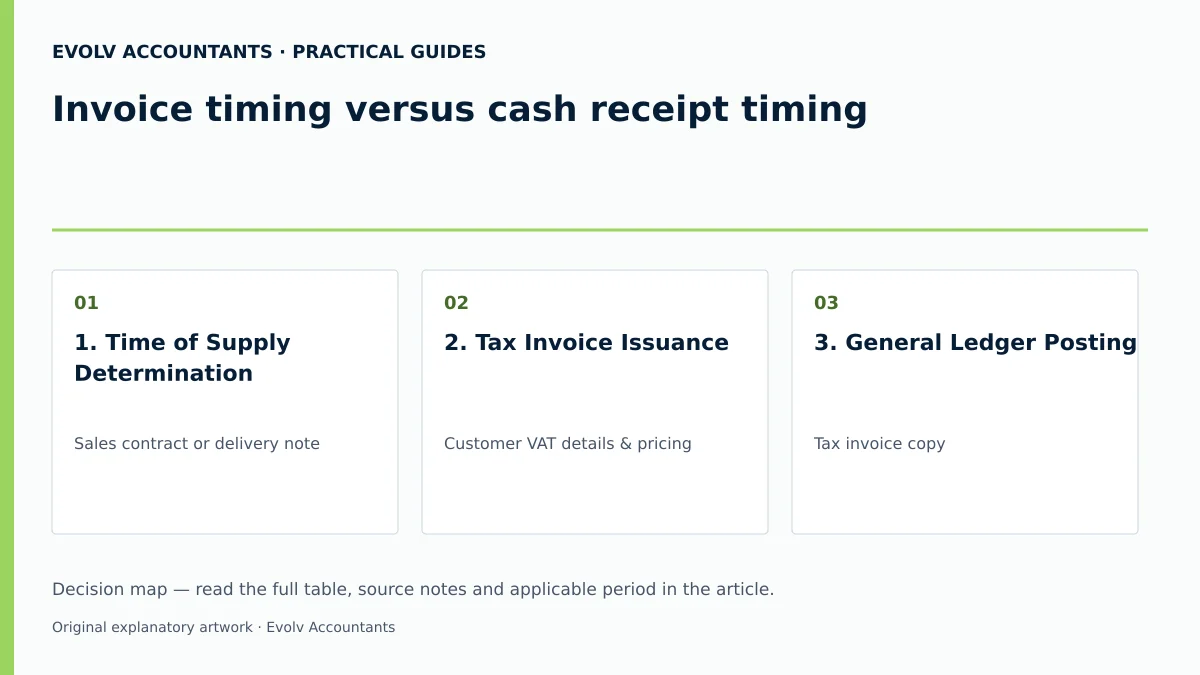
Task and Completion Checklist Table
| Step | Input or evidence | Responsible person | Completion check | Exception or next action |
|---|---|---|---|---|
| 1. Time of Supply Determination | Sales contract or delivery note 4 54 | Billing Clerk / Accountant | Earlier of invoice date or cash receipt established 2 4 | Flag advance payments for immediate VAT inclusion 2 |
| 2. Tax Invoice Issuance | Customer VAT details & pricing 22 | Invoicing Officer | Valid tax invoice issued within 21 days 22 28 | Issue credit note if pricing or details are incorrect 47 48 |
| 3. General Ledger Posting | Tax invoice copy 13 15 | Bookkeeper | Sales and output tax recorded in correct tax period 1 12 | Reconcile accounts receivable with sales ledger 52 |
| 4. VAT201 Return Declaration | Sales register & eFiling profile 31 32 | Tax Practitioner / Vendor | Field 1 completed; Field 4 output tax verified 26 33 | Submit revision on eFiling if errors are detected 55 56 |
| 5. Independent Verification | eFiling Work Page & VATSOA 39 42 | Financial Manager | Status shows "Filed" and Statement of Account is clear 40 43 | Follow up unallocated payments using correct PRN 36 37 |
Frequently Asked Questions
FAQ 1: What happens if a customer pays before the tax invoice is issued?
Under the general time of supply rule, the time of supply is triggered on the date payment is received if that occurs before the invoice is issued 2 4. Output tax must be declared in the tax period in which the cash was received 2 3.
FAQ 2: Must I pay VAT to SARS if my customer delays payment across multiple months?
Yes. If you account for VAT on the invoice basis, output tax is due in the tax period when the invoice was issued, regardless of customer payment delays 1 3. Extended debtor terms can create temporary cash flow strain that vendors must manage 52.
FAQ 3: Can any private company register for the cash/payments basis to delay output tax?
No. Juristic persons such as private companies (Pty Ltd) and trust funds do not qualify for the payments basis and are legally required to account for VAT on the invoice basis 19 53.
FAQ 4: How long must I keep tax invoices if the client paid long after the invoice date?
All tax invoices, accounting records, and bank statements must be retained for at least five years from the date of the return to which they relate, serving as an audit trail for SARS verification 13 14 15 16.
FAQ 5: What is the deadline for issuing a tax invoice to a client after supplying goods or services?
A registered vendor is required by law to issue a valid tax invoice to the recipient within 21 days of making a taxable supply 28 29 30.
Related guides
- What a valid South African tax invoice must contain
- Correcting a tax invoice with the wrong VAT number
- The Proactive SARS Audit Guide: Keeping Your Business Ledger Sanitised
Sources
- https://www.sars.gov.za/wp-content/uploads/Ops/Guides/Legal-Pub-Guide-VAT404-VAT-404-Guide-for-Vendors.pdf
- Obligations of a VAT vendor | South African Revenue Service
- https://www.sars.gov.za/wp-content/uploads/Ops/Guides/GEN-ELEC-04-G01-Guide-for-completing-the-Value-Added-Tax-VAT201-Declaration-External-Guide.pdf
- FAQs for VAT vendors | South African Revenue Service