
Correcting a tax invoice with the wrong VAT number
5 February 2025

Correct an incorrect recipient VAT number through the applicable statutory route, retaining the original transaction and a traceable corrected invoice.
Rules reviewed: 20 October 2026. Read the linked primary sources for the applicable period, commencement dates and conditions.
For an error in required invoice particulars, such as the recipient’s VAT number, section 20(1B) applies where none of the section 21(1)(a)–(e) circumstances applies. The supplier must correct the invoice within 21 days of the recipient’s request, keep enough information to identify the original transaction and corrected document, and leave the original time of supply unchanged. A particulars-only correction does not itself create a second taxable supply or require a cancelling credit note. Tax Administration Laws Amendment Act 22 of 2018, section 7: VAT Act section 20(1B); SARS VAT Connect 9: correcting material invoice errors
Distinguish a correction of invoice particulars under section 20(1B) from a cancellation, consideration change or other section 21 adjustment. Use a debit or credit note when the section 21 conditions require it, rather than cancelling every invoice containing a typing error. Tax Administration Laws Amendment Act 22 of 2018, section 7: VAT Act section 20(1B); SARS VAT Connect 9: correcting material invoice errors
For a full tax invoice, verify the recipient’s VAT particulars where the recipient is a registered vendor. A defective document can prevent an input-tax deduction until the documentary requirements are met. The SARS correction guidance requires the recipient to hold the corrected document before deducting input tax; penalties and interest depend on the actual non-compliance and tax shortfall. SARS VAT Connect 9: correcting material invoice errors
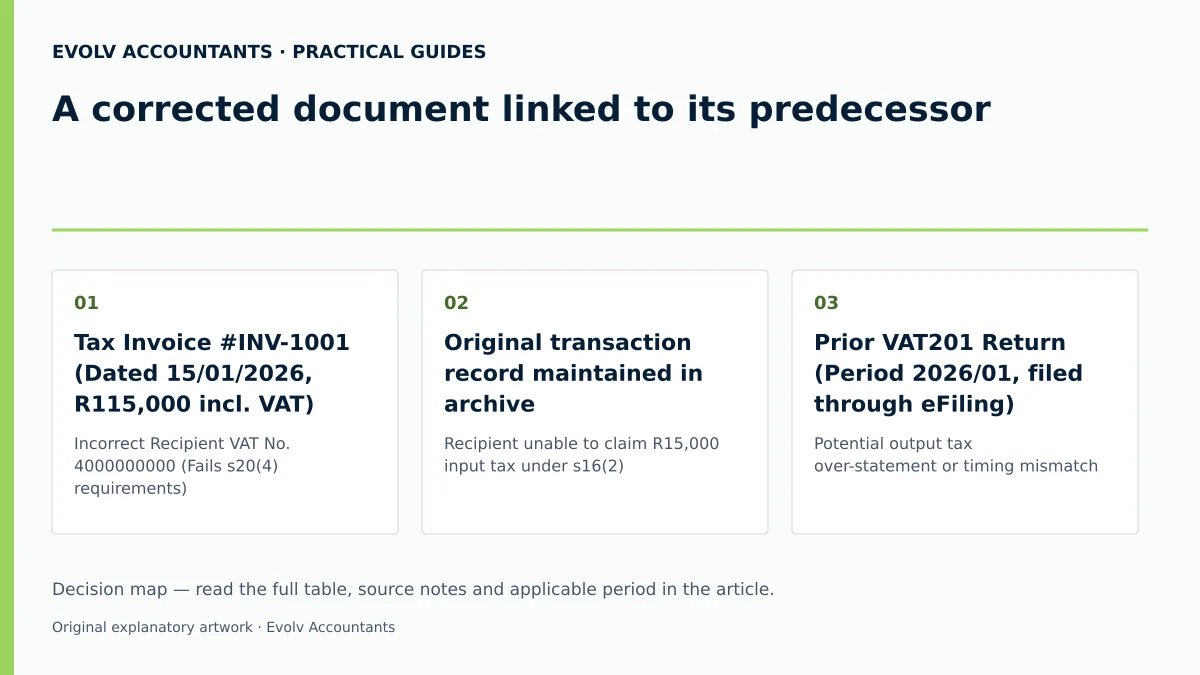
A corrected document linked to its predecessor
Erroneous fields and administrative defects on tax invoices
Where consideration exceeds R5,000, apply the full-invoice requirements in section 20(4). The supplier’s name, address and VAT number are required; the recipient’s name and address, and VAT number where the recipient is a registered vendor, must also be shown with the other required particulars. The abridged-invoice rules in section 20(5) concern consideration not exceeding R5,000. SARS VAT404: tax-invoice requirements
An incorrect required VAT number or other material particulars error must be corrected so that the document supports the actual transaction and the recipient’s documentary entitlement. Verify the recipient’s status and use section 20(1B) where no section 21 circumstance applies. Tax Administration Laws Amendment Act 22 of 2018, section 7: VAT Act section 20(1B)
Material legal and financial consequences for buyers and sellers
A purchasing vendor must hold the documentary support required by section 16(2). SARS’s section 20(1B) guidance says input tax may be deducted only once the recipient holds the corrected document. Do not assume that an invalid VAT number is harmless, or that it automatically produces a fixed penalty in every case. SARS VAT Connect 9: correcting material invoice errors
Correcting required particulars under section 20(1B) leaves the original time of supply unchanged. The supplier must account for the original supply under the applicable VAT rules even if the recipient withholds payment while awaiting a corrected document. The correction must not create a duplicate sale or move tax into a different period without a lawful basis. Tax Administration Laws Amendment Act 22 of 2018, section 7: VAT Act section 20(1B)
Preserve the original records: a corrected document linked to its predecessor
Five-year statutory document retention obligation
Under section 55 of the VAT Act and section 30 of the Tax Administration Act, every registered vendor is required to retain all tax invoices, credit notes, debit notes, deposit receipts, and accounting records in their original form for a mandatory period of at least five years from the date the relevant VAT return was submitted 6 22 23.
— Practical point from this guide
Preserve the original erroneous invoice and its audit history. Correct the required particulars through an authorised, traceable process; do not delete the original evidence or silently replace the transaction record. Tax Administration Laws Amendment Act 22 of 2018, section 7: VAT Act section 20(1B)
Maintaining immutable audit trails across digital and physical systems
Keep the original invoice, the recipient’s correction request, the corrected invoice and evidence linking both documents to the same transaction. Retain a debit or credit note as well only where a section 21 adjustment actually applies. Tax Administration Laws Amendment Act 22 of 2018, section 7: VAT Act section 20(1B)
Physical and electronic archiving systems must ensure that:
- Retain the original document number, issue date and erroneous particulars in the audit history.
- Link the corrected invoice to the original transaction and record the request and correction dates.
- Keep evidence of delivery to the recipient; retain the original time of supply and any separately justified section 21 documents. Tax Administration Laws Amendment Act 22 of 2018, section 7: VAT Act section 20(1B)
Evolv practical advice on document access control and versioning
Evolv Accountants recommends that SMEs enforce strict role-based access controls within their accounting software. Standard billing clerks should be restricted from deleting or modifying posted billing entries. Every invoice correction must require management authorisation and generate an automated, immutable audit trail. This prevents administrative non-compliance penalties under tax administration laws and ensures seamless document production if SARS requests supporting documentation on eFiling 16 26.
Choose the correct amendment route: documented completion and exceptions
Invoicing corrections vs. SARS VAT201 return revisions
Vendors must clearly distinguish between correcting a transaction-level document (a tax invoice) and revising a period-level tax declaration (a SARS VAT201 return) 2 27:
- Invoice particulars: Use section 20(1B) to correct required details where section 21 does not apply, retaining the transaction link. A document correction does not automatically require a VAT201 change. Tax Administration Laws Amendment Act 22 of 2018, section 7: VAT Act section 20(1B)
- Return-Level VAT201 Revision: Required when an invoice error caused the vendor to understate output tax or overstate input tax on a previously submitted VAT201 return, necessitating a formal Request for Correction (RFC) on SARS eFiling 27 28.
Credit notes and debit notes vs. fresh replacement tax invoices
Section 21 governs debit and credit notes for its specified circumstances, including relevant cancellations, changes in consideration and incorrect tax amounts. Section 20(1B) provides the separate correction route for particulars errors where those circumstances do not apply. Tax Administration Laws Amendment Act 22 of 2018, section 7: VAT Act section 20(1B); SARS VAT Connect 9: correcting material invoice errors
For a wrong recipient VAT number with an unchanged transaction and tax amount, use the particulars-correction process:
- Verify and correct: Confirm the recipient’s registered particulars and correct the required fields within 21 days of the request.
- Link and retain: Keep the original transaction, corrected document and request/delivery evidence linked; do not change the original time of supply or duplicate the supply. Tax Administration Laws Amendment Act 22 of 2018, section 7: VAT Act section 20(1B)
When to lodge a Request for Correction (RFC) on SARS eFiling
If the original invoice error occurred in a past tax period for which a VAT201 return has already been submitted to SARS, the vendor must determine whether a return revision is required 27 28:
- Overstated Return (Output Tax Overdeclared): If the vendor overdeclared output tax on a past return, the vendor may access the filed VAT201 return on eFiling and select "Request for Correction" (RFC) 28 31. The application automatically generates a new version of the VAT201 return under the same Payment Reference Number (PRN) 28.
- Input Tax Underclaimed: Note that under SARS administrative rules, a vendor is not permitted to increase input tax deductions when performing a VAT201 revision on a past tax period 32 33. Instead, proviso (i) to section 16(3) permits the vendor to deduct the omitted input tax in the current or any future tax period, provided the claim is made within five years from the date of first entitlement 32 34.
Make and verify the correction: a corrected document linked to its predecessor
Approved step-by-step change sequence
For a particulars-only error, use the following documented correction sequence:
- Verify the recipient: Confirm the legal entity, VAT number and effective registration details against SARS records.
- Classify the error: Check that consideration, tax amount and the other section 21 circumstances are unchanged. Otherwise assess the proper debit/credit-note route.
- Correct the invoice: Apply section 20(1B) within 21 days of the recipient’s request. Retain a clear reference to the original invoice and original time of supply.
- Deliver the corrected document: Keep proof that the recipient received the corrected invoice and can associate it with the original transaction.
- Check the VAT return separately: Do not post a credit, new supply or Field 12/18 adjustment solely because particulars changed. Assess an RFC only if declared VAT amounts were wrong, under SARS’s correction rules.
- Archive the evidence: Retain the original invoice, request, corrected document, authorisation and delivery evidence. Tax Administration Laws Amendment Act 22 of 2018, section 7: VAT Act section 20(1B); SARS VAT201 return guide: fields and correction restrictions
Correction audit trail artefact
| Original record | Error | Authorised action | Changed record | Proof and downstream check |
|---|---|---|---|---|
| Illustrative invoice INV-1001: R100,000 plus R15,000 VAT | Wrong recipient VAT number; consideration and VAT unchanged | Correct the required particulars under section 20(1B) within 21 days of the request | Corrected INV-1001 linked to the original record; time of supply unchanged | Correction request, validation, approval and delivery evidence |
| Original invoice and transaction retained | Purchaser lacks the required corrected documentary proof | Supplier supplies the corrected document; purchaser checks section 16(2) and deduction timing | Corrected document supports the same underlying purchase | No duplicate sale, purchase or input-tax deduction |
| Already filed VAT201 | Check whether any VAT amount, rather than only particulars, was wrong | Apply SARS RFC rules only where a return correction is required | Return version changes only if an actual permitted correction is made | Reconcile the ledger and VAT201; keep any RFC receipt |
Reproducible hypothetical example
Scenario: Vendor Alpha (Pty) Ltd sells commercial manufacturing equipment to Buyer Beta CC on 10 February 2026.
- Consideration: R100,000 principal plus R15,000 VAT (calculated at the standard VAT rate of 15%), yielding a total consideration of R115,000 39 40.
- Document Requirement: Because the total consideration exceeds R5,000, section 20(4) requires a full tax invoice 1 4.
- Defect Identified: On 18 February 2026, Buyer Beta CC notifies Vendor Alpha that original Tax Invoice #INV-8001 reflects an incorrect recipient VAT registration number 4111111111 instead of Beta's correct ten-digit VAT number 4999999999 3.
Correction Execution:
- On 18 February 2026 Buyer Beta requests correction of the recipient VAT number on INV-8001. The sale, R100,000 price and R15,000 VAT are unchanged.
- On 20 February Vendor Alpha supplies the corrected INV-8001, preserving the original transaction link and time of supply. This is within the section 20(1B) 21-day period; no cancelling credit note or second supply is created. Tax Administration Laws Amendment Act 22 of 2018, section 7: VAT Act section 20(1B)
- Both parties retain the request, original document, corrected document and transmission record.
- Alpha accounts for the original taxable supply in the appropriate original period and VAT201 category. Correcting the VAT number alone does not reverse that supply or generate a new one.
- Assuming the manufacturing equipment is acquired as a capital asset wholly for taxable activities and all deduction conditions are met, Beta uses the corrected document to support the R15,000 input-tax deduction. The relevant domestic capital-input category is Field 14, rather than Field 15 for non-capital inputs. Apply the actual deduction-timing and RFC restrictions. SARS VAT201 return guide: fields and correction restrictions
Consequences and remaining exceptions: documented completion and exceptions
VAT201 adjustments only where the transaction requires them
Debit and credit notes that are genuinely required must follow the VAT201 guidance. A section 20(1B) particulars-only correction with no tax-amount change does not itself create one of these adjustments. SARS VAT201 return guide: fields and correction restrictions
- Field 12 (Output Tax Adjustments): Used to declare output tax payable in respect of debit notes issued by the vendor or credit notes received from suppliers 37.
- Field 18 (Input Tax Adjustments): Used to claim input tax deductions in respect of credit notes issued by the vendor or debit notes received from suppliers 37.
Handling company name changes, pre-incorporation, and backdated registrations
SARS rules provide specific administrative relief for unique organizational scenarios:
- Company Name Change: Under SARS VAT 404 guidance, if a recipient company undergoes an official name change, an existing tax invoice issued in the old name is not invalidated 42. The recipient vendor should not request an alternative document ruling under section 16(2)(g); instead, it must retain CIPC documentation proving the legal name change alongside the tax invoice and update its registered particulars on eFiling 42.
- Backdated VAT Registration: If SARS backdates a vendor's effective registration date, tax invoices received for supplies purchased prior to the processing date will omit the recipient's VAT number. SARS guidance clarifies that the requirement to reflect the recipient's VAT number does not apply to backdated periods, allowing the vendor to claim input tax on those invoices 43.
- Pre-incorporation Expenses: Under section 16, a newly incorporated company may deduct input tax on qualifying enterprise goods or services acquired by a promoter up to six months prior to incorporation, provided the company reimburses the promoter in full and holds complete supporting records 44 45.
Verify current vendor registration details
Use the recipient’s actual effective registration status and current SARS guidance. Do not present an older guide’s turnover figure as an alternative current registration regime. SARS current VAT registration guidance
- Verify identity and status: Confirm the correct legal entity, VAT number and effective registration date. A turnover estimate does not replace this check.
- Use the applicable period: Consult the current SARS registration requirements for the relevant period; do not combine an older VAT404 threshold with a later period’s guidance. SARS current VAT registration guidance
- Document the correction: Keep the evidence used to validate the recipient’s particulars with the original and corrected invoice.
Next steps for VAT invoices
Internal control ownership and recurrence checks
To prevent billing errors and protect input tax deductions, Evolv Accountants recommends assigning a dedicated Control Owner (such as a Financial Manager or Senior Bookkeeper) to execute a monthly invoice control checklist:
- Master Data Verification: Run a monthly check against the SARS VAT Vendor Search tool for all new client and supplier profiles before issuing or processing invoices 35 36.
- Automated Field Validation: Configure accounting and ERP systems to require a ten-digit numeric entry in the VAT number field for all customer accounts flagged as registered vendors 3 4.
- Full-invoice threshold: Apply section 20(4) to consideration exceeding R5,000; section 20(5) provides the abridged-invoice rules for consideration not exceeding R5,000. Verify the recipient’s VAT number where the full-invoice rules require it.
- Monthly reconciliation: Reconcile actual sales, purchases and any genuine debit/credit-note adjustments to VAT201. Confirm that particulars-only corrections have not created duplicate transactions or unjustified Field 12/18 adjustments. SARS VAT201 return guide: fields and correction restrictions
- Recurrence Audit: Conduct a quarterly audit of all credit notes issued to identify recurring billing errors, staff training gaps, or system configuration defects.
Frequently Asked Questions
Can I simply write the correct VAT number onto the original tax invoice and resend it to the customer?
The supplier may and must correct required particulars through section 20(1B) where section 21 does not apply. Preserve the original audit history, identify the transaction and corrected document, and make the correction within 21 days of the recipient’s request. A silent edit that destroys the trail is unsuitable, but a cancelling credit note is not universally required. Tax Administration Laws Amendment Act 22 of 2018, section 7: VAT Act section 20(1B)
What happens if our customer claimed input tax on an invoice that had their VAT number wrong?
Check the recipient’s documentary entitlement and whether any VAT amount was incorrectly claimed. SARS guidance says input tax may be deducted only after the corrected document is held. Obtain the correction promptly, retain the evidence and assess any return correction under the actual SARS rules. Do not assume automatic disallowance, a fixed 10% penalty or an exemption from interest merely from the typing error alone. SARS VAT Connect 9: correcting material invoice errors; SARS VAT201 return guide: fields and correction restrictions
How long do we have to issue a replacement tax invoice and claim the input tax?
Section 20(1B) requires the supplier to correct the required particulars within 21 days of the recipient’s request, leaving the original time of supply unchanged. The recipient must separately meet the input-tax documentation and deduction-timing requirements. The five-year deduction rule is not permission for the supplier to delay correcting the invoice. Tax Administration Laws Amendment Act 22 of 2018, section 7: VAT Act section 20(1B); SARS VAT201 return guide: fields and correction restrictions
Must we submit a Request for Correction (RFC) on SARS eFiling when we correct an invoice?
A particulars-only correction with unchanged consideration and VAT does not itself require a VAT201 RFC. Where a declared amount was wrong, follow the SARS correction rules: Part A may be increased or decreased, while Part B may only be decreased on a revised return. A permitted later-period input-tax claim is a separate question. SARS VAT201 return guide: fields and correction restrictions
Is a credit note required if our customer changes their registered company name?
No. SARS VAT 404 guidance confirms that a tax invoice issued in a company’s previous legal name is not invalidated by a subsequent official name change 42. The customer does not need a replacement invoice or a SARS section 16(2)(g) ruling; they must simply retain CIPC proof of the name change alongside the original tax invoice to support their input tax claim 42. Ask Evolv about a corrected document linked to its predecessor. Share the relevant records so the support required can be scoped. Ask Evolv about a corrected document linked to its predecessor
Related guides
- What a valid South African tax invoice must contain
- Replacing a lost supplier tax invoice
- The Proactive SARS Audit Guide: Keeping Your Business Ledger Sanitised
Sources
- https://www.sars.gov.za/wp-content/uploads/Ops/Guides/Legal-Pub-Guide-VAT404-VAT-404-Guide-for-Vendors.pdf
- https://www.sars.gov.za/wp-content/uploads/Ops/Guides/GEN-ELEC-04-G01-Guide-for-completing-the-Value-Added-Tax-VAT201-Declaration-External-Guide.pdf
- Obligations of a VAT vendor | South African Revenue Service
- Tax Administration Laws Amendment Act 22 of 2018, section 7: VAT Act section 20(1B)
- SARS VAT Connect 9: correcting material invoice errors
- SARS VAT201 return guide: fields and correction restrictions
- SARS current VAT registration guidance