
Replacing a lost supplier tax invoice
8 May 2026

Replacing a lost supplier tax invoice requires securing valid replacement evidence and applying correct eFiling adjustment procedures to safeguard input tax claims.
South African small and medium enterprises (SMEs) operating as registered Value-Added Tax (VAT) vendors must maintain strict documentary proof before deducting input tax on enterprise purchases 1 2 3. When an original supplier tax invoice is misplaced or destroyed, claiming input tax without valid replacement documentation exposes the vendor to tax disallowances, administrative non-compliance penalties, and interest charges upon a South African Revenue Service (SARS) audit 4 5 6.
Vendors must obtain a supplier-certified duplicate tax invoice or request a formal SARS ruling for alternative documentary proof under section 16(2)(g) of the VAT Act 7 8 9. Furthermore, finance teams must execute adjustments through approved eFiling submission routes to guarantee audit readiness while strictly preventing double-claiming across tax periods 10 11 12.
Replacement evidence and duplicate claim prevention
Identifying erroneous fields and tax period misallocations
When a supplier tax invoice is lost after a transaction has been processed in the financial records, attempting to claim the associated input tax on a VAT201 return without holding valid documentary proof creates an immediate compliance error 1 3. In the VAT201 declaration, standard-rated local purchases are declared under Field 15 (or Field 14 for capital goods) 13. If an input tax deduction is entered in Field 15 without a underlying valid tax invoice, the entry constitutes an improper deduction 2 3.
— Practical point from this guide
Conversely, if an SME omits the input tax claim in the original tax period due to the missing document but later receives a replacement copy, entering the claim into an incorrect historical period via an eFiling Request for Correction (RFC) violates SARS administrative rules 10 11.
Material consequences of unverified input tax claims
The material consequence of claiming input tax on an unverified or missing invoice is the artificial underpayment of net VAT liability or the overstated request for a VAT refund 4 14. Upon verification or audit, SARS will disallow the unsupported input tax under section 16(2), issuing an additional assessment or a Section 95 estimated assessment 3 15 16.
Under the Tax Administration Act (TAA), this shortfall triggers an administrative penalty of 10% for late or underpaid tax, statutory interest, and potential Understatement Penalties (USP) ranging up to 200% depending on vendor behavior 4 6 17.
Preserve the original records: replacement evidence
Statutory 5-year audit trail requirements
South African tax legislation imposes a strict duty on vendors to maintain comprehensive accounting records and primary source documents for at least five years from the date of return submission 1 18 19. This documentation establishes the audit trail used by SARS to verify tax compliance 12 18. When replacing a lost invoice, the vendor must preserve all historical transaction records, including:
- The original purchase order, quotation, and supplier delivery note.
- Proof of payment, such as electronic funds transfer (EFT) bank statements or payment receipts.
- Written correspondence with the supplier requesting a replacement document.
- Internal accounting logs and previous VAT201 return submission receipts.
Protecting document integrity and access authority
SMEs must store primary evidence in its original paper or approved electronic format without altering historical accounting entries 20 21. Historical transactions must remain immutable in the general ledger. Access authority to digital accounting software and eFiling profiles should be restricted to authorised financial personnel to prevent unauthorized record deletions or retroactive alterations.
Choose the correct amendment route: duplicate claim prevention
Comparing Request for Correction (RFC) vs later-period deductions
Vendors often misunderstand the distinction between amending a past return via Request for Correction (RFC) on eFiling and deducting an omitted input tax claim in a subsequent tax period 10 22. SARS operational guidelines establish clear boundaries:
- Request for Correction (RFC) on eFiling: Under Section 25(5) of the TAA and SARS eFiling guide GEN-ELEC-04-G01, an RFC allows a vendor to correct undisputed errors on a previously submitted VAT201 return 16 23. However, SARS rules explicitly dictate that while Part A amounts (output tax) can be increased or decreased, Part B amounts (input tax) can only be decreased on a past period revision 23 24. A vendor is strictly prohibited from increasing input tax deductions on a past tax period via an RFC 10 11.
- Later-period input tax deduction: Where a vendor receives a replacement tax invoice for a past transaction, the correct legal and operational route is to deduct the input tax in the current or future open tax period 10 11 25. Proviso (i) to Section 16(3) permits a vendor to claim omitted input tax in any subsequent tax period, provided the deduction is made within five years from the date first entitlement arose (i.e. 21 days from the original time of supply) 25 26 27.
Amending Input Tax for Lost Invoices Scenario: Lost invoice found/replaced after original tax period closed Is the vendor seeking to INCREASE input tax for a past tax period?
| PROHIBITED BY SARS RULES 10 11 | PERMITTED BY SECTION 16(3) 10 25 | |
|---|---|---|
| Part B input tax cannot be increased on | Claim in Field 15 of current open | |
| past period revisions. | VAT201 return within 5-year limit. |
Navigating Section 16(2)(g) rulings and formal disputes
If a supplier has ceased trading, liquidated, or refuses to issue a replacement copy, the vendor cannot unilaterally deduct input tax using secondary records like bank statements 2 28. In such exceptional circumstances, the vendor must apply to SARS under Section 16(2)(g) for a formal VAT ruling authorising alternative documentary proof 7 9 29.
The ruling application must be lodged at least two months prior to the expiry of the five-year limitation period, demonstrating that reasonable steps were taken and that the inability to obtain a tax invoice was beyond the vendor's control 7 28.
If SARS issues an assessment disallowing an input tax claim, the vendor must lodge a formal dispute by submitting a Notice of Objection (DISP01 form) via eFiling within 80 business days of the assessment date 30 31.
Make and verify the correction: replacement evidence
Approved step-by-step change sequence
To process a replacement supplier invoice lawfully and eliminate duplicate claims, SMEs must execute the following change sequence:
- Verify transaction and missing documentation: Cross-examine bank statements, supplier statements, and general ledger accounts to confirm the original purchase date, consideration, and VAT amount.
- Obtain valid replacement document: Request a duplicate tax invoice from the supplier. As noted in the SARS VAT 404 guide, "it is illegal to issue more than one tax invoice per taxable supply" 8. Therefore, the supplier must issue a copy explicitly endorsed with the words "COPY" or "DUPLICATE" 8.
- Inspect replacement invoice compliance: Ensure the duplicate invoice contains all statutory details under Section 20(4) (for considerations of R5 000 or more) or Section 20(5) (for considerations under R5 000) 32 33.
- Schedule input tax claim in current open return: Enter the input tax value in Field 15 (or Field 14) of the current tax period's VAT201 return on eFiling 10 13 25.
- Update VAT control reconciliation: Record the document serial number, original transaction date, replacement date, and claim period in the internal VAT reconciliation ledger to prevent re-claiming.
Verification against VAT control tables and audit trails
After submitting the current VAT201 return via eFiling, the vendor must generate and review the VAT Filing Control Table and Statement of Account (VATSA) to confirm that the return status reflects "Filed through eFiling" and that payment or refund calculations align with expectations 34 35 36.
Consequences and remaining exceptions: duplicate claim prevention
Downstream tax and accounting reconciliations
Replacing an invoice and claiming input tax in a later period impacts linked accounting records:
- Income Tax (ITR14): The VAT component claimed as input tax must not be deducted as an expense in the income statement. Claiming both expense deductions and input tax credits overstates business expenses.
- Supplier Accounts Payable: Reconcile the supplier account ledger to ensure the duplicate invoice is flagged as a replacement rather than a new outstanding bill.
- Financial Statements: Ensure that unclaimed VAT temporary asset accounts are cleared upon claiming the input tax in Field 15 13.
Complex statutory exceptions and specialised transactions
Special rules govern replacement evidence across specific transaction categories:
- Importation of Goods: Input tax on imported goods cannot be substantiated by a supplier invoice alone; the vendor must hold the Customs Bill of Entry (SAD 500), the eFiling VAT payment receipt, and the EDI Customs Release Notification 9 37 38.
- Second-Hand Goods: Notional input tax claims on non-taxable second-hand goods require a fully completed and signed VAT264 declaration form alongside proof of payment and supplier identity records 37 39 40.
- Petty Cash Purchases: For small purchases not exceeding R50 (including VAT), a full tax invoice is not legally required; a till slip or cash docket reflecting the VAT charged or a standard-rate statement is acceptable evidence 41 42.
Next steps for VAT invoices
Governance, control ownership and recurring reviews
SMEs must assign dedicated control ownership to a qualified Financial Manager or Senior Accountant. The control owner is responsible for executing monthly pre-filing VAT reconciliations, auditing supplier tax invoices for statutory compliance prior to filing, and maintaining the lost invoice tracking register.
Practical Action Checklist for Lost Supplier Tax Invoices
- [ ] Identify the missing document: Flag unverified input tax entries during monthly accounts payable reconciliations.
- [ ] Request a compliant copy: Contact the supplier immediately to request a certified duplicate invoice clearly marked "COPY" or "DUPLICATE" 8.
- [ ] Validate statutory fields: Confirm supplier and recipient names, addresses, VAT numbers, serial numbers, date, description, and tax amounts 32.
- [ ] Check the five-year rule: Verify that the original time of supply falls within the preceding five-year limitation period 25 27.
- [ ] Process in current open return: Include the input tax in Field 15 (or Field 14 for capital goods) of the current VAT201 return 10 13.
- [ ] Log in Correction Audit Trail: Update the internal control register to lock the transaction against duplicate claims.
- [ ] Archive supporting evidence: File the replacement copy alongside bank payment receipts and supplier correspondence for five years 1 18.
Correction Audit Trail
| Original record | Error | Authorised action | Changed record | Proof and downstream check |
|---|---|---|---|---|
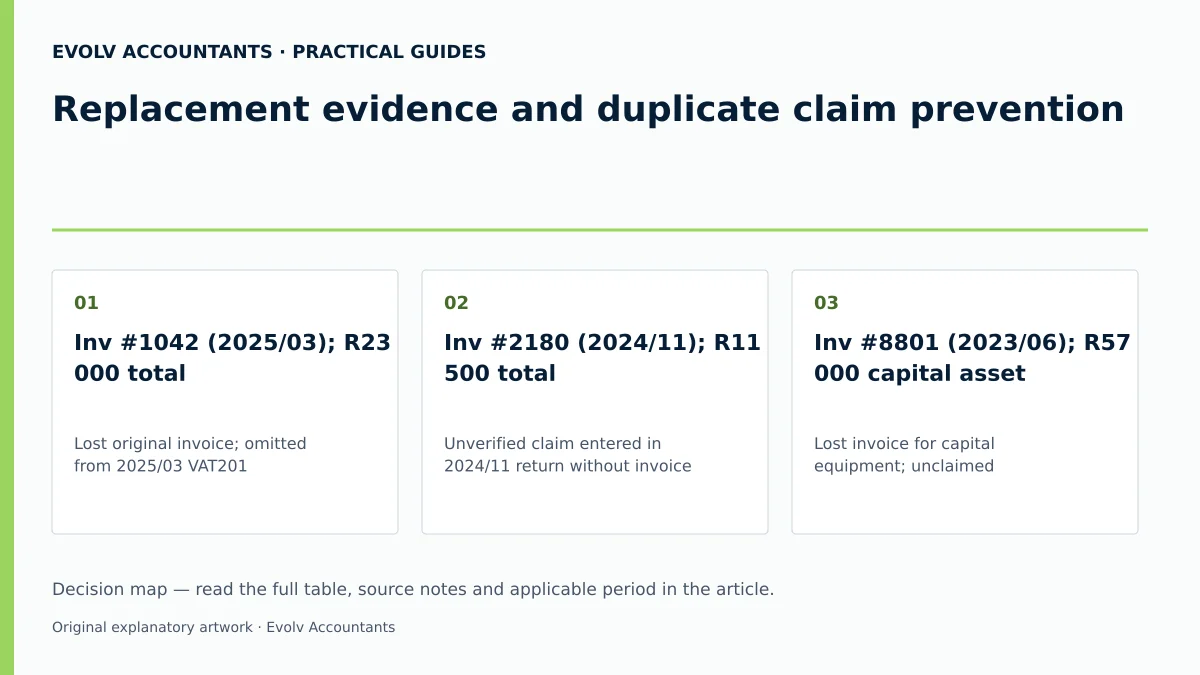
| Inv #1042 (2025/03); R23 000 total | Lost original invoice; omitted from 2025/03 VAT201 | Obtain supplier duplicate marked "COPY"; claim in open period | Field 15 on 2025/05 VAT201 increased by R3 000 input tax | Certified copy invoice, EFT payment proof, general ledger entry, VATSA statement |
| Inv #2180 (2024/11); R11 500 total | Unverified claim entered in 2024/11 return without invoice | Obtain duplicate copy; submit RFC for 2024/11 to decrease input tax | 2024/11 VAT201 revised (Version 2) reducing Part B input tax | Revised VAT201 filing receipt, PRN payment adjustment, current period Field 15 entry |
| Inv #8801 (2023/06); R57 000 capital asset | Lost invoice for capital equipment; unclaimed | Obtain supplier duplicate; verify capital asset register | Field 14 on current VAT201 increased by R7 434,78 input tax | Supplier duplicate copy, asset register entry, ITR14 tax asset reconciliation |
Reproducible Hypothetical Example
Scenario: Apex Logistics (Pty) Ltd, a registered South African VAT vendor accounting on the invoice basis, purchased vehicle spare parts on 10 April 2025 for R23 000 (VAT inclusive). The original tax invoice was misplaced during delivery.
- Sourced Rates and Thresholds:
- Standard VAT rate: 15% 34 43.
- Tax fraction: 15 / 115 44 45.
- Full tax invoice threshold: Consideration of R5 000 or more 32 33.
- Input tax limitation period: 5 years under Section 16(3) 25 27.
- Compulsory VAT registration threshold administrative position: Current SARS registration guidance administers R2,3 million, while older guides retain R1 million; this represents an administrative positioning rather than a direct statutory amendment to Section 23 of the VAT Act 46.
- Calculations:
- Total consideration: R23 000,00.
- Input tax portion: R23 000,00 × (15 ÷ 115) = R3 000,00.
- Net purchase value excluding VAT: R20 000,00.
- Execution:
- Apex Logistics omitted the R3 000 input tax claim from its April 2025 VAT201 return because no invoice was held.
- On 18 June 2025, Apex Logistics obtained a replacement duplicate invoice from the supplier clearly marked "DUPLICATE COPY" containing all Section 20(4) details 8 32.
- Rather than filing an invalid RFC to increase past input tax for April 2025, Apex Logistics declared the R3 000 input tax in Field 15 of its May–June 2025 VAT201 return 10 13 25.
- Result: R3 000 input tax lawfully claimed; zero risk of duplicate claims or audit disallowance.
Frequently Asked Questions
What should an SME do if a supplier refuses or is unable to issue a duplicate tax invoice?
If a supplier has ceased trading or refuses to issue a duplicate invoice, the vendor cannot claim input tax unilaterally 2 28. The vendor must apply to SARS under Section 16(2)(g) for a VAT ruling approving alternative documentary evidence (such as bank payment receipts and delivery notes) 7 9 29. The application must be submitted at least two months before the five-year limitation period expires 7.
Can an SME adjust a previously submitted VAT201 return via eFiling to claim a forgotten input tax invoice?
No. Under SARS eFiling rules (GEN-ELEC-04-G01), Part B amounts (input tax) on a previously submitted VAT201 return cannot be increased via a Request for Correction (RFC) 10 11 23. The omitted input tax must instead be claimed in the current or a future open VAT201 return within five years of the original time of supply 10 25.
How long does a South African vendor have to claim input tax on a replaced supplier invoice?
Under proviso (i) to Section 16(3) of the VAT Act, a vendor has five years from the end of the tax period in which the tax invoice should originally have been issued (i.e. within 21 days of supply) to deduct the input tax 25 26 27.
Is a supplier allowed to issue a second original tax invoice if the first one was lost?
No. Section 20(1) and SARS guide VAT 404 specify that it is illegal to issue more than one tax invoice per taxable supply 8. The supplier must issue a copy explicitly endorsed with the wording "COPY" or "DUPLICATE" 8.
What is the current compulsory VAT registration threshold and how does it relate to supplier invoice compliance?
Current SARS administrative guidance administers a R2,3 million compulsory registration threshold, whereas older SARS guides reference the historical R1 million threshold set out in Section 23 of the VAT Act 46. Vendors dealing with suppliers must verify the supplier's active VAT registration status on the SARS portal before deducting input tax, ensuring that tax invoices issued by suppliers reflect valid 10-digit VAT registration numbers 32 33.
Related guides
- What a valid South African tax invoice must contain
- Full tax invoices versus abridged tax invoices
- The Proactive SARS Audit Guide: Keeping Your Business Ledger Sanitised
Sources
- https://www.sars.gov.za/wp-content/uploads/Ops/Guides/Legal-Pub-Guide-VAT404-VAT-404-Guide-for-Vendors.pdf
- https://www.sars.gov.za/wp-content/uploads/Ops/Guides/GEN-ELEC-04-G01-Guide-for-completing-the-Value-Added-Tax-VAT201-Declaration-External-Guide.pdf
- Obligations of a VAT vendor | South African Revenue Service