
When a receipt is not enough for an input VAT claim
8 August 2025

An input VAT claim requires the prescribed evidence: usually a valid tax invoice, with specific alternatives and the record exception for purchases of R50 or less.
For South African small and medium enterprises (SMEs), holding a till slip or proof of payment is frequently mistaken for sufficient audit evidence when submitting a Value-Added Tax (VAT201) return. While a standard commercial receipt or bank transaction confirmation proves that cash moved, the South African Revenue Service (SARS) operates an invoice-based credit VAT system where input tax deductions are strictly contingent upon holding statutory documentation 1 2 3.
Without a qualifying full or abridged tax invoice—or approved alternative documentation such as customs release records—SARS will disallow input VAT claims upon verification or audit, resulting in tax re-assessments, interest, and non-compliance penalties 1 3 4 5.
Receipt evidence versus a qualifying tax invoice
To manage VAT compliance effectively, a registered SME must distinguish between vendor registration status and transaction-level input tax eligibility. A business becomes a vendor through compulsory or voluntary registration with SARS, which grants the legal authority and obligation to collect output tax on taxable supplies and deduct allowable input tax 6 7 8 9.
Under statutory provisions, compulsory registration applies when the total value of taxable supplies exceeds R1 million in a consecutive 12-month period or under a written contractual obligation 8 10. In contrast, current SARS administrative guidance reflects an operational threshold of R2.3 million; vendors must recognise this administrative position without treating it as an unqualified statutory amendment to Section 23 8.
Vendor status alone does not guarantee that every business purchase qualifies for an input VAT deduction. Eligibility is evaluated on a purchase-by-purchase basis and requires holding prescribed documentary proof at the time the deduction is declared on the VAT201 return 1 4 11. Under the invoice-based accounting method—which is the standard default for South African vendors—input tax can be claimed once the prescribed invoice is held, subject to the relevant tax-period and time-limit rules 11 12 13.
Vendors have a statutory limit of five years from the end of the tax period in which the tax invoice should have been issued to claim an input tax deduction, after which the entitlement lapses 11 14 15.
— Practical point from this guide
- VENDOR REGISTRATION & ELIGIBILITY
The qualification tests to check: receipt evidence
Before declaring an input VAT deduction in Fields 14, 14A, 15, or 15A of the VAT201 return, an SME must evaluate five independent qualification tests rather than relying on purchase size labels 4 16 17:
- Enterprise and Taxable Purpose Test: The goods or services must be acquired by the vendor wholly or partly for consumption, use, or supply in the course of making taxable supplies in the carrying on of an enterprise 4 18. Purchases made for private use, exempt supplies (such as residential accommodation or financial services), or non-taxable activities are strictly excluded 18 19 20.
- Standard-Rate Charging Test: Standard-rated VAT (currently 15%) must have been validly charged by a registered vendor supplier 18 21 22. The only statutory exceptions are qualifying acquisitions of non-taxable second-hand goods from non-vendors or goods repossessed under an instalment credit agreement 18 23 24.
- Prescribed Document Test: As SARS guidance highlights, "The most important document in a VAT system is the tax invoice" 3. The vendor must be in possession of a valid full tax invoice, abridged tax invoice, or customs release document when the return is submitted 1 3 5 25.
- Statutory Disallowance Check: Certain business purchases are specifically denied input tax deductions by law, even when acquired for enterprise operations 19 26. Key exclusions include passenger "motor cars" (vehicles with three or more wheels, constructed mainly for carrying passengers on public roads) and entertainment expenses (such as staff meals, client hospitality, or food and beverages) 19 26.
- Petty Cash Exception Test: For small purchases where the consideration is R50 or less (including VAT), a formal tax invoice is not required 27 28. However, a till slip, cash docket, or sales slip must still be retained in a petty cash record showing the VAT amount charged or a statement that the price includes standard-rate VAT 27 28.
Evidence behind the eligibility decision: a qualifying tax invoice
Each qualification test relies on specific documentary evidence that must be verified by the business owner, bookkeeper, or appointed tax practitioner before filing 1 5 29.
Full tax invoices (consideration over R5,000)
When the consideration for a supply exceeds R5,000 (including VAT), Section 20(4) dictates that a full tax invoice must be obtained 28 30. The invoice must reflect seven mandatory structural requirements:
- The words "Tax Invoice", "Invoice", or "VAT Invoice" 30.
- The name, address, and 10-digit VAT registration number of the supplier 30.
- The name, address, and 10-digit VAT registration number of the recipient vendor 30.
- An individual serialised invoice number and the date of issue 30.
- A full and proper description of the goods or services supplied 30.
- The quantity or volume of goods or services supplied 30.
- The price and VAT charged, shown under one of three approved methods (showing price excluding VAT, VAT charged, and total; showing total consideration and rate of VAT; or showing total consideration with a statement that VAT is included) 30 31.
Abridged tax invoices (consideration R5,000 or less)
Where the consideration for a taxable supply is R5,000 or less (including VAT), an abridged tax invoice is legally permissible under Section 20(5), except for zero-rated exports which always require full invoices 28 31 32. An abridged invoice must contain all the features of a full tax invoice, but allows the omission of the recipient vendor's name, address, and VAT registration number, as well as the specific quantity or volume 30 31.
Imported goods and second-hand goods evidence
For imported goods, input tax cannot be claimed using a foreign supplier invoice alone 25. The vendor must hold a valid Customs bill of entry (e.g., SAD 500), the eFiling VAT payment receipt, and an EDI Customs Status 1 Release Message 25. If imported via an agent, a statement from the agent containing prescribed details must be held within 21 days of the month-end 25 33.
For non-taxable second-hand goods acquired from non-vendors, the vendor must complete and retain a signed Form VAT264 declaration, proof of payment, and a copy of the seller's identity document or business registration letterhead 23 34 35.
- QUALIFYING TAX INVOICE REQUIREMENTS
- FULL TAX INVOICE (Consideration > R5,000) ABRIDGED TAX INVOICE (Consideration <= R5,000)
- 1. Words "Tax Invoice" / "VAT Invoice" 1. Words "Tax Invoice" / "VAT Invoice"
- 2. Supplier Name, Address & VAT Number 2. Supplier Name, Address & VAT Number
- 3. Recipient Name, Address & VAT Number 3. [Recipient details omitted]
- 4. Serial Number & Date of Issue 4. Serial Number & Date of Issue
- 5. Full Description of Goods/Services 5. Full Description of Goods/Services
- 6. Quantity or Volume 6. [Quantity / Volume omitted]
- 7. Price and VAT Charged (Approved Method) 7. Price and VAT Charged (Approved Method)
A qualifying case and an excluded case: receipt evidence
To demonstrate the application of these rules, consider a hypothetical SME, Cape Manufacturing (Pty) Ltd, operating as a registered vendor on the invoice accounting basis 8 12.
Qualifying case
Cape Manufacturing purchases raw industrial materials costing R11,500 (including 15% VAT) from a registered local supplier. The supplier issues an electronic tax invoice containing its trading details and VAT number, Cape Manufacturing's legal name, address, and VAT number, a unique serial number, date of issue, exact volume of raw materials, and a clear line item reflecting R1,500 VAT charged 30. Cape Manufacturing holds this invoice before submitting its bi-monthly VAT201 return.
- Result: The transaction passes all five tests 4 5 18 30. Cape Manufacturing validly claims an input VAT deduction of R1,500 in Field 15 of its VAT201 return 16 17.
Excluded cases
During the same tax period, Cape Manufacturing incurs two other expenses:
- Transaction A: The business purchases office refreshments and catering supplies costing R3,450 for a client meeting. The store issues an abridged tax invoice reflecting R450 VAT.
- Result: Although a valid abridged tax invoice is held, the purchase constitutes an entertainment expense 19. Input tax is strictly disallowed by law 19.
- Transaction B: The business buys specialized workshop tools costing R8,050 from a local hardware vendor. The store clerk hands the buyer a standard thermal payment receipt reflecting R1,050 VAT, but the receipt omits Cape Manufacturing's name, address, and VAT registration number.
- Result: Because the consideration exceeds R5,000, Section 20(4) mandates a full tax invoice 28 30. The payment receipt fails the Prescribed Document Test 1 30. The R1,050 input tax claim is disallowed until a revised full tax invoice is obtained from the supplier 1 11 30.
What changes the answer: a qualifying tax invoice
An initial eligibility determination must be reassessed when operational, commercial, or financial changes occur during the business lifecycle:
- Change in Extent of Taxable Use: If capital assets or operational goods originally acquired for taxable enterprise use are subsequently converted to private or exempt use, an output tax adjustment must be declared in Field 12 of the VAT201 return 36 37. Conversely, moving assets from exempt to taxable use allows an input tax adjustment in Field 16 36 37 38.
- Credit and Debit Notes: Where goods are returned, prices are adjusted, or prompt settlement discounts alter the original consideration, suppliers and recipients must issue or obtain debit or credit notes 39 40 41. Credit notes received and debit notes issued require an output tax adjustment in Field 12, whereas credit notes issued and debit notes received are declared as input tax adjustments in Field 18 42.
- Writing Off Irrecoverable Debts: Under the invoice basis, if an SME has declared output tax on a credit sale that subsequently becomes irrecoverable and is written off, an input tax adjustment can be claimed in Field 17 38 43.
- Shift in Turnover and Tax Periods: If an SME's annual taxable turnover grows to exceed R30 million, it ceases to qualify for bi-monthly Category A or B filing and must inform SARS within 21 days to transition to monthly Category C filing 44 45 46.
- Changes in Registered Particulars: Registered vendors must notify SARS within 21 days of any changes to business addresses, banking details, trading names, or representative persons 47.
Eligibility decision table
| Test | Facts to obtain | Evidence | Applicable source | Result or unresolved question |
|---|---|---|---|---|
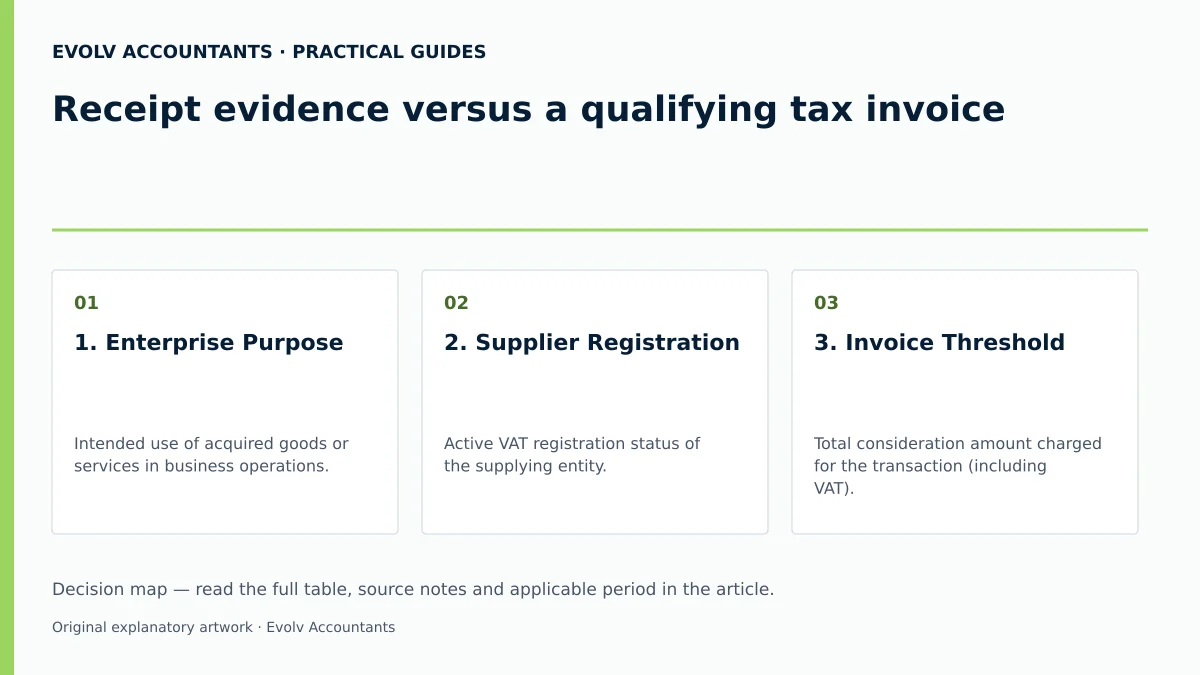
| 1. Enterprise Purpose | Intended use of acquired goods or services in business operations. | Internal purchase order, job card, or expense requisition showing taxable activity link. | VAT 404 Guide, Ch. 8 4 18 | Pass: Purpose criterion met; check the other conditions and any apportionment 4. Fail: No deduction for the exempt/private portion 18. |
| 2. Supplier Registration | Active VAT registration status of the supplying entity. | Supplier 10-digit VAT number verified via SARS eFiling / Online Query System. | SARS Vendor Obligations 6 48 | Pass: Supplier-registration criterion met; verify the VAT and other deduction conditions 18 21. Unresolved: Check eFiling status if unverified 48. |
| 3. Invoice Threshold | Total consideration amount charged for the transaction (including VAT). | Commercial invoice or billing record indicating total price. | VAT 404 Guide, Ch. 13 28 | > R5,000: Requires Full Tax Invoice 28 30. <= R5,000: Abridged invoice may be used, subject to the zero-rated-supply rules; apply the record exception for purchases of R50 or less where relevant 31. |
| 4. Document Completeness | Structural compliance with statutory tax invoice field requirements. | Physical or electronic document verifying 7 mandatory fields (Full) or 5 fields (Abridged). | VAT 404 Guide, Ch. 13 30 31 | Pass: Documentary criterion met; check the other deduction conditions 1 3. Fail: Obtain corrected prescribed proof or establish an available statutory alternative 1 11. |
| 5. Disallowed Categories | Nature of asset or expense purchased (motor cars / entertainment). | Itemised description on tax invoice and asset specification. | VAT 404 Guide, Ch. 8 19 26 | Pass: Standard business input 49. Fail: Denied unless a specific statutory exception is established 19 26. |
The five-year period is a minimum, not an automatic destruction date. SARS record-keeping guidance requires the relevant records to remain available; retain them beyond the ordinary minimum where an ongoing audit, investigation, objection or appeal or another applicable rule requires it.
Next steps for VAT invoices
To ensure input VAT claims withstand SARS verification and audit, SMEs should implement this five-step compliance checklist:
- Verify Supplier Tax Credentials: Check that the supplier's 10-digit VAT registration number is valid and active before processing payments 6 48.
- Inspect Invoice Structure Upon Receipt: Confirm that purchases over R5,000 contain the SME's full legal name, address, and VAT registration number 28 30. Reject payment receipts or incomplete invoices 1 30.
- Screen for Prohibited Inputs: Flag entertainment and passenger motor car expenses to prevent automated inclusion in input tax totals 19 26.
- File Within the Statutory Five-Year Window: Ensure all valid tax invoices are declared on the VAT201 return within five years of the original entitlement date 11 14.
- Maintain Secure Five-Year Audit Archives: Store all tax invoices, credit notes, bills of entry, and petty cash records in original or approved electronic formats for at least five years 1 6 50 51 52.
Frequently Asked Questions
Can an SME deduct input VAT using a till slip for purchases over R5,000?
No. For any transaction where the consideration exceeds R5,000 (including VAT), Section 20(4) strictly requires a full tax invoice containing the recipient vendor's legal name, address, and VAT registration number 28 30. A standard till slip or payment receipt is legally insufficient, and SARS will disallow the claim upon verification 1 30.
What happens if a supplier fails to issue a tax invoice within 21 days?
Under section 20, a registered vendor is legally required to issue a tax invoice within 21 days of making a supply exceeding R50 53. If a supplier fails to provide a qualifying tax invoice, the recipient vendor cannot claim the input VAT deduction on that return and must request a compliant document before claiming in a subsequent tax period 1 11 53.
How does an SME handle input VAT on petty cash expenses of R50 or less?
For minor purchases of R50 or less (including VAT), a formal tax invoice is not required 27 28. The SME can deduct input VAT provided it retains a till slip, cash slip, or sales docket in its petty cash records showing the VAT amount or a statement that the price includes standard-rate VAT 27.
How long does an SME have to claim an input VAT deduction if an invoice was misplaced?
If a qualifying tax invoice was misplaced, the SME can claim the input VAT in a subsequent tax period once the document or a valid copy is obtained, provided the claim is made within five years from the end of the tax period in which the invoice should have originally been issued 11 14 15.
Can input VAT be claimed on imported goods using only a foreign vendor's invoice?
No. An input VAT deduction for imported goods requires a valid Customs bill of entry (such as Form SAD 500), an eFiling Customs payment receipt, and an EDI Customs Status 1 Release Message confirming release by Customs 25. A commercial invoice from a foreign supplier does not constitute valid statutory proof for an input tax claim 25. Ask Evolv about receipt evidence versus a qualifying tax invoice. Share the relevant records so the support required can be scoped.
Related guides
- Issuing a credit note for a returned sale
- What a valid South African tax invoice must contain
- The Proactive SARS Audit Guide: Keeping Your Business Ledger Sanitised
Sources
- https://www.sars.gov.za/wp-content/uploads/Ops/Guides/Legal-Pub-Guide-VAT404-VAT-404-Guide-for-Vendors.pdf
- Obligations of a VAT vendor | South African Revenue Service
- https://www.sars.gov.za/wp-content/uploads/Ops/Guides/GEN-ELEC-04-G01-Guide-for-completing-the-Value-Added-Tax-VAT201-Declaration-External-Guide.pdf
- FAQs for VAT vendors | South African Revenue Service