
Issuing a credit note for a returned sale
5 January 2025

Issuing a credit note for a returned sale requires a South African VAT vendor to adjust previously declared tax records and link the adjustment to the original tax invoice.
When a customer returns goods after a standard tax invoice has already been rendered, a registered Value-Added Tax (VAT) vendor cannot simply erase or destroy the original document 1 2. Under South African tax law administered by the South African Revenue Service (SARS), the vendor must issue a legal credit note that explicitly cross-references the initial invoice number and date 3 4.
This credit note serves as the official primary accounting evidence required to decrease the output tax liability or claim an input tax adjustment on the VAT201 return 1 5. Proper linkage ensures that both the supplier and the recipient maintain an unbroken audit trail, preventing double deductions or under-declarations of tax 1 6.
Credit note linkage and adjusted VAT records
This guide is written for South African small and medium-sized enterprises (SMEs), financial managers, and internal accounting staff operating registered VAT entities within the jurisdiction of the Republic of South Africa.
When goods are returned by a client, the commercial transaction initially accounted for is altered or partially cancelled 1 3. In South African VAT law, as set out in Chapter 13 of the VAT 404 Guide for Vendors, a credit note is triggered whenever a tax invoice has been issued and the previously agreed consideration for the supply is reduced, or where part or all of the supplied goods are returned to the vendor 1 3.
Completion of this task means that the vendor has drafted a compliant credit note, linked it in the general ledger to the original sale, recorded the corresponding adjustment in Field 18 ("Other") of the VAT201 return for the active tax period, and retained the primary evidence for the statutory retention period 5 6 7.
— Practical point from this guide
Accounting for a credit note occurs in the specific tax period during which the credit note is issued by the supplier or received by the customer 8. Under SARS tax period allocations, vendors file on a two-monthly basis (Category A or B), a monthly basis for larger turnover (Category C), a six-monthly basis for micro-enterprises or farmers (Category D), or an annual basis for specific connected property entities (Category E) 9.
Regarding vendor registration requirements, SARS statutory guidelines historically set the compulsory VAT registration threshold at R1 million in taxable turnover over any consecutive 12-month period 10.
Current SARS operational guidance administers a registration threshold of R2.3 million; vendors must recognise that this reflects SARS's current administrative position rather than an unqualified statutory amendment to Section 23 of the Value-Added Tax Act, and the Rates and Monetary Amounts and Amendment of Revenue Laws Act does not alter Section 23 itself.
Prepare the information and authority: credit note linkage
To execute a credit note adjustment correctly, specific primary documents, system permissions, and transactional data must be gathered before making adjustments on eFiling 11 12.
Mandatory primary documents and inputs
- Original Tax Invoice: The historical full or abridged tax invoice issued for the sale, containing the original serial invoice number, tax date, consideration, and VAT charged 4 13.
- Goods Return Confirmation: A customer return slip, warehouse receipt note, or written agreement confirming the quantity and physical return of the items 3.
- Formal Credit Note Document: A freshly generated document bearing the mandatory statutory fields required by SARS 4 12.
- General Ledger & VAT Control Accounts: The primary accounting entries reflecting the reduction in sales turnover and the corresponding adjustment to the VAT account 6 14.
Statutory particulars required on a credit note
Under regulator guidance provided in the VAT 404 Guide, a valid credit note must reflect all of the following core details 4 12:
- The explicit words "Credit Note" 12.
- The trading or legal name, physical address, and 10-digit VAT registration number of the vendor issuing the document 12 15.
- The name, address, and VAT registration number of the recipient (where a full tax invoice was originally required for consideration of more than R5 000) 12 13.
- The date on which the credit note is issued 12.
- The precise amount by which the value of the supply and the VAT charged has been reduced 12.
- A brief explanation of the circumstances giving rise to the credit note (for example, "Goods returned by customer due to specification mismatch") 4.
- Sufficient tracking information to identify the original transaction, specifically citing the original tax invoice reference number and date of issue 4.
Authority and permissions
An authorised staff member may prepare the credit note under the business’s controls. Submission of the VAT201 must be undertaken through an authorised SARS profile, with the required representative or practitioner authority 16 17.
Complete the task step by step: adjusted vat records
Executing a credit note linkage and making adjusted VAT records requires a systematic process grounded in SARS eFiling guidelines 5 11 18.
Step 1: Verify the return event and retrieve original sale evidence
Inspect the returned goods and confirm that a valid tax invoice was previously issued 3. Check whether the transaction occurred within the current active tax period or a prior tax period 8.
Step 2: Draft the statutory credit note
Generate the credit note containing all mandatory particulars 4 12. Note that as a strict legal rule under Section 20 of the VAT Act, SARS stipulates: "It is illegal to issue more than one tax invoice per taxable supply" 2. Therefore, a vendor must never issue a replacement or negative invoice to correct a returned sale; a dedicated credit note must be issued instead 2 3.
Step 3: Calculate the exact VAT adjustment
Determine the VAT portion of the credit using the standard tax fraction 19 20. Apply the tax fraction formula:
VAT Amount = Returned Consideration (VAT inclusive) × (r ÷ 100 + r)
Where r is the prevailing standard VAT rate of 15%, giving the tax fraction (15 ÷ 115) 19 20.
Step 4: Record internal accounting entries
Post the credit note to the sales returns journal 6. For a standard-rated sale return, debit the Sales Returns account (VAT-exclusive portion), debit the Output VAT / VAT Adjustment control account (VAT portion), and credit the Customer Accounts Receivable or Cash account 6 14.
Step 5: Complete the VAT201 return on eFiling
- Access the SARS eFiling platform and navigate to "Returns" > "Returns Issued" > "Value Added Tax (VAT201)" 18.
- Select the applicable tax period and click "Request Return" to open the Vendor Declaration 18.
- For a supplier issuing a credit note, report the VAT adjustment amount in Field 18 ("Other") under Part B ("Calculation of Input Tax") 5 7. This field accommodates credit notes issued and debit notes received, allowing the supplier to deduct the tax adjustment against overall output liability 5 7.
- For a recipient customer receiving a credit note from a supplier, report the adjustment in Field 12 ("Other and imported services") under Part A ("Calculation of Output Tax"), as receiving a credit note decreases prior input tax and creates an output tax adjustment payable to SARS 5 21.
- Verify that the pre-populated 19-digit Payment Reference Number (PRN) is present on the return header 22 23.
- Click "Submit VAT201" to transmit the return electronically before the last business day of the calendar month 18 24.
Check the result against the evidence: credit note linkage
Completing a return submission on eFiling does not automatically guarantee SARS acceptance or final settlement 25 26. Independent verification against primary documentary evidence is required.
Verifying system transmission and accounting alignment
- eFiling Work Page Status: Confirm that the return status on the eFiling VAT Work Page displays "Filed through eFiling" or "Processed by SARS" 27 28.
- Statement of Account (VATSA): Request a fresh Statement of Account (VATSA) via eFiling under the "Returns" menu to verify that SARS has correctly processed the declared figures and applied any resulting credit balance 29.
- PRN Matching: Ensure that any net payment made or refund expected aligns precisely with the unique 19-digit Payment Reference Number generated for that specific return version 22 30.
- Reconciliation Audit Trail: Cross-examine the total value entered in Field 18 against the physical credit note register for the tax period 6 7.
Understanding verification and audit boundaries
SARS uses automated risk engines to flag returns where current declarations deviate significantly from historical trends 31 32. If a credit note adjustment results in a net refund or a substantial drop in output tax, SARS may issue a formal Request for Supporting Documents 26 33. Vendors must upload the original invoice, the signed credit note, proof of physical return of stock, and general ledger schedules via eFiling or the SARS Online Query System within the designated timeframe 26 34.
Handle exceptions and unresolved cases: adjusted vat records
Specific edge cases require careful handling to avoid non-compliance or administrative penalties.
Edge Case 1: Lost or missing original tax invoices
If the original invoice cannot be located, the vendor must inspect internal sales records and accounting databases to retrieve the historical invoice serial number, date, and tax amount 4. A credit note cannot be issued without citing the original transaction reference 4.
Edge Case 2: Cash theft or misappropriation
If cash or stock is stolen or misappropriated, SARS guidance explicitly confirms that the vendor is not entitled to issue a credit note or claim an input tax deduction 35. The VAT Act provides no relief or credit note mechanism for stolen cash funds 35.
Edge Case 3: Prompt settlement discounts and cash rounding
A credit note is not required when a reduction in price is due to a prompt settlement discount, provided the terms of the discount were clearly stated on the original tax invoice 36 37. In such cases, the vendor claims the VAT adjustment in Field 18 during the tax period when the discount conditions are met 36. Similarly, cash rounding differences handled under Binding General Ruling (BGR) 65 do not require credit notes if documented correctly on the invoice 37 38.
Edge Case 4: Adjustments for prior tax periods (Request for Correction)
If a vendor omitted a credit note from a previously filed VAT201 return, the correction procedure depends on vendor classification 39 40:
- Decreasing Output / Adjusting Returns: The vendor may use the "Request for Correction (RFC)" feature on eFiling to create a Version 2 return for that past period 40 41. Full revised amounts (not just the variance) must be entered 42.
- Input Tax Omissions: Under Section 25 read with SARS operational rules, a vendor is not permitted to increase input tax deductions on a past period revision 39 42. Instead, the unclaimed credit note deduction must be claimed in the current or a subsequent VAT201 return, provided it is claimed within five years from the original entitlement date 39 42.
Evolv advisory boundary
Where return adjustments involve complex cross-border exports, second-hand goods notional calculations, or historical audit disputes with SARS, SMEs should seek tailored advisory support before submitting revised returns 43 44.
The five-year period is a minimum, not an automatic destruction date. SARS record-keeping guidance requires the relevant records to remain available; retain them beyond the ordinary minimum where an ongoing audit, investigation, objection or appeal or another applicable rule requires it.
Next steps for VAT invoices
The following task checklist provides a reusable workflow for managing credit note linkage and adjusted VAT records in business accounting systems.
Task and completion checklist
| Step | Input or evidence | Responsible person | Completion check | Exception or next action |
|---|---|---|---|---|
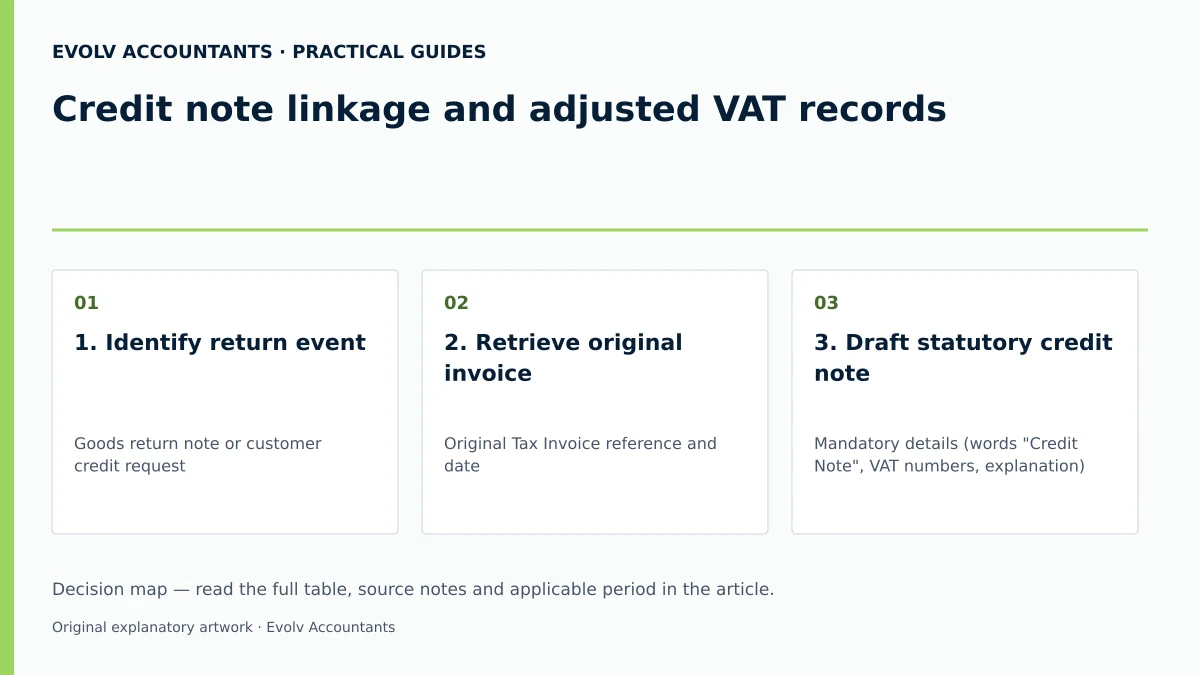
| 1. Identify return event | Goods return note or customer credit request | Credit Controller / Sales Admin | Physical return of stock verified | Confirm if sale was standard-rated or exempt 1 45. |
| 2. Retrieve original invoice | Original Tax Invoice reference and date 4 | Accounts Receivable Clerk | Invoice details cross-checked in ledger | If invoice lost, extract details from sales system archive 4. |
| 3. Draft statutory credit note | Mandatory details (words "Credit Note", VAT numbers, explanation) 12 | Finance Officer | All mandatory SARS fields present | Never issue a second tax invoice for the same supply 2. |
| 4. Calculate VAT fraction | Returned consideration × (15 ÷ 115) 19 20 | Accountant | Tax calculation matches exact returned value | Label illustrative values clearly in ledger 19. |
| 5. Post ledger entry | General ledger journal voucher | Senior Bookkeeper | Sales returns and VAT control accounts balanced | Ensure 5-year document retention archive is updated 6. |
| 6. Complete eFiling VAT201 | Credit note total schedule for the tax period | Tax Specialist / Representative Vendor | Supplier enters the VAT adjustment amount in Field 18 ("Other") 5 7 | Customer receiving credit note enters in Field 12 5 21. |
| 7. Verify processing | Statement of Account (VATSA) & PRN confirmation 22 29 | Financial Manager | Status displays "Filed" or "Processed" 27 28 | If flagged for audit, submit supporting records within deadline 26 34. |
Frequently Asked Questions
When must a credit note be issued for a returned sale?
A credit note must be issued whenever a tax invoice was previously rendered for a taxable supply and the agreed consideration is subsequently reduced because goods are returned in full or in part to the supplier 1 3.
In which field of the VAT201 return is a credit note reported?
A vendor who issues a credit note as a supplier reports the VAT adjustment in Field 18 ("Other") under Part B ("Calculation of Input Tax") 5 7. A vendor who receives a credit note as a purchaser reports the VAT adjustment in Field 12 ("Other and imported services") under Part A ("Calculation of Output Tax") 5 21.
Can a supplier issue a second tax invoice instead of a credit note?
No. Under South African VAT law, it is illegal to issue more than one tax invoice per taxable supply 2. Any price alteration, cancellation, or return of goods must be executed using an official credit note or debit note 2 3.
How long must credit notes and related invoices be retained?
All primary tax records, including original tax invoices, credit notes, goods return notes, and bank statements, must be retained for at least five years from the date of the relevant return submission 6 46.
What happens if a credit note is issued in a tax period after the original sale was declared?
The credit note is declared in the VAT201 return for the tax period in which the credit note is actually issued 8. The vendor does not need to backdate the credit note to the original sale period 8. ***
Related guides
- Issuing a debit note after undercharging VAT
- What a valid South African tax invoice must contain
- The Proactive SARS Audit Guide: Keeping Your Business Ledger Sanitised
Sources
- https://www.sars.gov.za/wp-content/uploads/Ops/Guides/Legal-Pub-Guide-VAT404-VAT-404-Guide-for-Vendors.pdf
- https://www.sars.gov.za/wp-content/uploads/Ops/Guides/GEN-ELEC-04-G01-Guide-for-completing-the-Value-Added-Tax-VAT201-Declaration-External-Guide.pdf
- Obligations of a VAT vendor | South African Revenue Service