
Issuing a debit note after undercharging VAT
19 January 2025

Issuing a debit note after undercharging VAT requires a registered South African vendor to adjust output tax and rectify the consideration.
When a vendor undercharges Value-Added Tax (VAT) or understates the agreed consideration on a taxable supply, South African tax law strictly prohibits issuing a second tax invoice for the same transaction 1. Instead, the vendor must issue a statutory debit note reflecting the original invoice details, the debit note reason, and the corrected VAT amount 2 3.
The issuing vendor accounts for this adjustment by reflecting output tax in Field 12 ("Other and imported services") on the VAT201 return for the tax period in which the debit note is issued 4 5 6. Where a past return contained an undisputed error, the vendor may perform a Request for Correction (RFC) via eFiling within five years 7 8 9.
Debit note reason original sale and VAT correction
For South African SMEs operating as registered VAT vendors, issuing a debit note after undercharging VAT applies whenever an initial tax invoice understates the true consideration or reflects an incorrect lower VAT calculation 11. Completing this task means the vendor has legally adjusted the invoice values, issued a valid debit note to the recipient, accounted for the additional output tax on the VAT201 declaration, and retained full documentary evidence for audit verification 2 6 10 12.
— Practical point from this guide
Under the Value-Added Tax Act, all standard-rated supplies attract VAT at the rate of 15% (effective from 1 April 2018) 13 14 15. Registered vendors are legally required to levy output tax, issue proper tax invoices within 21 days of supply, submit periodic VAT201 returns, and retain records for at least five years 10 12 16 17. When an error causes an undercharge of VAT or sale consideration, section 20(1) prohibits issuing a duplicate tax invoice 1.
Issuing a debit note bridges the legal gap between the initial invoice and the corrected financial reality 1 11.
Current SARS registration guidance administers new applications from 1 April 2026 at R2.3 million in taxable supplies over any consecutive 12 months for compulsory registration and R120 000 for the standard voluntary route, with specified alternative conditions. Older guides quote R1 million and R50 000. These older figures must not be presented as the current application thresholds, and the administrative guidance does not itself prove an amendment to section 23.
Prepare the information and authority: debit note reason original sale
Before issuing a debit note or altering accounting records, a vendor must gather all primary source documentation, establish proper internal approvals, and verify statutory requirements 2 10.
Mandatory document requirements for debit notes
A valid debit note must be prepared in accordance with statutory document rules 2. It must contain the following essential elements:
- The prominent title "Debit Note" 2.
- The legal name, business address, and 10-digit VAT registration number of the supplying vendor 2.
- The name, address, and VAT registration number of the recipient (required for full tax invoice adjustments where total consideration is more than R5 000) 2 19.
- The date on which the debit note is issued 2.
- An explicit debit note reason explaining the adjustment (for example, "original sale consideration understated" or "VAT rate error on original sale") 2 3.
- Clear cross-references identifying the original transaction, including the original tax invoice serial number and date of issue 3.
- The financial breakdown: the original understated amount, the corrected amount, the net increase in consideration, and the exact additional VAT charged 2 20.
Statutory thresholds and accounting basis rules
Current SARS registration guidance administers new applications from 1 April 2026 at R2.3 million in taxable supplies over any consecutive 12 months for compulsory registration and R120 000 for the standard voluntary route, with specified alternative conditions. Older guides quote R1 million and R50 000. These older figures must not be presented as the current application thresholds, and the administrative guidance does not itself prove an amendment to section 23.
Complete the task step by step: vat correction
Correcting an undercharge of VAT involves a structured sequence spanning document generation, recipient communication, and return submission 5 6 8.
Step 1: Calculate the correction and issue the debit note
Calculate the difference between the original understated consideration and the true consideration 2 20. Apply the statutory tax fraction of 15/115 to determine the additional VAT output liability if amounts are inclusive, or multiply net consideration by 15% 15 25 26. Generate the debit note containing all required statutory disclosures and dispatch it immediately to the recipient vendor 2 5.
Step 2: Determine the reporting mechanism on eFiling
Determine whether the adjustment falls into the current tax period or requires a historical revision 5 7:
- Current Period Adjustment: If the undercharge is identified in the same tax period or adjusted via an ongoing commercial relationship, the issuing vendor declares the additional output tax in Field 12 ("Other and imported services") of the current VAT201 return 4 6. This automatically increments Total Output Tax in Field 13 4.
- Historical Request for Correction (RFC): If the undercharge represents an undisputed error on a previously filed return, access eFiling, locate "Returns History", select the relevant tax period, and click "Request for Correction" 8 9 27.
Step 3: Complete and submit the revised VAT201 return
When completing an eFiling RFC:
- eFiling generates a new version of the VAT201 return retaining the original Payment Reference Number (PRN) 8 28.
- Enter the full revised totals for the entire tax period across all fields, NOT merely the incremental difference 8 29 30.
- Note that Part A output tax fields can be increased or decreased, but Part B input tax deductions on past returns can only be decreased 31 32. (Any unclaimed input tax attributable to past periods must be claimed in a future return within five years) 29 30.
- Review the auto-calculated net balance in Field 20 33. Submit the return electronically before the last business day of the month 34.
- Settle any additional tax payable using the populated PRN 8 35.
Check the result against the evidence: debit note reason original sale
Submitting a return or issuing a document does not automatically guarantee full regulatory acceptance by SARS 36 37. Vendors must independently verify completion against objective audit evidence 10 38:
- eFiling Submission Confirmation: Verify that the return status on the VAT Work Page reflects "Filed through eFiling" and generates a valid submission receipt 39 40.
- Statement of Account (VATSOA) Inspection: Request an updated Statement of Account via eFiling 38 41. Confirm that the additional output tax has been correctly debited, payments credited, and that no unexpected administrative penalties or interest have accrued 36 38 41.
- Audit Trail Verification: Ensure physical or digital copies of the original tax invoice, the newly issued debit note, delivery notes or revised contracts, and the eFiling VAT201 filing receipt are securely stored together 10 16. SARS mandates retaining all accounting records and supporting documents for a minimum of five years 10 16.
Handle exceptions and unresolved cases: vat correction
When issuing debit notes or executing VAT corrections, several complex edge cases may arise:
- Recipient Refuses to Pay or Accept Debit Note: A recipient vendor may object to an additional charge. However, the supplier's statutory liability to declare output tax on taxable supplies remains binding under the law 5 10. The issuing vendor must still account for the output tax in Field 12 4 6. If the resulting debt eventually becomes irrecoverable and is written off, an input tax deduction may be considered under Section 22 in a subsequent tax period 42 43.
- Multiple Revisions (Version 3 Onwards): When a vendor submits a second or subsequent revision (Version 3 or higher) for a single tax period on eFiling, SARS automatically requires supporting documents to be uploaded before processing the revision 7 44.
- SARS Audit or Verification Lockout: If SARS has finalised an audit on a specific tax period, or if a SARS official has performed a manual correction, eFiling will lock the return and prevent further automated RFC submissions 7 44. The vendor must lodge a formal dispute or request assistance through SARS branch channels 7 44 45.
- Specialist Boundaries: Where undercharges result from complex multi-rate transactions, historical change of accounting basis, or potential understatement penalties, vendors should seek professional advice from Evolv Accountants before submitting revised declarations 10 46.
The five-year period is a minimum, not an automatic destruction date. SARS record-keeping guidance requires the relevant records to remain available; retain them beyond the ordinary minimum where an ongoing audit, investigation, objection or appeal or another applicable rule requires it.
Next steps for VAT invoices
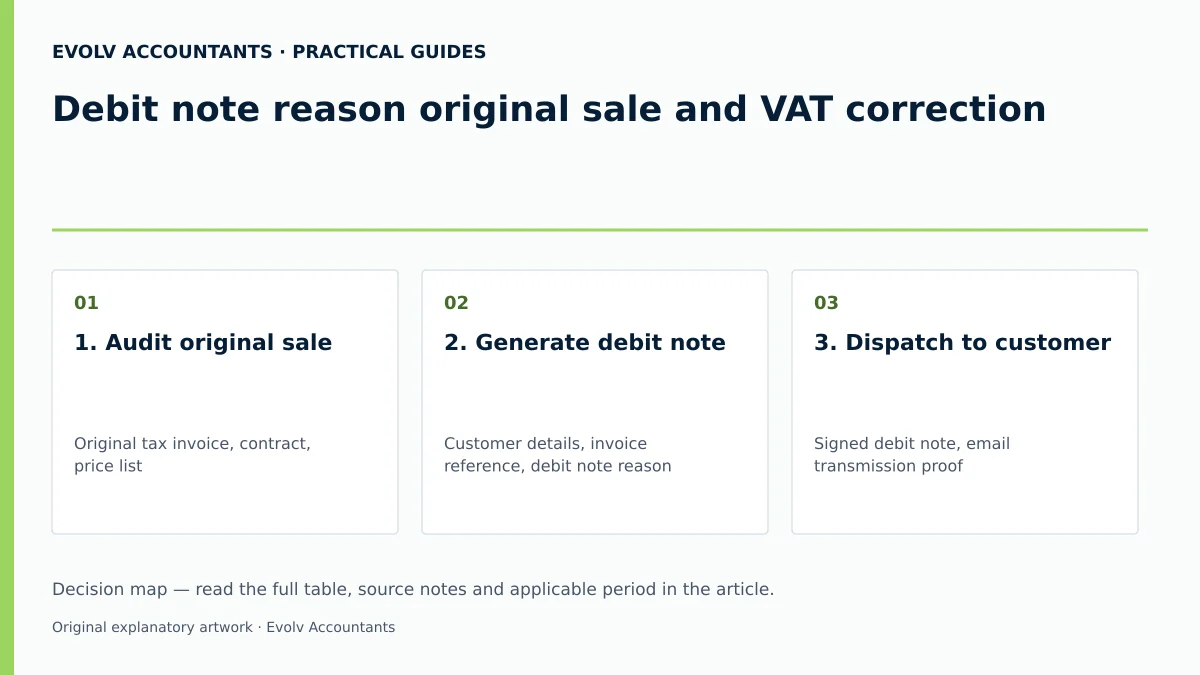
To systematically execute a VAT correction for an undercharged sale, follow this structured task and completion checklist.
Task and completion checklist
| Step | Input or evidence | Responsible person | Completion check | Exception or next action |
|---|---|---|---|---|
| 1. Audit original sale | Original tax invoice, contract, price list 2 19 | Financial Controller / Bookkeeper | Discrepancy in consideration or VAT verified 11 | If error is > 5 years old, consult Evolv Accountants 7 |
| 2. Generate debit note | Customer details, invoice reference, debit note reason 2 3 | Billing Officer / Accountant | Debit note issued with mandatory fields 2 | Account for output tax under the vendor’s approved accounting basis 5 |
| 3. Dispatch to customer | Signed debit note, email transmission proof 2 5 | Credit Controller | Customer delivery confirmed 5 | Retain transmission log in audit file 10 |
| 4. Update VAT201 return | Current VAT201 or eFiling Request for Correction 4 8 | Tax Practitioner / Accountant | Field 12 updated or RFC submitted 4 8 | If eFiling is locked by audit, lodge SARS enquiry 44 |
| 5. Settle tax & archive | PRN payment proof, VATSOA statement, 5-year archive 8 10 38 | Finance Manager | Affected-period assessment and payment entries reconcile on the Statement of Account 38 | Archive all records for 5 years 10 16 |
Practical hypothetical example
Consider a practical example of a registered South African vendor, Cape Logistics (Pty) Ltd, operating on the invoice accounting basis 22.
- Original Sale: On 10 October 2026, Cape Logistics issued Tax Invoice #1042 to a client for freight services. The agreed net fee was R10 000. However, due to a clerical error, the invoice charged 0% VAT instead of the standard 15% rate 13 14 15. The invoice reflected R10 000 total.
- Discovery & Debit Note: On 25 October 2026, the error was detected. Under Section 20, issuing a second tax invoice is illegal 1. Cape Logistics issued Debit Note #DN-1042 cross-referencing Tax Invoice #1042 2 3. The debit note reason stated: "VAT rate correction on original sale — standard rate 15% applied" 2 3.
- Calculation: Additional VAT = R10 000 × 15% = R1 500 15 25. Total revised consideration = R11 500.
- Return Filing: In the October 2026 VAT201 return, Cape Logistics entered R1 500 in Field 12 ("Other and imported services") 4 6. This increased Total Output Tax in Field 13 by R1 500 4.
- Recipient Handling: The recipient vendor, upon receiving Debit Note #DN-1042, claimed R1 500 as input tax in Field 18 ("Other") of its own VAT201 return 6 33.
Action plan for vendors
- Review all recent billing runs to identify any undercharged sales or rate errors 11.
- Issue statutory debit notes for all identified undercharges, ensuring cross-references to original invoices 2 3.
- Reflect additional output tax in Field 12 of your current VAT201 or submit an eFiling Request for Correction for past periods 4 6 8.
- Pay any resulting tax balance promptly using the pre-populated Payment Reference Number 8 35.
- Store all supporting documentation in a dedicated compliance folder for 5 years 10 16.
Frequently Asked Questions
Can I issue a second tax invoice to correct an undercharged sale?
No. Under South African VAT law, it is illegal to issue more than one tax invoice per taxable supply 1. When an initial tax invoice understates the consideration or VAT charged, the vendor must issue a formal debit note cross-referencing the original invoice 1 2.
Where is a debit note reported on the VAT201 return?
A vendor issuing a debit note declares the additional output tax in Field 12 ("Other and imported services") on Part A of the VAT201 return 4 6. This amount automatically adds into Total Output Tax in Field 13 4.
How does a recipient vendor process a debit note received?
A recipient vendor who receives a valid debit note for a taxable enterprise expense claims the additional VAT as an input tax deduction in Field 18 ("Other") on Part B of its VAT201 return 6 33.
How far back can a VAT201 return be revised on eFiling?
A vendor can perform a Request for Correction (RFC) on eFiling for the VAT portion of a VAT201 return for any tax period within the last five years 7 8. When revising a return, full revised totals must be entered, not just the incremental difference 8 29 30.
What is the compulsory VAT registration threshold in South Africa?
Current SARS registration guidance administers new applications from 1 April 2026 at R2.3 million in taxable supplies over any consecutive 12 months for compulsory registration and R120 000 for the standard voluntary route, with specified alternative conditions. Older guides quote R1 million and R50 000. These older figures must not be presented as the current application thresholds, and the administrative guidance does not itself prove an amendment to section 23.
Related guides
- Preparing for a SARS VAT registration verification
- What a valid South African tax invoice must contain
- The Proactive SARS Audit Guide: Keeping Your Business Ledger Sanitised
Sources
- https://www.sars.gov.za/wp-content/uploads/Ops/Guides/Legal-Pub-Guide-VAT404-VAT-404-Guide-for-Vendors.pdf
- https://www.sars.gov.za/wp-content/uploads/Ops/Guides/GEN-ELEC-04-G01-Guide-for-completing-the-Value-Added-Tax-VAT201-Declaration-External-Guide.pdf
- Obligations of a VAT vendor | South African Revenue Service
- Register for VAT | South African Revenue Service
- FAQs for VAT vendors | South African Revenue Service