
Choosing cash basis versus accrual bookkeeping
10 January 2025

Selecting between a cash basis and an accrual timing basis requires aligning bookkeeping methods with tax registration assumptions under South African law.
Choosing an accounting timing basis dictates how transactions are recognised in internal financial records and how statutory obligations are fulfilled. While a cash basis records income and expenses only when cash changes hands, accrual accounting recognizes economic events when earned or incurred regardless of cash settlement 1 2.
South African small and medium enterprises (SMEs) must navigate distinct legal requirements under the Companies Act 71 of 2008 and the Tax Administration Act 28 of 2011, alongside regulator guidance from the South African Revenue Service (SARS) 3 4 5 6. Evolv Accountants recommends evaluating both operational cash flow control and statutory tax registration types—such as Value-Added Tax (VAT), Micro Business Turnover Tax, and Corporate Income Tax—to establish a compliant financial foundation.
Timing basis versus tax registration assumptions
Understanding the distinction between cash basis and accrual timing basis is essential for every South African business owner. Under a cash accounting basis, revenue is recognised only when cash or payment is actually received in the bank account, and expenses are recorded when funds are disbursed 7 8.
Conversely, under an accrual accounting basis, revenue is recognised when it is earned (accrued) and expenditure when it is actually incurred, aligning with the International Financial Reporting Standards (IFRS) Conceptual Framework definitions of assets, liabilities, income, and expenses 1 9.
Neither timing basis represents a universal winner for all businesses. A cash basis offers operational simplicity and immediate visibility over physical bank balances, making it appealing for small, cash-led traders 8. However, it fails to reflect outstanding customer debts or unpaid vendor commitments, obscuring true financial performance 7.
Accrual accounting provides a complete view of financial position and economic performance, enabling structured trade credit and strategic planning, but requires active management of debtor collections and working capital 4 10.
To select the correct approach, SMEs must distinguish between three distinct legal and advisory tiers:
- Statutory Law: The Companies Act 71 of 2008 mandates that every company keep accurate and complete accounting records to satisfy its obligations and prepare annual financial statements 11 12. The Tax Administration Act 28 of 2011 dictates statutory administration, record retention rules, and audit procedures 13 14.
- Regulator Guidance: Official guides published by SARS—such as the Tax Guide for Small Businesses 2025/2026—explain the practical application of income tax computations, provisional tax, and VAT accounting options 2 10 15.
- Evolv Recommendations: Specific operational workflows, including daily bookkeeping schedules, bank reconciliation procedures, and 13-week cash flow forecasting models, represent professional guidance from Evolv Accountants rather than statutory mandates.
Compare the criteria that matter: timing basis
Evaluating an accounting timing basis requires assessing operational cash control, commercial liability tracking, statutory reporting mandates, and tax alignment. While internal management accounting can be adapted to business preferences, external reporting and statutory tax filings must conform to prescribed legal frameworks 4 16.
| Criterion | Option A (Cash Basis) | Option B (Accrual Basis) | Evidence or assumption | Implication for this reader |
|---|---|---|---|---|
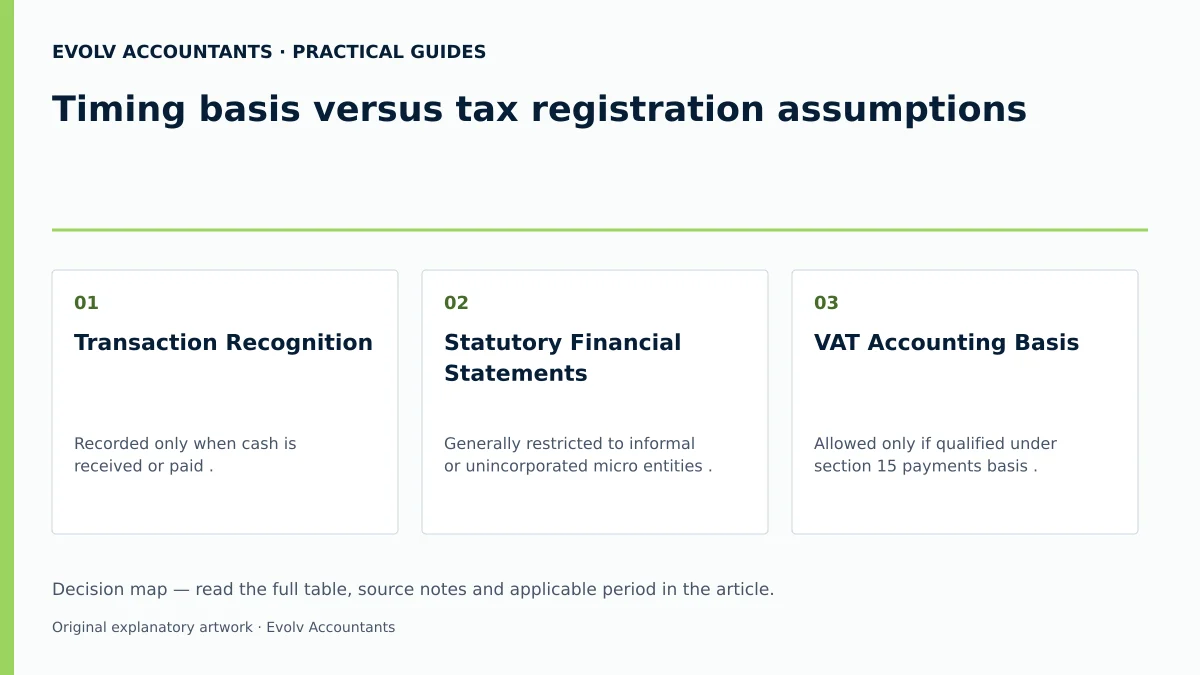
| Transaction Recognition | Recorded only when cash is received or paid 8. | Recognised when revenue is earned and expenses are incurred 1 9. | IFRS Conceptual Framework & VAT Act 1 2. | Cash basis hides unpaid bills; accrual matches revenue and expenses. |
| Statutory Financial Statements | Generally restricted to informal or unincorporated micro entities 17. | Mandated for all companies under Companies Act standards 4 18. | Companies Act 71 of 2008 s29(5) 18. | Companies must use the financial-reporting framework applicable to their statutory category; full IFRS is not a universal requirement 4 18. |
| VAT Accounting Basis | Allowed only if qualified under section 15 payments basis 19. | Default invoice basis for all standard VAT vendors 2. | Value-Added Tax Act 89 of 1991 s15 2 19. | Standard vendors must declare VAT on invoices before cash is collected 2. |
| Income Tax Alignment | Does not reflect statutory gross income accruals 20. | Aligns net profit building blocks with tax computations 9 10. | Income Tax Act 58 of 1962 s11(a) 9 10. | Taxable income requires adjusting accounting profit for accruals 10 21. |
| Working Capital Management | Tracks immediate cash flow but omits debt commitments 7. | Tracks trade receivables, trade payables, and net assets 1 4. | Evolv operational recommendation & IFRS 1 4. | Accrual provides essential visibility for credit management and forecasting. |
How the obligations differ: tax registration assumptions
Statutory tax rules differ fundamentally from internal bookkeeping routines. Income tax under the Income Tax Act 58 of 1962 is calculated from gross income—comprising total amounts in cash or otherwise received by or accrued to the taxpayer—less exempt income and allowable deductions 20 22 23. Under the general deduction formula of section 11(a), expenses are deductible if they are "actually incurred in the production of income" during the year of assessment 9.
Tax registration assumptions directly constrain which timing options are legally available:
- Corporate Income Tax: Standard private companies pay normal corporate income tax at a flat rate of 27% on taxable income for years of assessment ending on or after 1 April 2025 24.
- Small Business Corporations (SBC): Qualifying companies under section 12E benefit from progressive tax rates (0% on taxable income up to R95 750, 7% from R95 751 to R365 000, 21% from R365 001 to R550 000, and 27% above R550 000), provided gross income does not exceed R20 million and ownership criteria are satisfied 24 25.
- Micro Business Turnover Tax: Micro businesses with qualifying annual turnover up to R1 million can elect turnover tax under the Sixth Schedule in lieu of income tax and CGT, paying simplified rates from 0% (up to R335 000) up to 3% on turnover above R750 000 17 26 27.
- Value-Added Tax (VAT): Compulsory VAT registration applies when taxable turnover exceeds R2.3 million in any 12-month period, while voluntary registration requires a minimum turnover of R120 000 28 29. The default statutory VAT accounting method is the invoice basis, requiring output tax to be declared in the period an invoice is issued or payment received, whichever occurs earlier 2. The payments basis (cash basis) for VAT is restricted under section 15 to natural persons or sole partnerships with taxable supplies under R2.5 million and specific public entities 19.
- Record Retention Obligations: Under section 29 of the Tax Administration Act 28 of 2011, tax records must be retained for 5 years from the date of return submission 5 30. However, section 24 of the Companies Act 71 of 2008 mandates that companies retain accounting records and annual financial statements for 7 years 3 31.
Step-by-step compliance evaluation checklist
- Review organizational entity structure and confirm whether CIPC corporate status mandates Companies Act accounting standards 11 18.
- Audit annual taxable turnover against statutory thresholds for compulsory VAT (R2.3 million), Micro Business Turnover Tax (R1 million), and SBC status (R20 million) 17 25 28.
- Determine whether current VAT registration operates on the default invoice basis or an approved section 15 payments basis 2 19.
- Reconcile internal accounting net profit with taxable income by adjusting for statutory accrual timing differences and allowable deductions 9 10 21.
- Implement dual record retention protocols that satisfy both the 5-year Tax Administration Act requirement and the 7-year Companies Act rule 3 5.
Two business situations with different outcomes: timing basis
To illustrate how timing basis and tax registration assumptions interact, consider two hypothetical business scenarios operating under South African tax law.
Scenario A: Cash-focused service Close Corporation
Consider "Kasi Transport CC", a small close corporation providing local courier services. All clients pay immediately upon delivery in cash or electronic funds transfer, and operating costs (fuel and maintenance) are paid instantly.
- Facts: Annual gross turnover is R800 000. All shareholdings are held by natural persons, and the entity qualifies as a Small Business Corporation (SBC) under section 12E 25. Turnover is below the compulsory VAT threshold of R2.3 million, and the business chooses not to register voluntarily for VAT 28 29.
- Application: Because there are no credit sales or supplier credit terms, cash receipts equal accrued revenue. Applying SBC progressive income tax rates, the first R95 750 of taxable income is taxed at 0%, and the balance up to R365 000 is taxed at 7% 24. Internally, cash-focused bookkeeping accurately reflects daily bank liquidity. However, for statutory annual reporting, the close corporation must still prepare financial statements showing its assets and liabilities 4 32.
Scenario B: Wholesale trading company with credit sales
Consider "Apex Wholesalers (Pty) Ltd", a private company distributing industrial goods to commercial clients on 60-day payment terms.
- Facts: Annual credit turnover is R3 000 000, exceeding the compulsory VAT threshold of R2.3 million 28. The company incurs significant supplier trade debt on 30-day terms.
- Application: As a registered VAT vendor, Apex is legally required to account for VAT on the invoice basis 2. When issuing a credit invoice for R300 000 plus 15% VAT (R45 000 VAT), Apex incurs an immediate statutory obligation to declare and pay R45 000 in output VAT to SARS for that tax period, even though customer cash will not arrive for 60 days 2 33. Cash basis internal bookkeeping would create a severe cash flow mismatch by failing to track the pending R45 000 VAT liability and supplier payables 2 34. Accrual accounting is essential to track accounts receivable, claim input tax deductions on supplier invoices, and manage working capital 34 35.
Summary of illustrative rates and statutory thresholds
- Illustrative values: Scenario A annual turnover R800 000; Scenario B credit invoice R300 000 plus R45 000 VAT.
- Standard Corporate Income Tax Rate: 27% for years of assessment ending on or after 1 April 2025 24.
- SBC Tax Thresholds: R1–R95 750 at 0%; R95 751–R365 000 at 7%; R365 001–R550 000 at 21%; above R550 000 at 27% 24. Max gross income cap R20 million 25.
- Micro Business Turnover Tax Thresholds: R1–R335 000 at 0%; R335 001–R500 000 at 1%; R500 001–R750 000 at 2%; above R750 000 at 3% 26. Max qualifying turnover cap R1 million 17.
- VAT Registration Thresholds: Compulsory threshold R2.3 million; voluntary minimum threshold R120 000 28 29.
- VAT Payments Basis Threshold: R2.5 million taxable turnover for qualifying natural persons/partnerships 19.
- Standard VAT Rate: 15% 33.
When the comparison needs specialist input: tax registration assumptions
Certain commercial structures, complex contract terms, and statutory classifications require professional tax advisory input rather than standard bookkeeping rules:
- Personal Service Providers (PSPs): Companies or trusts rendering personal services directly by connected persons are classified as PSPs under the Fourth Schedule 36. PSPs face 28% PAYE tax withholding and severe expense deduction restrictions under section 23(k) 37. Furthermore, PSPs are excluded from SBC tax relief even if gross income is under R20 million 25.
- Complex Contracts & Pre-trade Expenses: Long-term contracts, retention fees, and pre-trade startup expenditure require specialist analysis under section 11A to determine the precise year of assessment in which deductions are allowed 38.
- Imported Services & Reverse Charge VAT: Acquiring offshore digital or professional services for non-taxable purposes triggers a VAT reverse charge, requiring declaration and payment to SARS within 60 days 39.
- SARS Audits & Dispute Resolution: Formal field audits and information requests under Chapter 5 of the Tax Administration Act require careful management, including formal procedures when legal professional privilege is asserted under section 42A 40 41.
Next steps for Bookkeeping foundations
Selecting and maintaining the appropriate bookkeeping timing basis requires establishing a formal decision record that documents your legal entity type, annual turnover, VAT registration status, and statutory record retention policies. Reconciling your operational accounting routines with your tax registration type ensures compliance with SARS requirements while optimizing internal cash flow management 2 10.
— Practical point from this guide
For detailed technical guidance on operational routines, refer to Evolv Accountants' internal implementation guides on setting up bookkeeping systems, designing charts of accounts, and establishing bank reconciliation workflows.
Frequently Asked Questions
Can a private company use cash basis bookkeeping for its statutory financial statements?
No. Under sections 28 and 29 of the Companies Act 71 of 2008, every company must maintain accurate accounting records and prepare annual financial statements that conform to prescribed financial reporting standards (IFRS or IFRS for SMEs) 4 11 18. These standards require accrual accounting to present fairly the company's financial position, assets, and liabilities 1 4.
May a registered VAT vendor choose to account for VAT on a cash payments basis?
A VAT vendor may only use the payments basis if it meets the strict criteria under section 15 of the Value-Added Tax Act 89 of 1991—such as being a natural person or partnership with annual taxable supplies not exceeding R2.5 million—and receives formal written approval from SARS 8 19 42. Standard private companies must account for VAT on the invoice basis 2.
How long must a South African SME retain its accounting and tax records?
Under section 29 of the Tax Administration Act 28 of 2011, tax records must be retained for 5 years from the date a return is submitted 5 30. However, section 24 of the Companies Act 71 of 2008 requires companies to keep accounting records and annual financial statements for 7 years 3 31. Businesses should maintain records for 7 years to satisfy both statutes.
How does an accrual accounting profit differ from taxable income?
Accounting net profit measures economic performance under accrual standards 10 21. Taxable income is determined under the Income Tax Act 58 of 1962 by taking gross income (received or accrued) and making statutory adjustments for exempt income, non-deductible items, capital allowances, and expenses actually incurred under section 11(a) 9 10 20.
Does electing Turnover Tax eliminate the need for proper bookkeeping records?
While Micro Business Turnover Tax under the Sixth Schedule simplifies tax compliance for entities with qualifying turnover up to R1 million, it does not exempt incorporated entities from maintaining accurate records under section 28 of the Companies Act 11 17 27. Micro businesses must retain records of all receipts, payments, and asset handovers to substantiate their turnover tax declarations 14 27.
Related guides
- Setting up bookkeeping for a new small business
- Designing a chart of accounts for a service business
- Reading the Financials: Cash Flow and the Balance Sheet for Directors
Sources
- IFRS - Conceptual Framework for Financial Reporting
- https://www.sars.gov.za/wp-content/uploads/Ops/Guides/Legal-Pub-Guide-Gen09-Tax-Guide-for-Small-Businesses.pdf
- https://www.cipc.co.za//wp-content/uploads/Legal/Regulations/CompaniesAct71_2008.pdf
- https://www.sars.gov.za/wp-content/uploads/Ops/Guides/LAPD-TAdm-G01-Short-Guide-to-the-Tax-Administration-Act-2011.pdf