
Designing a chart of accounts for a service business
9 June 2026

Designing a chart of accounts for a service business means structuring ledger categories to accurately track service revenue, operating expenses, tax compliance, and statutory obligations.
A well-designed chart of accounts provides South African small and medium enterprises (SMEs) with a systematic financial ledger structure that separates operational activities from capital and tax obligations 1 2.
For service-based businesses, which generate income primarily through professional expertise, retainers, and billable hours rather than physical inventory sales, the chart of accounts must reflect a service revenue model while fulfilling statutory record-keeping rules under the Companies Act 71 of 2008 and the Tax Administration Act 28 of 2011 3 4 5 6.
Establishing these accounting foundations ensures that internal bookkeeping supports accurate financial statements, facilitates tax compliance with the South African Revenue Service (SARS), and satisfies audit or review requirements 2 7 8.
Accounts suited to a service revenue model
This guidance applies to SME directors, business owners, and financial managers operating in South Africa during the 2025/2026 tax year 8. For corporate entities, this period covers financial years ending during the 12-month period up to 31 March 2026, alongside tax years of assessment for natural persons and trusts 8.
Designing accounts suited to a service revenue model means creating a categorised general ledger that captures all receipts, accruals, direct service costs, overheads, assets, liabilities, and equity elements without requiring physical Cost of Goods Sold structures 1 6 9. Completion of this task requires establishing a compliant account structure that yields balanced trial balances, facilitates statutory financial reporting, and supports SARS tax computations 2 5 10.
Prepare the information and authority: accounts suited to a service revenue model
To design and implement a service-tailored chart of accounts, specific documentation, legal authorizations, statutory definitions, and financial inputs must be gathered:
- Required Documentation and Inputs: CIPC Notice of Incorporation or Memorandum of Incorporation 11 12, bank account details and electronic bank feeds 13, client service contracts and fee notes 5, supplier tax invoices 14, employee payroll records 15, and SARS VAT registration documentation (Form VAT101) 16.
- Statutory Authorizations and Governance: Board approval for the accounting structure, formal designation of a Public Officer residing in South Africa under section 246 of the Tax Administration Act 17, and designated responsibility for company compliance under section 33(3) of the Companies Act 18.
- Core Statutory Definitions:
- Income and Gross Sales: The total receipts and accruals in cash or otherwise derived from service delivery 9 19.
- Operating Expenses: Business expenditures actually incurred in the production of income, for trade purposes, and not of a capital nature, qualifying under the general deduction formula 20.
- Accounting Net Profit vs Taxable Income: Net profit represents the accounting excess of income over expenses, whereas taxable income represents the figure derived after statutory tax adjustments 6 10 21.
- Financial Reporting Elements: Assets, liabilities, equity, income, and expenses as defined in the IFRS Conceptual Framework 1 2.
Complete the task step by step: documented completion and exceptions
Implementing a chart of accounts for a service enterprise requires a structured process grounded in primary statutory rules and financial reporting standards 1 2 5:
- Establish the Five Primary Element Groups: Define top-level account groups according to the IFRS Conceptual Framework: Assets (1000 series), Liabilities (2000 series), Equity (3000 series), Income (4000 series), and Expenses (5000/6000 series) 1.
- Configure Service Revenue Accounts: Create dedicated revenue accounts (e.g., 4000 Professional Consulting Fees, 4100 Retainer Income, 4200 Project Milestone Fees) to segregate distinct service revenue streams 6 9. Service enterprises do not maintain physical stock accounts, so trading inventory sub-ledgers are excluded 6 9.
- Segregate Direct Service Costs from Administrative Overheads: Create direct cost accounts (e.g., 5000 Subcontractor & Specialist Fees, 5100 Direct Software Licensing) separate from general operating overheads (e.g., 6000 Salaries & Wages, 6100 Office Rent, 6200 Accounting Fees) to enable clear profit margin analysis 6 20.
- Set Up Statutory Tax Control Accounts: Configure liability and asset accounts for tax administration, including Output VAT (2100), Input VAT (1200), PAYE Payable (2200), UIF Payable (2210), SDL Payable (2220), and Provisional Income Tax (2300) 15 22 23.
- Structure Corporate and Owner Equity Accounts: Establish capital accounts including Share Capital (3000), Retained Earnings (3100), and Directors' Loan Accounts (2400) in accordance with the Companies Act 24 25 26.
- Implement Document Retention Protocols: Associate each account group with record-archiving routines that satisfy the 5-year retention mandate under section 29 of the Tax Administration Act and the 7-year requirement under section 24 of the Companies Act 3 27.
Check the result against the evidence: accounts suited to a service revenue model
Independent verification of the chart of accounts requires validating financial evidence across accounting and tax dimensions rather than assuming initial setup is complete:
— Practical point from this guide
- Trial Balance Integrity: Confirm that total debit balances equal total credit balances across all active accounts 2.
- Financial Statement Fair Presentation: Ensure that generated statements fairly present the state of affairs and business position under section 29(1) of the Companies Act, bearing the required first-page notice detailing audit or review status and preparer identity 2 7.
- Tax and Regulatory Reconciliations:
- Reconcile general ledger cash accounts against monthly bank statements 5.
- Reconcile VAT control accounts against VAT201 declarations and valid tax invoices bearing required tax details for amounts over R5 000 14 28.
- Reconcile employee tax accounts against monthly EMP201 submissions and annual IRP5 reconciliations 15 29.
- Document Accessibility and Preservation: Verify that underlying records, books of account, and electronic logs are kept in an orderly fashion at the registered office or notified location, accessible for SARS inspection 4 30 31 32.
Handle exceptions and unresolved cases: documented completion and exceptions
Specific operational scenarios and technical edge cases require documented handling procedures:
- Hybrid Revenue Models: If a service business introduces minor physical product sales, inventory and Cost of Sales sub-ledgers (e.g., 5900 Cost of Goods Sold) must be introduced without disrupting existing service income categories 9.
- VAT Registration Thresholds and Basis: Compulsory VAT registration applies when taxable turnover exceeds R2.3 million in a 12-month period, while voluntary registration is permitted above R120 000 33 34. Service businesses default to the invoice accounting basis (where time of supply is the earlier of invoice date or payment receipt) unless specifically authorised otherwise 35.
- Personal Service Providers: If services are rendered personally by a connected person classified as a Personal Service Provider under the Fourth Schedule to the Income Tax Act, specific PAYE withholding rules and deduction restrictions apply 36.
- Ongoing Audits, Objections, or Disputes: When a taxpayer is under SARS audit or has lodged an objection under Chapter 9 of the Tax Administration Act, record retention requirements for relevant accounts extend beyond 5 years until the audit or dispute is finally resolved 37 38.
- Distinguishing Rules and Guidance: Statutory legal requirements (Companies Act 71 of 2008 and Tax Administration Act 28 of 2011) 3 5 must be distinguished from official regulator guidelines (SARS Tax Guide for Small Businesses) 8 39 and Evolv recommendations regarding internal bookkeeping practices, chart numbering schemes, and forecasting methods.
Next steps for Bookkeeping foundations
Reproducible Hypothetical Example
Consider a hypothetical South African service enterprise, "Apex Consulting (Pty) Ltd," operating during the 2025/2026 year of assessment 8. All figures are illustrative hypothetical values labelled for practical demonstration:
- Gross Service Income (Account 4000 & 4100): R1 500 000 9
- Direct Service Subcontractor Costs (Account 5000): R300 000 20
- Gross Profit: R1 200 000 (R1 500 000 − R300 000) 40
- Operating Overheads (Salaries, Rent, Software; Account 6000–6300): R500 000 6 20
- Accounting Net Profit: R700 000 (R1 200 000 − R500 000) 6
- Tax Adjustment: Add back non-deductible entertainment expenses (R10 000) and deduct qualifying capital allowances (R30 000) 10 20.
- Hypothetical Taxable Income: R680 000 (R700 000 + R10 000 − R30 000), forming the basis for corporate income tax calculation and provisional tax payments 10 41.
Task and Completion Checklist
| Step | Input or evidence | Responsible person | Completion check | Exception or next action |
|---|---|---|---|---|
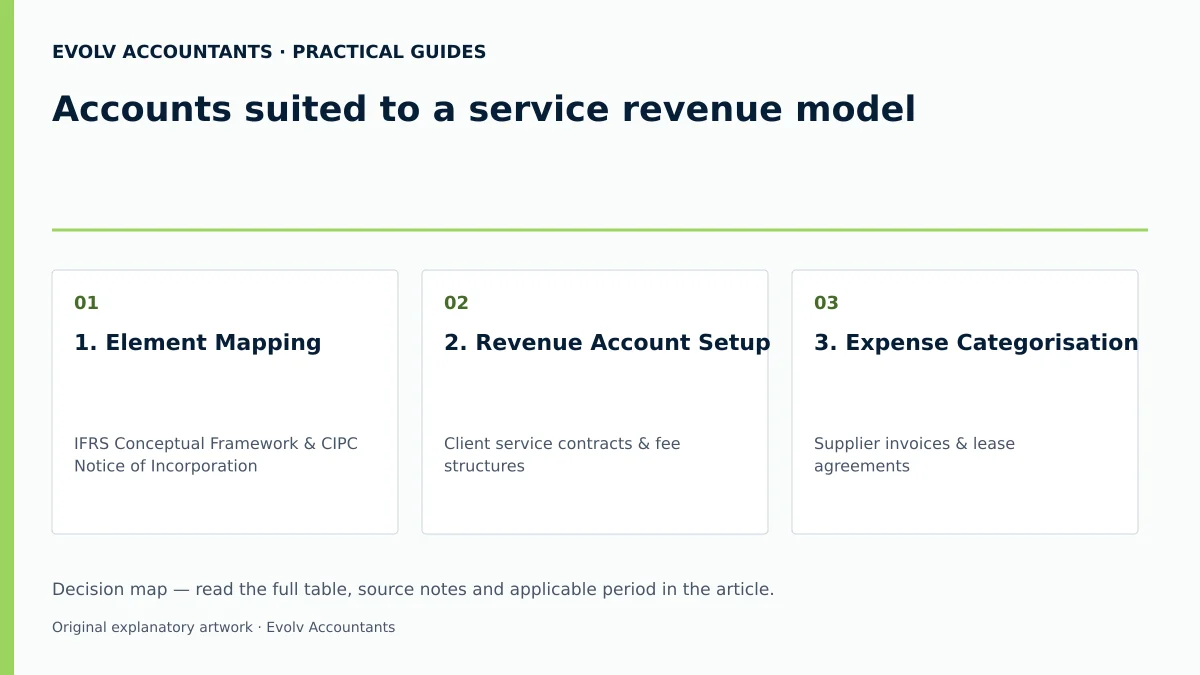
| 1. Element Mapping | IFRS Conceptual Framework & CIPC Notice of Incorporation | Financial Manager / Accountant | Five main element groups established (1000–6000) 1 11 | Adapt for hybrid sales if physical goods added 9. |
| 2. Revenue Account Setup | Client service contracts & fee structures | Bookkeeper | Dedicated service income accounts created 6 | Flag Personal Service Provider classification 36. |
| 3. Expense Categorisation | Supplier invoices & lease agreements | Bookkeeper | Direct costs separated from operating overheads 20 | Verify general deduction criteria under s11(a) 20. |
| 4. Tax Control Accounts | SARS VAT101 & PAYE registration records | Tax Administrator / Public Officer | VAT, PAYE, UIF, SDL, and tax accounts configured 15 16 17 | Confirm VAT threshold status (R2.3m / R120k) 33 34. |
| 5. Equity & Statutory Setup | Memorandum of Incorporation & Share Register | Public Officer / Company Secretary | Share capital & directors' accounts mapped 24 26 42 | Ensure annual return disclosures match CIPC 43. |
| 6. Audit Trail & Retention | Archiving schedule & electronic store | Compliance Officer | 5-year (TAA) and 7-year (Companies Act) archives active 3 27 | Extend retention indefinitely if return unfiled 27 38. |
Frequently Asked Questions
1. How long must a South African service SME retain its financial records and chart of accounts documentation?
Under section 29 of the Tax Administration Act, tax records and supporting documents must be retained for 5 years from the date of return submission 27 38. In addition, section 24 of the Companies Act requires companies to retain accounting records and annual financial statements for 7 years 3 44. If a return has not been submitted, retention is required indefinitely until filed, after which the 5-year period applies 27 38.
2. Does a service business require Cost of Sales accounts in its chart of accounts?
Service businesses do not maintain physical inventory or traditional Cost of Sales categories 6 9. However, direct service delivery costs—such as external subcontractor fees or project-specific software licenses—should be mapped to direct cost accounts (5000 series) to distinguish them from general administrative overheads 6 20.
3. What is the difference between accounting net profit and taxable income?
Accounting net profit represents total income less operating expenses as determined by accounting principles 6 21. Taxable income is calculated by taking net profit and applying statutory tax adjustments under the Income Tax Act, such as adding back non-deductible expenditure or subtracting statutory tax allowances 10 20.
4. What VAT control accounts are required when registering for value-added tax?
A registered VAT vendor accounting on the invoice basis must establish an Output VAT liability account (for tax collected on supplies made) and an Input VAT asset account (for tax paid on qualifying business purchases) 22 23 35. The net difference declared on the monthly or bi-monthly VAT201 return determines the amount payable to or refundable by SARS 23 28.
5. What happens if the preparer of financial statements provides false or misleading information?
Under section 28 of the Tax Administration Act, a taxpayer may be required to submit a certificate by the preparer recording the extent of examination of the books 45. Submitting a false or misleading preparer certificate constitutes a statutory criminal offence and may trigger administrative non-compliance penalties 45.
Related guides
- Setting up bookkeeping for a new small business
- Designing a chart of accounts for a trading business
- Reading the Financials: Cash Flow and the Balance Sheet for Directors
Sources
- IFRS - Conceptual Framework for Financial Reporting
- https://www.cipc.co.za//wp-content/uploads/Legal/Regulations/CompaniesAct71_2008.pdf
- https://www.sars.gov.za/wp-content/uploads/Ops/Guides/LAPD-TAdm-G01-Short-Guide-to-the-Tax-Administration-Act-2011.pdf
- https://www.sars.gov.za/wp-content/uploads/Ops/Guides/Legal-Pub-Guide-Gen09-Tax-Guide-for-Small-Businesses.pdf