
Setting up bookkeeping for a new small business
7 May 2025

Setting up bookkeeping for a new small business requires maintaining accurate accounting records and separating personal and commercial financial transactions.
Establishing an organised bookkeeping system for a South African small enterprise involves creating dedicated financial channels, capturing every transaction against verifiable primary documentation, and adhering to statutory accounting and tax frameworks 1 2 3.
Under South African legislation—including the Companies Act 71 of 2008 and the Tax Administration Act 28 of 2011—and regulatory guidelines from the South African Revenue Service (SARS) for the 2025/2026 tax year, businesses must maintain complete records in an orderly fashion and retain supporting evidence for prescribed statutory periods 1 4 5 6.
A simple books workflow and separate records
This practical guide is written for South African small and medium enterprise (SME) owners, close corporation members, and company directors operating within the Republic of South Africa 3 7 8. The applicable statutory period covers the 2025/2026 tax year of assessment—specifically covering 1 March 2025 to 28 February 2026 for natural persons and sole proprietors, and financial years ending during the 12-month period up to 31 March 2026 for corporate entities 6.
In this context, successful completion means establishing a fully reconciled bookkeeping workflow where business income and operational expenditure are completely isolated from personal finances, supported by an unbroken audit trail of primary documentation, and structured for financial statement preparation and tax compliance 1 2 9 10.
— Practical point from this guide
To ensure clarity, small business owners must distinguish between legislative mandates, regulator guidelines, and professional accounting practices:
- Statutory Law: Legislation such as Section 28 of the Companies Act 71 of 2008 obliges incorporated companies to maintain complete accounting records in an official language 11, while Section 29 of the Tax Administration Act 28 of 2011 imposes a legal duty on all trading entities to retain books of account and supporting documents 2.
- Regulator Guidance: Official publications from SARS, such as the Tax Guide for Small Businesses, outline the regulatory interpretation of gross sales, cost of sales calculations, and the general deduction formula 12 13 14.
- Evolv Recommendations: Specific operational workflows—such as weekly bank reconciliation schedules, digital document archiving conventions, and monthly cash flow forecasting models—represent Evolv's recommended professional practices rather than claimed statutory procedures or lender guarantees.
Prepare the information and authority: a simple books workflow
Before initiating a bookkeeping workflow, business owners must compile the required primary documentation, verify administrative authorities, and understand fundamental accounting classifications.
Required Source Documents and Inputs
A compliant bookkeeping system relies on objective primary evidence to substantiate every transaction entry 10 15:
- Sales Evidence: Issued tax invoices, cash register tapes, official receipts, and credit notes 10 16.
- Purchase and Expense Evidence: Supplier tax invoices, delivery notes, bills of entry for imported goods, and paid receipts 10 17.
- Banking Evidence: Monthly commercial bank statements, deposit slips, and electronic funds transfer (EFT) payment notifications 17 18.
- Statutory Registrations: The entity's Taxpayer Reference Number (TRN) allocated by SARS 19, CIPC registration certificates for companies or close corporations 7 8 20, and value-added tax (VAT) vendor details where applicable 21.
Administrative Authority and Appointments
Corporate entities must formally designate an individual residing in South Africa as the company's public officer under Section 246 of the Tax Administration Act 22 23. This representative holds legal authority for tax compliance and eFiling profile administration 18 22. Furthermore, any changes to registered particulars—including physical address, electronic contact details, representative taxpayer, or banking details—must be communicated to SARS within 21 business days 24 25.
Core Accounting Framework Definitions
Under the International Financial Reporting Standards (IFRS) Conceptual Framework and SARS regulatory guidance, bookkeeping entries are structured around core financial elements 12 26:
- Assets: Present economic resources controlled by the entity as a result of past events 26.
- Liabilities: Present obligations of the entity to transfer an economic resource as a result of past events 26.
- Equity: The residual interest in the assets of the entity after deducting all its liabilities 26.
- Income: Increases in assets or decreases in liabilities that result in increases in equity, other than those relating to equity participant contributions 26.
- Expenses: Decreases in assets or increases in liabilities that result in decreases in equity, other than distributions to equity participants 26.
- Gross Sales / Turnover: The total cash or credit considerations received by or accrued to the enterprise 12.
- Cost of Sales: The direct cost of goods acquired or produced, calculated as opening stock plus purchases less closing stock 12 13.
- Gross Profit: Gross sales less the cost of sales 13.
- Operating Expenses: Business expenditures incurred in the operation of trade 9.
Complete the task step by step: separate records
Executing a books workflow requires a systematic operational sequence grounded in primary record-keeping rules.
Step 1: Open a Dedicated Business Bank Account
A private company or close corporation is a distinct legal entity and must maintain its own dedicated bank account 7 8. While a sole proprietorship is owned by a natural person, establishing a separate commercial bank account is an essential operational step to prevent the commingling of personal and enterprise cash flows 27.
Step 2: Establish the Chart of Accounts Categories
Structure the general ledger accounts to align with IFRS Conceptual Framework categories (Assets, Liabilities, Equity, Income, Expenses) 26 and SARS income tax reporting categories 28.
Step 3: Capture Daily Source Documents
As SARS notes, accounting records must be kept in an "orderly fashion and in a safe place" 4. File every physical and electronic sales invoice, supplier bill, and payment receipt immediately upon issuance or receipt 10 17. Verify that corporate documents state the full registered company name and registration number as required by company law 29.
Step 4: Perform Routine Bank Reconciliations
Match every line item on the monthly commercial bank statement against captured general ledger income and expense entries 17 18. Identify unrecorded bank charges, interest, or direct deposits, and resolve unmatched items promptly.
Step 5: Compute Net Accounting Profit or Loss
At the close of each accounting period, calculate the enterprise net profit or loss using the standard formula 9 12:
- Calculate Cost of Sales: Opening Stock + Purchases - Closing Stock = Cost of Sales 12 13.
- Calculate Gross Profit: Gross Sales - Cost of Sales = Gross Profit 13.
- Calculate Net Profit: Gross Profit - Business Expenses = Net Profit (or Loss) 9.
For service businesses that do not hold trading stock, net profit is calculated directly by deducting operating business expenses from gross sales/turnover 30.
Step 6: Securely Archive Records for Prescribed Statutory Retention Periods
Store physical and electronic records in a secure location accessible from the registered office or notified South African location 4 31.
Check the result against the evidence: a simple books workflow
Verifying bookkeeping completion requires checking financial balances against independent external evidence rather than assuming that submitting returns equals official acceptance 32 33 34.
Independent Completion Evidence
- Reconciled Bank Statements: The general ledger bank balance exactly matches the closing balance on the official commercial bank statement 17.
- Complete Primary Audit Trail: Every recorded transaction entry is supported by a valid tax invoice, receipt, or bank record 10.
- Statutory Compliance Verification: CIPC annual returns are filed timeously 20 35, and SARS Tax Compliance Status (TCS) remains in good standing 36.
Submission versus Acceptance
Submitting an income tax return or filing documentation on eFiling does not signify final acceptance or audit discharge by SARS 32 34. Under Chapter 5 of the Tax Administration Act, SARS maintains broad information-gathering powers, including desk verifications, field audits, and unannounced business premises inspections to verify registration details and record formats 37 38 39.
Statutory Record Retention Rules
Taxpayers and corporate entities must adhere to statutory retention schedules: STATUTORY RECORD RETENTION PERIODS
| Statutory Framework | Prescribed Retention Period |
|---|---|
| Tax Administration Act 28 of 2011 (Section 29 & Table 3) | 5 years from date of return submission 5 17 40. |
| Unfiled Tax Returns (Tax Administration Act Table 3) | Indefinite retention until return is filed, then 5 years from submission date 5 40. |
| Ongoing Audit, Dispute or Appeal (Tax Administration Act Table 3) | Until audit or legal proceedings conclude or 5-year period ends, whichever is latest 40 41. |
| Companies Act 71 of 2008 (Section 24) | 7 years for company accounting records and annual financial statements 1 42. |
Handle exceptions and unresolved cases: separate records
Bookkeeping workflows frequently encounter operational edge cases that require specific corrective treatments.
Commingled Personal and Business Transactions
If an owner or director uses a business bank account for personal expenditure, the transaction must not be classified as a deductible business expense 14 27. In a company structure, record the payment as a director's loan account debit or owner drawing 27. Under Section 11(a) read with Section 23(g) of the Income Tax Act, business deductions are strictly limited to expenditure actually incurred in the production of income for the purposes of trade 14.
Missing Primary Invoices
When a supplier invoice is missing, the transaction cannot be treated as a verified tax deduction 10 14. Request a duplicate tax invoice from the vendor immediately to maintain audit trail integrity 10.
Accounting Net Profit versus Taxable Income
Accounting net profit is calculated under financial reporting frameworks to reflect commercial performance 28 43. Taxable income, defined in Section 1(1) of the Income Tax Act, is derived by making statutory tax adjustments (such as adding back non-deductible expenses or claiming specific capital allowances) to the accounting net profit 28 43.
Simplified Micro Business Option
Small enterprises with a qualifying annual turnover not exceeding R1,000,000 may elect to register for the simplified SARS turnover tax system in place of standard income tax, provisional tax, and capital gains tax 44.
Specialist Boundaries
If your records raise unresolved tax or accounting questions, ask Evolv to scope the professional support required.
Next steps for Bookkeeping foundations
To establish a verified bookkeeping setup, follow this structured checklist:
- Open a dedicated commercial bank account and update registered details with SARS within 21 business days of any change 24 25.
- Formally appoint a resident public officer for corporate compliance 22 23.
- Establish a standardized document capture workflow for all sales invoices, bills, and receipts 10.
- Perform monthly bank statement reconciliations against ledger records 17 18.
- Calculate monthly gross profit and net profit using standard accounting formulas 9 12.
- Archive all primary records securely for five years under the Tax Administration Act 5 17 and seven years under the Companies Act 1 42.
Task and Completion Checklist
| Step | Input or evidence | Responsible person | Completion check | Exception or next action |
|---|---|---|---|---|
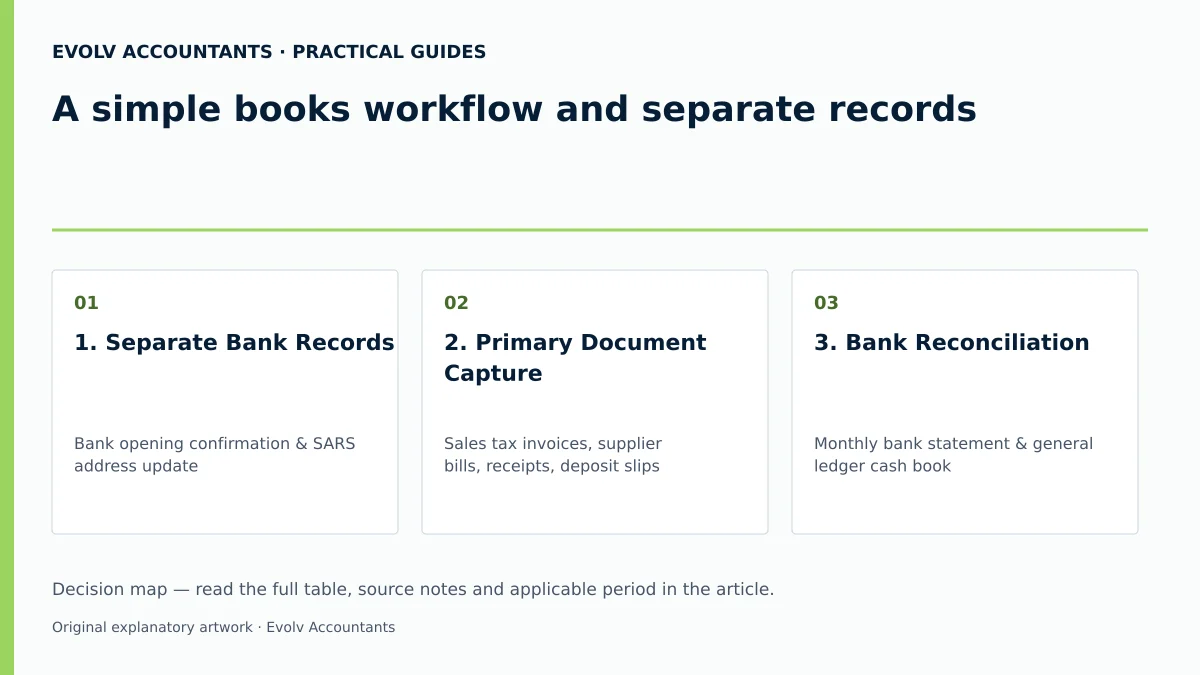
| 1. Separate Bank Records | Bank opening confirmation & SARS address update 24 25 | Public Officer / Owner | Commercial bank account operational; SARS details updated 24 | If personal funds commingle, record as owner drawings/loan account 27. |
| 2. Primary Document Capture | Sales tax invoices, supplier bills, receipts, deposit slips 10 | Bookkeeper / Administrator | Unbroken audit trail of physical and digital vouchers 10 | If invoice is missing, request duplicate from vendor immediately 10. |
| 3. Bank Reconciliation | Monthly bank statement & general ledger cash book 17 18 | Bookkeeper / Accountant | General ledger cash balance matches bank statement balance 17 | Investigate unmatched items or bank fees and adjust ledger. |
| 4. Profit & Loss Computation | Stock inventory sheets, sales records, expense vouchers 12 13 | Accountant | Net profit computed via Gross Sales - Cost of Sales - Expenses 9 12 | Flag timing differences between net profit and taxable income 43. |
| 5. Statutory Record Archiving | Physical/electronic archive at registered office 4 31 | Public Officer / Director | Records safely stored for 5 years (TAA) / 7 years (Companies Act) 1 5 | Retain records indefinitely if returns remain unfiled 5 40. |
Reproducible Hypothetical Example
The following hypothetical example illustrates the standard net profit calculation for a small South African retail enterprise (ABC Furniture Store) during the 2025/2026 tax year, based on SARS regulatory guidelines 9 12 13:
- Illustrative Input Values:
- Gross Sales Turnover (Cash sales R1,000,000 + Credit sales R5,000,000): R6,000,000 12
- Opening Stock at start of year: R800,000 13
- Stock Purchases during year: R3,000,000 13
- Closing Stock at end of year: R500,000 13
- Operating Expenses (rent, salaries, utilities, stationery): R1,300,000 9
- Step-by-Step Calculation:
- Cost of Sales Calculation:
Cost of Sales = (Opening Stock + Purchases) - Closing Stock Cost of Sales = (R800,000 + R3,000,000) - R500,000 = R3,300,000 13
- Gross Profit Calculation:
Gross Profit = Gross Sales - Cost of Sales Gross Profit = R6,000,000 - R3,300,000 = R2,700,000 9 13
- Net Accounting Profit Calculation:
Net Profit = Gross Profit - Operating Expenses Net Profit = R2,700,000 - R1,300,000 = R1,400,000 9
This net profit of R1,400,000 serves as the accounting building block for subsequent tax computation adjustments 28 43.
Frequently Asked Questions
Is a separate commercial bank account legally required for a small business in South Africa?
For incorporated entities such as private companies and close corporations, a separate bank account is mandatory because the entity possesses independent legal personality 7 8. Sole proprietorships operate under the owner's natural identity 27; however, establishing a separate account is strongly recommended to ensure clear audit trails 10.
How long must a South African SME retain its bookkeeping records?
Under Section 29 of the Tax Administration Act, tax-related records must be kept for five years from the date the return is submitted 5 17. Section 24 of the Companies Act requires companies to retain accounting records for seven years 1 42. If a return has not been submitted, records must be kept indefinitely until submitted, and then for five years thereafter 5 40.
What is the key difference between accounting net profit and taxable income?
Accounting net profit measures commercial performance under financial reporting standards 43. Taxable income is defined under Section 1(1) of the Income Tax Act and represents the figure on which normal tax is calculated, after applying statutory tax deductions and adjustments to accounting net profit 28 43.
How soon must a business notify SARS of changes to its banking or address details?
Under Section 23 of the Tax Administration Act, a taxpayer must notify SARS of any changes to physical, postal, or electronic addresses, representative taxpayers, or banking details within 21 business days 24 25.
What primary documents are required to support business expense deductions?
To satisfy the general deduction formula under Section 11(a) read with Section 23(g) of the Income Tax Act, expenses must be supported by valid supplier tax invoices, payment receipts, till slips, or bank transfer records establishing that the expenditure was actually incurred in the production of income for trade 10 14. Ask Evolv about a simple books workflow and separate records. Share the relevant records so the support required can be scoped.
Related guides
- Choosing cash basis versus accrual bookkeeping
- Designing a chart of accounts for a service business
- Reading the Financials: Cash Flow and the Balance Sheet for Directors
Sources
- https://www.cipc.co.za//wp-content/uploads/Legal/Regulations/CompaniesAct71_2008.pdf
- https://www.sars.gov.za/wp-content/uploads/Ops/Guides/LAPD-TAdm-G01-Short-Guide-to-the-Tax-Administration-Act-2011.pdf
- https://www.sars.gov.za/wp-content/uploads/Ops/Guides/Legal-Pub-Guide-Gen09-Tax-Guide-for-Small-Businesses.pdf
- IFRS - Conceptual Framework for Financial Reporting