
Designing a chart of accounts for a trading business
4 July 2025
Designing a chart of accounts for a trading business requires structuring specific ledger accounts for stock sales cost and trade creditors.
This practical guide assists South African small and medium enterprises (SME profit companies) in structuring their general ledger to account for inventory purchases, stock sales cost, and supplier liabilities. Establishing a compliant general ledger ensures that financial transactions conform to statutory record-keeping periods under South African legislation 1 2, align with regulatory tax guidelines issued by the South African Revenue Service (SARS) 3 4, and adhere to international financial reporting concepts 5 6.
Grounding bookkeeping structures in recognised legal and regulatory standards allows trading businesses to generate reliable financial statements and fulfill corporate accountability obligations 7 8.
Accounts for stock sales cost and creditors
This guidance is written for South African trading SME owners, internal bookkeepers, and financial managers operating during the current annual accounting period and year of assessment 9 10. In a trading business, completing the design of the chart of accounts means establishing an integrated double-entry ledger framework where inventory movements, cost of sales calculations, and credit purchases from trade creditors reconcile without variance at period close 3 4.
— Practical point from this guide
Statutory legislation sets mandatory accounting and record-retention requirements 1 11. As specified in Section 28(1) of the Companies Act 71 of 2008, a company must "keep accurate and complete accounting records in one of the official languages of the Republic" 9. Regulator guidance provided by SARS defines the specific mathematical structure for determining net business profit and cost of sales 3 12.
System implementation workflows, reconciliation frequencies, and sub-ledger control routines represent Evolv professional recommendations designed to maintain audit readiness.
Reproducible hypothetical example: Cost of sales and creditor posting
Consider a hypothetical South African trading business, Karoo Trading (Pty) Ltd, operating during a 12-month year of assessment 10. The company records the following illustrative transactions:
- Opening Stock (Beginning Inventory): R800,000 [Illustrative value] 3.
- Credit Purchases of Stock: R3,000,000 [Illustrative value] 3.
- Closing Stock (End-of-Period Physical Count): R500,000 [Illustrative value] 3.
- Gross Sales (Turnover): R6,000,000 [Illustrative value] 12.
- Supplier Payments Made: R2,400,000 [Illustrative value] 10.
To calculate the cost of sales for the period, the business applies the standard regulatory formula 3: Cost of Sales = (Opening Stock + Purchases) - Closing Stock 3 Cost of Sales = (R800,000 + R3,000,000) - R500,000 = R3,300,000 3
Gross profit is calculated as Gross Sales less Cost of Sales 13: Gross Profit = R6,000,000 - R3,300,000 = R2,700,000 13
The Trade Creditors Control Account records total credit purchases of R3,000,000 less supplier payments of R2,400,000, leaving an ending balance of R600,000 in current trade liabilities 3 4.
Prepare the information and authority: accounts for stock sales cost
Setting up accounts for stock sales cost requires compiling primary source documents, verifying statutory authorizations, and understanding official definitions 12 14.
Primary documentation inputs
To support ledger entries for stock purchases and cost of sales, the business must gather and retain the following supporting records 14 15:
- Supplier Tax Invoices: For supplies exceeding R5,000 [Illustrative statutory threshold], invoices must reflect the words "Tax Invoice", the supplier's name, address, and VAT registration number, the recipient's name, address, and VAT registration number, an individual serialised number, the date, and a full description of the goods 14.
- Goods Received Notes (GRNs) and Delivery Notes: Physical verification evidence confirming receipt of stock prior to invoice processing (Evolv recommendation).
- Stock Count Valuation Schedules: Itemised physical stock lists compiled at the end of the financial year reflecting lower of cost or arm's length price 3 15.
- Credit Notes and Debit Notes: Adjustment documentation issued by suppliers for returned or damaged inventory 16.
Statutory authority and retention periods
Under the IFRS Conceptual Framework, an asset is a present economic resource controlled by the entity, while a liability is a present obligation to transfer an economic resource 6. Inventory represents an asset held for sale, and cost of sales represents the expense recognised when that inventory is sold 3 6.
Record retention periods differ between statutory bodies:
- Companies Act 71 of 2008 (Section 24): Mandatory retention of accounting records and annual financial statements for 7 years 1 7.
- Tax Administration Act 28 of 2011 (Section 29): Mandatory retention of records, books of account, and supporting documents for 5 years from the date of tax return submission 2 15. If no return is submitted, retention is indefinite until compliance is restored 2 17.
Complete the task step by step: creditors
Recording trade creditors and managing supplier obligations requires a systematic, sequential workflow grounded in double-entry bookkeeping rules and tax requirements 4 14.
Sequenced implementation process
- Receive and Validate Supplier Invoices: Inspect incoming supplier invoices to verify statutory compliance, ensuring valid serial numbers, matching tax amounts, and correct recipient details 14.
- Match Order and Delivery Records: Cross-check supplier invoices against internal purchase orders and signed GRNs to confirm goods received (Evolv recommendation).
- Post Purchase Journal Entries: Record credit inventory purchases in the general ledger 4:
- Debit: Inventory Asset Account (Cost of trading stock) 3.
- Debit: Value-Added Tax (VAT) Input Account (15% standard rate [Illustrative statutory rate], applicable for vendors on the invoice basis holding valid tax invoices) 4 14.
- Credit: Trade Creditors Control Account (Total invoice consideration) 4.
- Update Accounts Payable Sub-Ledger: Post individual transaction details to specific supplier sub-ledgers to maintain accurate individual accounts payable balances (Evolv recommendation).
- Execute Supplier Disbursements: Process payments via electronic funds transfer (EFT) or bank instruction, recording a debit to the Trade Creditors Control Account and a credit to the Bank Account 10.
- Perform Monthly Creditor Reconciliations: Reconcile monthly supplier statements against internal sub-ledger balances, identifying and resolving timing differences or missing invoices prior to month-end close (Evolv recommendation).
Check the result against the evidence: accounts for stock sales cost
Establishing accounts for stock sales cost requires independent verification evidence rather than assuming that recording transactions or submitting tax returns implies official regulator acceptance 3 18.
Independent completion checks
- Physical Stock Verification: Perform a physical count at year-end and obtain signed stock count sheets to verify closing inventory figures 3 15.
- General Ledger Trial Balance Matching: Ensure the physical stock valuation matches the closing inventory account balance on the general ledger trial balance 3 19.
- VAT Input Audit Trail: Verify that every input tax claim made on credit stock purchases is supported by a valid, original tax invoice held in business records 14 20.
- Creditor Statement Reconciliation: Confirm that supplier statement balances reconcile to individual accounts payable sub-ledgers and the central Trade Creditors Control Account (Evolv recommendation).
- SARS Inspection Readiness: Ensure all books of account, ledgers, journals, and invoices are kept accessible at the registered South African office for potential unannounced SARS inspections 21 22 23.
Handle exceptions and unresolved cases: creditors
Handling edge cases in trade creditors and stock accounting requires identifying statutory triggers and establishing boundaries for professional escalation 20 24.
Unpaid creditors exceeding 12 months (VAT Output adjustment)
Under Section 27 of the VAT Act (as outlined in regulator guidance), where a vendor accounting on the invoice basis claims an input tax deduction on a credit purchase but fails to pay the supplier within 12 months after the end of the tax period, the vendor must make an output tax adjustment to SARS equal to the unpaid input tax portion 20.
Disputed supplier invoices and missing documentation
If a supplier invoice contains errors, missing VAT numbers, or disputed charges:
- Do not claim input tax on invalid or missing invoices; hold the input tax deduction until a correct debit/credit note or revised tax invoice is issued 14 16.
- Isolate disputed amounts in a temporary liability suspense account pending resolution (Evolv recommendation).
Unresolved stock discrepancies and shrinkage
Variances between perpetual inventory records and physical stock counts must be adjusted against the closing stock figure, directly impacting the cost of sales calculation 3.
Specialist boundaries
Where trade liabilities involve formal debt compromises, restructuring under Chapter 14 of the Tax Administration Act 24, or corporate business rescue under Chapter 3 of the Companies Act 25, internal bookkeepers must escalate the matter to qualified professionals for specialized legal and tax advisory services.
Next steps for Bookkeeping foundations
To establish a fully compliant chart of accounts for stock sales cost and trade creditors, implement the structured task list and checklist below.
Implementation steps
- Review existing chart of accounts codes for inventory, cost of sales, and trade creditors (Evolv recommendation).
- Configure double-entry posting rules for stock purchases, VAT input, and trade creditors control 4.
- Establish mandatory tax invoice validation protocols for all incoming supplier bills exceeding R5,000 [Illustrative statutory threshold] 14.
- Implement monthly supplier statement reconciliations and year-end physical stock count procedures 3 (Evolv recommendation).
- Archive all supporting source documents to satisfy the 7-year Companies Act 1 and 5-year TAA 2 retention rules.
Task and completion checklist
| Step | Input or evidence | Responsible person | Completion check | Exception or next action |
|---|---|---|---|---|
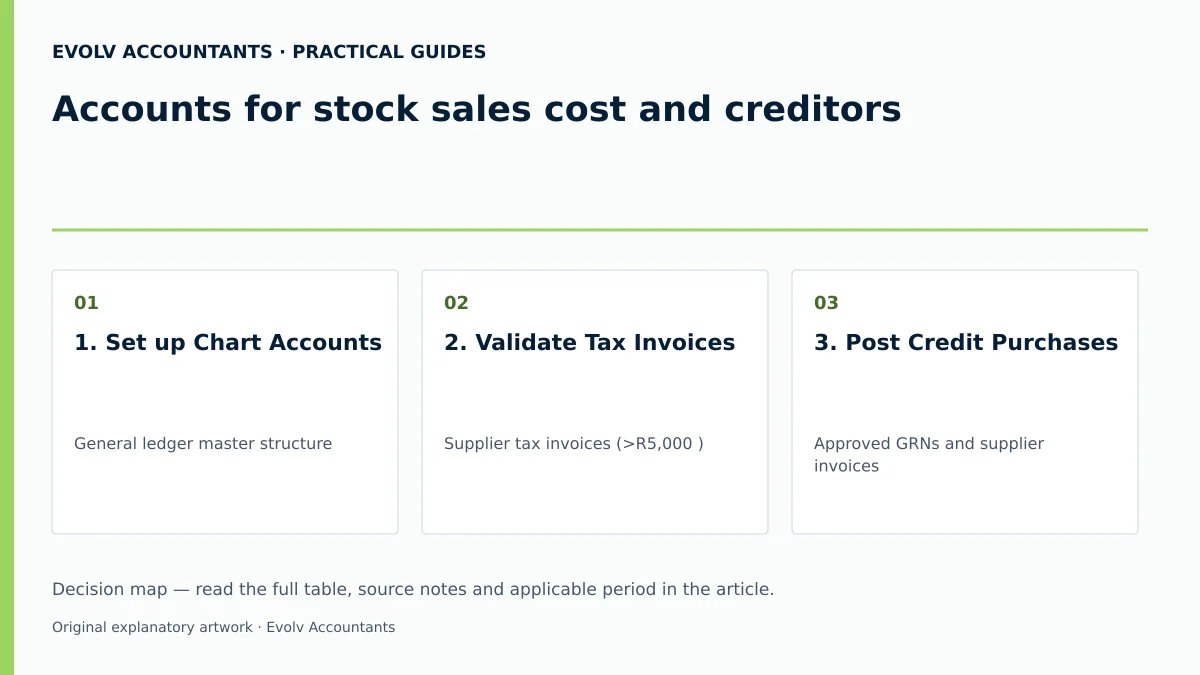
| 1. Set up Chart Accounts | General ledger master structure | Senior Bookkeeper | Ledger accounts created for Stock, Cost of Sales, and Creditors | Re-code misclassified expense accounts (Evolv recommendation) |
| 2. Validate Tax Invoices | Supplier tax invoices (>R5,000 14) | Accounts Payable Clerk | Valid VAT number, serial number, and line items verified 14 | Request corrected tax invoice from supplier before claiming input VAT 14 |
| 3. Post Credit Purchases | Approved GRNs and supplier invoices | Accounts Payable Clerk | Debit Stock, Debit Input VAT, Credit Trade Creditors 4 | Hold un-matched invoices in suspense pending GRN verification |
| 4. Reconcile Creditors | Supplier monthly statements | Bookkeeper / Accountant | Sub-ledgers reconciled to statement balances | Investigate variances; request missing debit/credit notes 16 |
| 5. Value Closing Stock | Physical stock count sheets 3 | Financial Manager | Closing inventory cost calculated; Cost of Sales journal posted 3 | Adjust for stock shrinkage; review slow-moving stock write-offs 3 |
| 6. Statutory Archiving | Physical and electronic document archives | Compliance Officer | Records safely stored for 5 years (TAA 2) / 7 years (Companies Act 1) | Flag open SARS audits or disputes for extended retention 26 |
Frequently Asked Questions
How long must a South African trading business retain creditor and inventory records?
Under Section 24 of the Companies Act 71 of 2008, profit companies must retain accounting records, ledgers, and annual financial statements for 7 years 1 7. Under Section 29 of the Tax Administration Act 28 of 2011, taxpayers must retain records, books of account, and supporting documents for 5 years from the tax return submission date 2 15. If an audit or dispute is ongoing, records must be kept until the matter is finalised 17 26.
What is the official formula for calculating cost of sales in a trading business?
According to SARS tax guidance, cost of sales is calculated as opening stock plus inventory purchases made during the year of assessment, minus closing stock on hand at the end of the year 3 12: Cost of Sales = (Opening Stock + Purchases) - Closing Stock 3.
What happens if a trade creditor remains unpaid for longer than 12 months?
Under VAT Act rules administered by SARS, if a vendor accounting on the invoice basis claims input VAT on a supplier invoice but fails to pay the creditor within 12 months following the tax period of the deduction, the vendor must account for an output tax adjustment equal to the unpaid VAT portion 20.
What information is required on a supplier invoice to support input VAT deductions on stock?
For supplies exceeding R5,000 [Illustrative statutory threshold], a valid tax invoice must display the words "Tax Invoice", the name, address, and VAT registration number of both supplier and recipient, an individual serialised number, invoice date, full description of goods, quantity supplied, and total consideration including VAT charged 14.
Is accounting net profit identical to taxable income when calculating stock sales tax?
No. Accounting net profit is determined under financial reporting standards 5 27. Taxable income is calculated by taking accounting net profit from the income statement as a building block and applying statutory adjustments for tax timing differences, non-deductible expenses, and specialized tax allowances 19 27.
Related guides
- Setting up bookkeeping for a new small business
- Understanding debits and credits with business examples
- Reading the Financials: Cash Flow and the Balance Sheet for Directors
Sources
- https://www.cipc.co.za//wp-content/uploads/Legal/Regulations/CompaniesAct71_2008.pdf
- https://www.sars.gov.za/wp-content/uploads/Ops/Guides/LAPD-TAdm-G01-Short-Guide-to-the-Tax-Administration-Act-2011.pdf
- https://www.sars.gov.za/wp-content/uploads/Ops/Guides/Legal-Pub-Guide-Gen09-Tax-Guide-for-Small-Businesses.pdf
- IFRS - Conceptual Framework for Financial Reporting