
Understanding debits and credits with business examples
29 March 2026

Accurate double-entry bookkeeping requires recording every financial transaction with equal balancing debit and credit entries to reflect changes in assets, liabilities, income, or expenses.
For South African small and medium-sized enterprises (SMEs), implementing two-sided bookkeeping entries ensures that company accounting records satisfy the financial presentation standards set out under section 29 of the Companies Act 71 of 2008 1 2 and the record-keeping mandates enforced by the South African Revenue Service (SARS) under section 29 of the Tax Administration Act 28 of 2011 3 4.
By capturing both where money originates and where it is allocated, business owners maintain audit-ready ledgers that prevent material misstatements, support accurate Value-Added Tax (VAT) and corporate income tax returns, and provide transparent financial insights across each reporting cycle 5 6.
Two sided entries that balance without jargon
Double-entry bookkeeping is the universal framework for recording financial activity. Every transaction represents an exchange of economic value that impacts at least two separate accounts in opposite and equal measures. In plain language, every debit entry on the left-hand side of a ledger must be matched by a corresponding credit entry on the right-hand side. This structural duality ensures that the fundamental accounting equation—where assets equal liabilities plus equity—remains in perfect balance across all reporting periods 2 7.
To maintain clarity, SME owners must distinguish between statutory law, regulator guidance, and professional implementation practices:
- Statutory Law: Primary legislation enacted by Parliament establishes binding compliance duties. As enacted under section 28(1) of the Companies Act 71 of 2008, "a company must keep accurate and complete accounting records in one of the official languages of the Republic" 8. Furthermore, section 29 of the Tax Administration Act 28 of 2011 mandates that taxpayers retain original, orderly, and safe records that enable SARS to verify tax compliance 4 5.
- Regulator Guidance: Official publications and standard frameworks guide implementation. The IFRS Conceptual Framework for Financial Reporting defines reporting objectives and core financial elements 7 9, while the SARS Tax Guide for Small Businesses outlines practical methods for calculating net profit, gross profit, and tax adjustments 10 11 12.
- Evolv Recommendations: Professional bookkeeping workflows, chart of accounts design, monthly ledger reconciliations, and cash flow forecast modeling represent Evolv Accountants' expert operational recommendations rather than claimed statutory procedures or lender guarantees.
By eliminating accounting jargon, debits and credits are simply directional tools. A debit entry records an application or increase of economic resources (such as purchasing equipment or incurring an operating expense), or a decrease in obligations. Conversely, a credit entry records a source of funds (such as generating sales revenue or incurring a trade liability), or a decrease in asset value.
— Practical point from this guide
Read the fields and definitions correctly: two sided entries that balance without jargon
Proper double-entry bookkeeping requires a precise understanding of key accounting elements, applicable reporting periods, measurement units, and underlying financial assumptions 7 13.
Core Definitions
- Assets: Present economic resources controlled by the entity as a result of past events, expected to produce future economic benefits, such as cash at bank, accounts receivable, and equipment 2 7. Debits increase asset accounts, whereas credits decrease them.
- Liabilities: Present obligations of the entity to transfer economic resources as a result of past events, such as trade payables, SARS tax liabilities, or bank loans 2 7. Credits increase liability accounts, whereas debits decrease them.
- Equity: The residual interest in the assets of the entity after deducting all its liabilities 2 7. Credits increase equity (including retained profits), whereas debits decrease equity (such as owner drawings or dividend distributions).
- Income: Increases in economic benefits during an accounting period in the form of inflows or enhancements of assets or decreases of liabilities, resulting in increases in equity 7 11. Income accounts are increased by credits.
- Expenses: Decreases in economic benefits during an accounting period in the form of outflows, depletions of assets, or incurrences of liabilities, resulting in decreases in equity 7 11. Expense accounts are increased by debits.
Reporting Periods and Units
All financial figures are measured and reported in South African Rand (ZAR). Statutory compliance operates across defined timeframes:
- Income Tax Year of Assessment: For natural persons (sole proprietors), the 2026 year of assessment runs from 1 March 2025 to 28 February 2026 13. For private companies, the year of assessment aligns with its financial year ending during the 12-month period up to 31 March 2026 13 14.
- Company Records Retention: Section 24(1) of the Companies Act requires companies to retain accounting records and annual financial statements for 7 years 15 16.
- Tax Records Retention: Section 29 of the Tax Administration Act requires taxpayers who have submitted returns to retain supporting records for 5 years from the date of submission 17 18. If a return has not been submitted, records must be retained indefinitely until submitted, and for 5 years thereafter 17 18.
SME owners should avoid assuming that specific financial ratios or profit margins have a single universal ideal value. Optimal liquidity and solvency ratios vary significantly depending on the company's operating sector, capital structure, and business cycle.
Work through an example: documented completion and exceptions
To illustrate double-entry accounting in practice, consider a hypothetical South African trading SME, Evolv Retailers (Pty) Ltd, carrying out a commercial transaction during the 2025/2026 reporting period.
Hypothetical Transaction Scenario
Evolv Retailers (Pty) Ltd purchases new trading inventory valued at an illustrative amount of R50,000 from a supplier. The business pays R20,000 immediately via electronic funds transfer from its bank account and arranges to pay the remaining R30,000 on 30-day credit terms.
Double-Entry Accounting Allocation
To record this transaction accurately, the two-sided journal entry is structured as follows:
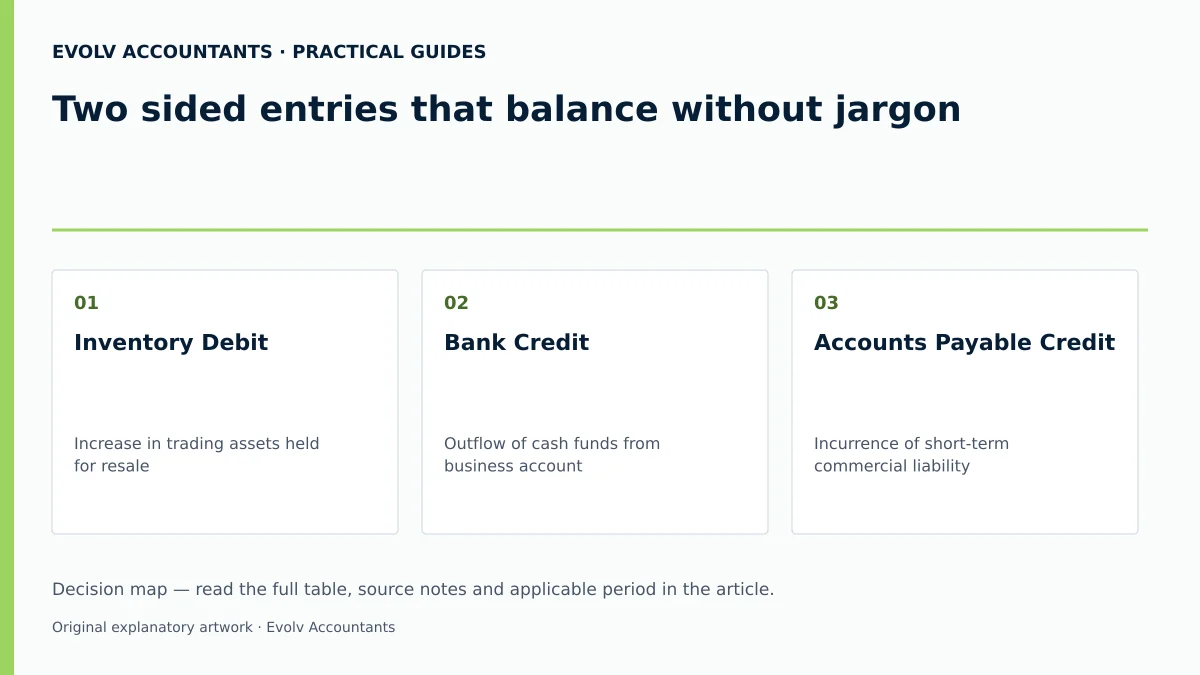
- Debit Entry: Inventory Account (Asset) is debited with R50,000 to reflect the increase in trading stock owned by the business.
- Credit Entry 1: Bank Account (Asset) is credited with R20,000 to reflect the cash outflow leaving the enterprise.
- Credit Entry 2: Accounts Payable (Liability) is credited with R30,000 to record the outstanding debt owed to the supplier.
Arithmetic Check: Total Debits = R50,000 Total Credits = R20,000 + R30,000 = R50,000 Net Balance = Total Debits - Total Credits = R0
The entry balances perfectly. The total assets of the firm increase by a net R30,000 (R50,000 inventory added minus R20,000 bank reduced), which is exactly matched by the R30,000 increase in liabilities.
Documented Example Matrix
| Field or Measure | Meaning | Underlying Record | Illustrative Result | Limit or Question |
|---|---|---|---|---|
| Inventory Debit | Increase in trading assets held for resale 7 19 | Supplier tax invoice & goods received note | +R50,000 asset addition | Does not confirm market unsaleability or obsolescence risk. |
| Bank Credit | Outflow of cash funds from business account 7 | Bank statement & electronic payment confirmation | -R20,000 asset reduction | Requires formal bank reconciliation against cleared ledger items. |
| Accounts Payable Credit | Incurrence of short-term commercial liability 7 | Credit agreement & statement of account | +R30,000 liability addition | Subject to supplier settlement terms and potential early payment discounts. |
| Gross Profit Margin | Sales revenue less cost of goods sold 19 | Comparative profit or loss statement 20 21 | Calculated upon inventory sale | Cannot be determined until inventory is actually sold to customers. |
| VAT Input Claim | Tax paid on commercial purchases 22 23 | Valid tax invoice showing vendor registration | Dependent on VAT status | Requires supplier to be a registered vendor with a compliant tax invoice. |
Reconcile it with related records: two sided entries that balance without jargon
Double-entry ledger records do not exist in isolation. Every double-entry journal flows sequentially into the trial balance, the general ledger, annual financial statements, and statutory tax returns 1 24 25.
- [Primary Source Document] → [Double-Entry Journal] → [General Ledger]
- [Bank & VAT Reconciliation] → [Trial Balance] → [Annual Financial Statements]
- [SARS Tax Computation]
Connection to Financial Statements and Tax Computations
- Trial Balance Verification: At the close of an accounting period, all ledger debit and credit balances are extracted onto a trial balance. If double-entry principles have been rigorously followed, the sum of all debit balances will equal the sum of all credit balances.
- Statement of Comprehensive Income: Revenue and expense accounts are closed off to derive the net accounting profit or loss using the basic formula: Income - Expenses = Net Profit (Loss) 11.
- Taxable Income Adjustment: As highlighted in the SARS Tax Guide for Small Businesses, accounting net profit differs from SARS taxable income defined under section 1(1) of the Income Tax Act 12 25. Accounting profit reflects standard reporting rules, whereas taxable income incorporates statutory adjustments, non-deductible items, capital allowance write-offs (such as section 12C manufacturing allowances 26 or section 11(a) general deductions 27), and exempt income 25 28.
- VAT and Audit Trail: For vendors exceeding the compulsory VAT registration threshold of R2.3 million in any consecutive 12-month period 29, double-entry records provide the audit trail necessary to substantiate input tax claims and output tax obligations against tax invoices and bank records 22 23.
Common misinterpretations and limits: documented completion and exceptions
SME directors and managers frequently encounter misunderstandings regarding double-entry bookkeeping and statutory compliance limits:
- Misconception 1: "Debits mean increase and credits mean decrease."
Reality: A debit entry increases asset and expense accounts but decreases liability, equity, and income accounts. A credit entry increases liability, equity, and income accounts but decreases asset and expense accounts 7.
- Misconception 2: "A balanced trial balance guarantees error-free bookkeeping."
Reality: A trial balance only proves mathematical equality between total debits and total credits. It cannot detect omitted transactions, duplicated entries, or compensating errors where incorrect accounts were debited and credited by identical amounts.
- Misconception 3: "Tax retention periods match company law periods."
Reality: Section 24 of the Companies Act requires company accounting records and annual financial statements to be retained for 7 years 15 16. In contrast, section 29 of the Tax Administration Act requires tax records to be kept for 5 years from the date of return submission 17 18. Evolv recommends maintaining records for the full 7-year period to ensure complete compliance across both legislative regimes.
- Misconception 4: "Historical ledger entries predict future business growth."
Reality: Bookkeeping captures past historical transactions. Cash flow forecasts and financial projections are hypothetical forward-looking planning tools based on management assumptions; they do not constitute predictions, guarantees, or lender funding assurances.
Next steps for Bookkeeping foundations
To establish robust, compliant double-entry bookkeeping, SME owners should execute the following structured checklist:
- Set Up a Compliant Chart of Accounts: Structure general ledger accounts into five core categories (Assets, Liabilities, Equity, Income, Expenses) tailored to your business model 2 7.
- Enforce Source Document Discipline: Ensure every transaction is supported by a valid tax invoice, receipt, or bank payment voucher displaying the company's full registered name and registration number as required by section 32(4) of the Companies Act 22 30.
- Perform Monthly Bank Reconciliations: Reconcile double-entry bank account records against official monthly bank statements to detect uncleared deposits, bank charges, and timing differences 3 31.
- Review Statutory Retention Rules: Establish secure digital or physical archives that store complete accounting records for at least 7 years to comply with Companies Act section 24 and TAA section 29 5 15 18.
- Conduct Quarterly Tax Alignment Checks: Compare bookkeeping profit against provisional tax estimates and VAT return summaries to ensure ongoing tax compliance before filing annual returns 25 32 33.
Frequently Asked Questions
How do debits and credits affect different accounting accounts?
Debits increase asset and expense accounts while decreasing liability, equity, and income accounts 7. Credits increase liability, equity, and income accounts while decreasing asset and expense accounts 7. Every balancing entry requires total debits to equal total credits across the transaction 2 7.
How long must South African SMEs retain bookkeeping records for statutory compliance?
Under section 24(1) of the Companies Act 71 of 2008, companies must retain accounting records and annual financial statements for 7 years 15 16. Section 29 of the Tax Administration Act 28 of 2011 requires tax records to be retained for 5 years from the date a return is submitted, or indefinitely if a return remains unsubmitted 17 18.
What is the difference between accounting net profit and SARS taxable income?
Accounting net profit is calculated as total revenue less operating expenses under financial reporting frameworks 11 12. Taxable income is determined under the Income Tax Act by adjusting accounting profit for statutory tax allowances, non-deductible expenses, capital gains, and exempt income 12 25 28.
Why is double-entry bookkeeping essential for VAT registration and compliance?
Double-entry bookkeeping creates the required audit trail connecting bank statements, sales ledgers, and supplier tax invoices 22 23. This documentation allows SARS to verify output tax collected and input tax claimed, ensuring compliance for businesses meeting or exceeding the R2.3 million compulsory VAT registration threshold 23 29.
How does double-entry bookkeeping assist in preparing CIPC annual returns?
Section 33 of the Companies Act requires companies to file annual returns with the CIPC 32. Maintaining balanced, accurate double-entry ledgers ensures that annual financial statements prepared within six months of financial year-end accurately present the company's financial position for CIPC compliance 1 32 34. Ask Evolv about two sided entries that balance without jargon. Share the relevant records so the support required can be scoped.
Related guides
- Setting up bookkeeping for a new small business
- Choosing cash basis versus accrual bookkeeping
- Reading the Financials: Cash Flow and the Balance Sheet for Directors
Sources
- https://www.cipc.co.za//wp-content/uploads/Legal/Regulations/CompaniesAct71_2008.pdf
- https://www.sars.gov.za/wp-content/uploads/Ops/Guides/LAPD-TAdm-G01-Short-Guide-to-the-Tax-Administration-Act-2011.pdf
- https://www.sars.gov.za/wp-content/uploads/Ops/Guides/Legal-Pub-Guide-Gen09-Tax-Guide-for-Small-Businesses.pdf
- IFRS - Conceptual Framework for Financial Reporting