
Choosing the correct VAT registration effective date
17 May 2025

Determining the correct VAT registration effective date is vital because it fixes when an enterprise must charge output tax and may claim input tax.
Selecting an effective date requires matching commercial sales history against statutory registration triggers or voluntary entry conditions, submitting accurate details via South African Revenue Service (SARS) eFiling or virtual branch appointments, and retaining verifiable records 1 2.
While compulsory registration applies when taxable turnover exceeds the regulatory threshold, establishing the precise liability date dictates whether historical transactions must be adjusted, how past sales invoices are treated, and whether input tax on setup expenditure remains deductible 1 3 4. Enterprise leadership must navigate strict backdating boundaries—such as the six-month limit on eFiling RAV01 submissions—while maintaining audit trail integrity to prevent understatement penalties and interest charges 1 5 6.
Effective date evidence and backdating limits
Under South African tax legislation, a business becomes a value-added tax (VAT) vendor from the date it first becomes liable to register, subject to final determination by the SARS Commissioner 7 8. Compulsory VAT registration is triggered when the value of taxable supplies made or expected to be made in any consecutive 12-month period exceeds the regulatory threshold 9 10.
Current SARS web guidance administers this compulsory threshold at R2.3 million 9 10, whereas older published operational guides (such as the VAT 404 Guide for Vendors) retain reference to a R1 million threshold 11. Once the threshold is exceeded, the enterprise is legally required to submit a registration application within 21 business days 10 12.
The effective date selected on the registration form dictates the precise start of an enterprise's VAT obligations 1 13. For compulsory registrations, SARS permits backdating of the VAT liability date on the eFiling RAV01 system up to six months from the date the compulsory threshold was exceeded 1.
If compulsory backdating required exceeds six months, the electronic system blocks automated processing, requiring the enterprise to schedule a virtual or branch appointment with SARS and present supporting documentation—such as financial statements, signed commercial contracts, and issued invoices 1 2 14.
Conversely, for voluntary VAT registrations (available where taxable supplies exceeded R120 000 in the preceding 12 months under current web guidance 15 or R50 000 under older guide text 16), the effective date is set according to the application date; backdating is prohibited unless the applicant provides specific supporting proof justifying retroactive entry 1.
Capturing an erroneous effective date on the RAV01 form or miscalculating monthly turnover running totals introduces significant material consequences 13 17. Selecting a delayed effective date after exceeding the liability threshold leaves historical turnover exposed to retrospective output tax assessments at the standard 15% rate 8 18.
Conversely, selecting an over-backdated effective date without underlying transaction records creates unfiled historical tax periods, triggering mandatory 10% late payment penalties, administrative non-compliance penalties, and accrued statutory interest 5 6.
— Practical point from this guide
Preserve the original records: effective date evidence
Section 55 of the Value-Added Tax Act 89 of 1991 (VAT Act) and Chapter 4 of the Tax Administration Act 28 of 2011 (TA Act) place a strict legal duty on vendors to retain all original books of account, tax invoices, credit notes, bank statements, and contractual records for at least five years 3 19 20. When establishing or modifying a VAT effective date, SARS requires verifiable primary evidence to corroborate the exact point at which liability arose 1 14.
To substantiate an effective date during a SARS verification or audit, an SME must assemble a complete documentation pack 1 14 21:
- Monthly Sales Ledgers: Detailed general ledger revenue accounts demonstrating consecutive 12-month rolling turnover totals 14 17.
- Commercial Contracts: Signed written agreements establishing contractual commitments that push taxable turnover above the compulsory threshold 10 14.
- Issued Tax Invoices: Sequential sales documentation verifying the historical timing and value of supplies made 3 14 22.
- Bank Statements: Corresponding financial records showing actual receipt of customer payments 1 14.
- eFiling System Audit Logs: Saved electronic submission receipts, RAV01 application forms, and SARS eBooking confirmation slips 1 2 23.
Enterprises must never erase history, alter original accounting entries, or re-issue backdated invoices prior to formal SARS approval 20 24. Retaining unaltered original source documents alongside timestamped eFiling submission logs proves full disclosure and protects the business against civil understatement penalties 20 24 25.
Choose the correct amendment route: backdating limits
When an effective date error is identified or a backdated registration is required, the enterprise must distinguish between distinct administrative channels to ensure statutory alignment 1 26 27:
eFiling RAV01 Automated Amendment
Used exclusively for compulsory VAT registration backdating where the requested effective date falls within six months of the threshold trigger date 1 28. The amendment is processed electronically via the "SARS Registered Details" menu on eFiling 28.
Branch or Virtual Appointment Submission
Mandatory for compulsory registration backdating that extends beyond six months, as well as any voluntary registration backdating request 1 2. The applicant must submit a full evidence dossier—including financial statements, lease agreements, and sales contracts—to a SARS official 1 14.
Request for Correction (RFC) on VAT201 Declarations
Governed by Section 25(5) of the TA Act, this route is used when a vendor needs to correct undisputed errors or omissions on filed returns across active tax periods resulting from an updated effective date 26.
Later-Period Adjustment via Section 21
Where historical commercial transactions require adjustment post-registration, suppliers issue debit or credit notes 29. These adjustments are accounted for in the VAT201 return for the tax period in which the alteration occurs, avoiding unnecessary retrospective return rewrites 29 30.
Formal Dispute Resolution (DISP01 Objection)
If SARS rejects a requested effective date, alters the date unilaterally, or issues an additional assessment with understatement penalties, the vendor must lodge a formal notice of objection (DISP01) within 80 business days via eFiling 27 31.
Make and verify the correction: effective date evidence
To execute a backdated registration or correct an effective date error, SMEs should execute the structured control sequence outlined in the checklist below:
- Audit Monthly Turnover: Calculate historical 12-month rolling taxable turnover on a monthly basis to pinpoint the exact calendar month compulsory liability was triggered 10 17.
- Compile Primary Evidence: Assemble signed customer agreements, bank statements, general ledger sales accounts, and signed financial statements substantiating the liability date 1 14.
- Submit Registration or Amendment: Complete the RAV01 form on eFiling for backdating up to six months, or schedule a SARS virtual appointment for extended periods 1 2.
- Obtain Notice of Registration: Download the official Notice of Registration from eFiling once approved, verifying the recorded VAT number and effective date 23 32.
- Verify Public Registry Status: Perform a online "VAT Vendor Search" on the SARS website to confirm active registration details 23 32.
- Adjust Invoicing Records: Re-issue tax invoices for supplies made during the backdated period to include the vendor's VAT number and 15% standard rate 18 22 33.
- File Outstanding Returns: Complete and submit outstanding VAT201 declarations for each tax period from the approved effective date, settling net liabilities via credit push payment 3 34 35.
Consequences and remaining exceptions: backdating limits
Backdating a VAT registration imposes financial and reporting consequences across multiple operational areas 3 8 25. Once an effective date is finalised, the vendor is legally obligated to account for 15% output tax on all standard-rated supplies made from that date forward, regardless of whether VAT was originally collected from clients 8 18 36.
Hypothetical Practical Example
[Illustrative Example]: Consider "Apex Logistics CC", a South African transport enterprise. Assume the enterprise began trading on 1 April 2026 and had no earlier registration liability. On 30 April 2026, its taxable supplies since commencement reach R2 500 000 [Illustrative Value], exceeding the compulsory registration threshold of R2 300 000 [Current SARS Web Guidance] 9 10. Apex Logistics CC was required to apply for VAT registration within 21 business days 10.
Due to administrative delays, it submits its RAV01 application via eFiling on 30 September 2026 [Illustrative Date], requesting a backdated effective date of 1 May 2026 (five months prior) 1.
Because the five-month backdating request falls within the six-month eFiling limit, the requested date is within the online backdating window; assume SARS approves the evidence and issues a Notice of Registration effective 1 May 2026 1 23.
Financial & Accounting Reconciliation:
- Backdated Turnover: Between 1 May and 30 September 2026, Apex Logistics CC executed gross taxable sales of R1 150 000 [Illustrative Value].
- Output Tax Calculation: The gross sales are deemed inclusive of 15% VAT, yielding an output tax liability of R150 000 (R1 150 000 × 15/115) [Illustrative Value] 18 37.
- Input Tax Claim: During the same period, Apex incurred R57 500 in VAT-inclusive operational expenditure (standard-rated vehicle repairs and other eligible operating inputs) [Illustrative Value]. It holds valid tax invoices substantiating input tax of R7 500 (R57 500 × 15/115) [Illustrative Value] 4 22.
- Net Liability & Invoicing: Apex re-issues compliant tax invoices to its corporate clients 22, allowing them to claim input tax 4. Apex submits its backlog of VAT201 returns 3 34 and settles the net VAT payable of R142 500 (R150 000 output less R7 500 input) [Illustrative Value] 18 34. The company retains the application evidence and checks the effective date on SARS’s notice.
Correction Audit Trail
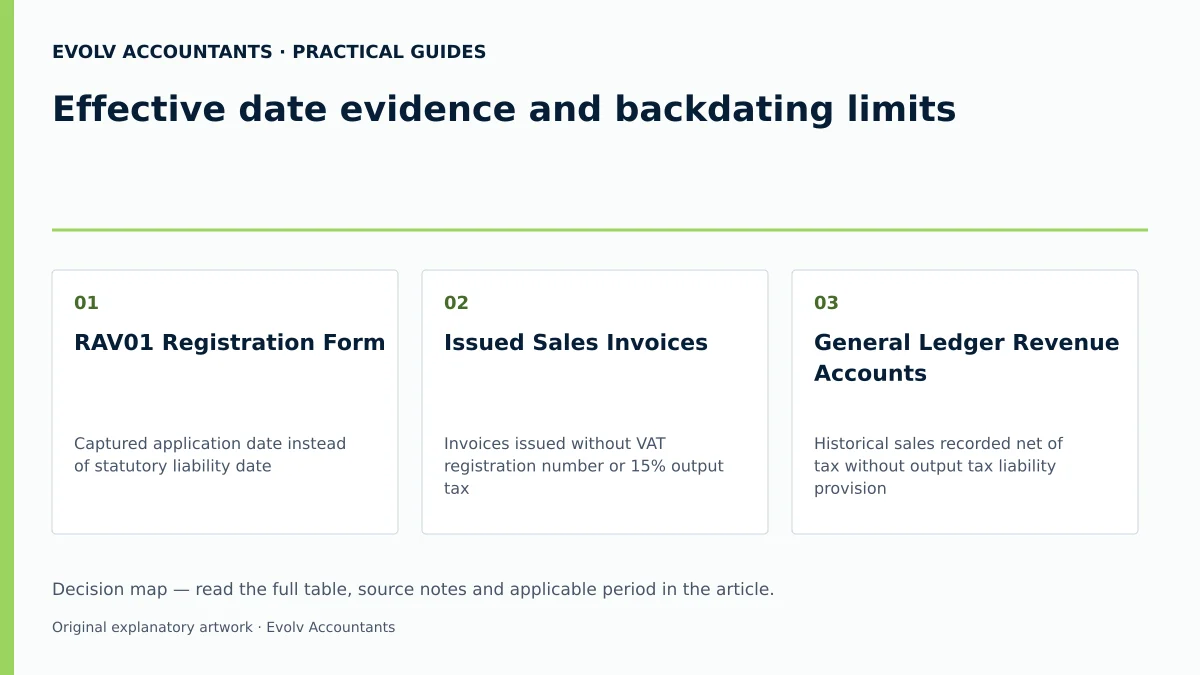
The table below outlines the correction framework required to maintain audit integrity when adjusting effective date records:
| Original record | Error | Authorised action | Changed record | Proof and downstream check |
|---|---|---|---|---|
| RAV01 Registration Form 1 13 | Captured application date instead of statutory liability date 1 13 | Use eFiling within the permitted backdating window; book the required SARS branch appointment for older requests 1 2 | Updated VAT Registration Details reflecting backdated liability date 1 23 | Downloaded Notice of Registration; verified via SARS VAT Vendor Search 23 32 |
| Issued Sales Invoices 3 22 | Invoices issued without VAT registration number or 15% output tax 18 22 | Re-issue full tax invoices containing vendor VAT number to eligible clients 22 33 | Revised Tax Invoices reflecting standard-rate output tax 18 22 | Replacement invoices and client credit notes archived in 5-year audit file 3 20 29 |
| General Ledger Revenue Accounts 3 20 | Historical sales recorded net of tax without output tax liability provision 3 38 | Pass general ledger journal entries reallocating gross sales to revenue and VAT payable 3 38 | Reconciled General Ledger Revenue & Output VAT Accounts 3 38 | Draft VAT201 control schedule matches general ledger trial balance 3 34 |
| Supplier Purchases Invoices 4 33 | Supplier invoices omit vendor's new VAT number due to pre-registration timing 33 | Validate pre-registration supplier invoices for allowable enterprise inputs 4 33 | Input Tax Claim Schedule for backdated period 4 33 | Invoices meet Section 20 criteria; validity preserved under backdating rules 4 33 |
| Historical VAT201 Returns 3 26 | Omitted sales and input declarations for backdated tax periods 3 26 | Submit outstanding VAT201 returns via eFiling for each past period 3 26 34 | Submitted VAT201 Declarations and PRN Receipts 34 39 | eFiling Statement of Account reflects processed returns and settled balances 40 41 |
Next steps for VAT registration
Enterprises must assign a designated control owner—such as the Chief Financial Officer, Senior Tax Manager, or appointed Representative Vendor—to oversee VAT registration compliance and effective date alignment 43. The control owner should enforce a mandatory monthly recurrence check where the finance team calculates the consecutive 12-month rolling taxable turnover on the final business day of each calendar month 17.
Frequently Asked Questions
Can an enterprise backdate a voluntary VAT registration?
Under SARS web guidance, voluntary VAT registrations are set according to the application date, and backdating is generally prohibited 1. If an applicant seeks to backdate a voluntary registration, it must present compelling supporting documentation to SARS justifying the request 1.
What happens if compulsory VAT registration backdating exceeds six months?
The SARS eFiling RAV01 system blocks automated backdating beyond six months from the date the compulsory threshold was exceeded 1. The vendor must schedule a virtual or branch appointment with SARS, providing signed financial statements, customer contracts, and issued invoices 1 2 14.
How does backdating an effective date impact tax invoices previously issued?
Sales made during the backdated period become legally subject to 15% output tax 8 18. Vendors should re-issue tax invoices containing their assigned VAT number to registered business clients 22 33. Pre-registration supplier invoices held by the vendor remain valid for input tax claims even if they omit the vendor's new VAT number 33.
Which threshold applies when determining compulsory VAT registration liability?
Current SARS web guidance administers a compulsory VAT registration threshold of R2.3 million in any consecutive 12-month period 9 10. Older SARS operational guides retain reference to a R1 million threshold 11. SMEs should align with SARS's current administrative position of R2.3 million while monitoring regulatory updates 9 10 42.
What primary evidence must be preserved to substantiate a backdated VAT effective date?
Vendors must preserve original records for at least five years 3 19 20. Evidence includes monthly general ledger sales breakdowns, signed commercial contracts, bank statements, signed financial statements, and eFiling submission confirmation notices 1 14 23. The five-year period is a minimum, not an automatic destruction date. SARS record-keeping guidance requires the relevant records to remain available; retain them beyond the ordinary minimum where an ongoing audit, investigation, objection or appeal or another applicable rule requires it.
Related guides
- Correcting a VAT registration submitted with wrong details
- When a South African business must register for VAT
- The Proactive SARS Audit Guide: Keeping Your Business Ledger Sanitised
Sources
- Register for VAT | South African Revenue Service
- Obligations of a VAT vendor | South African Revenue Service
- https://www.sars.gov.za/wp-content/uploads/Ops/Guides/Legal-Pub-Guide-VAT404-VAT-404-Guide-for-Vendors.pdf
- FAQs for VAT vendors | South African Revenue Service
- https://www.sars.gov.za/wp-content/uploads/Ops/Guides/VAT-REG-02-G01-Guide-for-Completion-of-VAT-Application-External-Guide.pdf