
Correcting a refund claim before verification finishes
16 February 2025

Correcting a VAT refund claim during a SARS verification requires submitting a complete revised VAT201 declaration on eFiling.
When a South African vendor discovers an error on a previously submitted VAT201 return that generated a refund claim currently undergoing verification by the South African Revenue Service (SARS), the vendor must lodge a formal Request for Correction (RFC) on eFiling to issue a new version of the return 1 2.
Because a filed VAT return constitutes an original self-assessment under the Tax Administration Act (TA Act), the return cannot be deleted or overwritten 3 4; instead, SARS maintains an immutable correction history on the VAT201 Work Page 5. In completing the revised declaration, vendors must capture full corrected figures rather than net differences 2 6 7.
Under regulatory rules, Part A output tax figures may be increased or decreased, but Part B input tax deductions cannot be increased for prior periods—any omitted input tax must be claimed on a subsequent return within five years 1 7 8.
Correction history and the pending verification
Material consequences of declaration errors
A value-added tax (VAT) declaration submitted on Form VAT201 contains specific fields that calculate net VAT liability or refund entitlement for a given tax period 9 10 11. Under Part A, vendors declare output tax on standard-rated supplies (Field 1 and Field 1A), zero-rated supplies (Field 2 and Field 2A), and exempt supplies (Field 3) 12 13 14 15.
Under Part B, vendors deduct input tax on local capital goods (Field 14), imported capital goods (Field 14A), local goods and services (Field 15), imported non-capital goods (Field 15A), change-in-use adjustments (Field 16), bad debts (Field 17), and other permissible deductions like credit notes issued or debit notes received (Field 18) 9 16.
When an erroneous entry occurs—such as overstating Part B input tax in Field 15 or understating Part A output tax in Field 1—the total VAT in Field 20 becomes distorted 9 10. If Field 19 (Total Input Tax) exceeds Field 13 (Total Output Tax), Field 20 reflects a negative value, indicating a VAT refund due from SARS 9 10 17. When a return reflects a refund claim or a significant variance from prior reporting periods, SARS's automated risk engine flags the return and selects the vendor for verification 18 19 20 21.
Selecting a return for verification holds processing of the refund claim beyond the statutory 21 business days payout window 19 22 23. The material consequence of an uncorrected error during verification is severe: if SARS detects an unsubstantiated input tax deduction during verification, SARS will disallow the claim, adjust the assessment on Form VAT217, and levy administrative non-compliance penalties of 10%, interest, and potential Understatement Penalties (USP) under Chapter 16 of the TA Act 19 24 25 26 27 28 29.
Regulatory framework versus administrative practice
SMEs must distinguish between statutory law, regulator guidance, and professional advice:
- Statutory Law: Governed by the Value-Added Tax Act, 1991 (VAT Act) and the TA Act 4 22. Under Section 23 of the VAT Act, the statutory baseline for compulsory VAT registration remains R1 million in taxable turnover over a 12-month period 30 31 32.
- Regulator Guidance: Operational instructions issued in SARS guides, such as the Guide for Completing the VAT201 (GEN-ELEC-04-G01) and the VAT 404 Guide for Vendors 33 34 35. Currently, SARS's operational guidance administers a R2.3 million registration threshold position in practical processing, whereas older guides retain the R1 million statutory baseline 30 31 32. Evolv notes that this reflects an administrative operational position rather than an unqualified statutory amendment to Section 23 of the VAT Act.
- Evolv Recommendations: Strategic advice recommending that vendors maintain rigorous reconciliation files, verify all tax invoices prior to submission, and initiate corrections promptly upon discovering an error rather than waiting for SARS auditors to detect discrepancies 36.
Preserve the original records: correction history
Statutory record-keeping obligations
Section 30 of the TA Act and Section 55 of the VAT Act mandate that every registered vendor must retain complete accounting records, tax invoices, credit/debit notes, customs bills of entry, and bank statements for at least five years from the date of assessment 37 38 39 40 41. When an error occurs on a filed VAT201 return, vendors must never destroy, alter, or backdate original accounting entries or source documents 38 39.
— Practical point from this guide
Version control and immutable audit trails
SARS's eFiling platform enforces immutable audit trails through electronic versioning 2 5. Submitting an original VAT201 return creates Version 1 5 42. Requesting a correction does not overwrite Version 1; instead, eFiling generates Version 2 in a "Saved" status with the same Payment Reference Number (PRN) and tax period 2 5 43.
The VAT201 Work Page displays complete historical details for every version 5:
- Return type and tax period 5.
- Version number and declared amount 5.
- Processing status (e.g. "Filed through eFiling", "Saved", or "Submitted at SARS") 5 44 45.
- Submission date and submission channel 5.
- Profile name of the person who last updated the return 5.
The electronic login credentials of the user submitting the return serve as the legal electronic signature of the declarant 46. Evolv recommends restricting eFiling access authority to appointed representative taxpayers or registered tax practitioners, ensuring every submission is backed by written internal authorisation 13 47 48 49.
Choose the correct amendment route: the pending verification
Distinguishing procedural amendment pathways
When a VAT refund claim is pending verification, choosing the correct procedural route is vital to avoid administrative delays. Vendors must distinguish four distinct mechanisms:
Request for Correction (RFC)
An RFC is used to remedy undisputed errors on a previously filed return before SARS issues an additional assessment or finalises an audit 1 3 50. Section 25(5) of the TA Act allows SARS to accept amended returns for undisputed errors 3.
Revisions and version thresholds
Vendors may revise the VAT portion of a VAT201 return for any tax period within the preceding five years, and the diesel portion within two years 50. While there is no cap on the number of revisions, submitting a second revision (Version 3 onwards) triggers an automated mandate requiring supporting documents to be uploaded simultaneously with the revised return 50.
Prohibition on increasing prior-period input tax
A critical statutory rule applies to Part B input tax deductions: while Part A output tax amounts may be increased or decreased on a revised return, Part B input tax amounts may only be decreased 1 6 7. A vendor is strictly prohibited from increasing input tax deductions on a past tax period revision 7 8. If an SME omitted valid input tax in a prior period, the vendor must deduct that input tax in a current or future tax period return within five years from the date of first entitlement 7 8.
Submit the requested material within the 40-business-day period applicable to the section 95(1)(c) estimate, or request an extension promptly. The SARS guide describes the extension-button availability up to five years and 40 business days after the original assessment for which verification was created; this is not an automatic extension.
Check the date and conditions in the actual notice and any approved extension. SARS VAT201 guide.
For an objection-eligible additional assessment or decision after verification or audit, use the formal dispute route. The standard objection period is 80 business days, calculated from the assessment, decision or furnishing of reasons as prescribed; do not substitute an RFC for that dispute. SARS VAT404 dispute guidance.
Make and verify the correction: correction history
Step-by-step approved change sequence
To execute a compliant Request for Correction while a verification is pending, vendors must follow this numbered sequence:
- Log into eFiling and navigate to Returns -> Returns History -> Value Added Tax (VAT201) 42 56.
- Select the relevant tax period and click Request for Correction 2 56.
- Open the newly generated version (reflected in "Saved" status) on the VAT201 Work Page 43 57.
- Capture complete corrected figures across all fields—not merely the net difference between original and revised amounts 2 6 7.
- Validate that Part A output tax reflects exact revised figures and Part B input tax is not increased above original declared levels 1 7 8.
- Click Submit VAT201 on the toolbar 58 59.
- Confirm on the VAT201 Work Page that status reflects "Filed through eFiling" or "Submitted", showing the incremented Version number 5 44.
- Upload supporting documentation via the Submission of Relevant Material link or SARS Online Query System 60 61 62.
Correction audit trail artefact
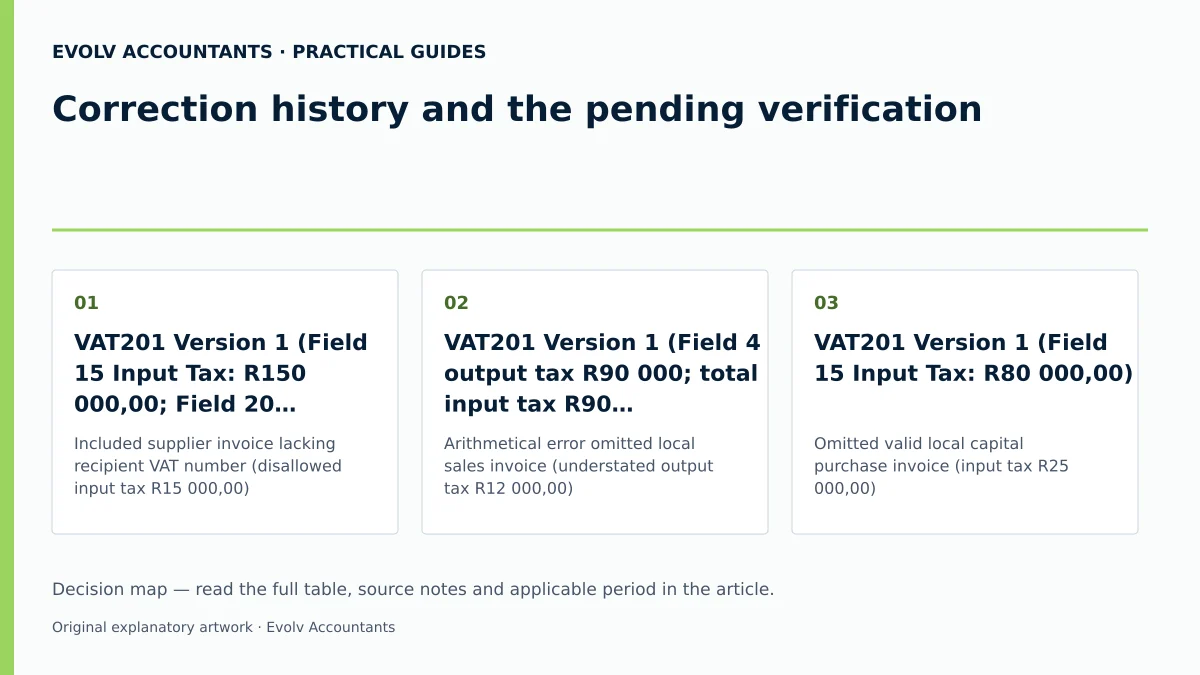
The table below illustrates a structured correction audit trail required to substantiate changes during a SARS verification:
| Original record | Error | Authorised action | Changed record | Proof and downstream check |
|---|---|---|---|---|
| VAT201 Version 1 (Field 15 Input Tax: R150 000,00; Field 20 Refund: R45 000,00) 5 9 10 | Included supplier invoice lacking recipient VAT number (disallowed input tax R15 000,00) 63 64 | Approved RFC to remove non-compliant invoice from Version 2 2 56 | VAT201 Version 2 (Field 15 Input Tax: R135 000,00; Field 20 Refund: R30 000,00) 2 5 9 | Uploaded revised input schedule, tax invoices, and verified VAT201 Work Page status 5 60 61 |
| VAT201 Version 1 (Field 4 output tax R90 000; total input tax R90 000; initial net R0) 12 13 | Arithmetical error omitted local sales invoice (understated output tax R12 000,00) 3 | Approved RFC to increase Field 4 output tax to R102 000,00 1 2 | VAT201 Version 2 (Field 4 Output Tax: R102 000,00; Field 20 Net Payable: R12 000,00) 1 2 9 | PRN payment receipt, updated Statement of Account (VATSA) showing payment allocation 56 65 66 |
| VAT201 Version 1 (Field 15 Input Tax: R80 000,00) 9 | Omitted valid local capital purchase invoice (input tax R25 000,00) 7 8 | Statutory restriction: Part B input tax cannot be increased on RFC 1 8. Retained Version 1 7 | Carried forward R25 000,00 input tax to Field 14 of subsequent VAT201 period 7 8 | Valid local capital-purchase invoice and subsequent-period VAT201 declaration 7 8 63 |
Reproducible hypothetical example
To illustrate the mathematical mechanics of correcting a refund claim, consider a registered SME operating on the invoice basis 11 64:
Baseline parameters and sourced rates
- Compulsory Registration Threshold: Statutory baseline R1 000 000,00 30 32; SARS operational guidance position R2 300 000,00.
- Standard VAT Rate: 15% (effective 1 April 2018) 13 67 68.
- Tax Fraction: 15 / 115 13 67.
- Tax Period: Category B (two-monthly period ending August) 69 70.
Original declaration (Version 1)
- Standard-Rated Sales (Field 1): R1 150 000,00 inclusive of VAT.
Output Tax (Field 4) = R1 150 000,00 × (15 ÷ 115) = R150 000,00 12 13
- Declared Input Tax (Field 15): R195 000,00 9.
- Field 20 Calculation:
Field 20 = Total Output (R150 000,00) - Total Input (R195 000,00) = -R45 000,00 9 10 Version 1 declared a net VAT refund claim of R45 000,00 10.
Verification discovery and correction (Version 2)
During SARS verification, the SME discovers that Field 15 included a duplicate supplier invoice containing R15 000,00 in input tax 3. Additionally, a credit note issued to a customer for R23 000,00 (VAT inclusive) was omitted from Field 18 9.
Corrected calculation (Version 2)
- Adjusted Output Tax (Part A): Unchanged at R150 000,00 (Field 1 / Field 4) 12.
- Corrected Input Tax (Part B - Field 15):
Field 15 = R195 000,00 - R15 000,00 (duplicate removed) = R180 000,00 1 9
- Omitted credit-note deduction: Do not add the omitted R3 000 to Field 18 on the past-period revision. Retain the credit note and claim the permissible deduction in a current or future return within the applicable time limit.
- Corrected Total Input Tax (Field 19): R180 000, with no other input fields in this example.
- Corrected refund (Field 20): R150 000 output tax less R180 000 input tax = a R30 000 refund.
The RFC contains the full revised figures and removes the duplicate R15 000 deduction, reducing the original R45 000 refund claim to R30 000. The separate R3 000 omitted deduction is dealt with in a later return. Submitting a correction does not automatically eliminate penalties: retain the reasons and check SARS’s actual assessment.
Consequences and remaining exceptions: the pending verification
Downstream account and payment reconciliations
Submitting a Request for Correction impacts several linked systems across SARS eFiling:
- Payment Reference Number (PRN): Every revised return retains the unique 19-digit PRN assigned to the original return for that tax period 71 72 73. If a correction converts a refund claim into a net tax liability, payment must be made using the original PRN via Credit Push or EFT 56 71 73 74 75.
- Statement of Account (VATSA): The VATSA reflects real-time financial transactions, processing status, and liability balances per period 65 66. Evolv recommends requesting a VATSA immediately after filing Version 2 to verify proper allocation 65 66.
- Bank Details Verification: Corrected refunds are paid only into verified bank accounts 23 76 77. Third-party banking details are strictly prohibited except for foreign entities or holding/subsidiary companies in a group structure submitting Form VAT119i indemnity 76 78 79 80.
- Debt Equalisation (Set-off): SARS is legally entitled to set off an approved VAT refund against outstanding tax debts or across separate registered branches of the same entity 37 81.
Complex exceptions and VDP relief
Where errors involve historical understatements or non-compliance, vendors should consider the Voluntary Disclosure Programme (VDP) under Chapter 16 of the TA Act 27 82 83. An approved VDP agreement provides relief from administrative non-compliance penalties and understatement penalties 82 83 84. When filing a VAT201 under a VDP agreement, the vendor must select "Y" in the VDP container and capture the valid VDP application number 12 85.
The five-year period is a minimum, not an automatic destruction date. SARS record-keeping guidance requires the relevant records to remain available; retain them beyond the ordinary minimum where an ongoing audit, investigation, objection or appeal or another applicable rule requires it.
Next steps for VAT refunds
Internal governance and control ownership
To maintain compliance during SARS verifications, SMEs must establish formal internal controls:
- Assign Control Owner: Designate a qualified representative taxpayer or registered tax practitioner as control owner responsible for authorising all eFiling submissions and RFC requests 13 47 49.
- Implement Pre-Filing Recurrence Checks: Establish a mandatory monthly reconciliation procedure comparing general ledger VAT accounts against source tax invoices before submitting Form VAT201 11 38.
- Maintain Verification Dossiers: Compile an electronic verification pack containing tax invoices, bank statements, calculation schedules, and eFiling receipts immediately upon lodging any refund return 39 60.
Frequently Asked Questions
Can a vendor increase Part B input tax on a prior period VAT201 return using a Request for Correction?
No. Under SARS operational rules, Part B input tax deductions cannot be increased when performing a revision on a past tax period 1 7 8. If valid input tax was omitted from a past return, the vendor must claim the deduction on a future tax period return within five years from the date of first entitlement 7 8.
What happens if SARS issues a section 95 estimated assessment while a verification is pending?
Submit the requested material within the 40-business-day period applicable to the section 95(1)(c) estimate, or request an extension promptly. The SARS guide describes the extension-button availability up to five years and 40 business days after the original assessment for which verification was created; this is not an automatic extension. Check the date and conditions in the actual notice and any approved extension. SARS VAT201 guide. For an objection-eligible additional assessment or decision after verification or audit, use the formal dispute route. The standard objection period is 80 business days, calculated from the assessment, decision or furnishing of reasons as prescribed; do not substitute an RFC for that dispute. SARS VAT404 dispute guidance.
How does submitting a Request for Correction affect the refund payout deadline?
SARS may withhold a refund while verifying entitlement. Interest and the 21-business-day calculation depend on the applicable statutory exceptions, including defective returns, banking details and access to records; selection for verification alone should not be treated as proof of an unlimited interest-free suspension. Check the dates, notices and the specific withholding or recalculation ground. SARS refund guidance.
What additional documentation is required when submitting a third version of a VAT201 return?
When a vendor revises a VAT201 return for the second time onwards (creating Version 3 or higher), eFiling automatically requires the vendor to upload supporting documentation simultaneously with the submission to substantiate the changes 50.
What is the difference between statutory legislation and SARS administrative guidance regarding the VAT registration threshold?
Section 23 of the Value-Added Tax Act establishes the statutory compulsory VAT registration threshold at R1 million in taxable turnover over 12 months 30 31 32. SARS's current operational guidance administers a R2.3 million threshold position in registration processing. This represents an administrative operational position and does not constitute a statutory amendment to Section 23 of the VAT Act.
Related guides
- Handling a VAT audit request for a site visit
- Why a VAT refund can be delayed
- The Proactive SARS Audit Guide: Keeping Your Business Ledger Sanitised
Sources
- https://www.sars.gov.za/wp-content/uploads/Ops/Guides/GEN-ELEC-04-G01-Guide-for-completing-the-Value-Added-Tax-VAT201-Declaration-External-Guide.pdf
- https://www.sars.gov.za/wp-content/uploads/Ops/Guides/Legal-Pub-Guide-VAT404-VAT-404-Guide-for-Vendors.pdf
- https://www.sars.gov.za/wp-content/uploads/Ops/Guides/VAT-REG-02-G01-Guide-for-Completion-of-VAT-Application-External-Guide.pdf
- VAT Refunds for vendors | South African Revenue Service