
Handling a VAT audit request for a site visit
2 February 2025

For a SARS site visit, establish whether it is a limited inspection or a formal VAT audit, verify authority and manage records within the lawful scope.
When SARS officials conduct an inspection or audit at a enterprise's premises, small and medium-sized enterprises (SMEs) must verify official credentials, control physical access to business records, and preserve a complete audit trail of all primary evidence inspected or copied 1 2. Establishing systematic custody protocols protects the vendor's legal rights, ensures compliance under the Tax Administration Act (TA Act) and the Value-Added Tax Act, and prevents unnecessary delays in VAT return processing or refund disbursements 2 3 4.
Site visit evidence custody and access controls
This practical guide is designed for South African SME owners, financial directors, internal accountants, and representative vendors operating within the South African tax jurisdiction 5 6. It applies to standard tax periods—whether Category A or B bi-monthly filings, Category C monthly submissions for enterprises exceeding R30 million turnover, or Categories D and E 7 8—and addresses the statutory five-year record retention requirement for all primary VAT documentation 9 10 11.
In the context of a SARS site visit, completing the task means successfully validating the authority of the visiting officials, managing real-time access to physical and digital accounting systems, maintaining an immutable document custody register, and obtaining written official receipts for any evidence examined or removed from the premises 2 12.
— Practical point from this guide
Distinction between Law, Regulator Guidance, and Evolv Advisory
To maintain legal clarity, South African SMEs must distinguish between statutory law, regulatory administrative guidance, and professional accounting practice:
- Statutory Law: The Value-Added Tax Act 89 of 1991 and the Tax Administration Act 28 of 2011 set the underlying legal duties, including mandatory record retention for five years, the obligation to issue valid tax invoices within 21 days, and official powers of inspection 2 9 11 13.
- Regulator Guidance: Documents issued by SARS—such as VAT 404 - Guide for Vendors and external guides for completion of returns and applications—reflect the Commissioner's administrative interpretation and operational procedures 5 14 15. For compulsory registration, while statutory guides cite the statutory threshold under section 23 of the Value-Added Tax Act as R1 million 16, current SARS operational guidance administers the registration position at R2.3 million; this reflects administrative positioning rather than an unqualified statutory amendment to section 23 16.
- Evolv Recommendations: Strategic advice provided by Evolv Accountants to help SMEs implement practical governance, access control frameworks, document custody logs, and pre-audit readiness checks.
Prepare the information and authority: site visit evidence custody
Before granting access to enterprise premises or financial records, the SME must prepare specific documentation, verify official permissions, and assign clear responsibilities 2 6.
Statutory Definitions and Inspection Categories
Understanding the legal nature of the SARS visit is essential for defining the scope of evidence custody 2 17:
- Unannounced Inspection: SARS officials are empowered under the inspection provisions of the TA Act to conduct unannounced inspections at a vendor's place of business to ascertain whether the business is registered, verify that records are kept as required, or establish the identity of the person occupying the premises 2. Officials may not enter domestic premises or dwellings not used for trade without proper legal authorisation 2.
- Verification: A less intensive evaluation of return accuracy, usually restricted to a single, recent VAT period, where supporting documentation is requested and reviewed 17 18.
- Audit: A detailed examination of books and records covering multiple tax periods to verify tax correctness, output tax declarations, and input tax deductions 2 12.
Required Primary Documents and Authority Credentials
The representative vendor must assemble and control the following evidence inputs 2 6 19 20:
- SARS Official Credentials: As noted by the South African Revenue Service, officials "must be issued with an identity card which he or she must produce when required to do so" 2.
- Notice of Registration & Representative Taxpayer Authority: The vendor's official Notice of Registration and proof of the representative vendor's appointment 6 21.
- Sales and Output Tax Evidence: Full tax invoices for supplies exceeding R5 000 (containing recipient details and serial numbers) 22 23, abridged tax invoices for supplies R5 000 or less 22 23, till slips or sales dockets for amounts of R50 or less 22 24, and debit/credit notes 25 26.
- Purchase and Input Tax Evidence: Valid supplier tax invoices 19 27, Customs SAD 500 bills of entry with eFiling VAT payment receipts and EDI Status 1 Release Messages for imported goods 20 28, agent statements issued under section 54(3)(b) 29 30 31, and signed VAT264 declarations for second-hand goods acquisitions 20 32.
- General Ledgers and VAT Returns: Submitted VAT201 declarations, 19-digit Payment Reference Numbers (PRNs), and trial balances for the relevant tax periods 33 34.
Complete the task step by step: access controls
To maintain evidence integrity and safeguard business operations during a SARS site visit, SMEs should execute the following sequenced access control procedure 2 12:
- Request and Inspect Official Identification: Upon the arrival of SARS personnel, immediately request the official SARS identity card from every visiting officer 2. Verify the officer's photograph, full name, and official SARS capacity before granting entry beyond the reception area 2.
- Establish the Legal Basis and Scope: Request the written notice of audit or determine whether the visit is an unannounced inspection under the TA Act 2 12. Record the specific tax period(s) and enterprise activities under review 2 17.
- Notify the Representative Vendor and Evolv Advisor: Inform the designated representative vendor or legal public officer immediately 6. Ensure that external tax advisors from Evolv Accountants are notified to oversee evidence presentation.
- Escort Officials to a Designated Inspection Room: Direct SARS officials to a secure, private room separated from general finance and operational work areas. As a practical custody measure, arrange supervised access where possible, while complying with the officials’ lawful powers and the scope of the inspection or audit.
- Retrieve and Present Catalogued Records: Provide the relevant records lawfully requested for the communicated scope, and clarify any request that extends beyond it with the representative vendor or adviser 2 9. Maintain a real-time Document Custody Log recording:
- Document description and date;
- Specific box/file reference number;
- Whether the document was inspected, copied, or handed over;
- Name and signature of the receiving SARS official.
- Secure an Official Acknowledgement: Before the SARS officials depart, request a formal, signed site visit confirmation or acknowledgment slip detailing all records examined or copies taken 2 12.
Check the result against the evidence: site visit evidence custody
Submission or presentation of documentation to a visiting SARS auditor does not equal formal acceptance or audit finalization 12 35 36. Independent completion check steps must be performed to verify the legal status of the audit:
- Reconcile Document Custody Logs: Verify that every physical invoice or electronic schedule provided during the site visit is fully accounted for on the internal custody register.
- Monitor eFiling Work Page Status: Access the SARS eFiling profile to review the VAT Work Page 35 36. Check whether the status reflects "Selected for Audit", "Submitted at SARS", or "Processed" 35 36.
- Obtain Official Written Correspondence: Formal audit completion is evidenced only by receiving written SARS correspondence via eFiling under "SARS Correspondence"—such as a Finalisation of Audit letter, a Notice of Assessment (VAT217) 35 37, and distinguish those final documents from a notice of proposed adjustments, which invites a response and does not establish completion 12 37.
- Review Response Deadlines: Where SARS issues a notice of proposed material adjustments, ensure the 21-business-day response period is calculated and logged immediately 12.
Handle exceptions and unresolved cases: access controls
During site visits and subsequent audit verifications, specific edge cases and document deficiencies may arise 4 37 38:
Refusal of Immediate Access and Suspension of Refund Timelines
If an SME cannot provide immediate access to books and records—for example, due to the absence of key keyholders or offsite document storage—SARS is empowered to suspend the statutory 21-business-day refund processing clock 3 4. The 21-day period is put on hold from the date the request for access is issued until the date the vendor allows access to the records 4.
Missing Tax Invoices and Alternative Documentary Proof
If primary tax invoices are missing or destroyed, input tax deductions will be disallowed upon audit 19 27. A vendor cannot claim input tax without valid prescribed documentation 19.
Under section 16(2)(g) of the VAT Act, a vendor may apply to SARS for a formal VAT ruling to use alternative documentary proof, provided the application is made at least two months prior to the expiry of the 5-year prescription period and the vendor proves that the failure to hold prescribed documents was due to circumstances beyond its control 38 39.
Submit the requested material within the 40-business-day period applicable to the section 95(1)(c) estimate, or request an extension promptly. The SARS guide describes the extension-button availability up to five years and 40 business days after the original assessment for which verification was created; this is not an automatic extension.
Check the date and conditions in the actual notice and any approved extension. SARS VAT201 guide.
Dispute Resolution and "Pay Now, Argue Later"
If SARS issues an adverse assessment following a site visit, the vendor may lodge a formal objection on form DISP01 via eFiling within 80 business days 43 44. Under the statutory "pay now, argue later" principle, the obligation to pay the assessed tax is not automatically suspended by an objection 45. The vendor must submit a separate request for Suspension of Payment under section 164 of the TA Act 35 45.
The five-year period is a minimum, not an automatic destruction date. SARS record-keeping guidance requires the relevant records to remain available; retain them beyond the ordinary minimum where an ongoing audit, investigation, objection or appeal or another applicable rule requires it.
Next steps for VAT refunds
SMEs expecting VAT refunds must ensure complete alignment between site visit evidence, filed VAT201 returns, and registered banking particulars 3 46. SARS is required to pay valid refunds within 21 business days of receiving a correctly completed return 3 47, provided no outstanding returns exist and no verification or audit is pending 3. If refunds are delayed beyond 21 business days without lawful suspension, statutory interest becomes payable at the prescribed rate 3 48.
Where refund banking details involve third-party accounts, these are strictly restricted to foreign companies or group subsidiaries accompanied by an approved VAT119i indemnity form 46 49 50.
Task and Completion Checklist
| Step | Input or evidence | Responsible person | Completion check | Exception or next action |
|---|---|---|---|---|
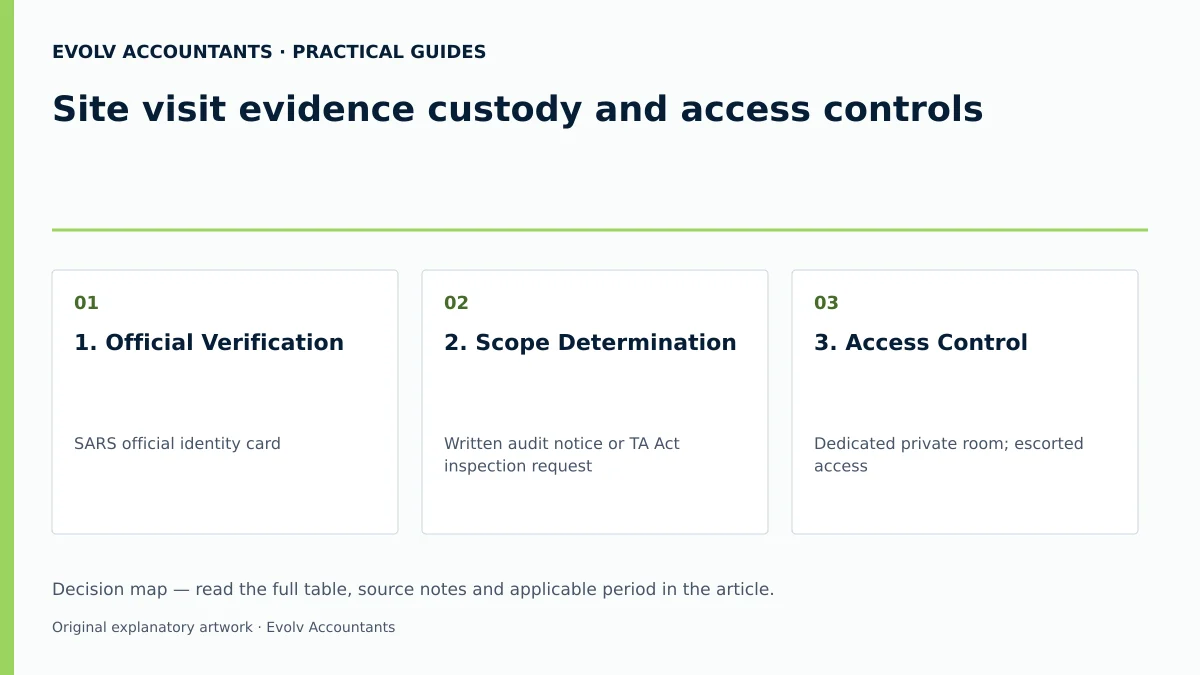
| 1. Official Verification | SARS official identity card 2 | Front desk / Security | ID photo and name verified; official details logged 2 | Deny access if valid SARS ID card is not produced 2. |
| 2. Scope Determination | Written audit notice or TA Act inspection request 2 12 | Representative Vendor 6 | Nature of visit (unannounced inspection vs audit) confirmed 2 17 | Confirm domestic dwelling exclusion if applicable 2. |
| 3. Access Control | Dedicated private room; escorted access 2 | Finance Manager / Escort | Supervised access arranged consistently with the officials’ lawful authority and communicated scope | Escalated to Public Officer if unauthorized access requested. |
| 4. Document Presentation | Primary invoices (above R5 000 / at or below R5 000), SAD 500, bank statements 20 22 23 | Internal Accountant | Document Custody Log completed and signed | First obtain replacement prescribed records; consider a section 16(2)(g) application only if its conditions are met 38 39. |
| 5. Exit Acknowledgment | Site visit summary slip / SARS receipt list 2 12 | Representative Vendor 6 | Written acknowledgment obtained from SARS official 2 | Copy of log retained in permanent audit file. |
| 6. Audit Tracking | eFiling VAT Work Page and Correspondence tab 35 51 | Evolv Tax Advisor / Vendor | Assessment notice (VAT217) or audit completion letter received 35 37 | Submit Request for Extension if section 95 estimate issued 41 42. |
Reproducible Hypothetical Example: Site Visit and Refund Audit
Background and Calculation Setup
Beta Trading Enterprise (Pty) Ltd, a South African manufacturing SME registered for VAT on the invoice basis, submits its bi-monthly VAT201 return for the tax period.
- Output Tax Calculated (Part A):
- Standard-rated taxable sales: R1 000 000 (excluding VAT).
- Output Tax collected at 15% rate: R150 000 52.
- Input Tax Calculated (Part B):
- Local capital equipment purchases: R800 000 (excluding VAT) -> Input VAT: R120 000 53.
- Local operational expenses (standard-rated): R600 000 (excluding VAT) -> Input VAT: R90 000 53.
- Total Input Tax claimed: R120 000 + R90 000 = R210 000 52 53.
- Net VAT Result (Field 20 / Field 34):
- Output Tax (R150 000) - Input Tax (R210 000) = R60 000 VAT Refund Claimed 52 54.
Audit Scenario and Interest Timeline
- Day 1: Return submitted via eFiling. The eFiling Risk Engine selects the return for refund verification 55.
- Day 5: SARS contacts the vendor about an audit site visit within the communicated scope, including the capital equipment and its supporting invoices 2.
- Site Visit Execution: The SME verifies the SARS officer's identity card 2, presents the capital purchase tax invoice (showing seller name, VAT number, serial number, and 15% VAT breakdown) 23, and logs the inspection on the Document Custody Register.
- Outcome & Refund Release: Access is fully granted on Day 5. SARS finalizes the verification.
- Interest Calculation on Delay: If SARS had withheld the refund beyond 21 business days without lawful suspension (e.g., paying on Day 35), statutory interest would accrue on the R60 000 refundable amount at the prescribed rate for the legally relevant interest period, calculated from actual dates and the applicable statutory clock 3 47 48. However, because access was granted immediately on Day 5, no period suspension occurred 4, and SARS releases the R60 000 refund directly to Beta Trading's verified bank account 3 56.
Frequently Asked Questions
Can a SARS official enter my business premises without prior notice?
Yes. Under the Tax Administration Act, SARS officials are empowered to conduct unannounced inspections at any place of business to confirm VAT registration, inspect required records, or identify premises occupants 2. However, officials must produce an official SARS identity card upon arrival and cannot enter private domestic dwellings not used for trade 2.
What happens if I refuse to grant a SARS official access during a site visit?
If access to books and records is denied or hindered, SARS will suspend the statutory 21-business-day refund processing clock 3 4. The suspension remains in effect from the date access was requested until the date access is formally granted, preventing interest from accruing against SARS 4.
How long am I required to keep VAT invoices and accounting records?
The Tax Administration Act and VAT Act require vendors to retain all primary accounting records, tax invoices, debit/credit notes, bills of entry, and bank statements in their original form for at least five years from the date the return was submitted 9 10 11.
Can SARS pay a VAT refund into my tax practitioner's bank account?
No. To prevent VAT fraud, SARS strictly prohibits the use of third-party banking details for refund payouts 46 49 50. Third-party bank accounts are allowed only in two narrow exceptions: non-resident companies and group subsidiaries/holding companies, subject to filing an indemnity form VAT119i and supporting resolutions 46 49 50.
What can I do if SARS issues an estimated assessment after a site visit?
Submit the requested material within the 40-business-day period applicable to the section 95(1)(c) estimate, or request an extension promptly. The SARS guide describes the extension-button availability up to five years and 40 business days after the original assessment for which verification was created; this is not an automatic extension. Check the date and conditions in the actual notice and any approved extension. SARS VAT201 guide. Ask Evolv about site visit evidence custody and access controls. Share the relevant records so the support required can be scoped.
Related guides
- Finding proof of your own VAT registration
- Why a VAT refund can be delayed
- The Proactive SARS Audit Guide: Keeping Your Business Ledger Sanitised
Sources
- https://www.sars.gov.za/wp-content/uploads/Ops/Guides/Legal-Pub-Guide-VAT404-VAT-404-Guide-for-Vendors.pdf
- VAT Refunds for vendors | South African Revenue Service
- https://www.sars.gov.za/wp-content/uploads/Ops/Guides/GEN-ELEC-04-G01-Guide-for-completing-the-Value-Added-Tax-VAT201-Declaration-External-Guide.pdf
- https://www.sars.gov.za/wp-content/uploads/Ops/Guides/VAT-REG-02-G01-Guide-for-Completion-of-VAT-Application-External-Guide.pdf
- FAQs for VAT vendors | South African Revenue Service