
Correcting an employee UIF employment history
18 January 2025

Correcting an employee UIF employment history requires rectifying erroneous payroll records and submitting updated employee declarations directly to the UI Commissioner.
Inaccurate Unemployment Insurance Fund (UIF) employment records can severely disrupt employee benefit claims and create statutory compliance exposures for South African small and medium enterprises (SMEs). When an employee's employment start date, termination date, monthly remuneration, or status reason is incorrectly captured on state databases, the error prevents the Unemployment Insurance Commissioner from accurately calculating credit days and payout entitlements.
Resolving these discrepancies requires employers to maintain original payroll source files, select the appropriate regulatory correction mechanism, execute master data updates via official digital platforms, and reconcile downstream tax records across both the Department of Employment and Labour and the South African Revenue Service (SARS).
Amendment history and supporting payroll facts
Identifying erroneous declaration fields and consequences
An employee's UIF employment history recorded on the national database consists of key master data and monthly transaction records 1 2. Under statutory provisions, employers must report specific payroll facts for every worker employed for 24 hours or more per month 3 4. Common errors encountered in SME payroll histories include:
— Practical point from this guide
- Incorrect commencement or termination dates: Distorts the employee's total service period and calculated benefit credits.
- Misstated gross or deductible remuneration: Results in incorrect monthly contribution calculations or invalid benefit claim amounts.
- Incorrect termination reason codes: Recording a retrenchment as a resignation can prejudice or delay a claim. Correct the record to the documented facts; UIF decides entitlement under its benefit rules. UIF employment-history guidance.
- Flawed identity or personal particulars: Prevents the state system from linking monthly declarations to the correct individual profile 5.
The material consequence of an uncorrected error is significant. For the employee, an incorrect history delays or invalidates legitimate claims for unemployment, maternity, illness, adoption, or parental benefits 6 7. For the employer, submitting inaccurate declaration statements or failing to maintain accurate records constitutes an offence under Chapter 17 of the Tax Administration Act 28 of 2011, exposing the entity and its representative officers to statutory penalties or prosecution 8 9 10 11.
Distinguishing PAYE, SDL and UIF compliance obligations
SME business owners and payroll managers must keep Pay-As-You-Earn (PAYE), Skills Development Levy (SDL), and UIF obligations distinct:
- Statutory Law: The Unemployment Insurance Act 63 of 2001 (UI Act) governs employee benefit entitlements, while the Unemployment Insurance Contributions Act 4 of 2002 (UIC Act) mandates monthly contribution collections 6 12.
- Regulator Guidance: Official SARS guidance (UIF-GEN-01-G01) clarifies that while employers registered with SARS for PAYE or SDL pay their monthly 2% total UIF contribution (1% employee deduction plus 1% employer matching contribution) directly to SARS via the Monthly Employer Declaration (EMP201), all monthly employee-level declaration details (UI-19 record information) must ONLY be submitted directly to the UI Commissioner 10 13 14 15 16.
- Evolv Recommendation: Evolv advises SMEs to maintain a clear operational boundary between financial payment flows sent to SARS and individual employment history records submitted to the Department of Employment and Labour, ensuring both sets of records reflect identical payroll facts.
Preserve the original records: amendment history
Statutory record-keeping mandates
Before making any digital correction or submitting amended paperwork, employers are legally required to preserve all historical payroll data and source documentation.
- Statutory Law: Paragraph 14(1) of the Fourth Schedule to the Income Tax Act 58 of 1962 and Chapter 4 of the Tax Administration Act 28 of 2011 explicitly require every employer to retain a comprehensive register of remuneration paid and UIF contributions deducted for every employee 17 18.
- Regulator Guidance: SARS and Department of Employment and Labour guidelines specify that all employer declaration records, whether held in manual form or electronic media, must be retained for a mandatory minimum period of five years from the date of submission 17 18.
- Evolv Recommendation: Evolv recommends establishing a secure digital audit repository for every tax period. Employers must never overwrite, delete, or discard original payroll spreadsheets, signed UI-19 forms, or uFiling submission receipts when preparing an amendment.
Establishing an immutable audit trail
To ensure full defensibility during a SARS tax audit or a Department of Employment and Labour inspection, employers must maintain a complete amendment history. An effective correction audit trail documents the original submission details, identifies the precise nature of the error, logs the management authorisation for the change, records the amended values, and attaches the downstream verification proof.
Choose the correct amendment route: supporting payroll facts
Navigating uFiling versus manual UI-19 submission channels
Employers must choose the appropriate regulatory channel to correct an employee's record based on how the original declarations were lodged and how the employer is registered:
- uFiling Portal (Digital Route): Commercial and domestic employers registered on the uFiling system can view up to five years of return history and execute employee master data updates directly online 1 19.
- UI-19 Form Submission (Direct Route): Where declarations were historically submitted manually or through payroll software file extracts that generated errors on the national database, employers must complete and submit a physical or electronic UI-19 form directly to the UI Commissioner 10 20.
- SARS EMP201 and EMP501 Reconciliations (Financial Route): If the correction involves monetary values that alter the overall UIF contribution payable, the employer must simultaneously update the financial return submitted to SARS 15 21.
Distinguishing correction, replacement, and dispute mechanisms
- Data Correction: Used when fixing typographical errors, misstated commencement dates, or miscalculated monthly salaries where the underlying employment relationship is agreed.
- Full Replacement: Applied when an entire monthly file upload contained corrupt data or omitted an entire employee cohort, requiring a complete upload of corrected records 20 22.
- Later-Period Financial Adjustment: Required when monetary underpayments or overpayments occurred in past tax months. Underpaid contributions must be paid over with statutory interest and penalties 23 24, whereas overpayments may be refunded under Section 7(5) of the UIC Act and Section 190 of the Tax Administration Act 25 26.
- Formal Dispute / Notice of Appeal: When a claims officer declines an employee's benefit claim due to disputed historic record facts, a formal Notice of Appeal must be lodged in writing within 90 days of the refusal notice 27.
Make and verify the correction: amendment history
Operating within uFiling Declarations Manager constraints
When making corrections online via uFiling, employers must adhere to specific technical system rules. As stated in the uFiling System User Guide, "Declarations can’t be modified or edited, you need to update or correct employer or employee details" 28. Editing the master employee profile automatically updates the underlying monthly return.
Numbered checklist for executing a uFiling record correction
- Access the Profile: Log into uFiling and select Declarations Manager to locate the linked employer account 28.
- Locate the Employee: Navigate to Employment Summary and select the specific employee record requiring correction 28 29.
- Update Master Particulars: Select Edit/View and correct the erroneous fields (e.g. gross remuneration, UIF deductible salary, commencement date, or termination reason code) 28 29.
- Re-calculate Returns: Click on View Returns and select Calculate Returns to prompt the portal to refresh the historical return calculations against the updated master data 19.
- Submit the Revised Return: Open the relevant monthly period and click Submit Declaration to transmit the updated record to the UIF database 19 30.
- Verify Submission Status: Confirm that the period indicator on the dashboard updates to "Submitted" and retain the timestamped confirmation screen for your audit file 19 30.
Correction Audit Trail Structure
The table below illustrates a recommended audit-trail format to substantiate historical employment corrections.
| Illustrative error | Source evidence | Supported correction | Completion check |
|---|---|---|---|
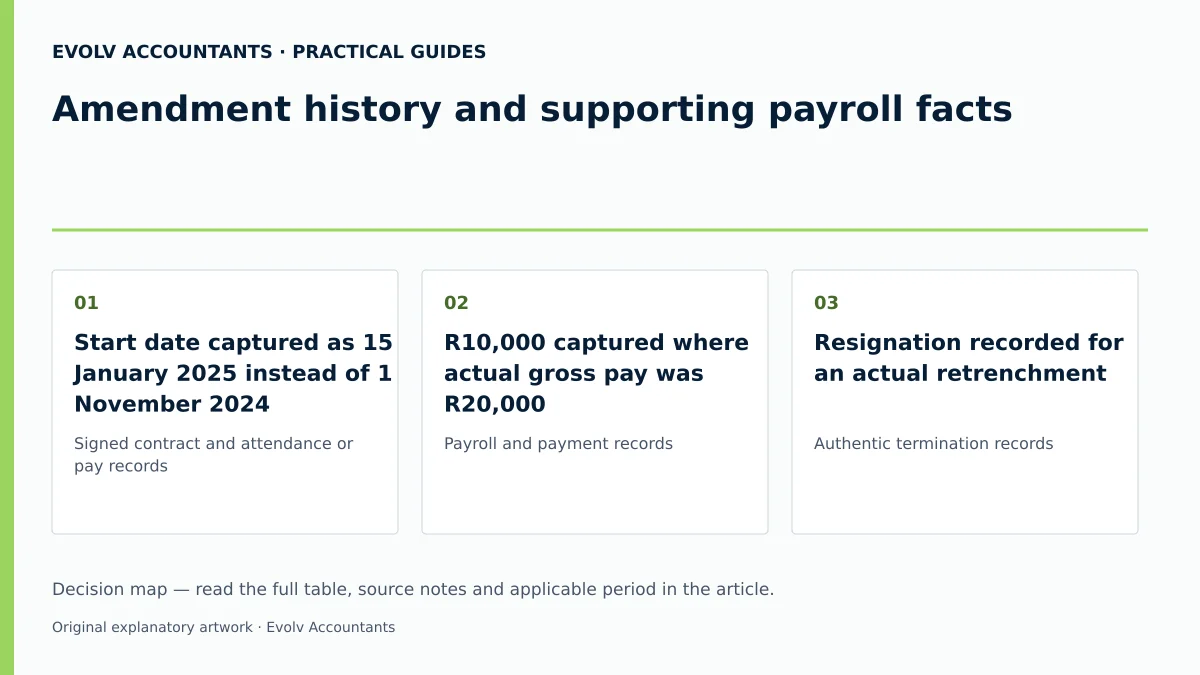
| Start date captured as 15 January 2025 instead of 1 November 2024 | Signed contract and attendance or pay records | Correct the employment start date through the prescribed employee-record route | Retain the actual submission result; do not invent a receipt number |
| R10,000 captured where actual gross pay was R20,000 | Payroll and payment records | Report R20,000 gross pay and calculate the separate UIF base up to R17,712, assuming no other exclusions | Illustrative additional contribution: R77.12 employee plus R77.12 employer; correct affected returns and payment where required |
| Resignation recorded for an actual retrenchment | Authentic termination records | Correct the reason to the applicable prescribed code or description | Retain the revised declaration; benefit entitlement remains for UIF to determine |
Official guidance; Official guidance.
Consequences and remaining exceptions: supporting payroll facts
Downstream financial and tax reconciliations
Updating an employee's remuneration history frequently impacts statutory contribution calculations.
- Contribution Rates and Statutory Ceiling: Under Section 6 of the UIC Act, the mandatory contribution is 1% of remuneration from the employee and 1% from the employer, giving a total contribution of 2% 14 31. Effective 1 June 2021, the maximum statutory earnings ceiling is R17 712 per month (R212 544 per annum) 14 15 32. For any employee earning above R17 712 per month, the monthly contribution is capped at R177.12 for the employee and R177.12 for the employer (total R354.24) 15.
- Interest and Default Penalties: Where a historical remuneration correction reveals an underpayment of monthly contributions to SARS, the employer becomes liable for statutory interest under Section 12 of the UIC Act 23, as well as a mandatory 10% penalty on the unpaid amount under Section 13 of the UIC Act 24. SARS may also issue an estimated assessment under Chapter 8 of the Tax Administration Act 33.
- Annual EMP501 Reconciliation: All corrected UIF contribution amounts must be reconciled against total Employees' Tax deducted and reflected on revised IRP5/IT3(a) certificates during the annual or interim EMP501 reconciliation process 21 34.
Reproducible hypothetical example: Remuneration correction calculation
- Scenario: [Illustrative] An SME employed a commercial worker on a monthly payroll frequency at a gross salary of R20 000 per month. Due to a processing error, the employer captured remuneration as R10 000 on uFiling and understated the aggregate UIF liability on the SARS EMP201 for that month.
- Original (Erroneous) Deduction:
- Reported Salary: [Illustrative] R10 000
- Employee 1% Deduction: [Illustrative] R100.00
- Employer 1% Contribution: [Illustrative] R100.00
- Total UIF Remitted to SARS: [Illustrative] R200.00
- Correct (Statutory Capped) Calculation:
- Actual Remuneration: [Illustrative] R20 000 per month (Exceeds statutory ceiling) 15
- Applicable Earnings Ceiling: R17 712 per month 14 15 32
- Correct Employee 1% Deduction: R177.12 15
- Correct Employer 1% Contribution: R177.12 15
- Correct Total Contribution Due: R354.24 15
- Adjustment Required:
- Employee-portion shortfall in the calculation: [Illustrative] R77.12 (R177.12 − R100.00)
- Additional Employer Contribution Due: [Illustrative] R77.12 (R177.12 − R100.00)
- Principal shortfall payable to SARS (check section 7 before recovering any employee portion): [Illustrative] R154.24
- Statutory Penalty (10% of unpaid amount under Section 13 UIC Act): [Illustrative] R15.42 24
- Statutory Interest: Calculated at prescribed rate from the day following the due date until payment is received 23 35.
- Execution: The employer updates the employee's monthly salary on uFiling to R20 000 (which auto-caps the UIF deductible salary to R17 712) 15 28, submits the amended uFiling declaration 19 30, and files an amended EMP201 return with SARS to pay the R154.24 principal shortfall plus statutory penalty and interest 15 23 24.
Handling complex exceptions and profile changes
In certain circumstances, standard online corrections cannot be completed without manual intervention:
- Banking details: Handle employer payment accounts through the employer banking workflow. The guide’s UI2.8 process concerns the account holder’s own banking-information changes, with portions completed by the bank and account holder; it is separate from correcting employment history. uFiling guide.
- Deceased Estates and Legal Disputes: Where an employee has passed away or a termination code is contested in a Commission for Conciliation, Mediation and Arbitration (CCMA) constructive dismissal proceeding, the employer must submit supporting legal agreements directly to the regional claims officer or UI Commissioner 27 38.
- Ceasing Business Operations: If an employer ceases trading, notification must be submitted to SARS within 14 days under Paragraph 15(3) of the Fourth Schedule and Section 8(2A) of the UIC Act 39.
Next steps for UIF employer duties
Operational governance and control ownership
To ensure ongoing statutory compliance, SMEs should implement structured internal payroll controls:
- Assign a Designated Control Owner: Appoint a qualified internal payroll administrator or external statutory compliance officer responsible for verifying monthly UIF declarations.
- Monthly Recurrence Checks: Establish a mandatory pre-submission check prior to the 7th day of every month to cross-verify uFiling employee totals against SARS EMP201 declarations 1 35 40.
- Five-Year Audit Maintenance: Review historical payroll archives annually to ensure all declaration records and proof of payment receipts are preserved for the mandatory five-year period 17 18.
Frequently Asked Questions
How do I edit a historical monthly UIF declaration on uFiling?
Under uFiling system rules, completed monthly declarations cannot be edited directly on the return screen 28. You must update or correct the underlying employee or employment details in the Declarations Manager (such as remuneration or start dates) 28. Once saved, click Calculate Returns under View Returns to refresh the monthly declaration history, and submit the updated return 19 28 30.
What is the current monthly earnings ceiling for UIF contributions?
With effect from 1 June 2021, the statutory maximum earnings ceiling for UIF contributions is R17 712 per month or R212 544 annually 14 15 32. For employees earning above this threshold, the maximum monthly contribution is capped at R177.12 for the employee (1%) and R177.12 for the employer (1%), giving a total maximum monthly contribution of R354.24 per employee 14 15.
If an employer is registered with SARS for PAYE, where must employee UIF declarations be sent?
While an employer registered with SARS pays monthly UIF contributions directly to SARS via the EMP201 declaration 13 15 16, individual monthly employee-level declaration details (UI-19 record information) must ONLY be submitted directly to the UI Commissioner (via uFiling or electronic UI-19 submissions) 10 41.
What penalties apply if an employer underpays monthly UIF contributions?
If an employer fails to pay the full UIF contribution on time, a statutory penalty of 10% is imposed on the unpaid amount under Section 13 of the UIC Act 24. In addition, statutory interest accrues on the outstanding balance from the day after the due date until payment is received under Section 12 of the UIC Act 23. Failure to submit returns or making false declarations also constitutes an offence punishable by a fine or imprisonment for up to two years 8 9 11.
How long must an employer retain payroll and UIF declaration records?
In terms of Paragraph 14(1) of the Fourth Schedule to the Income Tax Act and Chapter 4 of the Tax Administration Act, employers must retain all records of remuneration paid, UIF contributions deducted, and declaration receipts for a minimum of five years from the date of submission 17 18.
Related guides
- Resolving a UIF registration number mismatch
- When a small business must register for UIF
- Compliance and Regulations: Keeping Your Business on Track
Sources
- https://www.labour.gov.za/DocumentCenter/Publications/Unemployment%20Insurance%20Fund/uFiling%20System%20User%20Guide.pdf
- https://www.sars.gov.za/wp-content/uploads/Ops/Guides/UIF-GEN-01-G01-Guide-for-Employers-in-respect-of-the-Unemployment-Insurance-Fund-External-Guide.pdf
- Unemployment Insurance Fund | South African Revenue Service