
Correcting an IRP5 issued with the wrong income code
29 July 2026

Correcting an IRP5 tax certificate issued with an incorrect income code requires an employer to submit a revised EMP501 declaration via the original submission channel.
When a South African employer discovers that an employee tax certificate contains an incorrect income source code, prompt technical remediation is required to ensure statutory compliance and avoid administrative penalties. Reporting remuneration under an incorrect code can disrupt an employee’s personal tax assessment, trigger automated validation failures with the South African Revenue Service (SARS), or alter the company’s payroll tax liabilities.
Resolving an income code error requires gathering primary source evidence, preserving the original payroll audit trail, submitting an amended IRP5/IT3(a) certificate or a replacement where cancellation is required, through the supported Employer Reconciliation (EMP501) correction process, and verifying that downstream tax accounts balance across Pay-As-You-Earn (PAYE), Skills Development Levy (SDL), Unemployment Insurance Fund (UIF), and Employment Tax Incentive (ETI) records 1 2.
Correct code evidence and replacement certificate history
Erroneous fields and material consequences
Income source codes categorise employee remuneration on IRP5 and IT3(a) tax certificates to ensure proper tax treatment under the Income Tax Act No. 58 of 1962 3 4. An income code error occurs when earnings are misclassified—for example, declaring regular salary under code 3601 when it should reflect as backdated salary under code 3623 (or code 3907 for tax years prior to 2025), miscoding lump sums, or misallocating commission under code 3606 3 5 6 7.
The material consequences of issuing a certificate with an incorrect income code include:
- SARS Employment Taxes Validation (ETV) Failures: SARS runs automated validation checks against submitted certificate data 8. Mismatches between reported income codes, taxable thresholds, and tax directive details trigger validation errors that prevent successful processing 9 12.
- Employee Assessment Errors: Tax certificate data pre-populates directly onto the employee's personal income tax return (ITR12) and cannot be manually edited by the employee 10. An incorrect income code can cause SARS to miscalculate the individual's tax liability or disallow statutory deductions 10.
- Notice of Excessive Liability Change (ELC): If correcting an income code alters the total monthly liabilities declared on previous EMP201 returns, SARS systems generate an ELC notice requiring official justification and supporting documentation 11 13.
Statutory boundaries: Law vs regulator guidance
Employers must distinguish between statutory legislation, SARS administrative guidance, and internal advisory recommendations:
- Statutory Law: Paragraph 14(3) of the Fourth Schedule to the Income Tax Act obliges employers to render accurate annual reconciliation statements reflecting all tax withheld and certificates issued 14. Paragraph 28 governs employee tax deductions, while Paragraph 5(1A) establishes employer personal liability for tax shortfalls 15 16.
- Regulator Guidance: SARS External Guide EMP-GEN-02-G01 specifies procedural rules for electronic filing channels, validation protocols, and certificate formatting 17 18.
- Evolv Recommendations: Evolv Accountants recommends establishing an immutable pre-submission validation protocol and maintaining dedicated digital audit files for all certificate amendments.
Preserve the original records: correct code evidence
Record retention obligations
Under Chapter 4 of the Tax Administration Act No. 28 of 2011 and Paragraph 14(1) of the Fourth Schedule, every employer is legally bound to retain all books of account, remuneration registers, tax deduction records, and issued IRP5/IT3(a) certificates for a minimum period of five years 19 20.
When rectifying a coding error, employers must never attempt to overwrite or delete historical source records. The original payroll run data, original electronic submission files (CSV exports), and SARS acknowledgement receipts must remain fully accessible for audit purposes 21 22.
Certificate numbering rules and history
Every IRP5 and IT3(a) certificate carries a mandatory, unique 30-digit certificate number 23 24:
- First 10 digits: Employer PAYE reference number (or Income Tax reference number) 23 24.
- Next 4 digits: Transaction year (e.g., 2025) 23 24.
- Next 2 digits: Period of reconciliation (08 for interim ending August, 02 for annual ending February) 23 24 25.
- Final 14 digits: Unique alphanumeric string generated by payroll software or the employer 23 24.
SARS provides separate amendment and cancellation routes. Amend the existing certificate where the correction process permits. If a certificate is cancelled, its number may not be reused or allocated to the same or another employee in that reconciliation period; a replacement after cancellation needs a new unique number. Preserve the history in either case. SARS certificate correction rules.
Choose the correct amendment route: replacement certificate history
Submitting via the correct filing channel
Amendments to tax certificates and employer liabilities must be made by submitting a revised EMP501 return with updated or cancelled certificates 2 26. SARS enforces a strict channel restriction rule:
SARS specifies that "the same channel must be used" for subsequent transactions in a reconciliation period 27.
- Channel Continuity: If the original EMP501 for a tax period was submitted via e@syFile Employer, the Request for Correction (RFC) MUST be submitted via e@syFile Employer 27. If submitted via eFiling, the RFC must be processed on eFiling 27. Switching channels within the same reconciliation period is rejected by SARS systems 28.
- Volume Limits: Employers filing via eFiling can only submit reconciliations containing a maximum of 50 IRP5/IT3(a) certificates; employers with more than 50 certificates must use e@syFile Employer 27.
- Historical Submissions: Revisions for transaction years from 2009 onwards require a revised EMP501 return 26. Legacy EMP701 forms apply strictly to 1999–2008 paper-based historical submissions 26 29.
Amendment routes and operational restrictions
Depending on the status of the employer’s account, specific restrictions apply:
- Standard RFC: Available when the original submission is complete and no active SARS restriction exists 2 30.
- Audit in Progress: If SARS has initiated an active audit on the employer's reconciliation, submission of a revised EMP501 is blocked until the audit is finalised 2.
- Voluntary Disclosure Programme (VDP) & Agreed Estimates: An employer cannot use a standard RFC to modify a return submitted under a VDP agreement or an agreed estimate raised by SARS 22 31.
Make and verify the correction: correct code evidence
Step-by-step correction sequence
SME payroll administrators should follow this structured sequence to execute an income code correction:
- Audit Evidence: Gather supporting documentation proving the correct code classification (e.g., employment contract, commission agreement, or SARS tax directive) 9.
- Payroll Recalculation: Adjust the payroll software register to reallocate earnings from the incorrect code to the correct code, ensuring total gross remuneration remains accurately balanced 32.
- Access Original Channel: Log into eFiling or e@syFile Employer depending on the channel used for the original submission 27.
- Amend or Cancel Certificate: Amend the certificate where supported. If cancellation and replacement are required, issue the replacement under a new unique number and do not reuse the cancelled number 2 21 24.
- Update EMP501 Financials: Recalculate the overall EMP501 statement to ensure certificate totals equal monthly declared liabilities across PAYE, SDL, and UIF 1. Submit the EMP501 Request for Correction 2 33.
- Issue Replacement to Employee: Provide the finalised replacement IRP5/IT3(a) certificate to the employee 2.
Payroll Manager Action Checklist
- [ ] Confirm the specific income code error and verify correct code criteria against SARS source code guides 3 34.
- [ ] Retrieve the original CSV file and SARS submission receipt for the applicable tax year 21.
- [ ] Verify that no active SARS audit or VDP restriction is open for the tax period 2 31.
- [ ] If a certificate was cancelled, ensure its replacement receives a new unique number; otherwise use the supported amendment process 23 24.
- [ ] Re-balance EMP501 totals and submit the revised return via the original submission channel 1 27.
- [ ] Download ETV feedback letters and verify that the status reflects "Correction Filed" or "Processed" 35 36.
- [ ] Deliver the replacement certificate to the employee and advise them to submit a revised ITR12 if already assessed 2.
Consequences and remaining exceptions: replacement certificate history
Downstream account and payment checks
Correcting an income code may alter statutory balances across tax types:
- PAYE, SDL, and UIF Alignment: The sum of values on individual certificates must equal the total monthly liabilities declared on EMP201s and payments remitted to SARS 1.
- ETI Adjustments: If the code change affects qualifying remuneration for the Employment Tax Incentive, ETI calculated and utilized fields must be adjusted accordingly 31 37 38 39.
- Employer Tax Refund Restriction: Under Paragraph 28 of the Fourth Schedule, employers are strictly prohibited from refunding over-deducted PAYE directly to employees after the end of the tax year 32 40 41 42. Over-deducted tax can only be refunded by SARS to the employee upon assessment of their personal ITR12 return 32 40 42.
- Under-deduction Shortfalls: If the code change reveals that PAYE was under-deducted, the employer remains personally liable to SARS for the shortfall under Paragraph 5(1A) of the Fourth Schedule, with a right of recovery from future employee remuneration subject to a SARS directive 15 16 43. Unrecovered amounts are treated as non-deductible penalties under section 23(d) of the Income Tax Act 15.
Reproducible Hypothetical Example
Note: All financial values in this example are illustrative. Tax thresholds and rates reflect applicable statutory parameters.
An SME employer in the 2025 tax year paid an employee a backdated salary adjustment of R30,000 relating to prior tax years. On the original annual IRP5 certificate, the payroll administrator incorrectly included this R30,000 under code 3601 (regular taxable salary) instead of applying for a tax directive and reporting it under code 3623 (antedated salary) 5 7.
- Original Record: Total gross income reported under code 3601 was R280,000. Original 30-digit certificate number ended in ...00000000000001 23 24.
- Error Identification: The classification and missing directive information were incorrect for the assumed prior-year accrual; the applicable directive determines the tax treatment under Paragraph 9(3)(a) of the Fourth Schedule 5 6.
- Corrective Action:
- The employer applies for a SARS tax directive for the antedated salary 5 7.
- On e@syFile, the employer cancels certificate ...00000000000001 21.
- A replacement certificate is issued under number ...00000000000002, reflecting Code 3601 at R250,000, Code 3623 at R30,000, and attaching the directive number 7 9 21 24.
- Reconciliation Impact: For this illustrative coding-only case, assume the directive and recalculation confirm that aggregate PAYE remains R35,500; if PAYE changes, correct the affected liabilities as well 39 44. The EMP501 RFC balances perfectly, and SARS processes the replacement certificate 1 45.
Artefact: Correction audit trail
| Illustrative error | Evidence required | Supported correction | Downstream check |
|---|---|---|---|
| Salary or backdated remuneration reported under the wrong income code | Payroll facts and any actual SARS directive | Use the source code required for that payment and tax year; copy the directive details accurately where applicable | Recalculate affected tax and compare the amended certificate with payroll and declarations |
| A genuinely qualifying exempt bursary reported as a taxable benefit | Bursary terms, recipient facts and the applicable exemption requirements | Correct the taxable/exempt classification and the corresponding supported source code | Keep the qualification evidence and check any tax change |
| An issued certificate needs correction | Original certificate, correction reason and prior submission result | Use a supported amendment; if cancellation is required, preserve its trail and do not reuse the cancelled number | Submit the revised reconciliation through the required channel and inspect the processing result |
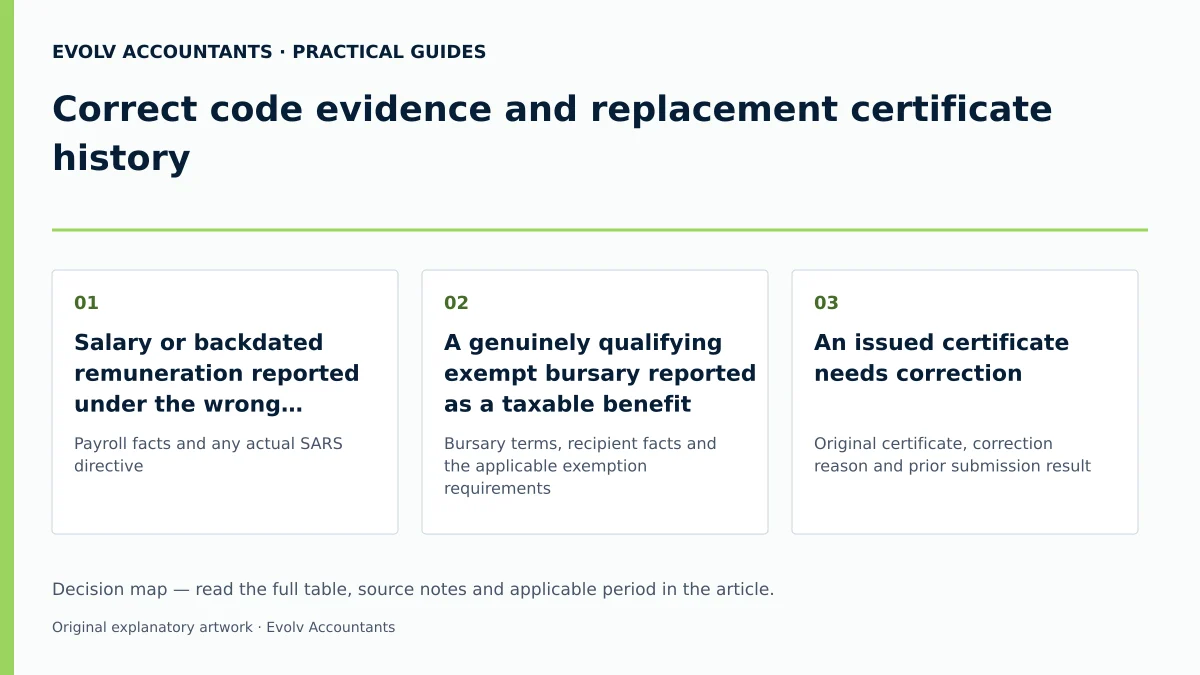
Official guidance; Official guidance; Official guidance; Official guidance.
Next steps for Employer reconciliations
Control ownership and recurrence checks
To prevent future code misallocations, SMEs should designate a senior Payroll Control Owner (such as the Financial Manager or Tax Practitioner) to conduct a mandatory pre-reconciliation audit prior to the bi-annual (August / period 08) and annual (February / period 02) SARS filing windows 25 54.
Frequently Asked Questions
What happens if an employee has already submitted their ITR12 before the code is corrected?
Once the employer successfully submits the revised EMP501 and replacement IRP5, SARS updates its master pre-population data 2. The employer must provide the replacement certificate to the employee and instruct them to submit a Request for Correction (RFC) on their personal eFiling ITR12 return to refresh the certificate data 2 55.
Can I reuse the original 30-digit certificate number if I am only changing one code?
A straightforward amendment and a cancellation are different processes. Use the supported amendment route where available. If the original certificate is cancelled, SARS prohibits reusing that cancelled number in the same reconciliation period; a replacement then needs a new unique number. SARS certificate rules.
Can an employer refund over-deducted PAYE to an employee after the tax year ends?
No. Employers are legally prohibited from paying PAYE refunds to employees after the conclusion of the tax year of assessment 32 40 41 42. Over-deducted employees' tax must be claimed by the individual directly from SARS upon assessment of their personal income tax return 32 40 42.
Why does eFiling block my EMP501 correction submission?
eFiling will block a revised EMP501 if the original return was submitted via e@syFile Employer, if more than 50 certificates are attached, or if an active SARS audit is currently open against the employer's account 2 27 28. You must use the original filing channel and resolve any active SARS audit cases before submitting an RFC 2 27.
Does correcting an income code automatically alter my monthly EMP201 liabilities?
Not necessarily. Reclassifying an income code can leave tax unchanged, but it can also alter taxable remuneration, directive treatment or other liabilities. Recalculate PAYE, SDL, UIF and any affected ETI using the actual facts and the directive; matching gross pay alone does not establish that EMP201 liabilities remain correct. SARS correction guidance.
Related guides
- IRP5 versus IT3(a) certificates
- Submitting an EMP201 employer declaration
- Compliance and Regulations: Keeping Your Business on Track
Sources
- https://www.sars.gov.za/wp-content/uploads/Ops/Guides/EMP-GEN-02-G01-A-Guide-to-the-Employer-Reconciliation-Process-External-Guide.pdf
- Guide for Employers in Respect of Employees' Tax (2027) | South African Revenue Service
- https://www.sars.gov.za/wp-content/uploads/Ops/Guides/UIF-GEN-01-G01-Guide-for-Employers-in-respect-of-the-Unemployment-Insurance-Fund-External-Guide.pdf
- https://www.sars.gov.za/wp-content/uploads/Ops/Guides/SDL-GEN-01-G01-Guide-for-Employers-in-respect-of-Skills-Development-Levy-External-Guide.pdf
- COMPLETING THE MONTHLY EMPLOYER DECLARATION (EMP201) | South African Revenue Service