
IRP5 versus IT3(a) certificates
29 July 2025

Determining whether to issue an IRP5 or IT3(a) certificate requires employers to evaluate whether tax was withheld from employee remuneration.
An Employees' Tax Certificate must be issued for every employee or worker to whom remuneration was paid or accrued during the tax year 1 2. When an employer deducts or withholds Pay-As-You-Earn (PAYE) or tax on lump sum benefits, South African Revenue Service (SARS) regulations mandate the issuance of an IRP5 certificate reflecting the tax withheld 3 4.
Conversely, where remuneration is paid or accrued but no employees' tax is deducted—due to non-taxable earnings, statutory thresholds, specific exemption certificates, or tax directive provisions—the employer must issue an IT3(a) certificate containing a mandatory reason code for non-deduction under source code 4150 4 5.
Tax withheld versus no tax withheld certificate cases
Understanding the distinction between an IRP5 and an IT3(a) certificate is fundamental to maintaining payroll compliance under South African tax law 1 6. Neither certificate type represents a choice or commercial preference for the business; rather, each reflects the factual tax treatment of an employee's remuneration during the applicable tax period 4.
— Practical point from this guide
An IRP5 certificate applies exclusively to cases where employees' tax was deducted or withheld from remuneration 4. This includes regular monthly PAYE deducted under standard statutory tax tables (source code 4102) or tax withheld on lump sum and severance benefits (source code 4115) 4 7. The presence of a positive tax value under these source codes legally defines the document as an IRP5 certificate, and source code 4150 (reason for non-deduction) must not be included 4 5.
An IT3(a) certificate applies to cases where remuneration was paid or accrued, but zero employees' tax was withheld 4 5. To submit an IT3(a) certificate successfully, the employer must populate source code 4150 with an approved SARS reason code explaining why tax was not withheld, while omitting tax deduction codes 4101, 4102 and 4115 as the validation rule requires 4 5.
Both certificate types must be included in the employer's bi-annual reconciliation submissions 1 8. The interim reconciliation covers the first six months of the tax year (March to August, period 08) and is submitted during September and October 8 9. The annual reconciliation covers the full twelve-month tax year (March to February, period 02) 8 9.
While interim certificates are submitted strictly to SARS, final certificates for period 02 must be furnished to employees to facilitate the prepopulation of their annual personal income tax returns (ITR12) 10 11.
Compare the criteria that matter: tax withheld
Selecting the correct tax certificate category requires comparing key operational, legal, and cash flow criteria across payroll processing and employer reconciliation duties 1 6.
- Control Constraints: Employers control payroll administration and monthly withholding calculations 6. However, under Paragraph 7 of the Fourth Schedule to the Income Tax Act, employers and employees are strictly prohibited from entering into private agreements undertaking not to deduct PAYE or Unemployment Insurance Fund (UIF) contributions 3. Any such agreement is legally void 3.
- Liability Constraints: When issuing an IRP5, the employer acts as a statutory collection agent, remitting withheld PAYE to SARS 3 12. If an employer fails to deduct required tax and mistakenly issues an IT3(a), the employer becomes personally liable to SARS for the tax shortfall 13 14. If the employer cannot recover this shortfall from the employee, the unrecovered amount is deemed a non-deductible penalty in the hands of the employer under section 23(d) of the Income Tax Act 14 15.
- Reporting & Validation Constraints: SARS Employment Taxes Validation (ETV) rules validate certificate data upon submission 16. An IRP5 is rejected if tax withheld exceeds the total reported remuneration 17. An IT3(a) is rejected if source code 4150 is missing or contains an invalid reason code 4 5.
- Tax & Cash Flow Constraints: PAYE declared on IRP5 certificates must be remitted monthly via the EMP201 declaration within 7 days following the end of each calendar month 6 12. For IT3(a) cases, no monthly PAYE is paid, but statutory levies such as Skills Development Levy (SDL) and UIF may still be due 18 19 20.
- Submission Channel Constraints: Reconciliations containing up to 50 certificates can be submitted via SARS eFiling 21. Reconciliations exceeding 50 certificates must be submitted using e@syFile Employer 22, whereas SARS branches accept a maximum of 5 manual certificates 23.
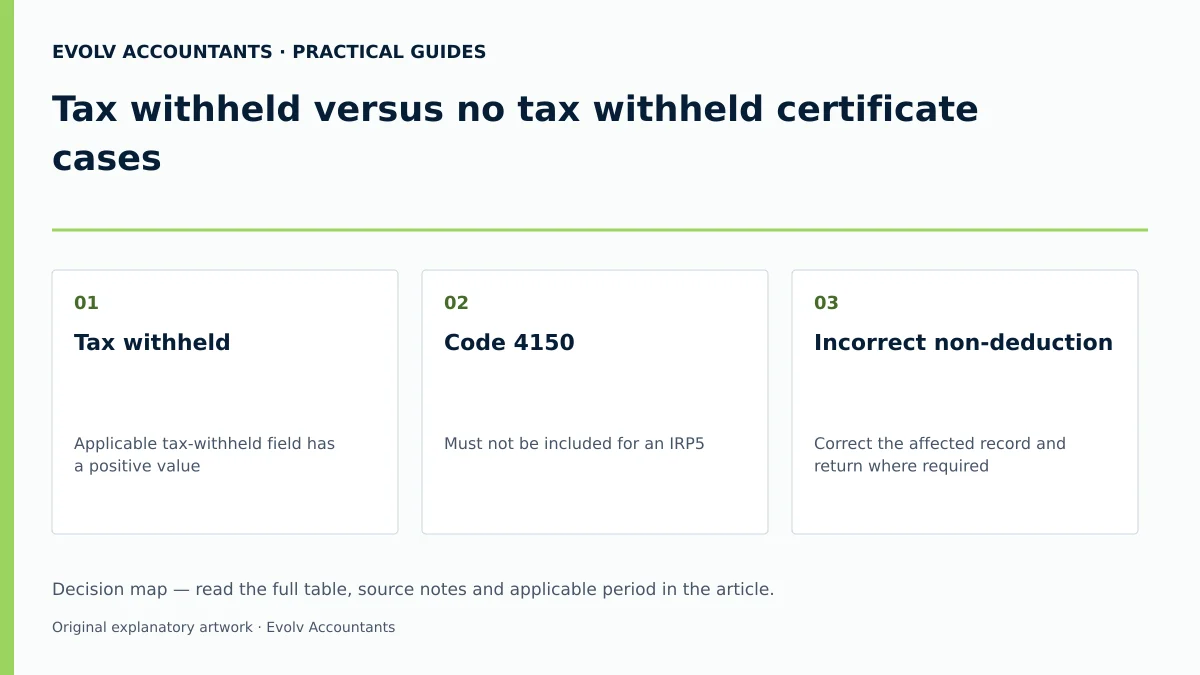
Decision comparison matrix
| Criterion | IRP5 | IT3(a) | Practical check |
|---|---|---|---|
| Tax withheld | Applicable tax-withheld field has a positive value | No tax withheld; complete the required non-deduction field | Test the certificate type against the actual payroll facts and current BRS |
| Code 4150 | Must not be included for an IRP5 | Required with a reason permitted for the tax year and circumstances | Do not use a generic reason-code range or assume reason 04 covers ordinary below-threshold wages |
| Incorrect non-deduction | Correct the affected record and return where required | Employer liability may arise if tax should have been withheld | A zero-tax certificate does not itself establish a valid exemption |
| UIF and SDL | Test separately under their own scope and bases | Test separately under their own scope and bases | Zero PAYE does not automatically exempt UIF or SDL; SDL is an employer expense |
| Final annual certificate | Issue the applicable final certificate to the employee | Issue the applicable final certificate to the employee | Check submission processing and inform employees about subsequent corrections |
Official guidance; Official guidance; Official guidance.
How the obligations differ: no tax withheld certificate cases
Distinguishing legal statutes, regulator administrative guidance, and professional advisory recommendations is essential for correct payroll administration 1 6.
Statutory law
The Fourth Schedule to the Income Tax Act No. 58 of 1962 mandates that employers deduct employees' tax from all remuneration paid to employees 6. The Unemployment Insurance Contributions Act No. 4 of 2002 mandates a total monthly UIF contribution of 2% (1% deducted from the employee and 1% contributed by the employer) on remuneration up to the statutory ceiling 19 20 25.
Effective from 1 June 2021, the maximum earnings ceiling for UIF contributions is R17,712 per month (R212,544 annually), capping the maximum monthly employee deduction at R177.12 19 26. The Skills Development Levies Act No. 9 of 1999 imposes a 1% levy on total leviable remuneration for employers whose total annual salary bill is expected to exceed R500,000 over a 12-month period 18 27.
Regulator guidance
SARS external guides (EMP-GEN-02-G01, SDL-GEN-01-G01, and UIF-GEN-01-G01) specify that IT3(a) certificates must record one of the following official reason codes under source code 4150 5 24 28:
- Code 03: Independent contractor earnings or director fees paid to a resident Non-Executive Director (NED) where no voluntary PAYE was requested 28 29.
- Code 04: Non-taxable earnings, including qualifying nil directives. From transaction year 2024, the guide restricts this value to cases with directive information or non-taxable income under 3696 with zero taxable income under 3699. Do not use it merely because a taxable salary falls below the personal tax threshold. SARS non-deduction validation rules.
- Code 05: Exempt foreign employment income under section 10(1)(o) 28.
- Code 07: Labour brokers operating with a valid SARS exemption certificate (IRP30) 24 31.
- Code 08: No tax withheld due to Medical Scheme Fees Tax Credits or applicable Additional Medical Expenses Tax Credits 24.
- Code 09: Paragraph 11A(5) Fourth Schedule notification where no withholding is possible 24.
- Code 10: Section 11(nA) clawback or recoupment of overpaid remuneration under source code 4588 (applicable from the 2026 year of assessment) 24 32.
Evolv professional recommendations
Evolv Accountants recommends that South African SMEs conduct a thorough pre-reconciliation audit of all worker contracts prior to submitting interim (period 08) and annual (period 02) EMP501 returns 1 8. Employers must ensure that workers receiving IT3(a) certificates under code 03 (independent contractors) or code 07 (labour brokers) maintain valid written contracts and current SARS exemption documentation on file to withstand SARS payroll audits 15 31.
Two business situations with different outcomes: tax withheld
To illustrate how statutory criteria change reporting outcomes, consider a South African SME with an annual payroll exceeding R500,000 (subject to 1% SDL) employing two individuals during the tax year 18 27.
Situation 1: Full-time staff member (Tax withheld — IRP5)
- Facts: Employee A is employed full-time at a salary of R25,000 per month (R300,000 annually).
- PAYE Calculation: Monthly earnings exceed personal tax thresholds, resulting in standard monthly PAYE deductions under statutory tax tables 3 6.
- UIF Calculation: Remuneration exceeds the R17,712 monthly ceiling 19 26. The monthly UIF deduction is capped at R177.12 (1% of R17,712) for the employee and R177.12 for the employer, totalling R354.24 under source code 4141 19 25 26 33.
- SDL Calculation: Calculated at 1% of total remuneration (R250.00 per month) under source code 4142 18 33.
- Outcome: Because PAYE was deducted, the employer must issue an IRP5 certificate reflecting code 4102 (PAYE > R0), code 4141 (UIF), and code 4142 (SDL) 4 7 33. Source code 4150 must be omitted 4.
Situation 2: Entry-level part-time worker (No tax withheld — IT3(a))
- Facts: Employee B works part-time, earning a salary of R3,500 per month (R42,000 annually).
- PAYE Calculation: Total annual remuneration is below the statutory personal income tax threshold, resulting in zero PAYE deductions (R0.00) 5.
- UIF Calculation: Monthly earnings are below the R17,712 ceiling. The 1% employee deduction (R35.00) plus 1% employer contribution (R35.00) equals R70.00 monthly under source code 4141 19 25 33.
- SDL Calculation: Included in leviable payroll at 1% (R35.00 per month) under source code 4142 18 27 33.
- Outcome: Because remuneration was paid but zero PAYE was withheld, issuing an IRP5 is invalid 4. The employer must issue an IT3(a) certificate recording code 4141 (UIF) and code 4142 (SDL), while populating source code 4150 with the reason permitted by the current SARS BRS for a taxable salary below the tax threshold; do not automatically select reason 04 4 5 28.
When the comparison needs specialist input: no tax withheld certificate cases
Certain complex employment arrangements require technical tax advice to prevent misclassification and audit penalties 34 35.
- Non-Executive Directors (NEDs): Director fees paid to a resident NED are not classified as standard remuneration, and employers are not obligated to withhold PAYE unless the NED submits a written request for voluntary tax deduction 29. If voluntary PAYE is deducted, an IRP5 is issued under code 3620 29. If no voluntary PAYE is deducted, the employer may issue an IT3(a) using reason code 03 under code 4150 28 29. Fees paid to non-resident NEDs remain subject to compulsory PAYE under code 3621, requiring an IRP5 29.
- Labour Brokers & Independent Contractors: Payments to independent contractors are reported on an IT3(a) under code 3616 with reason code 03 28 31. Payments to labour brokers without a valid exemption certificate require PAYE withholding under code 3617 (IRP5) 31. If the labour broker provides a valid SARS IRP30 exemption certificate, payments are made without PAYE under code 3619, requiring an IT3(a) with reason code 07 24 31.
- Tax directives and arbitration awards: Classify the actual payment and obtain the required directive before payment. A severance benefit and a taxable arbitration award are different. Use the income source code and tax treatment on the directive; SARS’s employer guide distinguishes taxable arbitration awards under 3608 and non-taxable amounts under 3602 from severance benefits. Do not apply3901/4115 indiscriminately to every CCMA award. SARS employer guidance.
Next steps for Employer reconciliations
To establish an audited compliance framework for employer reconciliations, SMEs should execute the following operational steps 1 8:
- Audit Payroll Records: Categorise all active and terminated workers into tax-withheld (PAYE > R0) and no-tax-withheld (PAYE = R0) categories for the reconciliation period 1 4.
- Assign Reason Codes: Verify that every no-tax-withheld worker is assigned a valid SARS reason code (01–10) under source code 4150 4 5 24.
- Verify Contribution Ceilings: Confirm that UIF remuneration is capped at R17,712 per month (R212,544 annually) and that SDL is correctly calculated at 1% for annual payrolls exceeding R500,000 18 19 27.
- Reconcile Monthly Declarations: Balance total EMP201 liabilities declared and payments made against the aggregate totals on all IRP5 and IT3(a) certificates 1 43.
- Select Submission Channel: Submit the EMP501 reconciliation via eFiling (for up to 50 certificates) 21 or e@syFile Employer (for over 50 certificates) 22.
- Distribute Final Certificates: Once SARS successfully processes the annual reconciliation, furnish copies of the final period 02 IRP5 and IT3(a) certificates to all employees 10 11.
Frequently Asked Questions
Can an employer issue an IRP5 certificate if zero tax was deducted from an employee's salary?
No. An IRP5 certificate is valid only when an amount greater than zero is recorded for PAYE (code 4102), SITE (code 4101), or tax on lump sums (code 4115) 4. If zero tax was withheld, the system requires an IT3(a) certificate with a valid reason code under source code 4150 4 5.
What happens if an employer mistakenly issues an IT3(a) certificate when PAYE was actually withheld?
Submitting an IT3(a) certificate that reflects tax deductions is invalid under SARS validation rules 4. The employer must submit a Request for Correction (RFC) on the EMP501 reconciliation to revise the certificate type to IRP5 and issue the corrected certificate to the employee 16 39.
Are employers required to pay UIF and SDL for workers who receive an IT3(a) certificate?
Non-deduction of PAYE does not itself decide UIF or SDL. Test UIF worker and remuneration exclusions and the contribution ceiling separately. For SDL, test the employer’s liability and exemptions and the employee’s leviable remuneration. Some IT3(a) recipients, including genuine independent contractors, may fall outside UIF employee status. SARS UIF guide; SARS SDL guide.
How does SARS handle direct employer tax refunds if an over-deduction of PAYE is discovered after the tax year ends?
Employers are legally prohibited from refunding over-deducted PAYE directly to employees after the end of the tax year in which the over-deduction occurred 13 41. The correction must be reflected on the period 02 tax certificate, and SARS processes any resulting tax refund directly to the employee upon assessment of their personal ITR12 return 13 41.
What administrative penalties apply for failing to submit accurate IRP5/IT3(a) certificates on time during the EMP501 reconciliation?
A late final EMP501 can attract a recurring administrative non-compliance penalty, calculated with reference to the reconciliation period’s employees’ tax and capped in aggregate at 10%. A separate10% late-payment penalty applies to amounts paid late or remaining unpaid; it does not arise merely because a fully paid reconciliation was submitted late. SARS penalty guidance.
Related guides
- Setting up the first payroll for a small business
- Submitting an EMP201 employer declaration
- Compliance and Regulations: Keeping Your Business on Track
Sources
- https://www.sars.gov.za/wp-content/uploads/Ops/Guides/EMP-GEN-02-G01-A-Guide-to-the-Employer-Reconciliation-Process-External-Guide.pdf
- https://www.sars.gov.za/wp-content/uploads/Ops/Guides/UIF-GEN-01-G01-Guide-for-Employers-in-respect-of-the-Unemployment-Insurance-Fund-External-Guide.pdf
- Guide for Employers in Respect of Employees' Tax (2027) | South African Revenue Service
- COMPLETING THE MONTHLY EMPLOYER DECLARATION (EMP201) | South African Revenue Service
- Unemployment Insurance Fund | South African Revenue Service
- Skills Development Levy | South African Revenue Service
- https://www.sars.gov.za/wp-content/uploads/Ops/Guides/SDL-GEN-01-G01-Guide-for-Employers-in-respect-of-Skills-Development-Levy-External-Guide.pdf