
Documents SARS may request during VAT verification
10 May 2025

A South African Revenue Service VAT verification requires a vendor to present complete source records that substantiate all declared output tax and input tax claims.
When the South African Revenue Service (SARS) selects a Value-Added Tax (VAT) return for verification or audit, vendors must provide an organised evidence pack linking every declared entry on the VAT201 return to valid primary accounting records. This pack includes tax invoices, customs bills of entry, proof of payment, bank statements and supporting schedules structured to satisfy statutory record-keeping obligations.
A claim linked verification evidence index
Purpose identification and regulatory authority
When SARS issues a verification request following the submission of a VAT201 return, the primary objective is to confirm the accuracy of declared output tax and input tax deductions 1. Verifications are typically scoped to a single tax period 2. Identifying the exact purpose of the review—whether it is a routine refund verification, an input tax audit, or a vendor registration check—determines the precise documentary evidence required 1 3 4. SARS VERIFICATION SCOPE & PURPOSE
— Practical point from this guide
| Review Trigger | Primary Verification Objective |
|---|---|
| VAT Refund Claim | Validate input tax claims and bank details |
| Output Tax Discrepancy | Verify sales registers and tax invoices |
| Importation Deduction | Match bills of entry to eFiling VAT receipts |
| Registration / Audit | Confirm enterprise continuity and records |
Distinguishing statutory law, SARS guidance and Evolv advisory
Small and medium-sized enterprises (SMEs) must distinguish between binding statutory legislation, administrative SARS guidance and professional advice:
Documents grouped by purpose: a claim linked verification evidence index
Mandatory primary accounting records
To substantiate figures entered on a VAT201 return, vendors must maintain mandatory primary accounting documents 12 13:
- Full Tax Invoices: Required for all taxable supplies where the consideration exceeds R5,000 14. A valid full tax invoice must state the words "Tax Invoice", "VAT Invoice" or "Invoice"; the name, address and 10-digit VAT registration number of the supplier; the name, address and VAT registration number of the recipient; an individual serialised number and date of issue; a full description of the goods or services; the quantity or volume supplied; and the price and VAT charged 14 15.
- Abridged Tax Invoices: Permissible for taxable supplies where consideration is under R5,000 14. It must contain the supplier's details, date, serial number, description of goods or services, and price with VAT, but recipient details are not mandatory 14.
- Importation Records: To claim input tax on imported goods, vendors must hold an EDI Customs Status 1 Release Message, a valid bill of entry (such as Form SAD 500), and an eFiling receipt confirming payment of VAT to SARS Customs 16 17. If an agent acts on behalf of the vendor, a monthly statement from the agent containing these particulars must be held 18 19.
- Second-Hand Goods Documentation: To deduct notional input tax on second-hand goods acquired under a non-taxable supply, the vendor must maintain a signed Form VAT264 declaration, proof of payment, a copy of the supplier’s identity document (or CIPC business registration for entities), and a declaration that the supply is non-taxable 16 20 21.
Conditional statutory forms and operational records
Specialized transactions require specific statutory forms and operational evidence:
- Third-Party Banking Indemnity (Form VAT119i): SARS prohibits refund payments into third-party bank accounts except for foreign entities or group companies (holding or subsidiary companies) 22 23. In such cases, an executed Form VAT119i indemnity and formal corporate authorisation must be submitted 22 23.
- Voluntary Disclosure Programme (VDP) Records: Where a VAT201 return reflects disclosures under a VDP agreement, the written agreement and mandatory VDP application number must be supplied 24 25.
- Diesel Refund Scheme Logbooks: Vendors registered for the diesel refund concession must maintain strict usage and storage logbooks proving qualifying primary production activities 26.
Recommended reconciliation schedules
Evolv recommends attaching detailed internal working papers to the evidence pack:
- Monthly VAT201 reconciliation matching general ledger output and input tax accounts to fields 1 through 18 of the return 27.
- Detailed sales registers and purchase/expense journals.
- Bank statements highlighting matching payments for claimed inputs.
- The latest eFiling Statement of Account (VATSOA) 28 29.
Check identity period and consistency: documented completion and exceptions
Cross-checking transaction details and registration alignment
Before uploading documents to SARS, vendors must perform internal quality checks:
- Verify that the vendor’s legal entity name, trading name, business address and banking details match SARS records exactly 30. Statutory changes to registered particulars must be communicated to SARS within 21 business days 30 31.
- Ensure tax invoices are issued in South African Rand (ZAR), except for specific zero-rated or non-resident electronic services 32. Tax invoices must be issued within 21 days of making a supply 33.
DOCUMENT CONSISTENCY CHECKLIST
| Validation Parameter | Requirement / Verification Standard |
|---|---|
| Legal Entity & VAT Number | Must match SARS Notice of Registration |
| Currency Standard | Must be in ZAR (unless exempt/zero-rated) |
| Issuance Window | Issued within 21 days of supply |
| Time Limit for Input Claim | Within 5 years from first entitlement date |
| Past Period Revision Rule | No input tax increases allowed on revisions |
Timeframes for input tax claims and historical revisions
Input tax must be claimed within five years from the date of first entitlement 34 35. When revising a previously submitted VAT201 return:
- Vendors may revise returns for past tax periods within five years for VAT and two years for diesel claims 36.
- Crucially, a vendor is not permitted to increase an input tax deduction on a past period revision 34 35. Additional input tax attributable to a past period must instead be deducted in a current or future VAT201 return, provided it falls within the five-year window 34 35.
Managing documentary exceptions via statutory rulings
If a vendor is unable to obtain prescribed tax invoices or import documents due to circumstances beyond its control, the vendor may apply to SARS for a Section 16(2)(g) ruling allowing alternative documentary proof 11 37. This application must be lodged at least two months prior to the expiration of the five-year entitlement period 37.
Build a reviewer ready evidence pack: a claim linked verification evidence index
Standardized indexing and file naming conventions
A reviewer-ready evidence pack enables SARS auditors to navigate files quickly. Files should be saved in digital format (PDF, JPG or PNG) not exceeding eFiling size limits, using clear naming conventions:
(VAT201Field)_[DocumentType]_[Supplier/InvoiceNo]_[Date].pdf Example: Field15_TaxInvoice_SupplierABC_INV1024_20260315.pdf
Electronic submission via eFiling and online query systems
When SARS issues a document request letter, a container opens under "Supporting Documents" on the eFiling VAT201 work page 10. Alternatively, supporting documents can be submitted via the SARS Online Query System (SOQS) 38.
- SARS Verification Request Received
- Access eFiling / SOQS Container
- Upload Claim-Linked Evidence Index
- Click 'Submit to SARS' & Confirm
- Status Updates to 'Submitted'
Step-by-step evidence pack preparation checklist
- Review Request Notice: Download the official SARS correspondence letter to identify the specific tax period and requested scope 2 10.
- Extract Trial Balance & Reconciliations: Reconcile VAT ledger accounts directly to the filed VAT201 return fields 27.
- Assemble Tax Invoices & Customs Records: Gather valid full tax invoices for all local purchases exceeding R5,000, along with SAD 500 bills of entry and eFiling receipts for imports 14 16.
- Compile Conditional Forms: Include Form VAT264 for second-hand goods or Form VAT119i for third-party bank accounts if applicable 20 22.
- Format & Index Files: Rename digital files according to VAT201 return field numbers and construct a cover index sheet.
- Upload & Transmit: Upload all indexed files to eFiling or SOQS and click "Submit to SARS" 38 39. Confirm that the work page status reflects "Submitted" 39.
Missing or contradictory records: documented completion and exceptions
Section 95 estimated assessments and extension requests
If a vendor fails to submit requested supporting documents or submits incomplete records, SARS is empowered under Section 95(1)(c) of the Tax Administration Act to issue an estimated assessment (Notice of Assessment VAT217) 40.
If a vendor requires additional time to gather authentic supporting material following an estimated assessment, the vendor may submit a formal "Request for Extension" via eFiling 40 41. Once an extension is granted by SARS, a revised submission date is locked into the system 42.
Authentic record reconstruction versus prohibited documentation
When records are missing or damaged, vendors must authentically reconstruct evidence:
- Contact original suppliers to obtain certified duplicate tax invoices marked clearly as "Duplicate" 43.
- Obtain official bank statements and customs clearing agent statements 18.
Vendors are strictly prohibited from creating fictitious invoices, modifying transaction amounts, or using non-factual business plans and unawarded tender proposals as proof of turnover 44.
Correcting mistakes via eFiling and VDP
If an error or omission is detected in a previously filed return, vendors can request a correction via eFiling 31 45. Where a default involves substantial tax liabilities, vendors may seek relief through the Voluntary Disclosure Programme (VDP) prior to SARS initiating an audit 24.
Purpose mapped evidence checklist
| Record | Why it is needed | Required or conditional | Owner | Verification and reference |
|---|---|---|---|---|
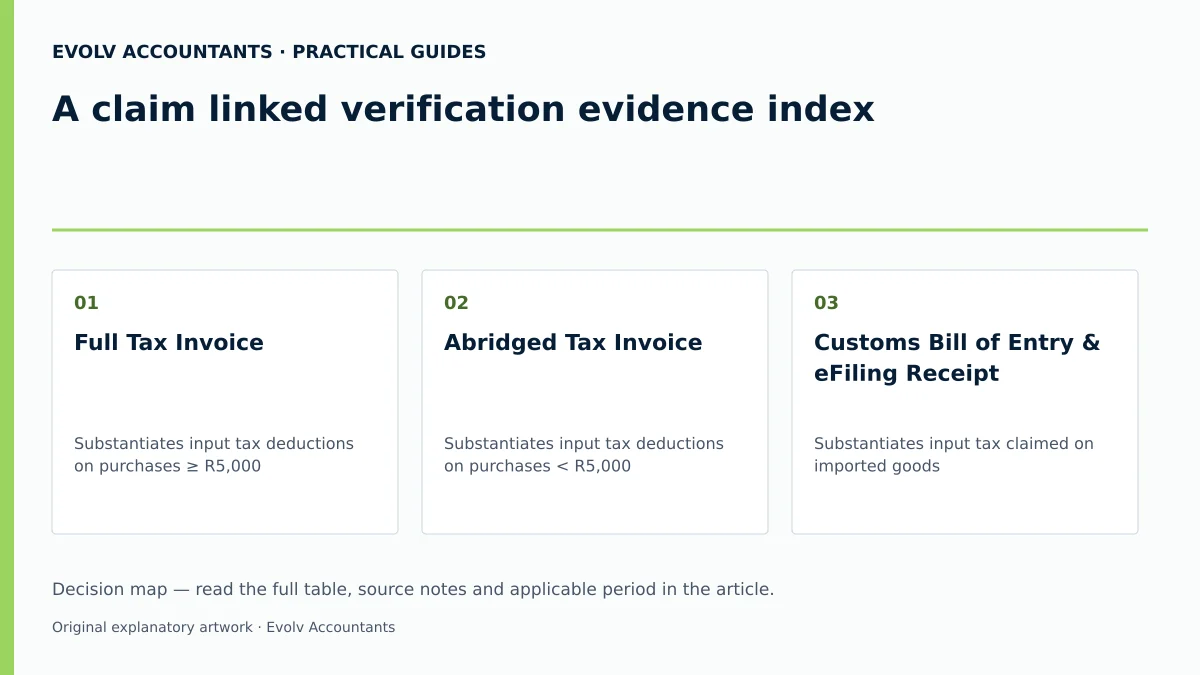
| Full Tax Invoice | Substantiates input tax deductions on purchases ≥ R5,000 | Mandatory for claims ≥ R5,000 | Finance / Procurement | Section 20(4); must contain 7 statutory fields 14 |
| Abridged Tax Invoice | Substantiates input tax deductions on purchases < R5,000 | Mandatory for claims < R5,000 | Finance / Procurement | Section 20(5); supplier details and VAT shown 14 |
| Customs Bill of Entry & eFiling Receipt | Substantiates input tax claimed on imported goods | Mandatory for imports | Logistics / Customs Agent | Form SAD 500 & eFiling VAT payment receipt 16 17 |
| Form VAT264 & Supplier ID | Substantiates notional input tax on second-hand goods | Conditional (non-taxable supplies) | Accounts Payable | Signed declaration, payment proof, ID copy 16 20 |
| Form VAT119i Indemnity | Authorises refund payment into third-party bank account | Conditional (group/foreign entities) | Executive / Treasury | Group indemnity & bank approval 22 23 |
| VAT201 Reconciliation Schedule | Links ledger balances to declared VAT201 return fields | Recommended | Tax / Accounting Lead | Internal schedule matching Fields 1–18 27 |
Practical example: Apex Industrial Solutions (Pty) Ltd
Apex Industrial Solutions (Pty) Ltd, a South African SME registered for VAT on the Category B bi-monthly cycle, submitted its VAT201 return for the March/April tax period. The return reflected the following figures:
- Field 1 (Standard Rate Output Tax): Sales of R1,000,000 excluding VAT. Output tax declared at 15% = R150,000 46 47.
- Field 14 (Capital Input Tax): Purchase of new machinery for R230,000 inclusive of VAT. Input tax claimed = R30,000 27.
- Field 15 (Other Goods/Services Input Tax): Local operational expenses of R345,000 inclusive of VAT. Input tax claimed = R45,000 27.
- Field 14A (Imported Capital Goods Input Tax): Imported specialized equipment with custom VAT paid of R60,000 27.
- Field 20 (Net Calculated Position): Output tax (R150,000) minus total input tax (R135,000) = R15,000 net VAT payable to SARS 48.
Two weeks after submission, SARS selected the return for input tax verification 1. To comply, Apex assembled a claim-linked evidence pack:
- VAT201_MarchApril_Declaration.pdf
- GL_to_VAT201_Reconciliation_Schedule.pdf
- Top5_Customer_Tax_Invoices.pdf
- Machinery_TaxInvoice_INV8821.pdf
- Expense_Tax_Invoices_Sample.pdf
Apex uploaded the indexed pack via eFiling 10 39. Because the pack directly matched every declared field to valid primary records, SARS finalised the verification without audit adjustments 1.
Next steps for VAT refunds
The 21-business-day refund workflow and interest rules
When a VAT201 return results in a net refund position, SARS is required by law to pay the refund within 21 business days of receiving the correctly completed return and all requested supporting documents 3 49. As SARS states in its vendor guide, "SARS is required to pay that VAT refund within 21 business days after receiving the correctly completed VAT return" 49.
If SARS fails to pay the refund within 21 business days, statutory interest is payable to the vendor at the prescribed rate 3 50. However, the 21-day counter is put on hold or recalculated if 3 51:
- The VAT return is incomplete or defective 3 51.
- Banking details are missing, unverified, or incorrect 3 51.
- The vendor has outstanding returns across any tax type 3 51.
- SARS is denied access to the vendor’s books and records 51.
- An active audit or verification remains pending 3.
REFUND TIMELINE & INTEREST RULES
| Operational Trigger | Impact on 21-Business-Day Counter |
|---|---|
| Valid Return Submission | Counter begins |
| Audit / Verification | Counter paused until audit finalised |
| Missing Banking Details | Counter paused until details verified |
| Outstanding Returns | Counter recalculated upon filing completion |
| Exceeds 21 Days (Clean) | SARS must pay statutory interest to vendor |
Status tracking, upload confirmation and statutory retention
Vendors can monitor refund progress on eFiling via the Refund Dashboard 50 52. Uploading files changes the eFiling document status to "Submitted", but this does not constitute final SARS approval or acceptance 3 39.
All verification packs, returns, bank statements and supporting invoices must be retained in original or approved digital form for at least five years 5 43.
Frequently Asked Questions
How long does SARS have to process a VAT refund once supporting documents are uploaded?
SARS is required to process and pay a valid VAT refund within 21 business days of receiving all requested supporting documents 3 49. If SARS exceeds this window without a valid statutory reason (such as outstanding returns or unverified bank details), interest is payable to the vendor 3 50 51.
Can input tax be claimed if a supplier invoice lacks our VAT registration number?
For supplies of R5,000 or more, a tax invoice must contain the recipient’s name, address and VAT registration number to be valid for input tax claims 14. If these details are missing, input tax will be disallowed upon verification unless a valid corrected invoice is obtained from the supplier 13 14.
What happens if a business cannot submit supporting documents within the deadline set by SARS?
If a vendor cannot meet the submission deadline following an estimated assessment, the vendor should log into eFiling and submit a formal "Request for Extension" under Section 95 40 41. Failing to respond may result in SARS disallowing input tax or issuing a Section 95(1)(c) estimated assessment 40.
Can a business claim input tax on second-hand goods bought from an unregistered individual?
Yes, a vendor can claim notional input tax on second-hand goods acquired from a non-vendor 16 20. The vendor must complete and retain a signed Form VAT264, proof of payment, a copy of the seller’s identity document, and a declaration that the supply is non-taxable 16 20.
May a business use its parent company's bank account to receive SARS VAT refunds?
Refunds are generally paid only into the vendor's own bank account 3 22. However, third-party bank accounts are permitted for subsidiary or holding companies within a group structure, provided a Form VAT119i indemnity and formal corporate resolution are submitted to SARS 22 23. Ask Evolv about a claim linked verification evidence index. Share the relevant records so the support required can be scoped.
Related guides
- Why a VAT refund can be delayed
- Responding to a VAT supporting document request
- The Proactive SARS Audit Guide: Keeping Your Business Ledger Sanitised
Sources
- https://www.sars.gov.za/wp-content/uploads/Ops/Guides/Legal-Pub-Guide-VAT404-VAT-404-Guide-for-Vendors.pdf
- VAT Refunds for vendors | South African Revenue Service
- https://www.sars.gov.za/wp-content/uploads/Ops/Guides/VAT-REG-02-G01-Guide-for-Completion-of-VAT-Application-External-Guide.pdf
- https://www.sars.gov.za/wp-content/uploads/Ops/Guides/GEN-ELEC-04-G01-Guide-for-completing-the-Value-Added-Tax-VAT201-Declaration-External-Guide.pdf
- FAQs for VAT vendors | South African Revenue Service