
Explaining unusual bank statement transactions to a lender
4 August 2026

Explaining unusual bank statement transactions to a lender requires providing authentic accounting evidence to prove the underlying commercial purpose of line items.
When South African small and medium enterprises (SMEs) apply for commercial credit, bank overdraft facilities, or public infrastructure funding, lenders and credit committees perform rigorous scrutiny of business bank statements. Unusual transactions—such as lump-sum owner drawdowns, high-value asset purchases, unexpected supplier payments, or round-figure inter-company transfers—frequently trigger credit risk queries.
To satisfy lender due diligence during the 2026 reporting period, SME directors and financial managers must present bank statements alongside structured accounting reconciliations, primary source documentation, verified tax compliance records, and clear cash flow activity classifications aligned with International Financial Reporting Standards (IFRS) and South African company law.
Authentic transaction purpose and supporting records
This practical guide is prepared for South African SME owners, directors, and finance managers operating within the Republic of South Africa for the 2026 reporting period. Completing the task of explaining unusual bank statement transactions means transforming raw bank line items into an authenticated evidence package that proves legitimate commercial intent, statutory record compliance, and financial stability to external credit assessors.
— Practical point from this guide
To ensure clarity during funding reviews, SMEs must distinguish between statutory legal obligations, official regulator guidance, and professional accounting advisory recommendations:
- Statutory Company Law: Under the Companies Act 71 of 2008, South African profit companies are legally required to maintain complete and accurate accounting records in an official language 1, retain company records for seven years 2, and prepare Annual Financial Statements (AFS) within six months after financial year-end 3 that present fairly the state of affairs and business 4. Section 22 explicitly prohibits carrying on business recklessly or trading under insolvent circumstances 5.
- Regulator Guidance: The South African Revenue Service (SARS) Tax Compliance Status (TCS) system requires taxpayers to maintain "Good Standing" by ensuring all tax returns are submitted, no unmanaged debt is outstanding, and registered particulars remain up to date on eFiling 6 7. For public funding schemes, the Department of Small Business Development (DSBD) Business Infrastructure Support Programme (BISP) guidance requires qualifying micro and small enterprises (annual turnover up to R10m) seeking infrastructure grants (R1m to R23m) or machinery support (R1m to R5m) to submit signed financial statements, regulatory compliance permits, and technical cost breakdowns 8 9. Note that programme funding parameters do not create a universal lender rule, and funding availability remains subject to administrative windows and budget allocations.
- Evolv Recommendations: Bookkeeping frameworks, bank account reconciliations, transaction clarification memorandums, and 13-week cash flow forecasts represent professional advisory workflows recommended by Evolv Accountants to streamline credit approval. These workflows support credit applications but do not constitute statutory procedures or lender guarantees.
Prepare the information and authority: authentic transaction purpose
Before engaging with a credit analyst or funding officer, SME management must assemble primary records, verify administrative authorities, and establish clear accounting definitions.
Primary Documents and Inputs
Preparing an authentic transaction package requires gathering the following underlying evidence:
- Bank Statements: Official bank statement extracts covering the required review period (typically 3 to 12 months).
- Primary Accounting Records: Corresponding tax invoices, purchase orders, signed commercial contracts, receipts, and proof of delivery matching general ledger entries 1.
- Statutory Financial Statements: Signed Annual Financial Statements or management accounts prepared by an accountant 3 9 10.
- Tax Compliance Evidence: A valid SARS Tax Compliance Status (TCS) Good Standing Security PIN generated via SARS eFiling 6 11.
- Corporate Approvals: Signed board resolutions or shareholder minutes authorising significant financial transactions, director advances, or asset acquisitions 10 12.
Required Permissions and Governance Authority
Accessing and sharing these records requires formal corporate authority. Directors must ensure that eFiling profile permissions are active to access "My Compliance Profile" (MCP) 13, bank mandate signatories are authorised to retrieve historical statement data, and executive management has signed off on the financial disclosure package 9 10.
Key Accounting and Legal Definitions
- Cash and Cash Equivalents: Under IAS 7 Statement of Cash Flows, cash comprises "cash on hand and demand deposits" 14.
- Cash Flow Classifications: IAS 7 requires sorting cash movements into operating activities (principal revenue-producing operations), investing activities (acquisition and disposal of long-term assets), and financing activities (changes in equity and borrowings) 15. Non-cash investing and financing items are excluded from cash flow statements but disclosed separately 16.
- Solvency and Liquidity Test: Defined under Section 4 of the Companies Act 71 of 2008, a company satisfies the test if its fairly valued assets equal or exceed liabilities, and it can pay its debts as they fall due in the ordinary course of business for 12 months 17 18.
- Tax Compliance Status (TCS) PIN: A security PIN issued under the SARS TCS system introduced in 2015, enabling authorised third parties to view live tax compliance standing via eFiling without exposing confidential underlying returns 19 20.
Complete the task step by step: supporting records
To provide lenders with verified transaction evidence, follow this structured, five-step accounting process grounded in South African primary regulatory standards:
- Isolate Statement Exceptions and Reconcile Accounts:
Compare bank statement line items against the general ledger cash account. Compile a dedicated exception schedule listing all high-value, non-recurring, or unusual transactions (such as bulk equipment deposits, owner drawdowns, or rounded inter-account transfers) 1.
- Collate Underlying Source Evidence:
Retrieve the exact tax invoice, contract, or payment voucher for each flagged transaction. Verify that vendor names, tax numbers, and registration numbers match statutory records, satisfying Section 32 of the Companies Act 71 of 2008 21.
- Classify Transactions Aligned to IFRS IAS 7:
Categorise each exception into operating, investing, or financing activities 15. For instance, classify long-term equipment purchases under investing activities and loan receipts or director advances under financing activities 15. Ensure non-cash asset swaps are noted separately for narrative disclosure 16.
- Generate a SARS TCS Good Standing Security PIN:
Access SARS eFiling, select the "TAX STATUS" menu, and review "My Compliance Profile" (MCP) 6 13. Verify that all returns are submitted and no unmanaged debt exists 7. Request a "Good Standing" TCS PIN to share with the lender for real-time verification 11 20.
- Compile an Indexed Transaction Clarification Memorandum:
Draft a concise memorandum cross-referencing each bank statement line item to its ledger code, supporting document ID, cash flow classification, and commercial rationale. Ensure the memorandum is signed by an authorised director 10.
Check the result against the evidence: authentic transaction purpose
Submitting documents to a lender does not equal funding acceptance. True completion must be verified through independent accounting and legal checks before submission:
- Bank Reconciliation Verification: Confirm that general ledger bank accounts reconcile fully with official bank statements, leaving zero unexplained variance 1.
- Statutory Record Compliance: Ensure all supporting accounting records are stored in an accessible written or electronic format in accordance with the seven-year retention requirement under Section 24(1) of the Companies Act 71 of 2008 2.
- Third-Party Tax Verification Test: Perform a trial verification of the generated SARS TCS PIN on eFiling to confirm that external credit analysts will see a green "Compliant" profile 19 20.
- Solvency and Liquidity Alignment: Verify that large cash outflows or distribution transactions documented on statement entries did not compromise the company's Section 4 solvency and liquidity standing 17 18.
- Lender Evaluation Boundary: Lenders perform independent credit checks, cross-examine invoice dates against statement value dates, and verify TCS PINs directly on SARS systems. The ultimate credit decision remains within the institutional discretion of the lender.
Handle exceptions and unresolved cases: supporting records
Unusual bank transactions frequently involve edge cases or missing information. Handle these scenarios using structured accounting remedies:
- Missing Invoices or Historical Receipts: Where original tax invoices cannot be located, compile secondary proof including bank confirmation receipts, supplier statement reconciliations, and a sworn director affidavit confirming the commercial nature of the expense 1.
- Director Loans and Financial Assistance: Transactions involving loans to directors or related entities must satisfy Section 45 of the Companies Act 71 of 2008. Ensure board resolutions exist and Section 4 solvency and liquidity requirements were met at the time of authorisation 12 17 22.
- Unresolved SARS Non-Compliance: If "My Compliance Profile" displays a red non-compliant status due to outstanding tax debt, formalize an agreed payment arrangement or suspension of debt with SARS 7. Provide the lender with the official SARS arrangement agreement alongside the TCS PIN 6 7.
- Disputed or Fraudulent Transactions: For unauthorized withdrawals or fraudulent bank debits, attach the official bank dispute reference number, police affidavit, and subsequent insurance or bank credit correspondence 5.
- Specialist Boundaries: Bookkeeping compilation and cash flow reporting are Evolv accounting recommendations. Where edge cases involve formal tax disputes, Section 45 solvency challenges, or criminal fraud, escalate the matter to registered tax practitioners, independent auditors, or legal specialists 10 23.
Next steps for Funding ready records
Reproducible Hypothetical Example
During the 2026 reporting period, Evolv SME Trading (Pty) Ltd applied for a commercial banking facility. The credit provider reviewed bank statements for June 2026 and flagged two unusual line items: a R250,000 debit payment and a R150,000 credit deposit.
- Clarification of R250,000 Debit: The transaction represented an upfront deposit for specialized manufacturing machinery. Evolv mapped the item as an investing cash flow under IAS 7 15. Supporting evidence included the supplier tax invoice, delivery note, and asset register entry, satisfying Section 28 accounting record standards 1.
- Clarification of R150,000 Credit: The deposit represented an unsecured director loan injection to fund seasonal inventory working capital. Evolv mapped the item as a financing cash flow under IAS 7 15. Supporting evidence included a signed director loan agreement and board resolution complying with Section 45 principles 12.
- Outcome: Backed by a valid SARS eFiling Good Standing TCS Security PIN 6 20 and signed AFS 3, the clarification package allowed the credit committee to verify the transactions without delaying the funding assessment.
Task and Completion Checklist
| Step | Input or evidence | Responsible person | Completion check | Exception or next action |
|---|---|---|---|---|
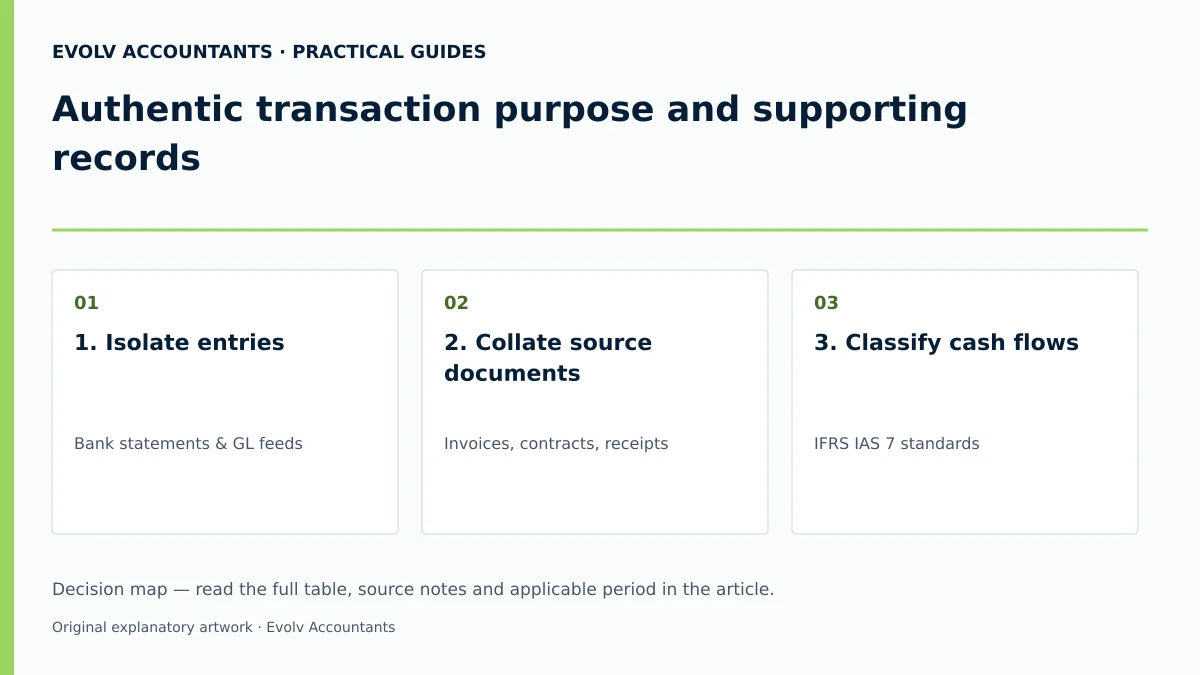
| 1. Isolate entries | Bank statements & GL feeds | Bookkeeper / Finance Lead | Exception schedule compiled | Cross-check unmatched statement lines |
| 2. Collate source documents | Invoices, contracts, receipts | Accounts Officer | Invoice details match bank entry | Secure vendor statement if invoice lost |
| 3. Classify cash flows | IFRS IAS 7 standards | Accountant | Operating/Investing/Financing set 15 | Note non-cash items separately 16 |
| 4. Verify tax standing | SARS eFiling profile | Tax Administrator / Director | Green MCP status & TCS PIN generated 6 13 | Request SARS payment agreement if debt exists 7 |
| 5. Finalise memorandum | Transaction memo & AFS | Finance Director | Signed memo cross-referenced to GL 4 | Escalate legal/tax disputes to specialists 23 |
Frequently Asked Questions
What qualifies as an unusual transaction on a business bank statement?
An unusual transaction is any entry that deviates from regular trading patterns, such as high-value non-recurring asset purchases, lump-sum owner withdrawals, round-number transfers between accounts, or sudden bulk payments to unfamiliar vendors 1.
Why do lenders require a SARS Tax Compliance Status PIN?
Lenders use the SARS TCS Security PIN to independently verify via SARS eFiling that the business has submitted all required returns and has no unmanaged tax debt, confirming overall regulatory Good Standing 6 7 20.
How are bank statement cash flows classified under IFRS IAS 7?
IAS 7 classifies cash flows into operating activities (core revenue movements), investing activities (long-term asset purchases/sales), and financing activities (equity and debt changes) 15.
What statutory records must South African SMEs retain for bank audits?
Under Section 24(1) of the Companies Act 71 of 2008, companies must keep all documents, books, and accounting records for at least seven years in a form that allows conversion into written text 2.
Does submitting explained bank transactions guarantee funding approval?
No. Submitting complete, verified accounting evidence enables the lender to complete due diligence, but funding approval remains subject to the lender's internal risk and credit underwriting criteria. Ask Evolv about authentic transaction purpose and supporting records. Share the relevant records so the support required can be scoped.
Related guides
- Raising growth capital in South Africa in 2026
- Preparing management accounts for a funding application
- Reading the Financials: Cash Flow and the Balance Sheet for Directors