
Preparing management accounts for a funding application
3 January 2025

Preparing management accounts for a South African SME funding application requires a reliable period close and complete financial disclosures.
South African small and medium-sized enterprises (SMEs) applying for growth capital, credit facilities, or public sector enterprise support must supply accurate, period-end financial records 1. Management accounts serve as interim reporting mechanisms that connect past annual financial statements with real-time operational performance 2 3.
Establishing an orderly accounting period close ensures underlying ledger transactions align with statutory requirements, tax authority records, and accounting standards, presenting an intelligible summary of enterprise solvency and liquidity 2 4 5 6.
Reliable period close and intelligible management reports
This guide addresses South African SME directors, financial managers, and business owners preparing financial records for funding evaluation. The legal and regulatory scope is anchored in South Africa under the Companies Act 71 of 2008 6 7, national tax compliance under the South African Revenue Service (SARS) Tax Compliance Status (TCS) system 8 9, and accounting principles specified in the International Financial Reporting Standards (IFRS) Conceptual Framework 10 and IAS 7 Statement of Cash Flows 11.
— Practical point from this guide
The accounting period under evaluation encompasses interim trading intervals alongside statutory financial years determined by a company's Notice of Incorporation or notice of change filings 12 13. Achieving a completed period close means that all commercial transactions for the specified timeframe have been posted, balance sheet accounts reconciled to primary evidence, statutory tax obligations verified, and structured management accounts signed off by management or an accountant 1 2 14.
Prepare the information and authority: reliable period close
Required Statutory and Corporate Documents
Before commencing a period close, management must gather primary authority records required under South African company law:
- Governance Records: The Memorandum of Incorporation (MOI) and registration certificate issued by the Companies and Intellectual Property Commission (CIPC) 15 16.
- Statutory Accounting Books: Accounting records kept in an official language, retained for the mandatory seven-year statutory period under Companies Act Section 24(1) and Section 24(3)(c)(iii) 7 17.
- Annual Financial Statements: Approved annual financial statements for preceding financial years, prepared within six months of year-end under Section 30(1) 3 14.
Regulatory Tax Compliance Inputs
Tax compliance verification requires online access to SARS eFiling services:
- My Compliance Profile (MCP): Visual profile displaying real-time compliance across registered tax types 18.
- Good Standing TCS PIN: Active Tax Compliance Status PIN issued via eFiling to enable third-party verification 9 19 20.
Funder and Grant Evidence
Where applying for grant support or credit facilities, applicant SMEs must compile supporting operational inputs. For example, under the Department of Small Business Development Business Infrastructure Support Programme (BISP), qualifying micro-enterprises (turnover up to R10m) and small enterprises (turnover up to R10m) must supply signed financial statements or management accounts signed by an accountant, Central Supplier Database (CSD) compliance documentation, and technical designs or cost breakdowns where applicable 1 21.
Framework Accounting Definitions
Under the IFRS Conceptual Framework, management accounts must adhere to standard financial element definitions 22:
- Assets: Present economic resources controlled by the entity as a result of past events 22.
- Liabilities: Present obligations of the entity to transfer an economic resource as a result of past events 22.
- Equity: The residual interest in the assets of the entity after deducting all its liabilities 22.
- Income and Expenses: Increases or decreases in assets, or decreases or increases in liabilities, resulting in changes in equity 22.
Complete the task step by step: intelligible management reports
Step 1: Reconcile General Ledger and Bank Balances
Reconcile all primary transaction journals and bank accounts (Evolv recommendation). Verify that double-entry general ledger postings in South African Rand (ZAR) are complete and compliant with Companies Act Section 28(1) 6. Confirm that cash on hand and demand deposits meet the definition of cash and cash equivalents under IAS 7 11.
Step 2: Format Management Financial Statements
Structure the draft management statements in accordance with Companies Act Section 29(1) 2. Ensure the statements present fairly the state of affairs and business position 2. Affix a prominent notice on the first page stating the accounting period covered, the name and professional designation of the individual who prepared or supervised the preparation, and whether the statements are unaudited, independently reviewed, or audited per Section 29(1)(e) 23.
Step 3: Classify Cash Flows According to IAS 7
Group interim cash receipts and payments into three operational categories under IAS 7 24:
- Operating Activities: Principal revenue-producing activities of the business, reported using either the direct method or the indirect method starting from operating profit or loss 24 25.
- Investing Activities: Acquisition and disposal of long-term physical or financial assets 24.
- Financing Activities: Capital receipts or repayments that alter the equity structure or borrowings of the enterprise 24.
Exclude non-cash investing and financing transactions from the cash flow statement and disclose them separately in summary notes 26.
Step 4: Verify SARS Tax Compliance Status
Log into SARS eFiling to view the My Compliance Profile (MCP) 18. Confirm that all required tax returns (Income Tax, Value-Added Tax, Pay-As-You-Earn) are submitted and that no unagreed tax debt is outstanding 27. Request a Good Standing TCS PIN under the eFiling TAX STATUS menu 19 20.
Step 5: Compile the Funding Reporting Pack
Assemble the signed period-close financial statements, the IAS 7 cash flow schedule, the active SARS Good Standing TCS PIN, and forward-looking hypothetical cash flow projections into a single funding pack (Evolv recommendation) 1 20 24.
Check the result against the evidence: reliable period close
To confirm that the management accounts are funding-ready, verify the completed reporting pack against independent evidence:
- Bank Verification: Ensure closing bank balance figures match independent bank statements and cash equivalent reconciliations under IAS 7 11 26.
- Solvency and Liquidity Statutory Test: Perform the solvency test under Companies Act Section 4(1)(a) to confirm that fairly valued assets equal or exceed fairly valued liabilities 4. Verify liquidity under Section 4(1)(b) to ensure the entity can pay debts as they fall due over the ensuing 12 months 5.
- Statutory First-Page Disclosure: Check that page one of the financial statements carries the mandatory notice specifying compiler credentials and review or audit status under Companies Act Section 29(1)(e) 23.
- SARS eFiling TCS Verification: Test the generated TCS PIN on SARS eFiling to confirm that third parties viewing the profile see an overall "Good Standing" status 8 9.
- Formal Management Sign-Off: Confirm that management accounts bear the signature of an authorised director or professional accountant as required by corporate practice and programme guidelines such as BISP 1 14.
Handle exceptions and unresolved cases: intelligible management reports
Non-Compliance Flags on SARS Profile
If the My Compliance Profile reflects a red non-compliance indicator, review the specific line item on eFiling 18 28. Where tax reference numbers are unlinked, complete the ERC01 form or use the Merge tool on eFiling 27. If an outstanding debt exists, negotiate a formal payment arrangement or suspension of debt with SARS before requesting a Good Standing TCS PIN 27.
Non-Cash and Barter Transactions
In cases involving non-cash asset swaps, debt conversions, or depreciation adjustments, remove these items from the IAS 7 cash flow statement 26. Present non-cash items in separate explanatory notes to preserve the integrity of liquid cash flow reporting 26.
Adjusted or Extended Accounting Periods
If the board changes the company's financial year end under Companies Act Section 27(4), verify that the altered financial year does not exceed 15 months from the preceding financial year end 13.
Distinguishing Legal, Regulatory, and Advisory Boundaries
It is essential to distinguish between legal obligations, regulator instructions, and professional accounting recommendations:
- Statutory Law: Companies Act 71 of 2008 sets legal duties for 7-year record retention 7, Section 28 accounting record keeping 6, Section 29 financial statement disclosures 2 23 29, and Section 30 annual financial statement timelines 3.
- Regulator Guidance: SARS eFiling TCS rules dictate PIN generation and tax compliance verification 8 9 19 20. Programme-specific guidelines, such as DSBD BISP rules for micro and small enterprises (maximum turnover R10m; grant support ranges of R1m to R23m for built infrastructure, R1m to R5m for equipment/machinery, and R1m to R10m for energy solutions) 1 21, represent specific funder criteria. Programme records do not establish a universal credit rule across all commercial lenders, nor do they guarantee funding approval or assert that a funding window remains open.
- Evolv Advisory Recommendations: Internal period-close checklists, 13-week rolling cash forecasts, and interim management pack compilation reflect Evolv professional guidance rather than statutory requirements.
Next steps for Funding ready records
Reusable Reader Task Checklist
- Retrieve CIPC registration documents, MOI, and preceding annual financial statements 3 15 17.
- Complete period-end general ledger postings and reconcile all bank accounts to independent bank statements 6 11.
- Prepare interim management statements bearing the Section 29(1)(e) prominent compiler notice 23.
- Draft the IAS 7 statement of cash flows classifying operating, investing, and financing activities 24.
- Verify SARS eFiling My Compliance Profile and generate an active Good Standing TCS PIN 18 19 20.
- Conduct the Section 4 solvency and liquidity test 4 5.
- Obtain formal sign-off on management accounts from an authorised director or accountant 1 14.
Task and Completion Checklist
| Step | Input or evidence | Responsible person | Completion check | Exception or next action |
|---|---|---|---|---|
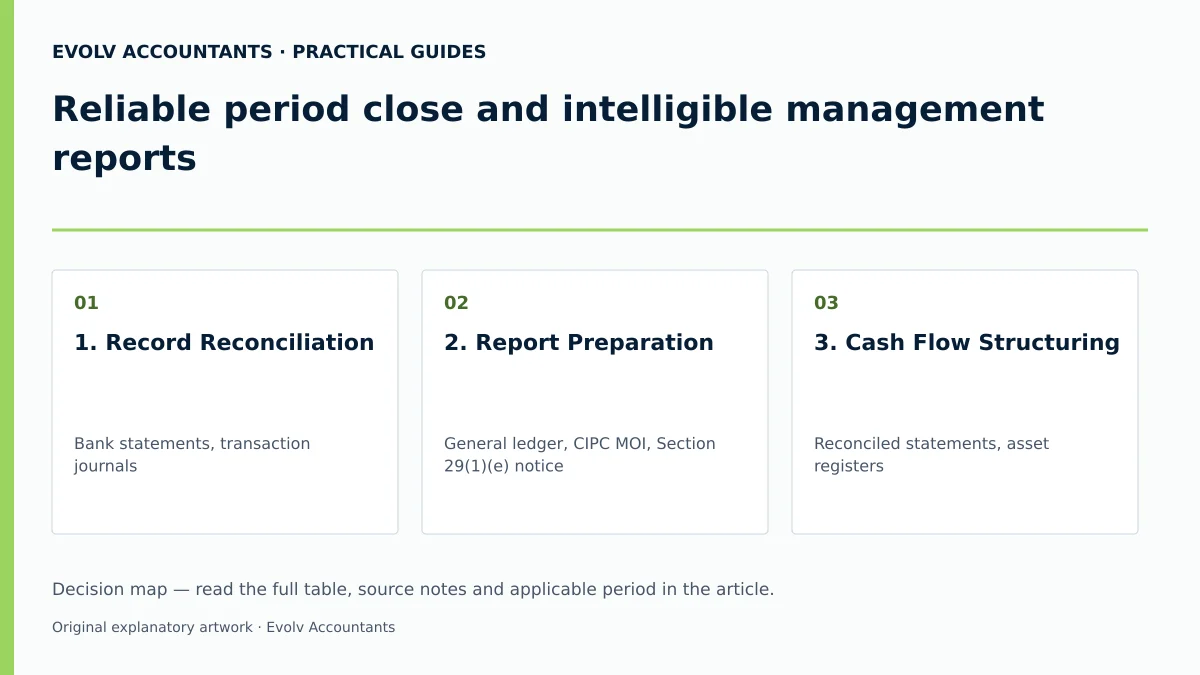
| 1. Record Reconciliation | Bank statements, transaction journals 6 11 | Bookkeeper / Accountant | All cash accounts reconciled to ZAR ledger balances | Investigate unreconciled items; clear timing differences |
| 2. Report Preparation | General ledger, CIPC MOI, Section 29(1)(e) notice 2 15 23 | Financial Manager / Accountant | Statements show assets, liabilities, equity, income, expenses | Add compiler name, designation, and review status notice |
| 3. Cash Flow Structuring | Reconciled statements, asset registers 24 | Accountant | Cash flows classified into operating, investing, financing | Exclude non-cash items; disclose in separate note 26 |
| 4. Tax Verification | SARS eFiling profile, tax returns 18 27 | Tax Practitioner / Public Officer | My Compliance Profile reflects full tax compliance | Resolve red flags; submit missing returns or request debt stay 27 |
| 5. TCS PIN Generation | SARS eFiling TAX STATUS menu 19 20 | Tax Practitioner / Director | Good Standing TCS PIN issued and verified online | Check reference links via Merge/ERC01 tool if denied 27 |
| 6. Solvency Review | Management accounts, 12-month cash forecast 4 5 | Board of Directors | Assets exceed liabilities; 12-month liquidity confirmed | Adjust capital structure or debt terms if insolvent |
| 7. Funder Submission Pack | Signed management accounts, TCS PIN 1 14 | Managing Director | Complete pack signed by director or accountant | Submit to funder; log confirmation of receipt |
Reproducible Hypothetical Example
An illustrative South African private company, Example Services (Pty) Ltd, prepares management accounts for an interim six-month period ending 30 September (all values are labelled illustrative estimates):
- Statement of Financial Position (Illustrative Values):
- Control Assets (Equipment & Cash): R2,500,000 (comprising R2,100,000 physical equipment and R400,000 bank demand deposit) 11 22.
- Liabilities (Trade Payables & Bank Loan): R1,000,000 (comprising R300,000 current payables and R700,000 long-term loan) 22.
- Residual Equity: R1,500,000 (Assets of R2,500,000 less Liabilities of R1,000,000) 22.
- Solvency Check: Assets (R2,500,000) exceed Liabilities (R1,000,000) by R1,500,000, satisfying Companies Act Section 4(1)(a) 4.
- Statement of Cash Flows per IAS 7 (Illustrative Values):
- Operating Activities: Net cash inflow of R350,000 generated from customer collections less supplier payments 24.
- Investing Activities: Cash outflow of R150,000 for machinery purchase 24.
- Financing Activities: Cash outflow of R50,000 for bank loan principal repayment 24.
- Net Increase in Cash: R150,000 (R350,000 operating less R150,000 investing less R50,000 financing) 24. Adding opening cash of R250,000 yields closing cash of R400,000 matching the balance sheet 11 24.
- Tax Compliance Verification:
- SARS eFiling profile verified; Good Standing TCS PIN generated with no outstanding returns 19 20 27.
- Compilation Notice:
- First page contains prominent notice: "Unaudited Management Accounts for the 6 months ended 30 September, prepared under the supervision of A. Director, General Manager" per Section 29(1)(e) 23.
Frequently Asked Questions
What mandatory notice must appear on the first page of management accounts?
A1: Under Section 29(1)(e) of the Companies Act 71 of 2008, financial statements must bear a prominent notice on page one stating whether the statements are audited, independently reviewed, or unaudited, along with the name and professional designation of the person who prepared or supervised their preparation 23.
How long must an SME retain its statutory accounting records in South Africa?
A2: Under Companies Act Section 24(1) and Section 24(3)(c)(iii), accounting records must be kept in written form (or convertible electronic form) for seven years, covering the current financial year and the previous seven completed financial years 7 17.
How are cash flows classified under IAS 7 for a funding pack?
A3: IAS 7 requires cash flows to be classified into operating activities (principal revenue-producing operations), investing activities (long-term asset acquisitions/disposals), and financing activities (equity and borrowing changes) 24. Non-cash transactions must be excluded from the cash statement and disclosed in separate notes 26.
What is the difference between a Tax Compliance Status PIN and the old Tax Clearance Certificate?
A4: Introduced by SARS in 2015, the TCS PIN replaces paper certificates and enables authorised third parties to view real-time compliance on eFiling 8 9. The "Tender" option was removed in April 2023, and the "Good Standing" TCS PIN is now used for funding and third-party verification 19 20.
Does meeting DSBD BISP application criteria guarantee approval from commercial lenders?
A5: No. Programme-specific grant criteria (such as BISP turnover caps of R10m for micro/small enterprises and grant support ranges of R1m to R23m for infrastructure or R1m to R5m for equipment) are specific to the Department of Small Business Development 1 21. They do not establish universal lender rules, guarantee credit approval, or imply that any funding window remains open.
Related guides
- Raising growth capital in South Africa in 2026
- Preparing financial projections for a funding application
- Reading the Financials: Cash Flow and the Balance Sheet for Directors
Sources
- Business Infrastructure Support Programme (BISP) – Department of Small Business Development
- https://www.cipc.co.za//wp-content/uploads/Legal/Regulations/CompaniesAct71_2008.pdf
- Manage your Tax Compliance Status | South African Revenue Service
- IFRS - Conceptual Framework for Financial Reporting
- IFRS - IAS 7 Statement of Cash Flows